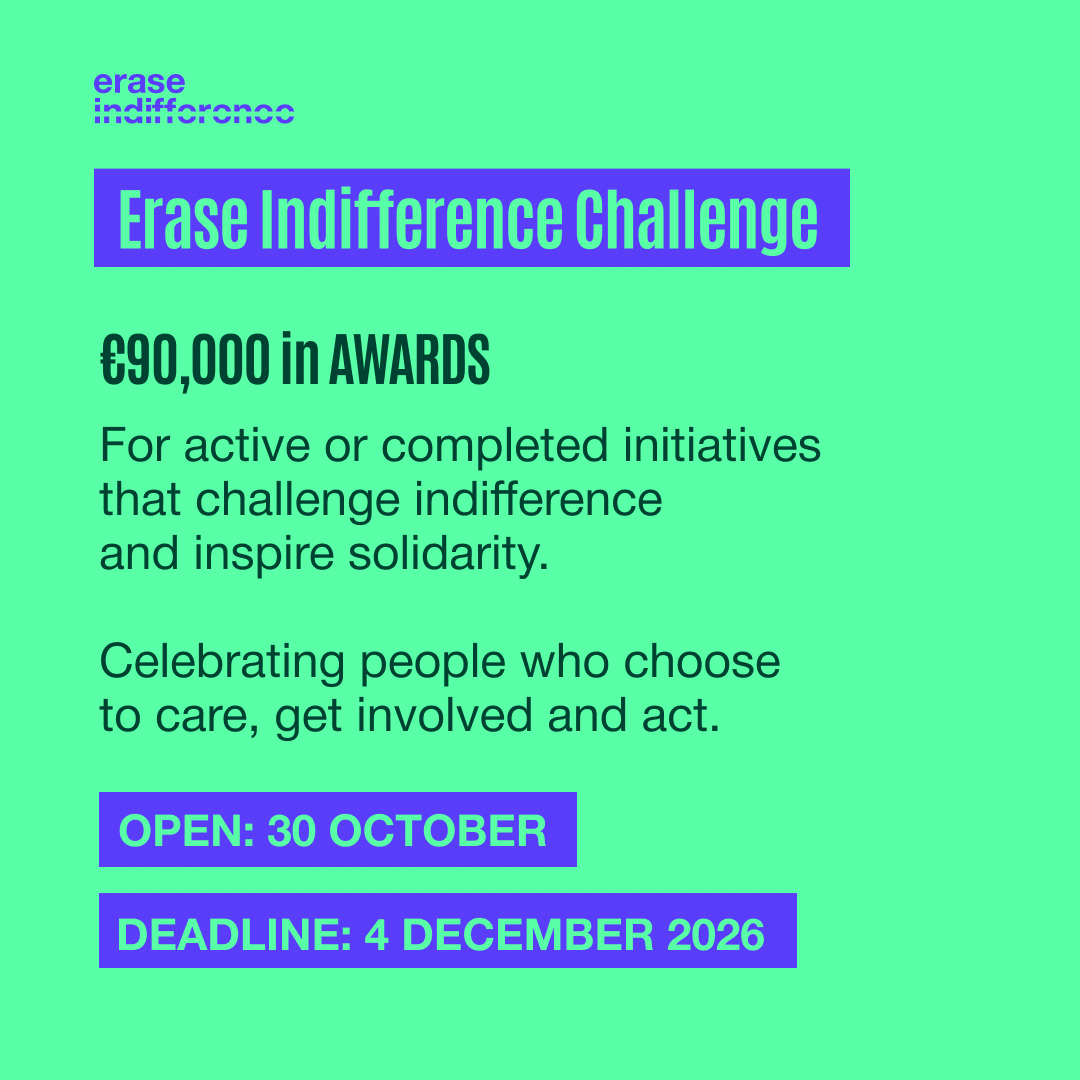
The Erase Indifference Challenge 2026 is a global initiative recognising and rewarding innovative projects that are taking practical action to reduce indifference towards discrimination. The Challenge seeks to highlight existing initiatives that are creating measurable social impact, encouraging empathy, promoting diversity and inspiring individuals and communities to stand against discrimination.
With a total award fund of €90,000, the 2026 edition provides an opportunity for organisations, project teams and social innovators to gain recognition and financial support for initiatives that are already making a difference. The awards are intended to recognise projects that go beyond raising awareness and demonstrate practical ways of addressing indifference, changing attitudes, encouraging engagement and creating meaningful social change.
The Challenge welcomes initiatives addressing different forms of discrimination, including racism, antisemitism, anti-immigration discrimination, misogyny and discrimination against LGBTQ+ people. It also emphasises innovation, creativity, measurable outcomes and evidence of real-world impact.
The 2026 application period runs from October 30 to December 4, 2026. Applicants with existing projects that address discrimination and social indifference are encouraged to prepare their submissions before the closing date.
1. Overview of the Erase Indifference Challenge 2026
The Erase Indifference Challenge is a global initiative established to recognise and reward projects that are actively working to reduce indifference towards discrimination.
The Challenge is based on the understanding that discrimination is not only sustained by the actions of individuals or institutions that directly engage in discriminatory behaviour. It can also persist when individuals and communities remain indifferent, fail to respond to injustice or do not take meaningful steps to challenge harmful attitudes and practices.
Indifference can appear in different forms. It may involve remaining silent when someone experiences discrimination, ignoring hate speech, failing to challenge prejudice or treating exclusion and inequality as normal features of society.
The Erase Indifference Challenge seeks to address this problem by recognising initiatives that encourage people to move from passive observation to active engagement.
Rather than focusing exclusively on ideas or proposals that have not yet been implemented, the Challenge is interested in initiatives that are already running or have been completed and can demonstrate tangible results.
Through the awards, the initiative aims to:
- Recognise projects that actively address indifference towards discrimination.
- Reward innovative and imaginative approaches to tackling prejudice and exclusion.
- Highlight initiatives that have demonstrated measurable social impact.
- Encourage empathy and greater appreciation of diversity.
- Inspire organisations and communities to develop similar solutions.
- Promote practical action against discrimination, hate and social indifference.
- Connect project leaders with external experts who can provide professional guidance and support.
The Challenge therefore provides a platform for existing social initiatives to gain recognition, demonstrate their achievements and contribute to a wider global movement against indifference.
2. What Is the Main Focus of the Challenge?
An important feature of the Erase Indifference Challenge is its particular focus on indifference towards discrimination.
Many initiatives around the world work directly with people affected by discrimination. Others focus on raising awareness about racism, religious intolerance, misogyny, xenophobia and other forms of social exclusion.
While these activities remain important, the Erase Indifference Challenge places additional emphasis on addressing the attitudes and behaviours that allow discrimination to continue without meaningful resistance.
The Challenge asks an important social question: What can individuals, organisations and communities do when they encounter discrimination, and how can they be encouraged to respond rather than remain indifferent?
For example, an initiative may work with schools to encourage students to challenge discriminatory behaviour rather than ignore it. Another may use community engagement, art, storytelling or digital platforms to encourage people to recognise prejudice and take action.
Other projects may work with institutions, businesses or community leaders to develop practical responses to discrimination and create environments where diversity and inclusion are valued.
The central concern is not simply whether a project discusses discrimination, but whether it demonstrates practical ways of reducing indifference towards it.
3. Forms of Discrimination Addressed by the Challenge
The Erase Indifference Challenge welcomes initiatives addressing different forms of discrimination. The application announcement identifies several areas, while also making clear that the listed forms are not exhaustive.
A. Racism
Racism involves prejudice, discrimination or unequal treatment based on race, colour, ethnic background or perceived racial identity.
Projects addressing racism may work to challenge racial stereotypes, encourage intercultural understanding, promote equal participation or help communities respond to racial discrimination.
Examples of relevant approaches may include educational programmes, community campaigns, creative projects, institutional interventions and initiatives that encourage bystander action.
B. Antisemitism
Antisemitism refers to prejudice, hostility or discrimination directed towards Jewish people.
Initiatives addressing antisemitism may seek to challenge harmful stereotypes, counter antisemitic narratives, improve public understanding and encourage communities to respond to antisemitic incidents.
The Challenge recognises the importance of practical approaches that reduce indifference towards antisemitism and encourage people to take action against religious and identity-based hatred.
C. Anti-Immigration Discrimination and Xenophobia
Migrants, refugees and other people perceived as coming from outside a particular national or cultural community may experience prejudice, exclusion and discriminatory treatment.
Projects in this area may focus on promoting understanding between communities, challenging xenophobic narratives, encouraging social inclusion and helping people respond constructively to discrimination against migrants and refugees.
D. Misogyny
Misogyny involves prejudice, hostility and discriminatory attitudes directed towards women and girls.
Initiatives addressing misogyny may work to challenge harmful gender stereotypes, encourage respect, promote women’s participation and create greater awareness of discriminatory behaviour.
The Challenge welcomes innovative approaches that encourage individuals and communities to recognise and respond to misogyny rather than remain silent.
E. Discrimination Against LGBTQ+ People
Discrimination against lesbian, gay, bisexual, transgender and queer people can occur through exclusion, harassment, prejudice, unequal treatment and other forms of hostility.
Projects in this area may focus on promoting inclusion, supporting respectful communities, challenging discriminatory attitudes and encouraging people to respond when LGBTQ+ individuals experience discrimination.
F. Other Forms of Discrimination
The Challenge’s announcement states that the listed forms of discrimination are not exhaustive.
This means the initiative is not presented as being limited to only the five areas described above. However, applicants working on other forms of discrimination should carefully review the official Challenge guidance and frequently asked questions to determine whether their projects fall within the programme’s scope.
4. What Types of Projects Are Eligible for the Challenge?
The Erase Indifference Challenge is looking for existing initiatives that have moved beyond the planning stage and can demonstrate practical results.
This is an important distinction. The Challenge is not primarily seeking proposals for projects that applicants hope to implement in the future. It wants to recognise initiatives that are currently running or have already been completed and have evidence of meaningful impact.
Applicants should therefore be able to explain what their projects have achieved and how those achievements contribute to reducing indifference towards discrimination.
The Challenge identifies several important characteristics of suitable initiatives.
A. Existing and Implemented Initiatives
Projects must be initiatives that are already running or have been completed.
This means applicants should be able to describe activities that have actually taken place rather than relying exclusively on future plans or theoretical proposals.
An initiative may be ongoing or completed, provided that it can demonstrate its implementation and results.
B. Demonstrated Real-World Impact
The Challenge places considerable importance on evidence of impact.
Applicants should be prepared to demonstrate how their initiatives have contributed to addressing discrimination or reducing indifference towards it.
Depending on the nature of the project, relevant evidence might include:
- The number of people reached or engaged.
- Participation in educational or community activities.
- Changes in awareness, attitudes or behaviour.
- Community responses to discriminatory incidents.
- Evidence of improved inclusion or engagement.
- Results from surveys, interviews or evaluations.
- Documented outcomes from project activities.
- Other measurable indicators that demonstrate social impact.
These are examples of possible evidence rather than a published mandatory list of indicators. Applicants should consult the official application guidance for the specific information required.
C. Innovation and Creativity
The Challenge values projects that use imaginative, effective and unconventional approaches to tackling discrimination and indifference.
Applicants should demonstrate what makes their initiatives distinctive and how their methods encourage people to engage with the issue.
Innovation does not necessarily mean developing a new technology or creating an entirely new type of organisation. It may also involve applying an existing approach in a creative way, developing a new community engagement strategy or combining different methods to produce stronger social outcomes.
D. Meaningful Social Impact
The initiative should demonstrate a meaningful contribution to society.
The Challenge is interested in projects that help communities become more responsive to discrimination, encourage empathy and promote greater appreciation of diversity.
Applicants should therefore explain not only what activities they have implemented but also why those activities matter and what changes they have helped create.
5. Awards: A Total of €90,000 to Be Distributed Among Winners
One of the major attractions of the Erase Indifference Challenge 2026 is its total award fund of €90,000.
The programme will distribute this amount among eight award recipients.
The announced award structure is as follows:
| Award Category | Number of Awards | Amount per Award |
|---|---|---|
| Main Award | 1 | €20,000 |
| Additional Awards | 7 | €10,000 each |
| Total | 8 | €90,000 |
Main Award: €20,000
One winning initiative will receive the main award of €20,000.
This award recognises an outstanding project that demonstrates a strong contribution to the Challenge’s objectives.
Seven Additional Awards: €10,000 Each
Seven additional initiatives will receive awards of €10,000 each.
These awards provide further recognition and financial support for projects demonstrating innovative approaches and meaningful results in reducing indifference towards discrimination.
Why the Awards Matter
Financial recognition can help social initiatives strengthen their work, sustain existing activities and increase their reach.
For organisations and project teams working with limited resources, award funding may provide an opportunity to build on achievements and continue addressing social challenges.
However, applicants should consult the official rules and sample agreements for the specific conditions governing the use of award funds. The supplied programme information does not establish detailed spending restrictions or post-award obligations.
6. Application Process and Important Dates
The Erase Indifference Challenge 2026 follows a defined application and selection timeline.
Applicants should take note of the following dates.
| Application Stage | Date |
|---|---|
| Open call begins | October 30, 2026 |
| Submission deadline | December 4, 2026 |
| Meetings with finalists | February 15–26, 2027 |
| Winners announced | February 28, 2027 |
Application Opening: October 30, 2026
The 2026 edition opened for applications on October 30, 2026.
From this date, interested applicants could prepare and submit their existing initiatives for consideration.
Submission Deadline: December 4, 2026
Application deadline: December 4, 2026.
All interested applicants should ensure that their submissions are completed before the closing date.
The Challenge encourages project creators to submit initiatives that demonstrate practical results, measurable outcomes and a meaningful contribution to reducing indifference towards discrimination.
Meetings With Finalists: February 15–26, 2027
The programme schedule indicates that meetings with finalists will take place between February 15 and February 26, 2027.
This stage provides an opportunity for the Challenge to engage with shortlisted project representatives before the final announcement.
Applicants should be prepared to provide further information about their initiatives if selected as finalists.
Winners Announced: February 28, 2027
The winners of the 2026 edition are scheduled to be announced on February 28, 2027.
The announcement will identify the initiatives selected to receive the main and additional awards.
Applicants interested in participating should familiarise themselves with the Challenge rules, frequently asked questions and application requirements before submitting their projects.
The programme provides several resources to help prospective applicants understand the process.
Step 1: Identify a Suitable Existing Initiative
The first step is to identify an initiative that directly addresses indifference towards discrimination.
Applicants should consider whether their project has been implemented and whether it can demonstrate meaningful results.
A project that only discusses discrimination in general may not sufficiently reflect the Challenge’s specific focus. Applicants should explain how their initiative encourages people to respond to discrimination, challenges indifference or promotes practical social change.
Step 2: Review the Challenge Rules and Manual
The Challenge provides a Manual containing specifications and additional guidance.
Applicants should review this document carefully to understand the programme’s expectations, application requirements and other relevant conditions.
The frequently asked questions section also provides additional guidance on important matters, including eligibility, project requirements, evaluation and awards.
Step 3: Prepare Evidence of Project Impact
Because the Challenge emphasises measurable results, applicants should prepare information demonstrating what their initiatives have achieved.
This may include descriptions of project activities, participation figures, evaluation findings, documented outcomes and other evidence relevant to the project’s objectives.
Applicants should be able to explain how the initiative has contributed to reducing indifference towards discrimination.
Step 4: Complete the Application
The Challenge provides a preview of the application questions so that prospective applicants can familiarise themselves with the information required.
The published information states that the preview is provided for reference only and that actual applications are submitted through Google Forms.
Applicants should ensure that they use the designated application process and provide complete and accurate information.
Step 5: Submit Before the Deadline
After reviewing the requirements and completing the application, applicants should submit their projects before December 4, 2026.
Submitting early may give applicants additional time to review their information and correct any errors before the deadline.
Start Your Application HERE!
8. International Specialists Supporting the Challenge
The Erase Indifference Challenge brings together international specialists with experience in human rights, social innovation, advocacy, public policy, technology, communication, education and social change.
These specialists contribute different professional perspectives to the initiative.
The announced international specialists include:
Emily May
Emily May is the Co-Founder and President of Right To Be. She is an award-winning international leader whose work focuses on advancing global efforts to end harassment through bystander intervention and advocacy.
Her experience is particularly relevant to the Challenge’s focus on encouraging individuals to move from passive observation to active responses when discrimination and harassment occur.
Tal-Or Cohen Montemayor
Tal-Or Cohen Montemayor is the CEO and Founder of CyberWell.
Her work focuses on developing data-driven solutions to address online antisemitism. She brings expertise in online hate, platform policy and digital enforcement.
Vincent Kyabayinze
Vincent Kyabayinze is a Ugandan visual artist and film director. He is the Founder of East African Visual Artists and the Human Rights Are Universal Arts Festival.
His work advances inclusion, human rights and social change through art, demonstrating the potential of creative expression as a tool for addressing social challenges.
Andrea Gunraj
Andrea Gunraj is Vice President of Strategic Policy and Partnerships at CivicAction.
She has more than 20 years of experience in nonprofit leadership, public education, equity, advocacy and social change.
Aleksandra Zemke
Aleksandra Zemke is the Founder and Director of Smilemundo.
Her work focuses on creating educational tools and games for social change, with expertise in civic education, sustainability, inclusion and anti-discrimination.
Kaja Burke-Williams
Kaja Burke-Williams is Vice President of Finance and Operations at Right To Be and Co-Founder of Ourside.
Her professional experience includes entrepreneurship, strategy and social impact.
Zuzanna Rudzińska-Bluszcz
Zuzanna Rudzińska-Bluszcz is a human rights lawyer, Yale World Fellow 2026, former Deputy Minister of Justice and CEO of ClientEarth Poland.
Her work brings experience in strategic litigation and justice reform.
Yann Boissière
Yann Boissière is a French liberal rabbi and Founder and President of the Association The Peace Voices.
The association advocates for dialogue between religions and spiritualities, an important contribution to initiatives promoting mutual understanding and respect.
Nancy Ruscheinski
Nancy Ruscheinski is a communications leader and former Chief Operating Officer of Zeno Group.
She has four decades of experience in strategy, innovation and building impactful client relationships.
Dariusz Maciołek
Dariusz Maciołek is Chief Marketing Officer and Chief Experience Officer at BNP Paribas Bank Polska.
His expertise includes marketing strategy, brand building and award-winning campaigns recognised by industry organisations.
Inez Okulska
Inez Okulska is Principal AI Innovation Architect at UiPath, an artificial intelligence scientist and a Top 100 Women in AI honoree.
Her professional background combines artificial intelligence, linguistics and robotics.
The range of expertise represented by these specialists reflects the multidisciplinary nature of the Challenge. Addressing discrimination and social indifference requires contributions from different professional fields, including human rights, education, communication, technology, policy and community development.
9. External Experts Supporting the Challenge
In addition to its international specialists, the Erase Indifference Challenge works with external experts who bring experience in consulting, research, evaluation, human rights, technology, innovation and organisational development.
These experts provide additional professional perspectives relevant to the assessment and development of social initiatives.
Beata Dubiel-Stawska
Beata Dubiel-Stawska is the Founder of Grupa B8.
She has expertise in consulting, mentoring and training for cultural institutions, NGOs and organisations working to drive social change across Europe and beyond.
Bartosz Stawski
Bartosz Stawski is a faculty member at global MBA programmes, including the Global Leaders Institute and Georgetown University.
His expertise includes leadership, innovation and competitiveness. He has also been identified as an innovation expert associated with the European Innovation Council in 2024.
Magda Sadura
Magda Sadura is a consultant, trainer and facilitator working at the intersection of culture and migration.
Her expertise includes cultural management, inclusion and organisational change.
Magdalena Tędziagolska
Magdalena Tędziagolska is a sociologist and Founder of Badania i Działania.
She specialises in social research, evaluation and facilitation for NGOs, businesses and public institutions. She has served as an evaluation expert for the Erase Indifference Challenge in 2023 and 2024.
Ida Rogalska
Ida Rogalska is a Product Owner and software developer in educational technology.
She is also a researcher applying natural language processing and critical discourse analysis to the study of political radicalisation in online discourse.
Her work has been associated with the Challenge as a technology expert in 2024.
Milena Adamczewska-Stachura
Milena Adamczewska-Stachura is a human rights lawyer specialising in LGBTIQ+ rights.
Her professional experience includes work at the European Parliament, the Ombudsman’s Office and civil society organisations. She served as a human rights expert for the Challenge in 2023.
Maria Radziejowska
Maria Radziejowska is an advocate at Pietrzak Sidor & Partners.
She has international expertise in criminal law, human rights and collaboration with global justice and human rights institutions. She was associated with the Challenge as a human rights expert in 2022.
Bartłomiej Walczak
Bartłomiej Walczak is a sociologist and evaluation scientist at the University of Warsaw.
His expertise includes educational research, evaluation systems and social impact analysis. He has contributed as an evaluation expert in the 2023 and 2024 editions.
Rafał Rudnicki
Rafał Rudnicki is a research specialist at the Shipyard Foundation.
His work focuses on social research, evaluation and impact assessment of programmes supporting communities and social change. He served as an evaluation expert in 2022.
Paweł Lipiński
Paweł Lipiński is Founder and Chief Executive Officer of Talkie.ai.
He has more than 24 years of experience in software leadership, business strategy and artificial intelligence-driven innovation, including experience leading a globally active software company.
He was associated with the Challenge as a technology expert in 2022 and 2023.
Maria Adamowicz
Maria Adamowicz is a research leader, evaluator, trainer and facilitator at the Shipyard Foundation.
She has more than 10 years of experience in evaluation and strategic processes for NGOs and institutions. She served as an evaluation expert in 2022.
The involvement of these specialists demonstrates the importance of bringing together different areas of knowledge when evaluating and supporting projects addressing complex social issues.
10. Project Library: Learning From Existing Initiatives Around the World
The Erase Indifference Challenge also features a project library where visitors can explore initiatives addressing indifference, discrimination and hate.
The library provides an opportunity for project creators, organisations, researchers and interested individuals to discover approaches that have already been implemented.
It is intended to serve as a source of inspiration, encouraging people to learn from existing projects, adapt useful ideas and develop their own initiatives.
The project library includes categories such as:
- Racism.
- Antisemitism.
- Anti-immigration discrimination and xenophobia.
- LGBTQ+ discrimination.
- Misogyny.
- Islamophobia.
Examples highlighted in the project library include:
Silent Voice, Justice to LGBTIQ Persons: An initiative listed under LGBTQ+ discrimination.
LGBTQ+ Friendly School Ranking: A project addressing LGBTQ+ discrimination through a school-related initiative.
Insignia: A project associated with several areas, including racism, antisemitism, anti-immigration discrimination, LGBTQ+ discrimination, misogyny and Islamophobia.
Israelis and Palestinians Innovating Together Towards a New Reality: An initiative listed under antisemitism and Islamophobia.
The project library demonstrates the variety of approaches that can be used to address discrimination and social indifference.
For prospective applicants, exploring existing initiatives may also help them understand the kinds of social challenges being addressed and the different ways projects can encourage meaningful change.
11. Frequently Asked Questions About the Erase Indifference Challenge
The Challenge provides a frequently asked questions section covering several important aspects of participation.
The following topics are identified in the programme’s FAQ. The available information lists these questions but does not provide all their detailed answers. Applicants should therefore consult the official FAQ and Manual before making decisions about eligibility or submission requirements.
What Is the Erase Indifference Challenge?
It is a global initiative that recognises and rewards implemented projects demonstrating tangible results and impact in addressing indifference towards discrimination.
The Challenge focuses on practical initiatives that encourage engagement, change behaviours and inspire action against social passivity.
Who Can Apply?
The official FAQ includes a question about applicant eligibility. However, the detailed answer is not included in the supplied programme information.
Applicants should consult the official eligibility guidance to confirm whether their particular organisation, group or project structure qualifies.
Can Informal Groups Apply?
The FAQ specifically addresses whether informal groups can participate.
Because the detailed answer is not provided in the available information, informal groups should verify the applicable requirements before submitting an application.
Can Applicants Submit Projects in Partnership?
The FAQ also addresses applications submitted through partnerships.
Prospective applicants planning to submit a collaborative initiative should review the official rules to understand how partnership applications are handled and what information is required from participating organisations.
Does the Initiative Have to Be Currently Active?
The Challenge’s published rules state that it welcomes initiatives that are currently running or have already been completed, provided they can demonstrate real-world results and meaningful social impact.
Therefore, a project does not necessarily have to remain active at the time of application, but it must be an existing implemented initiative rather than an entirely new proposal.
Can Applicants Submit More Than One Project?
The FAQ includes a question about submitting multiple projects. The detailed answer is not provided in the available information, so applicants should consult the official guidance.
How Are Applications Evaluated?
The Challenge provides information about its international specialists and external experts. However, the complete evaluation criteria and scoring process are not included in the supplied material.
Applicants should review the Manual and FAQ for the official assessment process.
What Happens If a Project Becomes a Finalist?
The programme schedule identifies meetings with finalists between February 15 and February 26, 2027.
Applicants should consult the official rules for further details about finalist meetings, required participation and any additional documentation.
Are There Requirements for Using the Award Money?
The FAQ includes questions about how award money may be used and whether winners have obligations after receiving an award.
The detailed answers are not included in the supplied information. Applicants should therefore review the sample agreements and official programme documentation before making assumptions about funding conditions.
12. Why the Erase Indifference Challenge Matters
Discrimination is a complex social challenge that cannot be addressed only through statements of support or occasional awareness campaigns.
Meaningful progress also requires individuals, communities, organisations and institutions to recognise discrimination when it occurs and take practical steps to challenge it.
The Erase Indifference Challenge is important because it draws attention to the role of social indifference in allowing discrimination to continue.
Its emphasis on existing projects and measurable outcomes encourages applicants to demonstrate what they have actually achieved. This creates an opportunity to recognise initiatives that are not only discussing social problems but also developing practical responses.
The Challenge also brings together specialists from different professional backgrounds. Their experience in human rights, education, research, technology, communications, advocacy and social innovation reflects the range of knowledge needed to address discrimination effectively.
Furthermore, the project library allows people to learn from initiatives developed in different contexts. This can encourage the exchange of ideas and help successful approaches reach wider audiences.
By distributing €90,000 among eight winning initiatives, the Challenge also provides financial recognition for projects contributing to a more inclusive and responsive society.
Visit HERE to learn more about the Erase Indifference Challenge 2026.
Conclusion
The Erase Indifference Challenge 2026 offers an important opportunity for existing social initiatives to receive international recognition and compete for a share of €90,000 in awards. It is designed for projects that are already taking concrete steps to reduce indifference towards discrimination and can demonstrate innovation, measurable outcomes and meaningful social impact.
Whether an initiative addresses racism, antisemitism, xenophobia, misogyny, LGBTQ+ discrimination or other relevant forms of discrimination, the central requirement is to show how it encourages people to move beyond indifference and take practical action.
With one main award of €20,000 and seven additional awards of €10,000 each, the Challenge provides an opportunity for successful projects to gain recognition and financial support for their work.
Organisations and project creators should carefully review the eligibility requirements, Challenge Manual, frequently asked questions and sample agreements before submitting their initiatives.
The application deadline is December 4, 2026. Applicants should ensure that their projects are submitted before the closing date and that their applications clearly demonstrate the work already undertaken and the impact achieved.