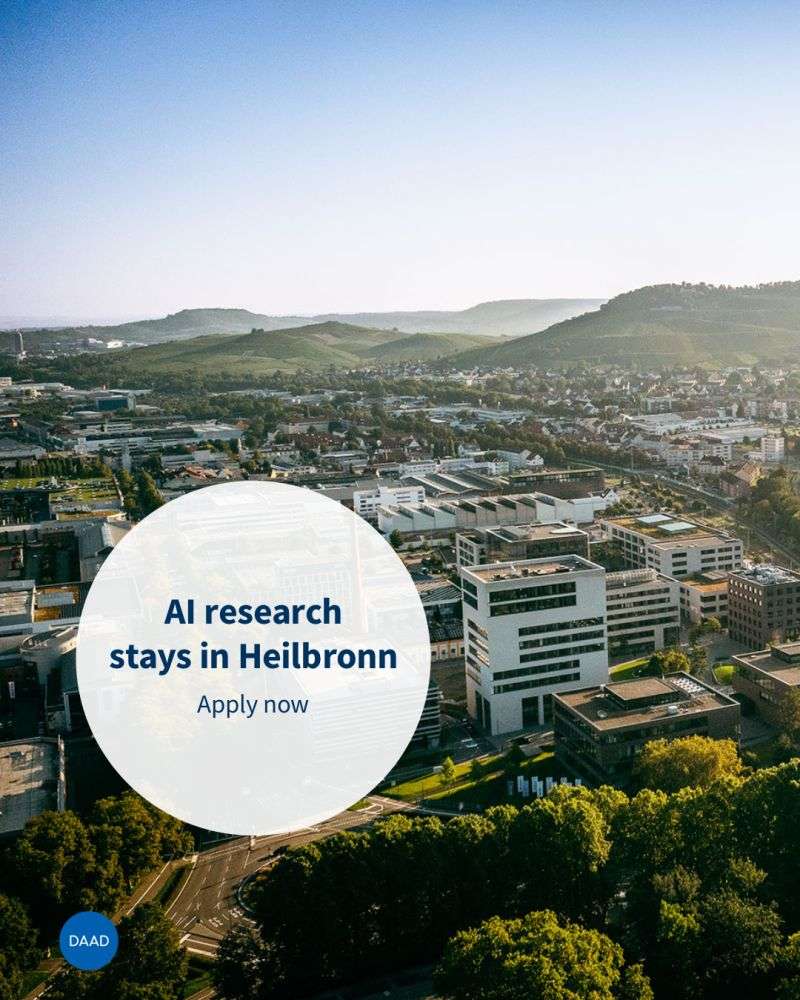
International researchers specialising in Artificial Intelligence (AI) and related disciplines have an opportunity to advance their research careers in Germany through the Heilbronn AI Fellowships, a research fellowship programme listed by the German Academic Exchange Service (DAAD). The programme is designed to attract outstanding international doctoral candidates in the final year of their PhD and early-career postdoctoral researchers to Heilbronn’s growing Artificial Intelligence research and innovation ecosystem.
The fellowship provides financial support of €2,800 per month, contributions towards health, accident and personal liability insurance, and a lump sum towards international travel expenses. Successful applicants can undertake a research stay lasting between one and twelve months at eligible universities and research institutions located on the Bildungscampus Heilbronn in Germany.
Beyond financial assistance, the programme offers researchers an opportunity to work in an environment that brings together academic institutions, research organisations, industry partners, advanced digital infrastructure and entrepreneurial networks. It also encourages collaboration between scientific research and practical applications, including technology transfer, innovation and the development of AI-driven solutions to real-world challenges.
For international PhD candidates and postdoctoral researchers seeking research opportunities in Germany, the Heilbronn AI Fellowship offers a pathway to strengthen their academic profiles, develop international research partnerships and contribute to emerging developments in Artificial Intelligence.
1. Overview of the DAAD Heilbronn AI Fellowships
The Heilbronn AI Fellowship is a research funding programme intended for international researchers working in Artificial Intelligence or related fields. It aims to attract talented doctoral candidates and postdoctoral researchers to research institutions within the Heilbronn innovation ecosystem.
The programme is part of efforts to strengthen Heilbronn’s position as an important European centre for AI research, innovation and entrepreneurship. It connects international academic talent with research institutions and industry partners, creating opportunities for scientific collaboration and the practical application of research findings.
The fellowship is particularly relevant to researchers whose work contributes to the development of Artificial Intelligence and related technologies. It supports research stays at eligible institutions on the Bildungscampus Heilbronn, where fellows can access an environment that combines academic research, industry engagement and innovation opportunities.
The programme is administered through the German Academic Exchange Service (DAAD), Germany’s academic exchange organisation. Applications are submitted online through the DAAD application portal and are evaluated through a competitive selection process involving independent experts.
2. Objectives of the Heilbronn AI Fellowship Programme
The fellowship has several interconnected objectives focused on strengthening international AI research and supporting the development of practical technological solutions.
Attracting outstanding international AI researchers
One of the programme’s primary objectives is to attract talented researchers from different countries to Germany. By supporting international doctoral candidates and postdoctoral researchers, the fellowship seeks to bring diverse academic expertise and research perspectives into Heilbronn’s AI ecosystem.
Advancing Artificial Intelligence research
The programme supports research projects in Artificial Intelligence and related fields. Fellows are expected to undertake research that contributes to scientific knowledge, addresses relevant research questions and has potential for further development or application.
Strengthening academic and industry collaboration
The Heilbronn research ecosystem brings together universities, research organisations, technology companies and innovation partners. Fellows can benefit from opportunities to connect academic research with industrial expertise and practical technological needs.
Encouraging technology transfer and real-world applications
The programme does not focus exclusively on theoretical research. It also encourages the transfer of scientific knowledge into practical applications. Researchers are therefore expected to consider how their work could contribute to AI-driven solutions, innovation and technological development.
Promoting international research cooperation
By bringing international researchers into Heilbronn’s academic and innovation networks, the fellowship seeks to establish and strengthen research partnerships. These connections may contribute to longer-term cooperation between researchers, universities and research institutions in Germany and other countries.
3. What the DAAD Heilbronn AI Fellowship Funds
The fellowship provides funding for an eligible research stay in Artificial Intelligence or a related field at one of the participating host institutions in Heilbronn.
The research stay can last between one and twelve months, depending on the proposed research project and the approved funding period.
During the fellowship, researchers are expected to undertake a research project that aligns with the programme’s objectives and the expertise of their selected host institution.
The programme offers an opportunity to:
- Develop and advance an existing AI research project.
- Explore new research questions in Artificial Intelligence and related disciplines.
- Collaborate with academics and researchers at eligible German institutions.
- Engage with industry partners and innovation networks.
- Explore opportunities for technology transfer and practical applications.
- Strengthen international academic cooperation.
- Develop research outputs that may contribute to future scientific or technological developments.
The fellowship is not described as a general university tuition scholarship. Rather, it supports a temporary research stay at an eligible institution in Heilbronn.
4. Eligible Host Institutions in Heilbronn, Germany
Applicants must plan to undertake their research project at an eligible university or research institution located on the Bildungscampus Heilbronn.
The programme identifies the following institutions as eligible research hosts:
1. DHBW Center for Advanced Studies
The DHBW Center for Advanced Studies is part of Baden-Württemberg Cooperative State University. It offers advanced academic and professional development opportunities and is among the institutions listed for the Heilbronn AI Fellowship.
2. DHBW Heilbronn – Baden-Württemberg Cooperative State University
DHBW Heilbronn is a university within Baden-Württemberg’s cooperative education system. It combines academic learning with practical and industry-oriented approaches.
International researchers can explore its academic and research environment when considering a suitable host institution.
3. Ferdinand-Steinbeis-Institute
The Ferdinand-Steinbeis-Institute is a research institution associated with innovation and the transfer of knowledge into practical applications. Its inclusion reflects the fellowship’s interest in research that can connect scientific developments with industry and society.
4. Fraunhofer HNFIZ
Fraunhofer HNFIZ is included among the eligible institutions listed by the fellowship programme. Applicants interested in undertaking research within the Fraunhofer research environment can explore the institution’s work and identify possible research connections.
5. Heilbronn University of Applied Sciences
Heilbronn University of Applied Sciences, also known as HHN, is one of the institutions located on the Bildungscampus. It provides an academic and applied research environment that may be relevant to researchers working on technology-related projects.
6. Technical University of Munich – TUM Campus Heilbronn
The Technical University of Munich is one of Germany’s prominent universities. Its Heilbronn campus is part of the local academic and innovation ecosystem.
Researchers interested in Artificial Intelligence and related fields can explore the campus’s academic activities and potential research connections.
7. Max Planck Institute – Heilbronn
The Max Planck Institute listed in the announcement is another eligible research institution. Applicants should explore its research activities to determine whether their proposed projects align with the institution’s expertise.
8. Campus Founders
Campus Founders is part of Heilbronn’s entrepreneurship and innovation ecosystem. Its inclusion reflects the programme’s wider interest in connecting research with entrepreneurship, innovation and the development of practical solutions.
Important: Applicants should identify an appropriate host institution and establish contact with the relevant research or academic representatives when preparing their applications. The proposed research project should demonstrate a clear connection to the selected host institution and the objectives of the fellowship.
5. Duration of the Fellowship
The Heilbronn AI Fellowship supports research stays lasting between one and twelve months.
The approved duration will depend on the proposed research project, its objectives and the arrangements made with the host institution.
Applicants should therefore develop a realistic research plan that explains:
- The research problem they intend to investigate.
- The objectives and expected outcomes of the project.
- The activities they plan to undertake during the research stay.
- The research methods and resources required.
- The proposed timeline and milestones.
- How the selected host institution will support the project.
The fellowship cannot normally be extended beyond the approved funding period. However, the announcement indicates that special circumstances may be considered individually.
Funding is available only within the programme’s overall funding period. Applicants should therefore confirm the availability of funding and the proposed research dates before finalising their plans.
6. Financial Benefits of the DAAD Heilbronn AI Fellowship
One of the major attractions of the Heilbronn AI Fellowship is its financial support for international researchers undertaking a research stay in Germany.
Successful fellows may receive the following benefits:
Monthly fellowship payment of €2,800
Selected researchers receive a monthly fellowship instalment of €2,800 to support their research stay in Germany.
The payment is intended to help fellows meet expenses associated with living and undertaking research during the approved fellowship period.
The total value of the monthly fellowship payments will depend on the duration of the approved research stay.
For illustration:
- A one-month fellowship corresponds to €2,800 in monthly fellowship payments.
- A six-month fellowship corresponds to €16,800 in monthly fellowship payments.
- A twelve-month fellowship corresponds to €33,600 in monthly fellowship payments.
These illustrations are calculated from the stated monthly instalment and do not include the additional insurance and travel support. They should not be interpreted as confirmation that every applicant will receive a twelve-month award.
Health, accident and personal liability insurance
The fellowship also provides payments towards health, accident and personal liability insurance cover.
This support is important for international researchers who will be staying in Germany and need appropriate insurance arrangements during their research period.
Applicants should consult the applicable DAAD fellowship conditions to understand the precise insurance arrangements and any requirements they must fulfil.
International travel support
Successful fellows receive a lump sum towards international travel costs.
This benefit is intended to contribute towards the cost of travelling to and from Germany for the approved research stay.
The announcement refers to DAAD travel allowances but does not specify a fixed travel payment amount in the information provided. Applicants should consult the relevant DAAD travel allowance information and fellowship conditions for details.
Additional support for disability or chronic illness
Under certain circumstances, additional costs arising from a disability or chronic illness may qualify for support.
Such requests are assessed individually. Applicants who require this assistance should review DAAD’s guidance on mobility and support for researchers with disabilities.
Possible family benefits
Researchers applying for a funding period exceeding six months may be eligible for additional family benefits, subject to the applicable conditions.
The availability and amount of family support will be determined individually. Applicants should not assume that these benefits are automatic.
Summary of financial benefits
The fellowship provides:
- €2,800 monthly fellowship instalment.
- Payments towards health insurance.
- Payments towards accident insurance.
- Payments towards personal liability insurance.
- A lump sum towards international travel costs.
- Possible additional support for disability-related or chronic illness-related expenses.
- Possible family benefits for eligible fellows undertaking research stays exceeding six months.
All additional benefits are subject to the programme’s applicable conditions and individual assessment where relevant.
7. Who Can Apply for the Heilbronn AI Fellowship?
The programme is intended for international doctoral candidates and postdoctoral researchers with strong academic backgrounds in Artificial Intelligence or related fields.
There are two main applicant groups.
Group 1: International PhD candidates
Applicants who are still completing their doctoral studies may apply if they are in the final year before their dissertation defence.
This means the programme is not generally intended for individuals who have only recently begun a PhD. Candidates should be approaching the completion of their doctoral research and should be able to demonstrate that they are at the appropriate stage of their studies.
Group 2: International postdoctoral researchers
Researchers who have already obtained a PhD or doctorate may apply if their doctoral qualification was awarded no more than five years before the application.
This five-year limit makes the fellowship particularly relevant to early-career postdoctoral researchers who have completed their doctoral studies and are seeking opportunities to advance their research.
Academic and professional background
Applicants should have:
- A strong academic background in Artificial Intelligence or a related field.
- A relevant doctoral research background or an eligible PhD qualification.
- An affiliation with a university or non-university research institution.
- A research project suitable for implementation at an eligible host institution in Heilbronn.
- A clear plan for undertaking the proposed research during the fellowship period.
The programme is research-focused. A general interest in Artificial Intelligence, a short course certificate or an undergraduate qualification alone does not satisfy the stated doctoral or postdoctoral eligibility requirements.
8. Research Project Requirements
A strong research proposal is central to the application.
The proposed research must be in Artificial Intelligence or a related field and should be appropriate for the selected host institution.
Applicants should demonstrate that their research is scientifically relevant, feasible and aligned with the objectives of the Heilbronn AI Fellowship.
The proposal should clearly communicate:
Research originality
Applicants should explain what makes their research distinctive. The proposal should identify the research problem and show how the proposed work may contribute new knowledge, methods or solutions.
Relevance and timeliness
The research should address a relevant issue in Artificial Intelligence or a related discipline. Applicants should demonstrate awareness of existing research and explain why the proposed project is important.
Practical application and technology transfer
The programme values research with potential applications beyond academic publication. Applicants should explain how their findings could contribute to practical solutions, innovation, industry collaboration or technology transfer.
Feasibility
The research plan should be achievable within the proposed fellowship period. Applicants need to provide a realistic timeline, explain the activities they will undertake and demonstrate that the host institution can support the project.
Alignment with the host institution
The selected institution should be appropriate for the research topic. Applicants should explain why the institution is a suitable research environment and identify relevant academic or research connections.
Long-term research cooperation
The programme also considers whether the proposed fellowship could contribute to longer-term academic collaboration or future research activities in Germany.
Applicants should therefore consider how the research stay fits into their wider academic and professional development.
9. How Applicants Are Selected
The Heilbronn AI Fellowship uses a single-stage selection process based on the submitted application documents.
Applications are jointly prepared by the applicant and the host institution. They are evaluated by independent experts in the relevant research fields, appointed by DAAD.
Partner institutions may also propose candidates.
To maintain fairness and impartiality, experts who have a conflict of interest or a supervisory relationship with an applicant are excluded from evaluating that application.
Funding is awarded only after a positive evaluation by the appointed experts. Meeting the eligibility requirements does not automatically guarantee selection.
Main selection criteria
The selection process considers two broad areas: academic qualifications and the quality of the proposed research project.
A. Academic qualifications
Experts assess the applicant’s academic background and research achievements, including:
- Academic performance: The applicant’s overall grade point average, development of academic performance and dissertation grade, where applicable.
- Course of study and doctorate: The applicant’s academic training, doctoral studies and research background.
- Academic achievements after graduation: Publications, lectures, conference presentations and other relevant scholarly contributions.
Applicants should provide evidence of their academic achievements and research experience through the required application documents.
B. Quality of the research project
The proposed research project is assessed in relation to:
- Originality and relevance: Whether the project addresses a meaningful research question and offers an original contribution.
- Timeliness: Whether the research is relevant to current developments in Artificial Intelligence or related fields.
- Research preparation: Whether the applicant has adequately prepared the project and identified an appropriate host institution.
- Application and transfer potential: Whether the research could contribute to practical applications, technology transfer or innovation.
- Feasibility: Whether the research can realistically be completed within the proposed timeline.
- Consistency of the research plan: Whether the objectives, methods, activities and schedule are logically connected.
- Suitability of the applicant: Whether the applicant’s background and proposed project fit the objectives of the fellowship.
- Professional development: Whether the fellowship is likely to contribute meaningfully to the applicant’s academic and professional development.
- Long-term cooperation: Whether the proposed research could support longer-term collaboration or research activities in Germany.
Equal opportunities
The selection process also considers equal-opportunity aspects.
Applicants may provide relevant information in the application form. DAAD provides further guidance on its scholarship selection procedure through its Important Scholarship Information for applicants.
10. How to Apply for the DAAD Heilbronn AI Fellowship
Applications are submitted online through the DAAD portal.
The application must be prepared jointly by the applicant and the proposed host institution. This means applicants should not treat the fellowship as an application that can be completed independently without identifying an appropriate research host.
The following steps provide a practical guide to preparing an application.
Step 1: Confirm your eligibility
Before beginning the application, establish whether you meet the programme’s academic requirements.
Confirm that you are either:
- An international PhD candidate in the final year before your dissertation defence; or
- An international postdoctoral researcher whose PhD or doctorate was obtained no more than five years ago.
You should also have a strong academic background in Artificial Intelligence or a related field and an affiliation with a university or non-university research institution.
Step 2: Identify an eligible host institution
Review the institutions listed under the fellowship programme and identify one that is suitable for your proposed research.
Consider the institution’s research strengths, relevant academic departments, available expertise and potential contribution to your project.
The host institution should be located on the Bildungscampus Heilbronn and must be one of the eligible institutions identified in the announcement.
Step 3: Develop your research proposal
Prepare a well-structured research proposal explaining what you intend to investigate during your stay in Germany.
Your proposal should address:
- The research problem.
- The background and justification for the project.
- The main research objectives.
- The originality and relevance of the proposed work.
- The research methods and activities.
- The expected outcomes.
- The proposed timeline.
- The suitability of the selected host institution.
- The potential for practical applications and technology transfer.
- Opportunities for longer-term research cooperation.
The proposal should be realistic and aligned with the expertise and research environment of the host institution.
Step 4: Establish contact and prepare the application jointly
The announcement states that applications are jointly prepared by the applicant and the host institution.
Applicants should therefore establish the necessary research connection and work with the host institution to prepare the application.
This is an important part of the process because the selection panel considers the suitability of the host institution and the quality of the research preparation.
Step 5: Prepare the required application documents
Applicants should prepare all documents requested in the DAAD application portal and follow the instructions for the specific fellowship programme.
The selection criteria indicate that academic performance, doctoral qualifications, research achievements and the quality of the research proposal are important.
Relevant supporting evidence may include academic records, doctoral information, publications, conference contributions and research documentation where requested by the portal.
The official announcement does not provide a complete itemised document checklist in the information reproduced here. Applicants should therefore use the current DAAD portal instructions as the definitive checklist rather than assuming that every document mentioned above is mandatory in a particular format.
Step 6: Submit the application through the DAAD portal
Complete the online application and upload all required documents before the applicable application deadline.
An application is considered valid only when all required documents have been submitted through the DAAD portal within the permitted application period.
If a required document is not available at the time of submission, applicants must clearly explain why it is missing and indicate when it will be provided.
Step 7: Avoid submitting multiple simultaneous applications
DAAD states that only one application per applicant can be considered at any given time.
Simultaneous applications cannot be processed. Applicants should therefore carefully review their documents and proposed research arrangements before submitting.
11. Application Deadline
The application deadline is not stated in the DAAD announcement information provided for this article.
The programme page indicates that funding is available until the end of the fellowship programme’s funding period, but this is not the same as an application closing date.
Interested researchers should consult the official DAAD fellowship page and online application portal to confirm:
- Whether applications are currently open.
- The applicable application deadline.
- The available funding period.
- Any restrictions on proposed research start dates.
- The latest application and document-submission instructions.
Applicants should not assume that applications are open indefinitely simply because the programme’s funding is available until the end of its funding period.
Click HERE for more information about DAAD Heilbronn AI Fellowships 2026/2027.
12. Important Application Conditions
Applicants should take note of several conditions before submitting their applications.
Online application: Applications are submitted through the DAAD portal.
Complete documentation: An application is valid only when all required documents have been submitted by the applicable deadline.
Missing documents: If a required document is unavailable at the time of submission, the applicant must explain the reason and indicate when it will be provided.
One application at a time: Only one application per applicant can be considered at any given time. Simultaneous applications cannot be processed.
Joint preparation: The application is prepared jointly by the applicant and the host institution.
Independent evaluation: Applications are assessed by independent experts appointed by DAAD.
No automatic award: Meeting the eligibility requirements does not guarantee funding. Awards are made following a positive expert evaluation.
Non-extendable fellowship: The approved fellowship period cannot normally be extended. Special circumstances may be considered individually.
Individual assessment of additional benefits: Support related to disability, chronic illness and family circumstances is subject to individual assessment and applicable conditions.
13. Official Application Links and Further Information
Interested researchers should consult the official DAAD scholarship database entry for the Heilbronn AI Fellowship.
- Official DAAD fellowship announcement: https://www2.daad.de/deutschland/stipendium/datenbank/en/21148-scholarship-database/?detail=57883183
- DAAD official website: https://www.daad.de/en/
- Bildungscampus Heilbronn: https://bildungscampus.hn/en/
- DAAD information for scholarship applicants: https://www.daad.de/en/studying-in-germany/scholarships/information-for-scholarship-applicants/
- DAAD information on mobility with a disability: https://www.daad.de/en/the-daad/mobility-with-a-disability/
Applicants should use the official DAAD programme page and portal for the latest application instructions, eligibility details and deadline information.
14. Why the Heilbronn AI Fellowship Is a Valuable Research Opportunity
The Heilbronn AI Fellowship offers more than a monthly financial allowance. It provides an opportunity for international researchers to participate in an academic and innovation ecosystem that connects scientific research with industry and entrepreneurship.
For early-career researchers, an international research stay can provide exposure to new research methods, academic networks, institutional resources and opportunities to collaborate with experts from different backgrounds.
The programme’s emphasis on technology transfer and real-world applications is particularly significant. Artificial Intelligence is increasingly being applied across sectors such as healthcare, education, manufacturing, agriculture, finance, transportation and environmental management. Research that addresses practical challenges can contribute to technological progress and wider societal benefits.
The opportunity to work with an eligible institution in Heilbronn may also help researchers develop professional relationships that support future research projects, academic partnerships and innovation initiatives.
However, applicants should recognise that this is a specialised research fellowship. It is intended for individuals who are already at an advanced stage of academic research in Artificial Intelligence or a related discipline. It is not an entry-level AI training programme or a general scholarship for undergraduate or master’s students.
Conclusion
The DAAD Heilbronn AI Fellowship is an international research opportunity for final-year PhD candidates and early-career postdoctoral researchers specialising in Artificial Intelligence or related fields. Through a monthly fellowship payment of €2,800, insurance contributions, international travel support and access to eligible research institutions in Heilbronn, the programme provides financial and academic support for researchers seeking to advance their work in Germany.
The fellowship supports research stays of between one and twelve months and encourages academic excellence, international collaboration, technology transfer and the development of AI solutions with practical applications.
Interested applicants must meet the doctoral or postdoctoral eligibility requirements, have an appropriate research background, identify an eligible host institution and prepare a strong research proposal jointly with that institution. Since the application deadline is not specified in the announcement information provided, prospective applicants should consult the official DAAD page and application portal for the latest dates and submission requirements.
For qualified international AI researchers, the Heilbronn AI Fellowship represents an opportunity to strengthen their research careers while contributing to Germany’s growing Artificial Intelligence research and innovation ecosystem.