
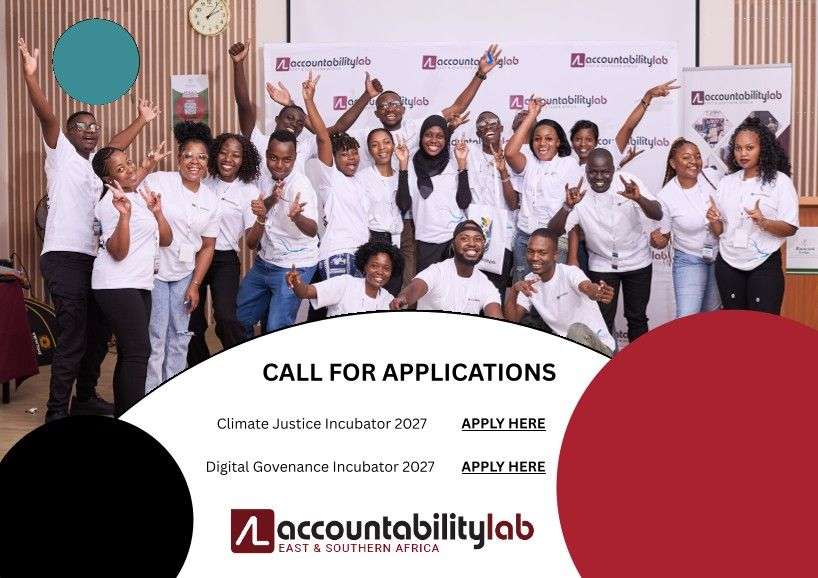
Accountability Lab East and Southern Africa (ALESA) is inviting applications from young leaders, civic innovators, community organisers, and emerging change-makers for its 2027 Digital Governance Incubator (DGI) and Climate Justice Incubator (CJI).
These two programmes are designed to support individuals and emerging initiatives that are using innovative approaches to address some of the most pressing governance, accountability, environmental, and human rights challenges facing communities across Africa.
Through the incubators, Accountability Lab seeks to strengthen the capacity of young civic leaders to develop practical solutions, influence decision-making, promote transparency, protect human rights, and encourage more inclusive and accountable systems.
The programmes recognise that young people play an increasingly important role in shaping the future of governance and development. Across Africa, young leaders are using digital technologies, community mobilisation, creative expression, policy advocacy, and locally driven initiatives to respond to challenges that affect their societies.
However, many promising initiatives face obstacles such as limited access to technical support, insufficient resources, weak institutional connections, and difficulties translating innovative ideas into sustainable solutions.
The 2027 Digital Governance Incubator and Climate Justice Incubator seek to address these challenges by providing opportunities for young civic leaders to strengthen their initiatives, develop their ideas, and contribute to meaningful social change.
Although both programmes operate under the same broader accountability and governance agenda, they have different thematic priorities and geographical eligibility requirements.
The Digital Governance Incubator focuses on civic technology, digital innovation, transparency, accountability, online civic space, and human rights in the digital governance sector.
The Climate Justice Incubator, on the other hand, focuses on addressing climate-related inequalities, strengthening community participation in environmental decision-making, promoting accountability in climate finance, and supporting fair and inclusive climate responses.
Applicants should carefully examine the requirements of each programme before submitting an application.
1. Accountability Lab 2027 Digital Governance Incubator (DGI)
About the Digital Governance Incubator
The Digital Governance Incubator (DGI) is an initiative designed to support young African leaders who are using technology, innovation, advocacy, community organising, and creative approaches to address challenges affecting digital governance.
The programme recognises that digital technologies are increasingly influencing how governments operate, how public services are delivered, how citizens access information, and how communities participate in democratic processes.
Digital transformation presents significant opportunities for improving transparency, strengthening public accountability, increasing access to information, and promoting more effective public institutions.
However, it also creates new challenges relating to privacy, online freedoms, misinformation, digital exclusion, surveillance, cybersecurity, and the protection of human rights.
The Digital Governance Incubator seeks to support initiatives that respond to these challenges by encouraging ethical, inclusive, and accountable approaches to digitalisation.
It is particularly interested in young leaders who are already using or developing practical solutions to strengthen transparency, accountability, and human rights in the digital governance sector.
Rather than limiting participation to technology developers or established digital organisations, the programme welcomes different approaches to addressing digital governance challenges.
For example, initiatives may use civic technology platforms, community education, policy advocacy, digital rights campaigns, creative arts, or grassroots organising to promote positive change.
The programme therefore provides an opportunity for young innovators and civic leaders to strengthen initiatives that use technology and other creative approaches to improve governance and protect community rights.
Geographic Focus and Eligible Countries for the Digital Governance Incubator
The 2027 Digital Governance Incubator is specifically focused on young leaders from the following three African countries:
- Zimbabwe
- Malawi
- Tanzania
Applicants must pay attention to this geographical requirement when considering their eligibility.
The programme is intended to support initiatives and individuals connected to these countries and working to address digital governance challenges within their communities.
Locally rooted initiatives are eligible. Applicants do not necessarily need to operate across multiple countries or demonstrate that their projects have a regional reach.
A project addressing a specific governance or digital rights challenge in a local community can still be relevant if it aligns with the objectives of the incubator.
What Does the Digital Governance Incubator Support?
The Digital Governance Incubator supports initiatives that use technology, innovation, civic engagement, and advocacy to strengthen transparency, accountability, and human rights.
Applicants are encouraged to present ideas that address gaps in digital governance or accountability and demonstrate how their initiatives can contribute to positive change.
The programme welcomes initiatives that focus on one or more of the following areas:
1. Addressing Gaps in Digital Governance and Accountability
Digital governance involves the use of digital technologies, systems, and platforms in public administration, institutional decision-making, public service delivery, and citizen engagement.
Although digital transformation can improve government efficiency, it can also create accountability challenges when digital systems operate without sufficient transparency or public oversight.
The incubator welcomes initiatives that seek to identify and address these gaps.
Potential areas of intervention include:
- Promoting transparency in digital government services.
- Encouraging public accountability in the use of digital technologies.
- Improving citizens’ access to public information through digital platforms.
- Developing tools that allow communities to monitor government performance.
- Promoting responsible use of digital technologies by public institutions.
- Strengthening citizen participation in digital governance processes.
- Addressing challenges associated with inaccessible or exclusionary digital public services.
For example, a young civic innovator could develop a digital platform that allows citizens to report problems with public services and monitor whether the relevant authorities respond to their complaints.
Such an initiative would use technology to strengthen transparency, public participation, and institutional accountability.
2. Protecting Online Civic Space and Community Rights
Online civic space refers to the digital environments through which individuals and communities express opinions, access information, organise campaigns, participate in public discussions, and engage with governance processes.
Social media platforms, online discussion forums, digital communication tools, and other internet-based services have become important spaces for civic participation.
However, online civic space can be affected by censorship, harassment, digital surveillance, restrictions on freedom of expression, and other practices that undermine fundamental rights.
The incubator welcomes initiatives that seek to protect online civic participation and strengthen digital rights.
Possible areas of intervention include:
- Promoting freedom of expression online.
- Raising awareness about digital rights and responsibilities.
- Addressing online harassment and digital intimidation.
- Supporting safer online spaces for civic engagement.
- Educating communities about privacy and data protection.
- Promoting responsible approaches to digital surveillance.
- Strengthening awareness of human rights in online environments.
For instance, an initiative could organise digital rights education workshops for young people, journalists, community activists, and grassroots organisations to help them understand their online rights and protect themselves from digital threats.
3. Promoting Ethical and Inclusive Digitalisation
Digitalisation should benefit different sections of society rather than deepen existing inequalities.
In many communities, access to digital services and opportunities is influenced by income, geographical location, disability, education, gender, and access to reliable internet connectivity.
The Digital Governance Incubator supports initiatives that promote ethical and inclusive approaches to digital transformation.
This means encouraging the development and use of digital systems that respect human rights, protect personal information, and provide fair opportunities for participation.
Potential activities include:
- Promoting inclusive access to digital public services.
- Addressing digital exclusion among underserved communities.
- Encouraging ethical use of artificial intelligence and other emerging technologies.
- Raising awareness about personal data protection.
- Promoting accessibility in digital platforms.
- Supporting digital literacy and responsible technology use.
- Encouraging public institutions to adopt transparent digital practices.
For example, a community initiative could provide digital literacy training to underserved populations to help them access government services, understand online public information, and participate more effectively in civic processes.
4. Using Technology to Create Positive Social Change
The incubator also welcomes initiatives that use technology as a tool for addressing broader social and governance challenges.
Technology can improve the way communities identify problems, collect information, engage institutions, and organise collective action.
Young leaders are encouraged to explore how digital tools can be applied to address real-world problems.
Possible initiatives may include:
- Civic technology applications.
- Digital accountability platforms.
- Community reporting systems.
- Digital advocacy campaigns.
- Online public education initiatives.
- Technology-driven human rights monitoring.
- Digital tools for citizen participation.
- Platforms that improve access to public information.
The focus is not necessarily on developing sophisticated software or advanced technological products.
An initiative may use relatively simple digital tools to achieve meaningful governance outcomes.
What matters is the problem being addressed, the relevance of the proposed solution, and its potential to create positive change.
5. Policy Advocacy and Community Organising
Technology alone cannot resolve every governance challenge. Effective digital governance also requires policies, institutional accountability, community participation, and informed public engagement.
The incubator therefore welcomes initiatives that combine policy advocacy and community organising with digital innovation.
Examples include:
- Campaigns promoting stronger digital rights protections.
- Community engagement on proposed technology policies.
- Advocacy for transparent public digital systems.
- Organising young people around online civic freedoms.
- Public education on digital governance.
- Building partnerships between technology innovators and civil society organisations.
Such initiatives can help ensure that digital transformation is guided by public interest, human rights, and democratic accountability.
6. Arts, Creativity, and Innovative Civic Engagement
The Digital Governance Incubator recognises that social change can be achieved through approaches that extend beyond conventional technology and advocacy.
Arts and creativity can provide powerful ways of communicating complex governance issues, encouraging public participation, and raising awareness about digital rights.
Applicants may therefore use creative methods to engage communities and influence public discussions.
Potential approaches include:
- Creative digital storytelling.
- Theatre and community performances.
- Visual arts and digital campaigns.
- Photography and documentary projects.
- Creative public education initiatives.
- Artistic approaches to communicating digital rights and accountability issues.
These approaches can make digital governance issues easier for communities to understand and encourage wider participation in conversations about technology and human rights.
Who Should Apply for the Digital Governance Incubator?
The programme invites applications from eligible young leaders in Zimbabwe, Malawi, and Tanzania who are working to address digital governance challenges.
It is particularly relevant to individuals who are:
- Civic technology innovators.
- Young digital rights advocates.
- Community organisers.
- Human rights defenders.
- Policy advocacy leaders.
- Digital inclusion advocates.
- Youth-led initiative founders.
- Social innovators.
- Creative professionals using arts and media to promote accountability.
- Individuals developing technology-based solutions to governance challenges.
The programme is suitable for both early-stage and existing initiatives.
Applicants do not need to have developed a fully operational technology platform or established a large organisation before applying.
An initiative that is still developing its concept may be eligible if it addresses a relevant digital governance challenge and demonstrates a clear commitment to creating positive change.
Are Early-Stage and Locally Rooted Initiatives Eligible?
Yes. The programme explicitly welcomes both early-stage and existing initiatives.
This is particularly important for young innovators who have promising ideas but may not yet have the resources, organisational structures, or technical expertise required to implement them fully.
Locally rooted initiatives are also eligible.
Applicants do not need to:
- Operate across several countries.
- Have formal organisational registration.
- Use complicated technical terminology.
- Run a large or established organisation.
- Present an overly polished proposal.
The emphasis is on the substance of the idea, its relevance to digital governance, and the applicant’s commitment to addressing the identified challenge.
Applicants are encouraged to communicate their ideas in clear and direct language and provide concrete examples wherever possible.
The assessment focuses on the quality and potential of the initiative rather than the sophistication of the language used to describe it.
2. Accountability Lab 2027 Climate Justice Incubator (CJI)
About the Climate Justice Incubator
The Climate Justice Incubator (CJI) is a programme designed to support young civic leaders who are developing initiatives to promote fair, inclusive, and accountable responses to climate change.
Climate change is one of the most significant development challenges facing African communities. Its effects extend beyond environmental degradation and include economic inequalities, food insecurity, water shortages, displacement, livelihood disruptions, and unequal access to essential resources.
Although climate change affects communities across the world, its consequences are not experienced equally.
Communities that contribute relatively little to global greenhouse gas emissions may experience some of the most severe consequences of climate-related disasters and environmental changes.
In Africa, vulnerable populations, smallholder farmers, rural communities, informal workers, women, young people, and other marginalised groups can face significant challenges when climate-related decisions and investments fail to consider their needs.
Climate justice therefore goes beyond addressing environmental problems. It also involves examining who experiences climate-related harm, who benefits from climate investments, who participates in environmental decision-making, and which institutions are responsible for ensuring fair outcomes.
The Climate Justice Incubator seeks to support young leaders who are working to address these inequalities.
Through the programme, Accountability Lab aims to encourage community-led solutions, strengthen transparency in climate-related decisions, and promote accountability among the institutions and actors responsible for climate policies, investments, and services.
The incubator is particularly interested in initiatives that ensure affected communities have meaningful opportunities to influence climate responses and hold responsible institutions accountable.
Geographic Focus and Eligible Countries for the Climate Justice Incubator
The 2027 Climate Justice Incubator focuses on four African countries:
- Rwanda
- Uganda
- Kenya
- Tanzania
Applicants should explain where their proposed initiative will operate and describe their relationship with the communities involved.
This geographical information is important because the programme places significant emphasis on locally rooted initiatives and community participation.
Applicants should demonstrate an understanding of the climate-related challenges affecting their target communities and explain how the proposed intervention will respond to those challenges.
The programme is particularly relevant to young civic leaders who are working directly with communities affected by climate change or collaborating with local organisations to promote environmental accountability.
What Does the Climate Justice Incubator Support?
The Climate Justice Incubator supports initiatives that address the unequal impacts of climate change and strengthen accountability for climate-related decisions, investments, and services.
The programme encourages applicants to develop initiatives that go beyond general environmental awareness.
Instead, applicants should identify specific climate-related injustices, explain how communities are affected, and demonstrate how their initiatives can contribute to fairer and more accountable outcomes.
A strong proposal should clearly explain five important issues:
1. What Climate-Related Injustice Exists?
Applicants should identify the specific environmental or climate-related problem they intend to address.
This could involve unequal access to water, inadequate climate adaptation services, unfair distribution of climate finance, exclusion from environmental decision-making, or negative consequences associated with energy transition projects.
The problem should be clearly defined rather than described only in broad terms.
For example, an initiative could identify a situation in which a rural community experiences recurring water shortages but has limited influence over local water management and climate adaptation decisions.
2. Which Communities Experience Harm, Exclusion, or Unequal Access to Benefits?
Applicants should identify the communities affected by the problem.
Climate-related inequalities often affect different populations in different ways.
For example:
- Smallholder farmers may experience reduced agricultural productivity due to unpredictable rainfall.
- Rural communities may have limited access to reliable water supplies.
- Low-income households may struggle to afford clean and reliable energy.
- Informal workers may face livelihood disruptions caused by extreme weather.
- Women may experience additional burdens when climate change increases the time and resources required to access water and food.
- Young people may have limited opportunities to participate in climate policy decisions.
Applicants should explain who is affected and why the issue matters to those communities.
3. Which Actors Have Responsibility?
Climate justice initiatives should identify the institutions, organisations, or individuals responsible for addressing the identified challenge.
Depending on the issue, these actors may include:
- Government ministries and departments.
- Local authorities.
- Environmental regulatory institutions.
- Private companies.
- Climate finance institutions.
- Energy companies.
- Development organisations.
- Organisations responsible for delivering climate-related services.
Identifying responsible actors helps establish who should be held accountable and where advocacy or engagement efforts should be directed.
4. What Should Change?
Applicants should explain the specific changes they want to achieve.
This may involve improving transparency, strengthening community participation, ensuring fair distribution of climate investments, improving access to essential services, or encouraging institutions to fulfil their environmental commitments.
A proposal should demonstrate a clear connection between the identified problem and the change being pursued.
5. How Will Affected Communities Help Shape the Response?
Community participation is a central consideration of the Climate Justice Incubator.
The programme encourages initiatives in which affected communities are not treated merely as beneficiaries but as active participants in identifying problems, developing solutions, monitoring implementation, and holding responsible institutions accountable.
Applicants should explain how community members will contribute to the initiative.
This may involve community consultations, participatory monitoring, local advocacy groups, public meetings, citizen reporting, or community-led research.
Thematic Priorities of the Climate Justice Incubator 2027
The Climate Justice Incubator identifies four major thematic priorities.
Applicants are encouraged to develop initiatives that respond to one or more of these areas.
1. Climate Finance Accountability and Equitable Access
Climate finance refers to financial resources allocated to support activities that address climate change.
These resources may be used for climate adaptation, environmental protection, renewable energy, disaster preparedness, climate-resilient infrastructure, and other related interventions.
However, the availability of climate finance does not automatically guarantee that vulnerable communities benefit from it.
Questions surrounding transparency, allocation, implementation, and accountability remain important.
The Climate Justice Incubator therefore supports initiatives that promote transparency in climate spending and ensure that communities have fair access to climate-related investments.
Potential areas of intervention include:
Transparency in climate spending: Initiatives that monitor how climate-related funds are allocated, distributed, and spent by relevant institutions.
Community access to climate funding: Projects that help local communities understand available climate finance opportunities and participate in decisions about how resources should be allocated.
Delivery of funded projects: Initiatives that monitor whether climate-funded projects are implemented as promised and whether intended communities receive the expected benefits.
Fair benefit-sharing in climate investments: Activities that address inequalities in how communities benefit from climate-related investments.
Carbon-market accountability: Initiatives that promote transparency and accountability in carbon-market projects, including examining how affected communities participate in these projects and share their benefits.
For example, a community-based organisation could establish a monitoring initiative that allows residents to track the implementation of a publicly funded climate adaptation project and report cases where promised services are not delivered.
Such an initiative could help strengthen public oversight and ensure that climate finance produces tangible benefits for the communities it is intended to serve.
2. Locally Led Adaptation, Water and Food-System Justice
Climate adaptation involves measures taken to reduce the negative effects of climate change and help communities prepare for changing environmental conditions.
However, adaptation strategies are not always developed with sufficient participation from the communities most affected.
The Climate Justice Incubator supports initiatives that strengthen local influence over adaptation priorities and promote equitable access to water, food security, and climate-resilient services.
This thematic area recognises that communities often understand their environmental challenges and local needs better than external institutions.
Their participation is therefore essential when designing effective adaptation strategies.
Potential areas of intervention include:
Community influence over adaptation priorities: Initiatives that ensure local communities participate in deciding which climate adaptation interventions should be prioritised.
Equitable access to water: Projects that address unequal access to safe and reliable water resources, particularly in communities experiencing climate-related water shortages.
Food-system justice: Initiatives that promote fair and sustainable food systems and address the effects of climate change on food production, distribution, and access.
Climate-resilient services: Projects that encourage the delivery of essential services capable of responding to changing environmental conditions.
Community-led adaptation planning: Initiatives that empower communities to identify climate risks and participate in developing locally appropriate solutions.
For instance, an initiative could work with smallholder farmers to document how changing rainfall patterns affect agricultural production and use the findings to advocate for more inclusive local adaptation policies.
Another initiative could help communities monitor water distribution and advocate for fairer access to water resources during periods of drought.
The emphasis is on ensuring that adaptation decisions reflect community priorities and produce fair outcomes.
3. Just Energy Transitions and Corporate Accountability
The transition towards cleaner and more sustainable energy systems is an important part of addressing climate change.
This transition may involve expanding renewable energy, reducing dependence on fossil fuels, improving energy efficiency, and introducing new technologies.
However, energy transitions can create social and economic challenges if the rights and interests of affected communities and workers are overlooked.
A just energy transition seeks to ensure that the benefits and costs of moving towards cleaner energy systems are distributed fairly.
The Climate Justice Incubator supports initiatives that promote community and worker rights, equitable access to energy-transition benefits, and accountability for corporate and institutional commitments.
Potential areas of intervention include:
Community rights: Initiatives that protect communities affected by energy projects and ensure that their concerns are considered during planning and implementation.
Worker rights: Projects that address the employment conditions, livelihoods, and rights of workers affected by changes in the energy sector.
Fair distribution of benefits: Initiatives that examine whether communities receive meaningful benefits from renewable energy and other energy-transition investments.
Corporate accountability: Activities that monitor whether companies fulfil their environmental, social, and human rights commitments.
Institutional accountability: Projects that encourage public institutions to ensure that energy transition policies and investments produce fair and inclusive outcomes.
For example, an initiative could engage communities living near renewable energy developments to examine whether local residents have access to employment opportunities and whether their concerns are considered in project implementation.
Another initiative could monitor corporate environmental commitments and encourage companies to provide transparent information about their activities and their impact on local communities.
4. Community-Led Climate Governance
Climate governance refers to the institutions, policies, processes, and decision-making arrangements through which climate-related issues are managed.
Effective climate governance requires transparency, accountability, public participation, and respect for human rights.
However, communities affected by climate change may not always have sufficient opportunities to influence environmental policies or monitor the implementation of climate-related programmes.
The Climate Justice Incubator supports initiatives that strengthen community participation in climate governance and improve accountability among decision-makers.
Potential areas of intervention include:
Community participation in climate policies: Initiatives that provide opportunities for affected populations to participate in the development and implementation of climate policies.
Monitoring climate commitments: Projects that help communities assess whether government institutions and other responsible actors are fulfilling their climate-related commitments.
Defending community rights: Initiatives that protect the rights and interests of communities affected by climate-related decisions and investments.
Engaging decision-makers: Activities that create opportunities for communities to present concerns, demand explanations, and seek responses from responsible authorities.
Strengthening local accountability: Projects that develop community monitoring systems and encourage transparent decision-making at the local level.
For example, a youth-led organisation could establish a community climate accountability initiative through which residents document environmental challenges, monitor local adaptation projects, and engage local authorities to demand appropriate responses.
The overall objective is to ensure that communities are actively involved in decisions that affect their environment, livelihoods, and future.
Who Should Apply for the Climate Justice Incubator?
The Climate Justice Incubator is intended for eligible civic leaders aged 18 to 35 from Rwanda, Uganda, Kenya, and Tanzania.
It is particularly relevant to young people who are developing or implementing initiatives that address climate justice, environmental accountability, community participation, and equitable climate action.
Potential applicants may include:
- Young climate justice advocates.
- Environmental activists.
- Community organisers.
- Youth-led organisation founders.
- Climate policy advocates.
- Environmental accountability campaigners.
- Civic innovators.
- Community development practitioners.
- Young researchers working on climate governance.
- Individuals promoting climate finance transparency.
- Advocates for sustainable and inclusive energy transitions.
- Leaders of community-based climate adaptation initiatives.
Applicants should demonstrate a clear understanding of the climate-related challenge they intend to address and explain how their initiative will contribute to fairer and more accountable outcomes.
The programme places particular importance on initiatives that are connected to the communities they seek to serve.
Importance of Community Relationships and Local Engagement
Applicants should explain where their initiative will operate and their relationship with the communities involved.
This requirement reflects the programme’s emphasis on locally led climate justice.
A strong initiative should demonstrate that its proposed activities are informed by the experiences, priorities, and needs of affected communities.
For example, an applicant working on water access should explain which communities experience water-related challenges, how those communities are involved in identifying solutions, and which institutions are responsible for addressing the problem.
Similarly, an applicant focusing on climate finance accountability should explain how community members will participate in monitoring climate investments and communicating concerns to responsible institutions.
The objective is to support initiatives that are genuinely connected to local realities rather than projects developed without meaningful community participation.
Key Differences Between the Digital Governance Incubator and Climate Justice Incubator
Although both programmes are offered under Accountability Lab East and Southern Africa, they have different objectives, eligible countries, and thematic priorities.
Applicants should select the programme that most closely matches their initiative.
| Feature | Digital Governance Incubator | Climate Justice Incubator |
|---|---|---|
| Programme name | Digital Governance Incubator (DGI) | Climate Justice Incubator (CJI) |
| Main focus | Digital governance, civic technology, accountability and human rights | Climate justice, environmental accountability and equitable climate action |
| Eligible countries | Zimbabwe, Malawi and Tanzania | Rwanda, Uganda, Kenya and Tanzania |
| Applicant profile | Eligible young leaders working on digital governance initiatives | Civic leaders aged 18–35 |
| Key themes | Civic technology, digital rights, ethical digitalisation, policy advocacy, community organising, arts and creativity | Climate finance, adaptation, water and food-system justice, just energy transitions and community-led climate governance |
| Initiative stage | Early-stage and existing initiatives welcomed | Initiatives addressing climate justice and accountability challenges |
| Geographical approach | Locally rooted initiatives are eligible; multi-country operations are not required | Applicants should identify where their initiative operates and explain their relationship with affected communities |
Which Programme Should You Apply For?
The choice depends on the nature of your initiative.
The Digital Governance Incubator is appropriate for applicants working on issues such as online civic freedoms, digital rights, civic technology, data protection, digital inclusion, technology-driven accountability, and ethical digital transformation.
The Climate Justice Incubator is appropriate for applicants working on climate finance transparency, environmental accountability, water access, food security, climate adaptation, renewable energy justice, and community participation in environmental decision-making.
Applicants should avoid selecting a programme simply because its general objectives appear attractive. They should demonstrate a clear connection between their initiative and the specific priorities of the incubator they intend to join.
Application Guidelines: How to Develop a Strong Application
Accountability Lab encourages applicants to communicate their ideas in clear, direct language and provide concrete examples wherever possible.
The programme is interested in understanding the substance of an initiative and the applicant’s commitment to creating positive change.
Applicants do not need to use complicated technical language or produce an excessively polished proposal.
However, they should be able to explain the problem they want to address, the people affected, their proposed solution, and the changes they hope to achieve.
The following guidelines can help applicants prepare a strong submission.
1. Clearly Identify the Problem
Start by explaining the specific issue your initiative seeks to address.
Avoid relying entirely on broad statements such as wanting to improve governance or fight climate change.
Instead, describe the actual problem affecting the community.
For a digital governance initiative, this might involve limited access to government information, online harassment, or a lack of transparency in digital public services.
For a climate justice initiative, it could involve unequal access to water, poor accountability in climate-funded projects, or the exclusion of local communities from environmental decision-making.
2. Explain Who Is Affected
Identify the communities or populations experiencing the problem.
Explain how they are affected and why the issue deserves attention.
This demonstrates that your initiative is grounded in real experiences rather than addressing an abstract problem.
3. Describe Your Proposed Solution
Explain what you intend to do to address the identified challenge.
Your explanation should be practical and understandable.
For example, you could propose developing a community reporting platform, organising digital rights workshops, monitoring climate adaptation projects, or establishing a local accountability campaign.
The proposed intervention should clearly respond to the problem identified.
4. Demonstrate Community Participation
Explain how the people affected by the problem will participate in the initiative.
This is particularly important for climate justice applicants, who are expected to explain their relationship with the communities involved.
For digital governance applicants, community participation can demonstrate that the proposed solution responds to actual user needs and protects the rights of those affected.
5. Explain the Expected Change
Describe what you want to achieve through your initiative.
This could include:
- Increased access to information.
- Stronger community participation.
- Improved institutional transparency.
- Better protection of digital rights.
- Greater accountability in climate spending.
- Fairer access to essential resources.
- Improved responsiveness from decision-makers.
- Stronger protection of community rights.
Applicants should demonstrate how their proposed activities can contribute to these changes.
6. Use Clear and Direct Language
The programme explicitly encourages applicants to communicate their ideas without unnecessary technical language.
Applicants should avoid using complicated expressions simply to make their proposals appear sophisticated.
Instead, they should explain their initiatives in a way that allows the assessment team to understand the problem, proposed intervention, and expected impact.
Concrete examples are particularly useful.
7. Explain the Initiative’s Local Relevance
Applicants should demonstrate their understanding of the communities and geographical areas in which their initiatives will operate.
For the Digital Governance Incubator, applicants should explain how their ideas respond to digital governance challenges in Zimbabwe, Malawi, or Tanzania.
For the Climate Justice Incubator, applicants should identify the location of their proposed intervention and explain their relationship with the affected communities in Rwanda, Uganda, Kenya, or Tanzania.
Important Eligibility Considerations
Before applying, prospective participants should consider the following requirements:
For the Digital Governance Incubator:
- Applicants should be eligible young leaders from Zimbabwe, Malawi, or Tanzania.
- Their initiatives should address digital governance, transparency, accountability, or human rights.
- Relevant approaches include civic technology, digital innovation, policy advocacy, community organising, arts, and creativity.
- Both early-stage and existing initiatives are welcome.
- Locally rooted initiatives are eligible.
- Formal organisational registration is not required by the stated programme guidance.
- Applicants do not need to operate across multiple countries.
- The quality of the idea and commitment to positive change matter more than polished writing.
For the Climate Justice Incubator:
- Applicants must be civic leaders aged 18–35.
- Applicants must be from Rwanda, Uganda, Kenya, or Tanzania.
- Initiatives should address the unequal impacts of climate change or strengthen accountability for climate-related decisions, investments, and services.
- Applicants should identify where their initiatives will operate.
- Applicants should explain their relationship with the communities involved.
- Proposed activities should align with at least one of the programme’s climate justice thematic priorities.
Application Deadline for the 2027 Accountability Lab Incubators
Prospective applicants should pay close attention to the application deadlines for the two programmes.
The application information provided specifies two different deadlines.
Digital Governance Incubator (DGI) Application Deadline: 29 November 2026, at 23:59 CAT.
Climate Justice Incubator (CJI) Application Deadline: 28 November 2026.
Applicants should ensure that they submit their applications before the applicable deadline rather than assuming both programmes have the same closing date.
Early preparation is encouraged to allow sufficient time to explain the proposed initiative, identify the communities involved, and provide concrete examples of the intended activities.
Technical and Application Submission Support
Applicants who encounter technical difficulties or require assistance with the application submission process for the Digital Governance Incubator can contact the designated support person.
Support Email: rehemah@accountabilitylab.org
Applicants should use this contact for technical or submission-related support.
When contacting the support team, applicants should clearly explain the problem they are experiencing and provide relevant details to help the team understand and respond to their concerns.
Frequently Asked Questions (FAQs)
1. What are the Accountability Lab 2027 Digital Governance and Climate Justice Incubators?
They are two programmes designed to support young civic leaders and innovators working to address governance, accountability, human rights, and climate justice challenges.
The Digital Governance Incubator focuses on technology, digital rights, and accountable digitalisation, while the Climate Justice Incubator supports initiatives promoting fair and accountable responses to climate change.
2. Which countries are eligible for the Digital Governance Incubator?
The Digital Governance Incubator focuses on Zimbabwe, Malawi, and Tanzania.
3. Which countries are eligible for the Climate Justice Incubator?
The Climate Justice Incubator focuses on Rwanda, Uganda, Kenya, and Tanzania.
4. What is the age requirement for the Climate Justice Incubator?
Applicants must be civic leaders aged between 18 and 35.
5. Is there an age requirement for the Digital Governance Incubator?
The supplied programme information describes eligible applicants as young leaders but does not specify a numerical age range. Applicants should consult the official application form for any additional age-related requirements.
6. Can someone apply with an early-stage initiative?
Yes. The Digital Governance Incubator explicitly welcomes both early-stage and existing initiatives.
Applicants do not need to have a fully developed or operational project before applying.
7. Must an applicant have a registered organisation?
No formal organisational registration is required under the stated Digital Governance Incubator guidance.
Locally rooted initiatives and individuals developing community-based solutions are welcome.
8. Must initiatives operate across multiple countries?
No. The Digital Governance Incubator explicitly states that applicants do not need to operate across several countries.
Locally focused initiatives are fully eligible, provided they meet the programme’s other requirements.
9. What makes a strong Digital Governance Incubator application?
A strong application should demonstrate how the initiative addresses a gap in digital governance or accountability, protects online civic space or community rights, promotes ethical and inclusive digitalisation, or uses technology to create positive change.
Applicants should explain their ideas clearly and provide concrete examples.
10. What makes a strong Climate Justice Incubator application?
A strong application should identify a specific climate-related injustice, explain which communities are affected, identify the responsible actors, describe what needs to change, and demonstrate how affected communities will participate in shaping the response.
11. What are the thematic priorities of the Climate Justice Incubator?
The programme focuses on four major areas:
- Climate finance accountability and equitable access.
- Locally led adaptation, water and food-system justice.
- Just energy transitions and corporate accountability.
- Community-led climate governance.
12. Can an initiative address more than one thematic priority?
The programme identifies four thematic priorities, and applicants may develop initiatives that connect with more than one area where appropriate. The application should clearly explain the initiative’s main focus and how its activities align with the programme.
13. What is the application deadline?
The deadlines are different:
- Digital Governance Incubator: 29 November 2026, at 23:59 CAT.
- Climate Justice Incubator: 28 November 2026.
14. Who should applicants contact for technical or submission assistance?
Applicants seeking technical or submission support for the Digital Governance Incubator can contact rehemah@accountabilitylab.org.
Conclusion
The Accountability Lab East and Southern Africa 2027 Digital Governance Incubator and Climate Justice Incubator present valuable opportunities for young African leaders who are committed to strengthening accountability, promoting human rights, and developing innovative solutions to pressing societal challenges.
Through the Digital Governance Incubator, young leaders in Zimbabwe, Malawi, and Tanzania can advance initiatives that promote civic technology, digital rights, transparency, ethical digitalisation, and inclusive governance. The programme recognises that technology should not only improve efficiency but also protect fundamental rights, expand civic participation, and strengthen accountability in public institutions.
The Climate Justice Incubator provides an opportunity for civic leaders aged 18–35 in Rwanda, Uganda, Kenya, and Tanzania to address the unequal impacts of climate change. By focusing on climate finance accountability, locally led adaptation, water and food-system justice, just energy transitions, and community-led climate governance, the programme seeks to ensure that climate responses are fair, inclusive, and responsive to the needs of affected communities.
One of the most important features of these opportunities is their recognition that meaningful change does not always begin with large organisations or fully developed projects. Early-stage ideas, locally rooted initiatives, and community-based solutions can also make important contributions when they address genuine challenges and demonstrate a commitment to positive change.
Young leaders with practical ideas, a clear understanding of the problems affecting their communities, and a willingness to promote accountability should consider these programmes.
However, applicants must carefully review the geographical and age requirements of their preferred incubator and ensure that their initiatives align with the relevant thematic priorities.
With application deadlines approaching, eligible applicants are encouraged to prepare their submissions early, communicate their ideas clearly, and demonstrate how their initiatives can contribute to more transparent, inclusive, and accountable societies across Africa