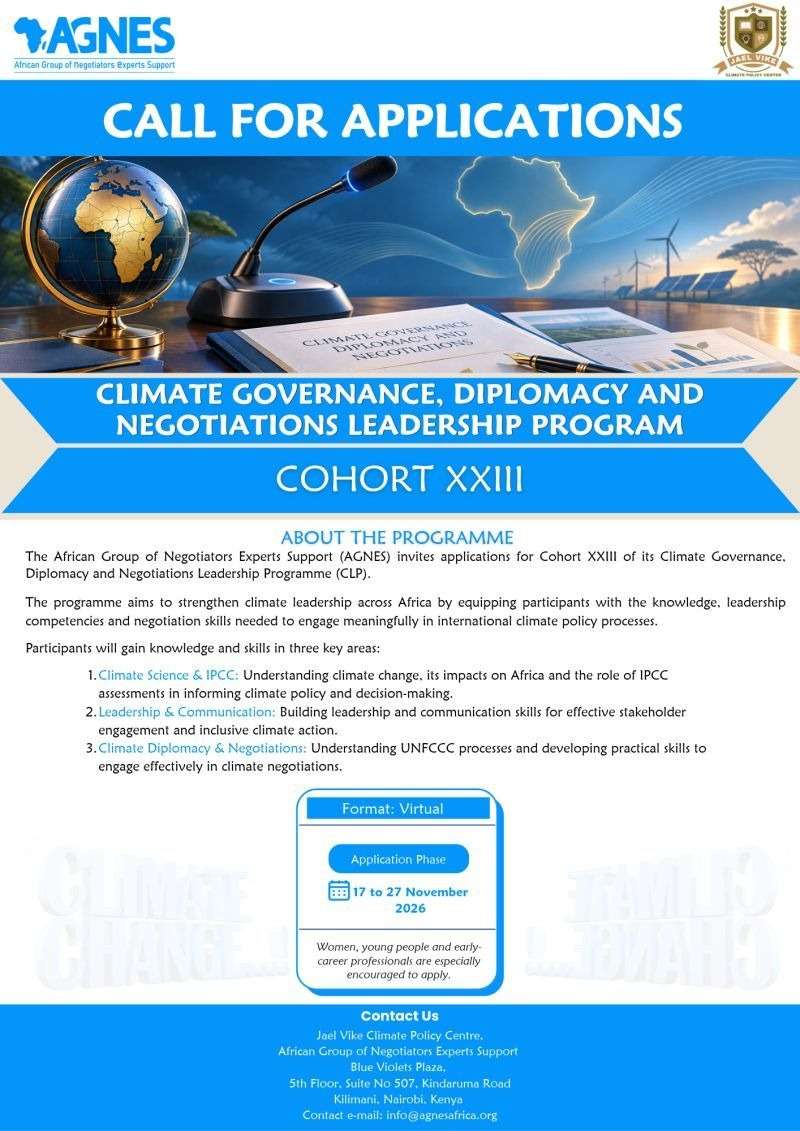
African professionals, policymakers, researchers, climate negotiators, diplomats, and emerging environmental leaders have an opportunity to strengthen their expertise in climate governance, international diplomacy, and climate change negotiations through the Climate Governance, Diplomacy and Negotiations Leadership Programme (CLP), Cohort XXIII. The programme is offered by the African Group of Negotiators Experts Support (AGNES), an organisation committed to strengthening Africa’s participation in global climate policy discussions and promoting evidence-based climate action across the continent.
As climate change continues to affect African economies, ecosystems, livelihoods, food security, and development priorities, the ability of African countries to participate effectively in international climate negotiations has become increasingly important. Decisions made under international climate agreements influence how countries address climate adaptation, mitigation, climate finance, loss and damage, and other critical issues. However, meaningful participation in these processes requires professionals who understand climate science, international policy frameworks, negotiation procedures, diplomacy, and the political processes through which global climate decisions are made.
The AGNES Climate Governance, Diplomacy and Negotiations Leadership Programme seeks to address this need by equipping current and emerging African climate leaders with the knowledge, practical skills, and leadership competencies required to engage effectively in international climate change policy discussions.
Applications for Cohort XXIII are open from 17 November to 27 November 2026. African professionals and emerging leaders working in climate change, environmental management, sustainable development, governance, diplomacy, research, law, and related sectors are encouraged to apply.
Women, young people, and early-career professionals are particularly encouraged to submit applications.
The Climate Governance, Diplomacy and Negotiations Leadership Programme is an initiative developed to strengthen Africa’s capacity to participate meaningfully in international climate governance and negotiations.
The programme is implemented by the African Group of Negotiators Experts Support (AGNES), an organisation established in 2015 to advance evidence-based climate policy, negotiations, and implementation in Africa by strengthening the science-policy-practice nexus and promoting inclusive climate action.
AGNES recognises that Africa’s engagement in international climate negotiations is essential to ensuring that global climate decisions reflect the continent’s priorities, circumstances, and development needs.
International climate negotiations involve complex discussions between governments, regional groups, international organisations, and other stakeholders. These negotiations determine the direction of international cooperation on climate change and influence the policies and actions countries undertake to address the climate crisis.
For African countries, participation in these discussions is particularly important because the continent faces significant climate-related challenges while also pursuing economic growth, poverty reduction, industrialisation, food security, and sustainable development.
The programme therefore focuses on developing a generation of African professionals and leaders who can understand international climate processes, communicate climate-related issues effectively, participate in negotiations, and contribute to the development and implementation of climate policies.
Through its leadership and capacity-building approach, the initiative seeks to strengthen the knowledge and practical abilities of individuals who are involved in climate governance at national, regional, and international levels.
Why Climate Governance, Diplomacy and Negotiations Matter for Africa
Climate change is not only an environmental issue. It is also a major development, economic, political, and governance challenge that affects different sectors across African countries.
The continent faces increasing pressure to address climate-related risks while ensuring that development priorities are adequately represented in international decision-making processes.
International climate agreements provide frameworks for countries to cooperate on addressing these challenges. However, the effectiveness of these agreements depends partly on the ability of individual countries and regional negotiating groups to understand the issues, contribute to discussions, negotiate positions, and implement agreed decisions.
1. Strengthening Africa’s participation in international climate negotiations
African countries participate in international climate negotiations through different national and regional mechanisms, including the African Group of Negotiators.
These negotiations provide opportunities for African governments to communicate their priorities, influence international climate policies, and advocate for decisions that reflect the continent’s circumstances.
However, effective participation requires technical expertise, diplomatic experience, negotiation skills, and a clear understanding of international climate governance structures.
The AGNES programme seeks to strengthen these capacities by preparing professionals who can contribute to negotiations and support the development of informed national and regional positions.
2. Addressing climate adaptation and mitigation challenges
Climate adaptation and mitigation are among the major areas addressed under international climate agreements.
Adaptation focuses on strengthening the ability of communities, institutions, and countries to prepare for and respond to the impacts of climate change. This includes addressing challenges associated with droughts, floods, changing rainfall patterns, rising temperatures, and other climate-related risks.
Mitigation involves reducing greenhouse gas emissions and supporting actions that limit the extent of future climate change.
African countries need professionals who understand both areas and can contribute to the development of policies, programmes, and international commitments that address the continent’s climate priorities.
3. Strengthening climate finance discussions
Climate finance is an important component of international climate negotiations because developing countries require financial resources to implement adaptation and mitigation measures.
African countries frequently engage in discussions concerning the availability, accessibility, and distribution of climate finance.
Professionals with a strong understanding of climate governance and negotiation procedures can contribute to discussions on financing arrangements, international cooperation, and the implementation of climate-related commitments.
4. Addressing loss and damage
Loss and damage is another important issue within international climate discussions. It concerns the impacts of climate change that cannot be fully avoided through adaptation and mitigation.
African countries face different forms of climate-related losses, including damage to infrastructure, agricultural production, ecosystems, livelihoods, and other development resources.
Understanding how loss and damage is addressed under international climate agreements is therefore important for professionals involved in climate policy, governance, diplomacy, and negotiations.
5. Connecting international climate decisions with national implementation
International climate decisions must eventually be translated into national policies, programmes, and practical actions.
Professionals working in government institutions, research organisations, civil society, universities, and other sectors play important roles in supporting this process.
The programme seeks to strengthen the ability of African professionals to understand international climate decisions and contribute to their application within national and regional contexts.
Objectives of the Climate Governance, Diplomacy and Negotiations Leadership Programme
The main objective of the programme is to strengthen climate leadership across Africa by equipping participants with the knowledge, leadership competencies, and negotiation skills needed to participate meaningfully in international climate change policy discussions.
The programme recognises that effective climate leadership requires more than technical knowledge of environmental issues. It also requires an understanding of international governance systems, diplomatic engagement, negotiation procedures, communication, and stakeholder participation.
Through the programme, participants are expected to develop the ability to interpret climate-related information, engage in policy discussions, understand international decision-making processes, and contribute to climate negotiations.
The initiative also seeks to strengthen the capacity of current and emerging African climate leaders, with particular attention to encouraging the participation of women and young professionals.
Expected Learning Outcomes
Upon successful completion of the programme, participants are expected to acquire several important competencies that can strengthen their professional contributions to climate governance and international negotiations.
1. Understanding the scientific basis of climate change
Participants are expected to explain the scientific foundations of climate change and understand how climate change affects Africa.
This includes developing knowledge of climate science, the causes and impacts of climate change, and the importance of scientific evidence in informing policy decisions.
Participants will also be expected to understand how assessments produced by the Intergovernmental Panel on Climate Change (IPCC) contribute to international and national climate policy development.
The IPCC plays an important role in assessing scientific information relating to climate change, its impacts, potential future risks, and available responses.
Understanding these assessments helps policymakers, negotiators, researchers, and other professionals make informed decisions based on scientific evidence.
Participants should therefore be able to explain how scientific findings inform climate governance, policy formulation, and international negotiations.
2. Developing climate leadership and communication skills
Effective climate leadership requires the ability to communicate complex issues clearly and engage different stakeholders.
The programme seeks to strengthen participants’ leadership and communication competencies so they can explain climate issues to different audiences, participate in discussions, and support inclusive climate action.
These skills are particularly important for professionals who work with government institutions, communities, researchers, civil society organisations, international organisations, and private-sector stakeholders.
Participants are expected to develop the ability to communicate climate-related information in ways that support understanding, cooperation, and informed decision-making.
They should also be able to engage stakeholders, contribute to discussions, and encourage participation in climate action initiatives.
3. Understanding the UNFCCC climate negotiation process
Another important learning outcome is the ability to explain how decisions are made under the United Nations Framework Convention on Climate Change (UNFCCC).
The UNFCCC provides the international framework through which countries cooperate on addressing climate change.
Its negotiation processes involve different governing bodies, subsidiary bodies, constituted bodies, and negotiating groups, each with specific responsibilities and roles.
Participants are expected to understand the functions of the following institutions and processes:
- Conference of the Parties (COP): The principal decision-making body of the UNFCCC, where Parties meet to review implementation and negotiate climate-related decisions.
- Conference of the Parties serving as the meeting of the Parties to the Paris Agreement (CMA): The governing body responsible for overseeing the implementation of the Paris Agreement.
- Conference of the Parties serving as the meeting of the Parties to the Kyoto Protocol (CMP): The body responsible for overseeing the implementation of the Kyoto Protocol.
- Subsidiary bodies: The supporting bodies that undertake technical, scientific, implementation, and other work necessary to support negotiations and decision-making.
- Constituted bodies: Specialised bodies established under the climate regime to address specific issues and provide technical or institutional support.
- Negotiating groups: Groups through which countries coordinate positions and engage in international climate discussions.
Understanding these structures is important for anyone seeking to participate effectively in international climate diplomacy.
Participants will be better positioned to understand how negotiations are organised, how decisions are developed, and how different institutions contribute to the international climate governance system.
4. Developing practical climate negotiation skills
The programme also focuses on practical negotiation techniques.
Climate negotiations involve complex discussions in which countries and negotiating groups present proposals, communicate priorities, interpret technical documents, and seek agreement on different issues.
Participants are expected to develop skills in:
- Preparing effectively for international negotiations.
- Understanding negotiation processes and procedures.
- Engaging constructively in formal and informal negotiation discussions.
- Interpreting negotiating texts and draft decisions.
- Understanding the use of brackets in negotiating documents.
- Communicating negotiating positions clearly.
- Following the development and revision of negotiation texts.
The ability to interpret negotiating texts is particularly important because international climate agreements are developed through detailed discussions involving different proposals, amendments, and areas of disagreement.
The use of brackets in negotiating documents can indicate text that remains under discussion or has not yet been agreed upon. Understanding this process helps participants follow negotiations and identify areas where further engagement may be necessary.
By strengthening these practical competencies, the programme seeks to prepare participants to engage more confidently in climate diplomacy and negotiations.
Who Should Apply for the AGNES Climate Governance, Diplomacy and Negotiations Leadership Programme?
The programme is open to African professionals, practitioners, and emerging leaders with an interest or experience in climate change, environmental management, sustainable development, governance, diplomacy, or related fields.
It is intended for individuals whose professional responsibilities, academic backgrounds, or areas of interest connect with climate policy, environmental issues, international relations, or sustainable development.
The following categories of professionals are particularly encouraged to apply.
1. Policymakers and public officials
Government officials and policymakers working on national or subnational climate policies and programmes are encouraged to apply.
These individuals play important roles in developing, coordinating, and implementing government responses to climate change.
Participation in the programme can strengthen their understanding of international climate agreements and help them connect global climate decisions with national policy priorities.
Professionals working in government departments, environmental agencies, climate policy units, and other relevant public institutions may find the programme particularly relevant.
2. Scientists, researchers, and technical experts
Scientists, researchers, and technical specialists from universities, research institutions, and think tanks are also encouraged to apply.
Climate science and technical research provide important evidence for policy development and international negotiations.
Researchers contribute by generating knowledge, analysing climate-related information, assessing environmental impacts, and communicating scientific findings to policymakers and other stakeholders.
The programme is relevant to professionals interested in strengthening the relationship between climate science, policy, and international decision-making.
3. Climate negotiators and diplomats
Climate negotiators and diplomats working at national, regional, or international levels are an important target group.
These professionals participate in discussions and negotiations concerning international climate agreements, policies, and commitments.
The programme can help strengthen their understanding of negotiation procedures, diplomatic engagement, climate governance institutions, and the interpretation of negotiating documents.
It is particularly relevant to professionals seeking to improve their practical negotiation and leadership competencies.
4. Representatives of international and intergovernmental organisations
Professionals working in international organisations and intergovernmental institutions are also encouraged to apply.
These organisations contribute to international cooperation, policy development, climate research, capacity building, and the implementation of climate-related programmes.
Individuals working in relevant institutions can benefit from a stronger understanding of African climate priorities and international negotiation processes.
5. Civil society organisations
Representatives of civil society organisations working on climate change, environmental protection, sustainable development, climate justice, and related issues are eligible to apply.
Civil society organisations play an important role in promoting public participation, advocating for inclusive climate policies, supporting community-level action, and holding institutions accountable.
The programme can strengthen the ability of civil society professionals to engage in climate governance discussions and contribute to evidence-based climate advocacy.
6. Women-led and youth-led organisations
The programme recognises the importance of inclusive climate leadership and encourages participation from women-led and youth-led organisations.
Women and young people are important contributors to climate action across Africa, including research, policy advocacy, environmental protection, community mobilisation, and sustainable development.
Strengthening their participation in climate governance and negotiations can help ensure that different perspectives and experiences are represented in decision-making processes.
7. Private-sector professionals
Professionals working in the private sector who have an interest or experience in climate change and sustainable development are also encouraged to apply.
The private sector has an important role in climate action through investment, innovation, technology, business practices, and the implementation of sustainability initiatives.
Professionals in this category can benefit from understanding international climate policies, governance frameworks, and negotiation processes that influence climate-related economic and development activities.
8. Legal professionals
Lawyers and other legal practitioners working in climate law, environmental governance, or climate justice are also part of the programme’s target audience.
Climate governance involves international agreements, national legislation, regulatory frameworks, institutional responsibilities, and legal obligations.
Legal professionals with an understanding of these areas can contribute to policy development, legal analysis, climate justice initiatives, and the implementation of climate-related commitments.
Encouraging Women, Young People, and Early-Career Professionals
One of the important features of the AGNES Climate Governance, Diplomacy and Negotiations Leadership Programme is its emphasis on strengthening inclusive climate leadership.
The programme specifically encourages applications from women, young people, and early-career professionals.
Africa requires a diverse group of climate leaders capable of addressing the continent’s environmental and development challenges. Encouraging participation from different professional backgrounds and generations can strengthen the quality of climate discussions and broaden the representation of African perspectives in international negotiations.
Women play important roles in climate research, environmental governance, policy development, community resilience, and sustainable development. Similarly, young people are increasingly contributing to climate innovation, environmental advocacy, research, and public engagement.
By encouraging these groups to apply, AGNES seeks to strengthen the participation of emerging leaders in climate governance and international policy discussions.
Early-career professionals can also benefit from developing an understanding of international climate institutions and negotiation procedures at an important stage in their professional development.
Why African Professionals Should Consider Applying
The Climate Governance, Diplomacy and Negotiations Leadership Programme is relevant to professionals who want to strengthen their understanding of how international climate policies are developed and how African countries participate in global climate decision-making.
Some of the important professional development opportunities associated with the programme include:
Improved understanding of international climate governance
Participants are expected to develop a clearer understanding of the UNFCCC, the Paris Agreement, the Kyoto Protocol, and the institutions responsible for overseeing international climate cooperation.
Stronger climate policy knowledge
The programme addresses the relationship between climate science, policy development, and decision-making. This can help participants understand how scientific assessments inform climate-related policies.
Improved negotiation competencies
Participants will develop an understanding of practical negotiation techniques, including preparation, engagement in negotiation processes, interpretation of negotiating texts, and the use of brackets.
Enhanced leadership and communication abilities
The programme focuses on leadership and communication skills that can help professionals explain climate issues, engage stakeholders, and support inclusive climate action.
Greater understanding of Africa’s climate priorities
By focusing on Africa’s participation in international climate processes, the programme provides an opportunity to strengthen awareness of the continent’s development needs and its role in global climate negotiations.
Professional relevance across different sectors
The programme is designed for professionals from government, academia, research institutions, diplomacy, civil society, international organisations, the private sector, and the legal profession.
This multidisciplinary approach recognises that climate governance requires collaboration between different sectors and areas of expertise.
Application Period and Deadline
Applications for the Climate Governance, Diplomacy and Negotiations Leadership Programme Cohort XXIII are open for a limited period.
The official application period is:
- Application opening date: 17 November 2026
- Application deadline: 27 November 2026
Interested applicants should ensure that they complete and submit their applications within this period.
The application announcement does not specify a programme commencement date, training duration, number of available places, or detailed selection timeline. Applicants should consult the programme’s official application information for any additional details.
Click HERE for more information about AGNES Africa Climate Governance, Diplomacy and Negotiations Leadership Programme 2026.
How to Apply for the AGNES Climate Governance, Diplomacy and Negotiations Leadership Programme
Interested African professionals and emerging climate leaders can apply through the official AGNES application process.
Applicants should follow these steps:
Step 1: Review the programme information
Carefully read the programme announcement and understand its objectives, expected learning outcomes, and target audience.
Ensure that your professional background, academic interests, or experience is relevant to climate change, environmental management, sustainable development, governance, diplomacy, or related fields.
Step 2: Assess your suitability
Determine how your current work, professional experience, or future career interests connect with climate governance and international climate negotiations.
Applicants should be able to demonstrate a genuine interest in strengthening African climate leadership and participating in climate-related policy discussions.
Step 3: Prepare your application
Gather the information required by the official application portal and provide accurate details about your professional background and relevant experience.
Applicants should clearly communicate their interest in the programme and demonstrate how the learning outcomes relate to their work or professional development objectives.
Step 4: Complete the online application
Visit the AGNES application portal and complete the application form for Climate Governance, Diplomacy and Negotiations Leadership Programme Cohort XXIII.
Ensure that all required information is provided before submitting the application.
Step 5: Submit before the deadline
Complete and submit your application within the official application period, which closes on 27 November 2026.
Applicants are encouraged not to wait until the final day to submit their applications.
About the African Group of Negotiators Experts Support (AGNES)
The African Group of Negotiators Experts Support, commonly known as AGNES, is an organisation established in 2015 to strengthen Africa’s participation in climate policy development, international negotiations, and climate action implementation.
Its work focuses on advancing evidence-based climate policy and strengthening the relationship between scientific knowledge, policymaking, and practical climate action.
AGNES recognises that effective climate governance requires strong collaboration between scientists, policymakers, negotiators, researchers, practitioners, and other stakeholders.
By supporting the development of African climate leadership and expertise, the organisation seeks to contribute to a stronger African voice in international climate discussions.
Its initiatives are particularly relevant as African countries continue to address climate-related development challenges and participate in international efforts to strengthen climate resilience and reduce greenhouse gas emissions.
The organisation also promotes inclusive climate action by encouraging participation from different professional groups, women, young people, and emerging leaders.
Contact Information
Applicants who require further information about the programme or the application process may contact AGNES through its official communication channels.
Organisation: African Group of Negotiators Experts Support (AGNES)
Office Address: Blue Violet Plaza, 5th Floor, Suite No. 507, Kindaruma Road, Kilimani, Nairobi, Kenya.
Email: info@agnesafrica.org
Telephone: +254 705 742 836
Office Hours: Monday to Friday, 8:00 a.m. to 5:00 p.m. The office is closed on weekends.
Conclusion
The AGNES Climate Governance, Diplomacy and Negotiations Leadership Programme Cohort XXIII presents an important opportunity for African professionals, policymakers, researchers, diplomats, legal practitioners, and emerging climate leaders to strengthen their expertise in international climate governance and negotiations.
As Africa continues to navigate the effects of climate change and participate in global environmental decision-making, the need for knowledgeable, skilled, and effective climate leaders remains essential. Understanding climate science, international agreements, negotiation procedures, diplomacy, and policy implementation can help professionals contribute more effectively to climate action at national, regional, and international levels.
Through its focus on leadership development, communication, climate science, UNFCCC processes, and practical negotiation techniques, the programme seeks to equip participants with competencies that can strengthen Africa’s engagement in global climate discussions.
Women, young people, and early-career professionals are particularly encouraged to apply, alongside experienced practitioners from government, academia, research institutions, civil society, international organisations, the private sector, and the legal profession.
Interested applicants should review the programme requirements, assess their suitability, and complete their applications within the official application period.
The application deadline is 27 November 2026. African professionals and emerging leaders interested in advancing their careers in climate governance, diplomacy, and international negotiations are encouraged to apply before the deadline.