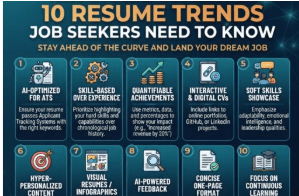
The job market in 2026 is placing greater emphasis on skills, measurable results, digital capabilities and the ability to demonstrate professional value.
As employers receive large volumes of applications, a CV needs to do more than list previous jobs. It should quickly communicate what a candidate can contribute to an organisation.
For job seekers, updating a CV is therefore not simply about changing the year or adding a new position. It involves improving how experience, skills, achievements and professional capabilities are presented.
Here are 10 important CV insights job seekers can consider when preparing applications in 2026.
1. Skills Need Evidence
Simply listing skills such as leadership, communication, project management or data analysis may not be enough.
Employers increasingly want evidence of how those skills have been applied. Instead of writing “excellent project management skills,” a stronger CV can describe a project managed, the candidate’s role and the result achieved.
For example, a candidate could state that they coordinated a digital campaign that increased website engagement by a measurable percentage.
2. Measurable Achievements Make CVs Stronger
One of the most useful CV improvements is replacing general responsibilities with specific achievements.
Rather than simply stating that a candidate “managed social media accounts,” the CV can explain the scale and impact of the work, such as the number of platforms managed, audience growth, engagement improvements or campaigns delivered.
Numbers provide recruiters with clearer evidence of professional contribution.
3. AI Skills Are Becoming More Relevant
Artificial intelligence is increasingly influencing workplaces across industries. Candidates do not necessarily need to become AI specialists, but demonstrating appropriate AI literacy can be valuable for many roles.
Depending on the position, candidates may highlight experience using AI-assisted research, content creation, data analysis, automation, productivity tools or other relevant technologies.
The key is to demonstrate practical use rather than simply adding “AI” as a keyword.
4. ATS-Friendly CVs Still Matter
Many employers use Applicant Tracking Systems to organise and filter applications.
A CV can improve its compatibility with these systems by using clear headings, conventional job titles, relevant keywords and straightforward formatting.
Candidates should avoid filling their CVs with keywords that are unrelated to their actual experience. The document should remain readable for both recruitment software and human reviewers.
5. The Professional Summary Should Be More Specific
Generic career objectives are becoming less useful.
A strong professional summary should quickly communicate a candidate’s professional area, experience level, key strengths and the type of value they can offer.
For example, instead of simply stating “hardworking graduate seeking a challenging opportunity,” a candidate can identify their field, relevant skills and areas of professional interest.
6. Transferable Skills Can Open More Opportunities
Candidates changing industries or applying internationally should pay particular attention to transferable skills.
Research, communication, project coordination, customer service, data management, digital content creation, administration and problem-solving can be relevant across multiple sectors.
A CV should make those connections clear instead of assuming the recruiter will identify them.
7. Digital Portfolios Can Complement a CV
For certain professions, a CV does not have to carry all the evidence of a candidate’s work.
Professionals in communications, journalism, graphic design, software development, marketing, research and related fields can use portfolios to demonstrate previous work.
Where appropriate, candidates can include a professional portfolio, LinkedIn profile, GitHub repository or other relevant online resource.
8. International Applications Require Greater Precision
Candidates applying for international jobs, scholarships, fellowships and internships should ensure that their CV follows the requirements of the specific opportunity.
Some organisations request a particular CV format, length or information. Others may have specific eligibility criteria related to education, nationality, location or professional experience.
A generic CV sent to every employer may therefore be less effective than a document adapted to the particular opportunity.
9. Career Gaps Do Not Need to Define a CV
Career breaks are not automatically evidence of poor professional performance.
Candidates can use their CV to highlight relevant activities undertaken during a career break, including education, professional development, volunteering, freelance work, caregiving, entrepreneurship or personal projects where appropriate.
The objective is to present the candidate’s overall professional journey accurately and clearly.
10. CVs Should Be Easier to Scan
Recruiters may review many applications for a single vacancy. A CV should therefore make important information easy to locate.
Clear headings, concise bullet points, consistent dates and a logical structure can improve readability.
Candidates should prioritise the most relevant experience instead of including every responsibility they have ever performed.

How to Update a CV for 2026
A useful CV review can begin with the target vacancy. Candidates should identify the employer’s main requirements and then check whether their CV provides evidence against those requirements.
Before submitting an application, candidates can review:
- Professional headline and summary
- Relevant technical and digital skills
- Measurable achievements
- Recent professional experience
- Education and certifications
- AI and technology experience where relevant
- Portfolio or professional links
- Keywords appearing in the vacancy
- Formatting and readability
- Contact information
Candidates should also remove outdated information that does not contribute to their application.
Final Thoughts
The modern CV is increasingly becoming a concise evidence document rather than a complete history of everything a candidate has done.
In 2026, job seekers can strengthen their applications by showing measurable achievements, demonstrating practical skills, highlighting relevant digital capabilities and tailoring their CVs to individual opportunities.
The most important principle is relevance. A CV should make it easy for a recruiter to understand who the candidate is, what they can do, what they have achieved and how their experience connects to the role.