Researchers working on migration, displacement, governance, humanitarianism, conflict, peace and contested places are invited to submit abstracts for an international workshop taking place at Jagiellonian University in Kraków, Poland, in March 2027.
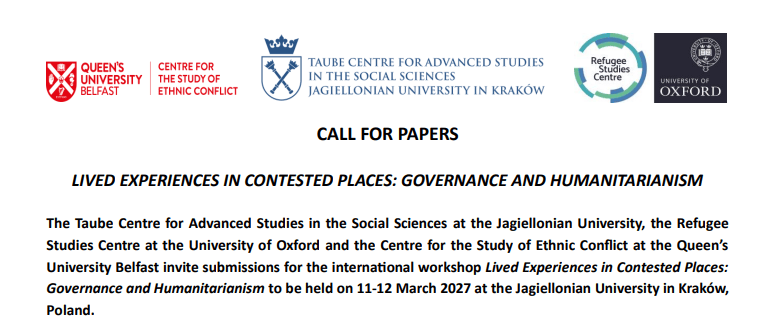
The international workshop, titled “Lived Experiences in Contested Places: Governance and Humanitarianism,” is being convened by the Taube Centre for Advanced Studies in the Social Sciences at Jagiellonian University, the Refugee Studies Centre at the University of Oxford, and the Centre for the Study of Ethnic Conflict at Queen’s University Belfast.
The event will bring together researchers examining how people experience and navigate everyday governance in environments where authority, territory, identity, mobility, legal status and belonging are contested.
The abstract submission deadline is December 11, 2026, while a limited number of travel grants will be available to support early-career scholars with travel and/or accommodation costs.
International Workshop on Governance, Migration and Humanitarianism
The workshop will take place on 11–12 March 2027 at Jagiellonian University in Kraków, Poland.
Its central focus is the relationship between lived experiences and systems of governance in places affected by political, territorial, social or humanitarian contestation.
The organisers are particularly interested in research that moves beyond formal institutions to examine how governance is experienced in everyday life. This includes the ways migrants, displaced people, returnees and other communities interact with authorities, institutions, informal networks and service providers.
The workshop will connect scholarship on contested places—including divided cities, borderlands, disputed regions and segregated territories—with research on migration and displacement across cities, neighbourhoods, camps, shelters and reception centres.
Who Should Submit?
The call is relevant to researchers whose work engages with governance, migration, displacement, humanitarianism, conflict, peace, identity or social exclusion.
Contributions may examine a wide range of geographical contexts and populations, particularly where people encounter multiple or competing systems of authority.
The organisers are especially encouraging submissions addressing:
- Lived experiences of governance and resistance in contested cities, municipalities, neighbourhoods, borderlands, camps, shelters and reception centres.
- Experiences of migrants, displaced populations and returnees navigating contested mobility, legal status and belonging.
- Everyday peace practices used to navigate, prevent or de-escalate conflict and violence.
- Fragmented, overlapping or contested systems of authority and service provision.
- How people negotiate status and belonging while accessing—or circumventing—formal and informal institutions.
- Informal networks and community responses to exclusion or unequal treatment.
- Intra-group and inter-group dynamics in contested environments.
- Creative and cultural practices addressing exclusion, identity, belonging, governance and peace.
Research Themes and Questions
The workshop provides an opportunity to explore governance from the perspective of people living within or moving through contested environments.
Possible research questions could examine how displaced communities navigate competing authorities, how migrants gain access to essential services, or how individuals respond when formal institutions exclude or discriminate against them.
Other contributions may investigate informal forms of governance, community networks, everyday resistance or peacebuilding practices.
Research on cultural and creative practices is also encouraged, particularly where these practices provide alternative ways of addressing questions surrounding identity, belonging, exclusion, governance and peace.
This broad thematic scope means that submissions can approach the workshop from different disciplinary perspectives, including migration studies, political science, sociology, anthropology, peace and conflict studies, humanitarian studies and related social sciences.
What Applicants Need to Submit
Researchers interested in participating should prepare a concise submission consisting of two components:
- Abstract: approximately 300 words
- Short biography: approximately 100 words
The abstract should clearly communicate the proposed paper’s central argument, research focus and relevance to the workshop theme.
Submissions should be sent to both workshop contacts:
Aleksandra Zdeb: [email protected]
Fabricio Carrijo: [email protected]
Prospective participants should ensure that their submissions address one or more of the workshop’s themes and are submitted before the stated deadline.
Key Dates
The main dates for the workshop are:
- 11 December 2026: Abstract submission deadline
- 21 December 2027: Acceptance notification date listed in the call
- 5 March 2027: Draft article deadline
- 11–12 March 2027: International workshop in Kraków
There appears to be an inconsistency in the published call regarding the acceptance-notification date, which is listed as December 21, 2027 even though the workshop takes place in March 2027. Applicants may therefore wish to contact the organisers to confirm the intended notification date.
Travel Grants for Early-Career Scholars
A limited number of travel grants will be available for early-career scholars.
The support is intended to help cover travel and/or accommodation expenses, although the call does not indicate that funding will be available to every selected participant.
Early-career researchers who may otherwise face financial barriers to attending an international academic workshop may therefore find this aspect of the opportunity particularly relevant.
Keynote Speakers
The workshop will feature keynote contributions from:
- Ivan Gusic, Uppsala University
- Tom Scott-Smith, Refugee Studies Centre, University of Oxford
Their participation adds an important academic dimension to discussions around contested places, migration, humanitarianism and everyday governance.
Why Researchers Should Consider Applying
The workshop offers researchers an opportunity to present their work to an interdisciplinary audience interested in how governance operates in complex and contested environments.
For scholars studying migration, forced displacement, humanitarian responses, borders, conflict, peacebuilding, belonging or informal governance, the call provides a platform to connect empirical research with broader debates about authority and everyday life.
The organisers are particularly interested in lived experiences, meaning that research focusing on communities, everyday practices and individual or collective responses can make a strong contribution.
Researchers who wish to participate should prepare their approximately 300-word abstract and 100-word biography well before the December 11, 2026 deadline and contact the organisers if clarification is needed regarding eligibility, travel support or the acceptance-notification date.