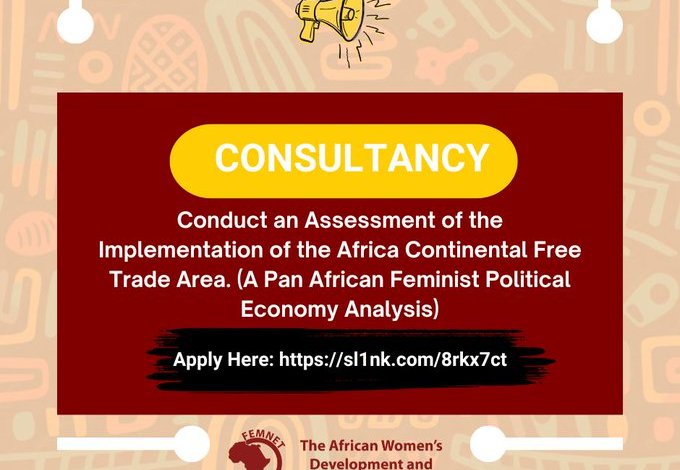
The African Women’s Development and Communication Network (FEMNET) has announced a call for proposals for consultants to conduct an Assessment of the Implementation of the Africa Continental Free Trade Area (AfCFTA) through a Pan-African Feminist Political Economy Analysis.
The consultancy seeks to examine how the AfCFTA is being implemented across Africa and assess its impact on women and youth, particularly those engaged in trade, informal economies, and women-led enterprises.
The assignment will provide evidence-based recommendations to strengthen the AfCFTA framework and promote gender-transformative economic policies that advance women’s economic justice and inclusive development.
The deadline for submission of applications is 15 July 2026.
About FEMNET and the Consultancy Opportunity
The African Women’s Development and Communication Network (FEMNET) is a pan-African feminist and membership-based organisation headquartered in Nairobi, Kenya, with more than 800 individual and institutional members across 50 African countries and the diaspora.
FEMNET works to amplify African women’s voices and influence policy decisions affecting women and girls across the continent.
The organisation focuses on several priority areas, including:
- Women’s economic justice and rights
- Transformative women’s leadership
- Sexual and reproductive health and rights
- Climate justice and natural resource governance
- Ending violence and discriminatory practices against women and girls
Through this consultancy, FEMNET aims to generate knowledge that will guide its advocacy and engagement around the implementation and future development of the AfCFTA.
Study Examines AfCFTA Through a Feminist Economic Justice Lens
The Africa Continental Free Trade Area is one of the flagship initiatives under Agenda 2063, designed to create a single African market for goods and services while increasing economic integration across the continent.
Although the agreement recognises gender equality and inclusive development, FEMNET highlights that trade policies are not automatically gender neutral.
Women across Africa continue to face structural barriers, including:
- Limited access to markets and finance
- Unequal participation in value chains
- Lack of social protection
- High levels of informal employment
- Heavy unpaid care responsibilities
- Barriers to technology and productive resources
The assessment will investigate whether AfCFTA implementation is addressing these inequalities or reinforcing existing economic disparities.
Assessment Focuses on South Africa, Nigeria and Senegal
The consultancy will examine AfCFTA implementation processes in three African countries:
- South Africa
- Nigeria
- Senegal
These countries were selected because they represent different economic, political, linguistic, and regional contexts.
The assessment will explore:
- Southern Africa perspectives through South Africa
- Anglophone West Africa experiences through Nigeria
- Francophone West Africa perspectives through Senegal
The research will analyse how women and youth experience AfCFTA opportunities and challenges across different trade and production environments.
Key Areas of Research and Analysis
The selected consultant or consulting team will conduct a feminist political economy analysis focusing on the distribution of costs and benefits arising from AfCFTA implementation.
The study will examine:
- National AfCFTA implementation and negotiation processes
- Participation of women’s rights organisations in trade decision-making
- Institutional trade structures and regulatory frameworks
- Tariff adjustments and economic impacts
- Market access opportunities for women traders
- Labour rights and decent work conditions
- Financial inclusion for women-led MSMEs
- Informal cross-border trade experiences
- Digital trade and investment policies
- Social protection mechanisms
- Public financing of care services
- Rules of origin and regional value chains
The research methodology will combine:
- Desk reviews
- Gender-responsive legal and policy analysis
- Focus group discussions
- Key informant interviews
Consultations will involve:
- Women cross-border traders
- Feminist organisations
- Women’s rights groups
- Informal worker associations
- Government officials
- Trade and labour ministries
- National AfCFTA implementation committees
- Relevant continental trade institutions
Expected Consultancy Deliverables
The successful consultant will be responsible for producing several outputs during the 30-day assignment.
Deliverables include:
- Inception report outlining methodology and research tools
- Analytical framework for monitoring AfCFTA implementation
- Identification of key indicators for future tracking
- Comprehensive assessment report
- Final research report
- Presentation summarising findings
- Country case briefs for South Africa, Nigeria, and Senegal
- Stakeholder validation meeting
- Advocacy brief for policy engagement
The final assessment will serve as a baseline document to guide FEMNET’s future advocacy and policy interventions on AfCFTA implementation.
Required Qualifications and Experience
FEMNET is seeking consultants with expertise in feminist economics, trade policy, and development research.
Applicants should have:
- Academic qualifications in gender studies, economics, trade, public policy, law, development studies, or related fields
- Preferably a postgraduate qualification
- Experience conducting feminist macroeconomic analysis
- Experience using mixed research methods
- Strong knowledge of gender-responsive trade policies
- Experience producing policy papers and advocacy briefs
- Experience working with feminist or women’s rights organisations
- Skills in developing gender-sensitive indicators and research tools
- Understanding of Pan-African feminist principles
Candidates should demonstrate commitment to advancing gender equality and economic justice across Africa.
Assignment Duration and Reporting Structure
The consultancy will run for 30 days, beginning on 28 July 2026.
The selected consultant will report to FEMNET’s Economic Justice and Rights Lead.
The assignment will operate under a consultancy agreement, with payments made through bank transfer according to agreed contractual arrangements.
Application Requirements and Deadline
Interested consultants or agencies must submit an Expression of Interest via email to [email protected] with the subject line:
FNT/EOI/26/2026 – Assessment of the Implementation of the Africa Continental Free Trade Area
Applications must include:
- Detailed cover letter including daily consultancy rate
- Updated CV
- Two professional references
- One PDF sample of a previous paper or policy brief focused on trade, development, gender, or trade policy
Applications without a relevant sample work document will not be considered.
The deadline for applications is 15 July 2026.
FEMNET Promotes Inclusive and Ethical Consultancy Practices
FEMNET emphasises its commitment to safeguarding, ethical conduct, and prevention of harassment, exploitation, abuse, and other forms of misconduct.
The organisation welcomes applications from diverse backgrounds and is committed to creating inclusive opportunities for people with disabilities.
Only complete applications will be reviewed, and shortlisted candidates will be contacted.