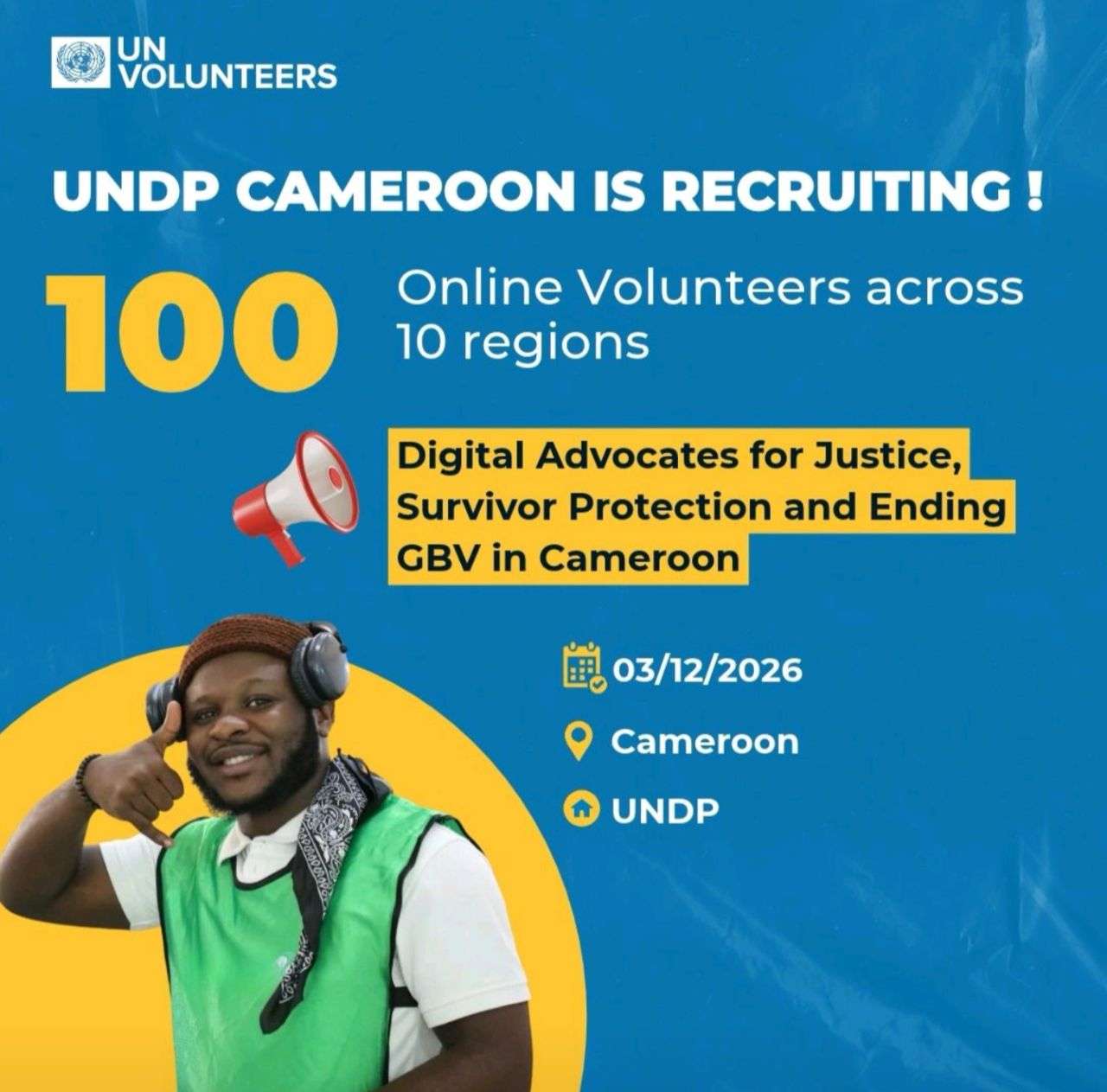
The United Nations Development Programme (UNDP), in collaboration with the United Nations Volunteers (UNV) programme, is inviting applications for an exciting online volunteer opportunity titled Digital Advocates for Justice, Survivor Protection and Ending Gender-Based Violence (GBV) in Cameroon. The initiative seeks to recruit 100 online volunteers to support a nationwide digital advocacy campaign aimed at preventing and responding to gender-based violence, promoting gender equality, protecting survivors and encouraging positive social behaviour.
This 12-week volunteer assignment offers an opportunity for individuals with an interest in social media advocacy, digital communication, public awareness, human rights, gender equality and community engagement to contribute to an important social development initiative. Selected volunteers will work remotely, dedicating approximately 1–5 hours per week to creating and sharing digital content, promoting campaign messages, engaging online audiences and supporting coordinated advocacy activities.
The assignment is hosted by UNDP and focuses on Cameroon, where gender-based violence remains a significant human rights and protection concern. Through the use of social media platforms and digital communities, the initiative aims to increase public awareness, challenge harmful gender norms, encourage positive behaviour and make information about available support services more accessible.
A total of 100 volunteer positions are available through a competitive recruitment process. Applicants with experience in social media communication, content creation, advocacy, public information or digital engagement are encouraged to apply. Individuals with a basic understanding of gender-based violence, gender equality or safeguarding principles will also have an advantage.
The opportunity is particularly relevant to university students, recent graduates, communication professionals, content creators, social media advocates and individuals passionate about ending violence against women and girls. Applicants with secondary-school education are eligible to apply, and people with disabilities and male candidates are strongly encouraged to submit applications.
About the United Nations Development Programme (UNDP)
The United Nations Development Programme is the United Nations’ global development network. It works in approximately 170 countries and territories, helping governments and communities address poverty, reduce inequalities and exclusion, strengthen institutions and build resilience for sustainable development.
UNDP supports countries by developing policies, strengthening leadership skills, building institutional capabilities and encouraging partnerships that can produce lasting development results. Its work covers a broad range of development priorities, including democratic governance, poverty reduction, crisis prevention and recovery, climate action, environmental protection and sustainable development.
In September 2015, world leaders adopted the 2030 Agenda for Sustainable Development, establishing a global framework for ending poverty, protecting the planet and ensuring that all people can enjoy peace and prosperity. The agenda introduced the Sustainable Development Goals (SDGs), which guide international development priorities through 2030.
UNDP works with governments, civil society organisations, development partners and communities to advance these goals. Its interventions are designed to strengthen national and local capacities, address development challenges and ensure that vulnerable populations are not left behind.
In Cameroon, UNDP has supported initiatives aimed at promoting recovery, stabilisation and development in communities affected by humanitarian crises. Its work has included support from development partners such as Japan, Germany, Sweden and the European Union.
The organisation has also committed to implementing the regional stabilisation strategy adopted in May 2018 by the States Parties of the Lake Chad Basin Commission (LCBC) and endorsed by the African Union.
This wider development and stabilisation work provides an important context for the digital advocacy initiative against gender-based violence.
About the Safe Spaces, Strong Voices Against GBV Project
The online volunteer assignment forms part of the broader Safe Spaces, Strong Voices Against Gender-Based Violence Project, an initiative designed to address gender-based violence through prevention, protection and empowerment strategies.
The project recognises that violence against women and girls is not only a personal or family issue but also a serious human rights, public health, social development and protection concern. It seeks to create environments where individuals, particularly women and girls, can speak out about violence, access support services and pursue justice without fear of stigma, discrimination or retaliation.
An important feature of the initiative is its focus on both physical and digital safe spaces.
Physical safe spaces can provide opportunities for affected individuals to access assistance, information and protection. Digital safe spaces, on the other hand, can help expand awareness, connect communities with reliable information and encourage conversations about preventing violence.
The project therefore seeks to use digital platforms to complement broader community-based interventions. By engaging online volunteers and influencers, it aims to reach more people, amplify messages and encourage communities to challenge harmful behaviours and attitudes that contribute to gender-based violence.
The initiative is being led by UNDP in collaboration with the United Nations Volunteers programme. It brings together the communication and advocacy capabilities of online volunteers and influencers to support a coordinated campaign against gender-based violence in Cameroon.
Understanding the Gender-Based Violence Challenge in Cameroon
Gender-based violence remains widespread in Cameroon, affecting women and girls disproportionately while also impacting men and boys. Despite government interventions and the efforts of development partners, many incidents remain unreported because of stigma, fear, limited awareness of available services and other social barriers.
The assignment description highlights the scale of the challenge through the following statistics:
- Approximately one in three women experiences physical or sexual violence.
- In 2024, more than 6,600 gender-based violence cases were recorded by the Ministry of Women’s Empowerment.
- The health system documented more than 5,700 cases during the same year.
- These health-system records included more than 2,200 cases of rape and approximately 3,500 cases of intimate partner violence.
These figures demonstrate the seriousness of the problem. However, the actual number of incidents is believed to be higher because many survivors do not report abuse or seek assistance.
Several factors contribute to underreporting. Survivors may fear being blamed, rejected or stigmatised by their families and communities. Others may not know where to obtain help or may lack confidence in the available support systems. Social and cultural attitudes can also discourage victims from speaking openly about their experiences.
Humanitarian crises have further increased the risks faced by vulnerable populations. Conflict in Cameroon’s North-West, South-West and Far North regions has created difficult conditions for women and girls, who may face heightened exposure to violence, exploitation and abuse.
Millions of people have been affected by these crises, and gender-based violence continues to be identified as a major protection concern.
The situation demonstrates the need for sustained public education, survivor-centred approaches, accessible information and stronger community engagement.
Why Digital Advocacy Is Important in the Fight Against Gender-Based Violence
The rapid growth of social media and digital communication in Cameroon provides an important opportunity to strengthen public awareness and encourage social change.
Platforms such as Facebook, X (formerly Twitter), Instagram, LinkedIn, TikTok, WhatsApp and YouTube allow information to reach large audiences quickly. They also provide spaces where individuals can discuss social issues, share educational materials and promote campaigns.
However, the assignment description identifies an important gap: although social media use is growing, digital platforms have not been fully utilised for coordinated gender-based violence prevention.
Influencers can shape public attitudes and reach large audiences, while online volunteers can maintain engagement, share reliable information and help sustain advocacy activities. Yet these groups have not been systematically mobilised for coordinated campaigns.
The UNDP and UNV initiative seeks to address this gap by bringing volunteers and influencers together to support a nationwide digital advocacy effort.
Through this approach, online volunteers will help:
- Increase public awareness of gender-based violence and its consequences.
- Challenge harmful social norms, stereotypes and behaviours.
- Promote gender equality and women’s empowerment.
- Encourage positive masculinity and respectful relationships.
- Share information about survivor protection and available support services.
- Promote national and international campaigns against gender-based violence.
- Encourage constructive online conversations about prevention, accountability and justice.
- Strengthen community participation in ending violence against women and girls.
Digital advocacy is expected to complement wider prevention and protection interventions by making important messages more visible and accessible to different communities.
Overview of the UNDP Online Volunteer Opportunity
The assignment is designed for individuals who want to use their digital communication and social media skills to support a meaningful development initiative.
The key details are as follows:
| Opportunity detail | Information |
|---|---|
| Assignment title | Digital Advocates for Justice, Survivor Protection and Ending GBV in Cameroon |
| Host organisation | United Nations Development Programme (UNDP) |
| Collaborating programme | United Nations Volunteers (UNV) |
| Assignment country | Cameroon |
| Modality | Online |
| Number of positions | 100 |
| Duration | 12 weeks |
| Weekly commitment | 1–5 hours |
| Recruitment method | Competitive recruitment |
| Task type | Social media presence |
| Area of expertise | Communication, advocacy and public information |
| Required education level | Secondary education |
| Sustainable Development Goal | SDG 16: Peace, Justice and Strong Institutions |
| Language requirements | English or French communication skills |
| Advertisement end date | 03/12/2026 at 00:00, as displayed in the vacancy |
The assignment is entirely online, meaning volunteers can contribute remotely rather than relocating to Cameroon.
The expected duration is 12 weeks, with a relatively flexible weekly commitment of between one and five hours. This makes the opportunity suitable for individuals who want to contribute to a development initiative while managing their studies, employment or other responsibilities.
The recruitment process is competitive, and applicants should demonstrate that they possess the communication abilities, digital skills and commitment required to support the campaign.
Roles and Responsibilities of Selected Online Volunteers
Selected volunteers will support a nationwide digital advocacy initiative aimed at preventing and responding to gender-based violence in Cameroon.
Working remotely under the coordination of UNDP and UNV Cameroon, volunteers will contribute to public education, social media engagement, campaign promotion and the production of digital communication materials.
Their responsibilities will include the following:
1. Develop and disseminate evidence-based digital content
Volunteers will help develop and share digital materials that communicate accurate and relevant information about gender-based violence.
Content will focus on subjects such as:
- Prevention of gender-based violence.
- Gender equality and equal opportunities.
- Women’s empowerment.
- Positive masculinity.
- Survivor protection.
- Respectful relationships and positive social behaviour.
- Awareness of available support services.
The emphasis will be on evidence-based information that can educate audiences and encourage constructive attitudes towards preventing violence.
Volunteers should ensure that the materials they share are responsible, respectful and appropriate for the audiences they seek to reach.
2. Share campaign materials across social media platforms
A major responsibility will involve distributing approved campaign materials across different digital platforms.
These may include:
- X (formerly Twitter)
- TikTok
- YouTube
Each platform provides different opportunities for reaching audiences. For example, short videos and visual stories may be suitable for Instagram and TikTok, while longer educational posts and professional discussions may be appropriate for LinkedIn and Facebook.
Volunteers will help ensure that campaign messages reach diverse audiences through consistent and coordinated sharing.
3. Promote national and international campaigns against GBV
Volunteers will support the promotion of important national and international campaigns related to gender-based violence.
One major campaign specifically identified in the assignment description is the 16 Days of Activism Against Gender-Based Violence.
The 16 Days of Activism is an international campaign that raises awareness, encourages action and promotes efforts to end violence against women and girls.
Volunteers will help increase the visibility of such campaigns by sharing approved messages, digital materials and relevant information through their social media networks.
4. Participate in coordinated online advocacy campaigns
Volunteers will participate in organised digital advocacy activities using campaign messages and hashtags approved by the coordinating team.
This means that volunteers will not simply publish unrelated individual posts. They will contribute to a coordinated campaign in which participants share consistent messages to strengthen the overall visibility and impact of the initiative.
The use of approved hashtags and communication materials will help audiences identify campaign content and follow discussions across different platforms.
5. Engage respectfully with online audiences
Digital advocacy involves more than publishing information. It also requires meaningful interaction with audiences.
Volunteers will be expected to engage respectfully with people who respond to campaign materials, ask questions or participate in discussions.
Their responsibilities will include:
- Responding appropriately to comments.
- Encouraging constructive conversations.
- Sharing verified information.
- Directing individuals to reliable information and available support services where appropriate.
- Promoting respectful discussions about gender equality and violence prevention.
Because gender-based violence is a sensitive subject, volunteers must communicate carefully and avoid language that could blame, shame or further harm survivors.
6. Produce creative digital communication materials
Volunteers will contribute to the development of creative digital products that make campaign messages accessible and engaging.
These materials may include:
- Infographics.
- Short educational videos.
- Blogs and articles.
- Survivor testimonies, where appropriately approved and handled.
- Podcasts.
- Animations.
- Visual stories.
- Social media posts and graphics.
Different formats can help communicate information to different audiences. Infographics, for example, can simplify statistics and key messages, while short videos can make educational content more engaging.
All materials should support the objectives of the campaign and follow appropriate ethical and communication standards.
7. Support behaviour change communication
Another important responsibility is to support communication activities that challenge harmful gender norms and stereotypes.
Gender-based violence is often reinforced by attitudes and beliefs that normalise discrimination, unequal power relationships, intimidation or violence.
Volunteers will help promote messages that encourage equality, mutual respect, accountability and positive masculinity.
The aim is to contribute to a gradual change in attitudes and behaviours that can help prevent violence and create safer communities.
8. Monitor social media trends and provide feedback
Volunteers will monitor relevant social media conversations and emerging trends relating to gender-based violence.
This will help the coordinating team understand what audiences are discussing, identify emerging issues and assess how campaign messages are being received.
Volunteers will provide regular feedback on audience engagement and relevant developments observed across digital platforms.
Such information can help strengthen future communication strategies and improve the effectiveness of the campaign.
9. Collaborate with other Online UN Volunteers
The initiative will involve 100 online volunteer positions, making teamwork and coordination important elements of the assignment.
Volunteers will collaborate with other participants to increase campaign visibility, share information and amplify advocacy messages.
Working collectively will help create a broader digital network capable of reaching different audiences and sustaining public engagement throughout the assignment.
10. Participate in virtual orientation and capacity-building activities
Volunteers will be expected to participate in virtual orientation sessions, capacity-building workshops and periodic coordination meetings.
These activities will help participants understand the objectives of the initiative, the campaign’s communication approach and the expectations associated with their volunteer responsibilities.
They will also provide opportunities for volunteers to exchange ideas, improve their advocacy skills and coordinate their activities.
11. Submit monthly activity reports
Volunteers will submit brief monthly reports documenting their online activities, audience engagement and campaign achievements.
These reports will help the coordinating team understand the contributions made by participants and assess the progress of the digital advocacy initiative.
Reporting may cover the digital content shared, campaign activities supported, audience interactions and other relevant achievements.
Expected Results and Impact of the Assignment
By the end of the 12-week assignment, the Online UN Volunteers are expected to have contributed to several important results.
These results are connected to the broader objective of increasing awareness, strengthening digital advocacy and encouraging action against gender-based violence.
1. Increased public awareness of gender-based violence
One expected result is improved public understanding of gender-based violence, its causes, consequences and prevention.
Through digital content and social media engagement, volunteers will help make important information available to wider audiences.
This may encourage individuals and communities to recognise harmful behaviours, understand the rights of survivors and become more aware of available support services.
2. Expanded digital reach and engagement
The campaign seeks to increase the visibility of GBV prevention messages across social media platforms.
By coordinating the efforts of 100 online volunteers and influencers, the initiative aims to reach broader audiences and encourage more people to participate in conversations about preventing violence.
3. Production of high-quality digital content
Volunteers are expected to contribute to the production and dissemination of useful digital materials, including infographics, short videos, articles, podcasts, animations and visual stories.
These resources will support the communication objectives of the campaign and provide audiences with accessible educational information.
4. Support for national and international campaigns
Volunteers will help strengthen the visibility of campaigns against gender-based violence, including the 16 Days of Activism.
Their participation will contribute to coordinated advocacy activities and encourage broader public engagement with national and international efforts to end violence.
5. Promotion of positive behaviour change
The initiative aims to challenge harmful stereotypes and promote positive social attitudes.
Through educational communication, volunteers will help encourage gender equality, women’s empowerment, positive masculinity and respectful relationships.
6. Stronger online community engagement
The campaign also seeks to strengthen interaction between digital communities and individuals interested in preventing gender-based violence.
By encouraging constructive discussions and sharing verified information, volunteers will contribute to online spaces where people can learn, exchange ideas and engage with the issue responsibly.
Qualifications and Eligibility Requirements
The UNDP online volunteer assignment is open to applicants who meet the minimum education requirements and can demonstrate an interest or experience in digital communication, social media advocacy or public engagement.
Unlike some international volunteer opportunities that require a university degree, this assignment identifies secondary or high-school completion as the minimum educational requirement.
University students, recent graduates and individuals with diplomas or degrees in relevant disciplines are strongly encouraged to apply.
Applicants should pay attention to the following requirements.
1. Educational qualifications
Applicants must have completed secondary or high-school education.
Although a university degree is not compulsory, students and graduates from relevant academic backgrounds are particularly encouraged to apply.
Relevant fields of study include:
- Communication.
- Journalism.
- Social Sciences.
- Gender Studies.
- Law.
- Public Health.
- Education.
- Psychology.
- International Relations.
- Development Studies.
- Information Technology.
- Marketing.
- Multimedia.
- Other related disciplines.
The diversity of these fields reflects the interdisciplinary nature of the assignment. Gender-based violence involves issues relating to human rights, public health, law, education, social behaviour and development. Applicants from different academic backgrounds can therefore contribute valuable perspectives.
2. Experience in social media and digital advocacy
Applicants should demonstrate experience using social media platforms for communication, advocacy, awareness raising or public engagement.
Experience may include managing social media pages, creating awareness campaigns, sharing educational materials, promoting community initiatives or participating in online advocacy activities.
Applicants should also demonstrate the ability to create engaging digital content, including:
- Graphics.
- Short videos.
- Blog posts.
- Articles.
- Social media captions.
- Other digital communication materials.
Professional experience is useful, but applicants should clearly demonstrate any relevant practical experience they have gained through volunteering, academic activities, personal projects or community initiatives.
3. Understanding of gender-based violence and gender equality
A basic understanding of gender-based violence, gender equality or safeguarding principles is an advantage.
Applicants should ideally understand why gender-based violence is a serious social and human rights issue and why communication about survivors must be handled with sensitivity.
Knowledge of gender equality, women’s empowerment, survivor protection and violence prevention can help volunteers produce more responsible and meaningful campaign content.
However, the assignment does not state that advanced professional expertise in gender-based violence is compulsory.
4. Strong writing and communication skills
Good writing and communication skills are important because volunteers will be expected to develop, share and promote campaign messages.
Applicants should be able to communicate information clearly, write engaging social media content and interact respectfully with different audiences.
The assignment accepts communication skills in English and/or French.
5. Commitment to ethical online communication
Because the campaign addresses sensitive issues, volunteers must demonstrate a commitment to respectful and ethical online communication.
This includes treating survivors with dignity, avoiding harmful stereotypes, sharing verified information and engaging with audiences responsibly.
Applicants should understand the importance of protecting individual dignity and avoiding content that could expose survivors to stigma, discrimination or further harm.
6. Knowledge of digital communication tools
Familiarity with digital content creation and social media management tools is an advantage.
The assignment specifically identifies the following tools:
- Canva.
- CapCut.
- Adobe Express.
- Meta Business Suite.
- Hootsuite.
- Similar digital communication platforms.
These tools can help volunteers design graphics, edit videos, schedule content and manage online engagement.
However, knowledge of these tools is not mandatory. Applicants can still be considered if they possess the required communication abilities and relevant social media experience.
Language Requirements
Cameroon is a bilingual country where French and English are the main languages.
The assignment requires applicants to have proficiency and strong writing skills in English and/or French.
The language information provided in the vacancy identifies both French and English at working knowledge level as desirable.
Applicants should therefore be able to communicate effectively in at least one of the two languages and produce content suitable for the audiences they are expected to reach.
Knowledge of both languages can be an advantage because it may help volunteers communicate campaign messages across different linguistic communities in Cameroon.
Key Competencies and Personal Attributes
In addition to educational qualifications and digital communication experience, successful volunteers are expected to demonstrate several professional and personal competencies.
These include:
1. Integrity and professionalism
Volunteers should act honestly, responsibly and professionally when carrying out their assignments.
They must communicate accurately, respect the objectives of the initiative and follow the standards expected of individuals supporting a United Nations programme.
2. Respect for diversity and inclusion
The campaign requires volunteers who respect people from different backgrounds and understand the importance of inclusive communication.
This is particularly important when addressing gender, violence, disability and other sensitive social issues.
3. Accountability and responsibility
Volunteers should take responsibility for their assigned tasks, meet agreed expectations and provide accurate reports of their activities.
4. Teamwork and collaboration
The assignment involves collaboration with other online volunteers and coordination with the UNDP and UNV teams.
Applicants should be comfortable working with others, sharing ideas and contributing to collective objectives.
5. Planning and organisation
Volunteers should be able to organise their activities, manage their time and contribute consistently throughout the 12-week assignment.
6. Effective communication
Clear communication is essential for creating digital content, sharing information and engaging with online audiences.
7. Creativity and innovation
The assignment requires individuals who can develop engaging ways to communicate important messages.
Creative thinking can help make complex topics easier to understand and encourage more people to engage with the campaign.
8. Adaptability and flexibility
Social media trends and online discussions can change quickly. Volunteers should be able to adapt their communication approaches while remaining consistent with approved campaign messages.
9. Results orientation
Applicants should be motivated by the results of their work and understand how their activities contribute to the wider objectives of the initiative.
10. Digital communication and online advocacy
Volunteers should understand how digital platforms can be used to share information, promote social causes and encourage constructive public engagement.
11. Content creation and storytelling
The ability to communicate important issues through stories, articles, graphics and videos will be valuable throughout the assignment.
12. Basic graphic design and multimedia production
Although not compulsory, basic skills in graphic design, video editing and multimedia production are desirable.
13. Digital literacy
Applicants should be comfortable using online platforms and digital tools to complete their assigned activities.
14. Online community engagement
Volunteers should be able to interact respectfully with audiences, encourage constructive discussions and promote responsible participation.
15. Information sharing and knowledge management
The assignment requires participants to share reliable information and contribute to the organisation of campaign knowledge and communication materials.
16. Ethical online conduct and digital safety
Volunteers must understand the importance of protecting privacy, sharing information responsibly and avoiding harmful digital behaviour.
17. Passion for gender equality and ending violence against women and girls
A genuine commitment to gender equality and the prevention of violence is central to the assignment.
18. Initiative and self-motivation
Because the opportunity is conducted online and requires independent contributions, volunteers should be proactive and capable of managing their responsibilities.
19. Commitment to volunteerism and community service
Applicants should demonstrate a willingness to contribute their time and skills towards the public good.
Who Should Apply for This UNDP Online Volunteer Opportunity?
This assignment is particularly suitable for people who want to use digital communication to contribute to social change.
The following groups may find the opportunity relevant:
University students: Students studying communication, journalism, law, gender studies, public health, social sciences, international relations and other relevant subjects can gain practical experience in digital advocacy.
Recent graduates: Graduates interested in development work, public information, communications and human rights can use the assignment to strengthen their experience.
Social media managers and content creators: Individuals who understand how to develop engaging digital content and manage online communities can contribute their practical skills.
Communication and journalism professionals: People with experience in public communication, media engagement, writing and storytelling can support the campaign’s educational objectives.
Human rights and gender equality advocates: Individuals interested in women’s rights, survivor protection, gender equality and violence prevention can contribute to an important public awareness initiative.
Volunteers and community organisers: People with experience supporting community projects, public education campaigns and social development activities can bring valuable perspectives to the assignment.
The vacancy also specifically encourages male candidates and persons with disabilities (PWDs) to apply.
Sustainable Development Goal Supported by the Assignment
The assignment contributes to Sustainable Development Goal 16: Peace, Justice and Strong Institutions.
SDG 16 seeks to promote peaceful and inclusive societies, provide access to justice for all and build effective, accountable and inclusive institutions.
Gender-based violence is closely connected to the objectives of this goal because violence, exploitation and discrimination undermine human rights, personal security and access to justice.
By supporting digital advocacy, public education and survivor protection, the initiative contributes to efforts to create safer communities and strengthen awareness of justice and protection mechanisms.
The assignment also supports broader development priorities relating to gender equality, women’s empowerment and inclusive participation.
Volunteerism and Compensation
The opportunity is an online volunteer assignment under the United Nations Volunteers programme.
The vacancy describes volunteerism as a broad range of activities undertaken voluntarily for the general public good, where monetary reward is not the principal motivation.
Applicants should therefore understand that this is a volunteer assignment rather than a salaried employment position.
The assignment offers an opportunity to contribute professional and personal skills towards a public-interest initiative while gaining practical experience in digital communication, advocacy, teamwork and international development.
The vacancy does not specify a salary or monetary stipend.
Inclusivity and Equal Opportunity
The United Nations Volunteers programme is committed to equal opportunity and welcomes applications from qualified individuals.
The programme emphasises diversity and inclusion and expects volunteers to respect human rights and individual dignity.
As part of their commitment to UNV values, volunteers are expected to combat discrimination and respect people regardless of:
- Race.
- Sex.
- Gender identity.
- Religion.
- Nationality.
- Ethnic origin.
- Sexual orientation.
- Disability.
- Pregnancy.
- Age.
- Language.
- Social origin.
- Other personal status.
The initiative also explicitly encourages male candidates and persons with disabilities to apply.
This inclusive approach reflects the importance of ensuring that efforts to end gender-based violence involve people from different backgrounds and communities.
Application Deadline and Important Dates
Interested applicants should pay close attention to the closing date displayed in the vacancy announcement.
Advertisement end date: 3 December 2026 at 00:00, as displayed in the original listing as 03/12/2026 00:00.
Applicants should verify the date and time displayed in the official application portal before submitting their applications, particularly because the vacancy listing presents the date in numerical format.
The assignment has an expected duration of 12 weeks. However, the expected start date field in the vacancy is displayed as “Invalid Date”. Applicants should therefore consult the official vacancy information or the coordinating team for clarification about the commencement date.
How to Apply for the UNDP Online Volunteer Assignment
Interested and qualified individuals should submit their applications through the official United Nations Volunteers online volunteering platform.
The recruitment process is competitive, and applicants should ensure that their profiles and application information demonstrate their suitability for the assignment.
The following steps can help prospective applicants prepare:
Step 1: Review the assignment requirements
Carefully read the vacancy description and confirm that you meet the minimum educational requirement and can demonstrate relevant social media, communication or advocacy experience.
Pay particular attention to the required language abilities, weekly time commitment and responsibilities.
Step 2: Prepare your UNV profile
Applicants should ensure that their UNV profile contains accurate and up-to-date information about their education, professional experience, volunteering activities and relevant skills.
Highlight any experience involving:
- Social media management.
- Digital communication.
- Content creation.
- Graphic design.
- Video editing.
- Public awareness campaigns.
- Human rights advocacy.
- Gender equality initiatives.
- Community engagement.
- Journalism and writing.
Applicants without formal professional experience may still demonstrate relevant abilities through university projects, personal content creation, student organisations and previous volunteer activities.
Step 3: Highlight relevant digital skills
Because the assignment focuses on social media advocacy, applicants should clearly explain their ability to create and share engaging digital content.
Where applicable, mention experience using Canva, CapCut, Adobe Express, Meta Business Suite, Hootsuite or similar tools.
Applicants should also highlight their familiarity with platforms such as Facebook, Instagram, LinkedIn, TikTok, WhatsApp, YouTube and X.
Step 4: Demonstrate your understanding of the assignment
Applicants should show an understanding of the importance of preventing gender-based violence, promoting gender equality and protecting survivors.
They should demonstrate that they can communicate sensitive subjects responsibly and contribute to constructive online discussions.
Step 5: Submit your application before the deadline
Complete the application process through the official UNV platform and ensure that all required information is provided before the advertised closing date.
Applicants are encouraged to submit early rather than wait until the final hours.
Click HERE for more information
Important Information About the Recruitment Process
Applicants should keep the following points in mind:
- There are 100 online volunteer assignments available.
- Recruitment is competitive; meeting the minimum requirements does not automatically guarantee selection.
- The assignment lasts 12 weeks.
- Volunteers are expected to contribute approximately 1–5 hours per week.
- The assignment is conducted online.
- The minimum educational requirement is secondary or high-school completion.
- University students and graduates from relevant fields are strongly encouraged to apply.
- Experience in social media advocacy and digital content creation is important.
- English and/or French communication skills are required.
- Knowledge of Canva, CapCut, Adobe Express, Meta Business Suite or Hootsuite is an advantage but is not compulsory.
- Male candidates and persons with disabilities are strongly encouraged to apply.
- The vacancy does not specify a salary or stipend.
Beware of Recruitment Scams
The United Nations does not charge any application, processing, training, interviewing, testing or other fees in connection with its recruitment process.
Applicants should never pay money to an individual or organisation claiming to guarantee selection or facilitate recruitment into this volunteer assignment.
They should also exercise caution when sharing personal information online. UN emblems, logos, names and addresses can be copied or reproduced by fraudulent individuals and organisations.
Applications should only be submitted through the official United Nations Volunteers recruitment platform.
Conclusion
The UNDP Online Volunteer Opportunity for Digital Advocates for Justice, Survivor Protection and Ending Gender-Based Violence in Cameroon offers an important opportunity for individuals to use their communication and digital skills to support a meaningful social development initiative.
With 100 online volunteer positions, a 12-week duration and a weekly commitment of just 1–5 hours, the assignment provides an accessible way for students, graduates, content creators, communication professionals and social advocates to contribute to a nationwide campaign against gender-based violence.
Through social media content creation, public awareness campaigns, online engagement and collaboration with other volunteers, participants will help promote gender equality, challenge harmful social norms, increase awareness of survivor protection and encourage positive behaviour.
The initiative also provides an opportunity to gain practical experience in digital advocacy, public communication, content creation and international development while contributing to the United Nations’ broader development objectives.
Applicants do not need a university degree to qualify, as secondary education is the minimum requirement. However, relevant experience in social media communication, advocacy, writing or digital content creation will be valuable. Individuals with disabilities and male candidates are particularly encouraged to apply.
Interested applicants should review the requirements carefully and submit their applications through the official UNV platform before the advertised closing date.
Application deadline: 3 December 2026 at 00:00, as displayed in the vacancy announcement.