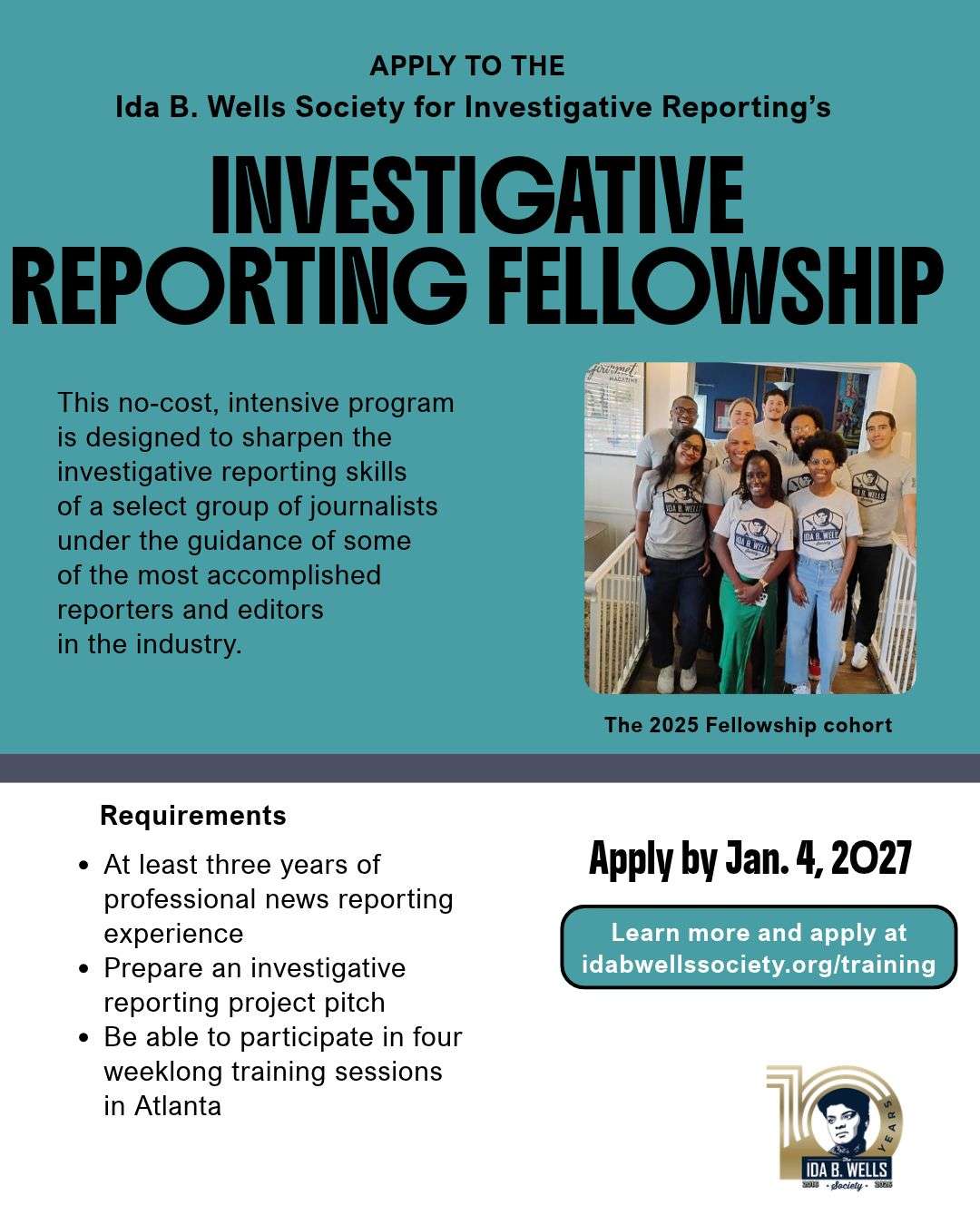
The Ida B. Wells Society for Investigative Reporting has officially opened applications for its 2027 Investigative Reporting Fellowship, offering an exciting professional development opportunity for experienced journalists who want to strengthen their investigative reporting skills, develop impactful journalism projects, and receive expert guidance from some of the most accomplished reporters and editors in the industry.
Returning for its third year, the fellowship is a no-cost, intensive professional training programme designed to equip journalists with the knowledge, practical skills, and investigative techniques necessary to produce high-quality, in-depth journalism. The programme will bring selected journalists to Atlanta, Georgia, for a series of in-person training sessions between March and October 2027.
Unlike conventional journalism training programmes that focus primarily on theoretical instruction, the Ida B. Wells Society Investigative Reporting Fellowship combines intensive professional development with practical project development. Participants will work on investigative reporting projects they have proposed for publication in their respective newsrooms, allowing them to apply the knowledge and skills acquired during training to real journalistic assignments.
The fellowship is particularly intended for journalists who are not currently assigned to investigative reporting teams but are interested in developing their investigative journalism capabilities. Freelance journalists are also encouraged to apply, provided they can secure the necessary support and publication commitment from a news organisation.
With applications now open, eligible journalists with at least three years of professional reporting experience are encouraged to take advantage of this opportunity to advance their careers, expand their investigative reporting expertise, and contribute to meaningful journalism.
The Ida B. Wells Society for Investigative Reporting is an organisation dedicated to strengthening investigative journalism through professional training, career development, membership services, networking opportunities, and other forms of support for journalists.
The Society’s work is centred on helping journalists develop the skills and resources necessary to investigate important issues, hold powerful institutions accountable, and produce journalism that serves the public interest.
Through its various initiatives, the organisation provides opportunities for journalists to improve their reporting abilities, access professional development programmes, connect with experienced industry professionals, and explore career opportunities within the journalism sector.
Its activities include investigative reporting training, fellowship programmes, internship opportunities, on-site professional development, membership services, job and grant opportunities, and other initiatives designed to support the journalism profession.
The organisation also provides opportunities for students and emerging journalists through initiatives such as the Howard University Chapter, alongside its broader efforts to strengthen investigative reporting.
Among its major professional development initiatives is the Ida B. Wells Society Investigative Reporting Fellowship, which is returning in 2027 for its third year.
What Is the Ida B. Wells Society 2027 Investigative Reporting Fellowship?
The Ida B. Wells Society Investigative Reporting Fellowship is an intensive, no-cost professional training programme designed for experienced journalists who want to develop stronger investigative reporting skills and produce meaningful investigative journalism.
For its 2027 edition, the fellowship will bring selected journalists to Atlanta for four weeklong in-person training sessions scheduled at approximately 10-week intervals between March and October 2027.
Throughout the programme, participants will receive instruction and guidance from accomplished journalists, investigative reporters, and editors with substantial experience in the industry.
The training will cover essential areas of investigative journalism, including developing an investigative mindset, using data to strengthen reporting, understanding investigative processes, conducting effective interviews, and writing compelling investigative stories.
An important feature of the programme is its practical approach. Rather than limiting participants to classroom learning, the fellowship requires them to work on proposed investigative projects intended for publication in their respective newsrooms.
This means participants will have the opportunity to develop their own investigative story ideas, receive professional guidance, improve their reporting techniques, and work towards producing publishable investigative journalism.
The fellowship is therefore an opportunity for journalists to combine professional training with the development of real-world reporting projects.
Who Should Apply for the 2027 Investigative Reporting Fellowship?
The fellowship is specifically designed for professional journalists who want to strengthen their investigative reporting capabilities but are not currently assigned to investigative reporting teams.
Journalists who regularly work in general news reporting, feature writing, broadcast journalism, digital journalism, multimedia journalism, or other areas of professional news reporting may find the programme particularly beneficial if they want to transition into or expand their work in investigative journalism.
The programme also welcomes freelance journalists who meet the eligibility requirements and can demonstrate that a news organisation is willing to support their participation and publish the investigative work they produce.
Applicants with at least three years of professional journalism experience are encouraged to apply.
The programme may be particularly suitable for:
- Professional journalists seeking to develop specialised investigative reporting skills.
- Reporters who are not currently working on dedicated investigative journalism teams.
- Print journalists interested in producing more detailed and evidence-based investigative stories.
- Broadcast journalists looking to strengthen their investigative reporting techniques.
- Digital journalists interested in data-driven investigations and multimedia storytelling.
- Multimedia journalists seeking to develop their capacity to investigate complex issues.
- Freelance journalists who have secured the support of a news organisation willing to publish their investigative work.
- Experienced reporters interested in receiving mentorship and professional guidance from accomplished investigative journalists and editors.
Applicants should understand that the fellowship is not designed exclusively for journalists who already specialise in investigative reporting. In fact, one of its central objectives is to help professional journalists develop the skills and confidence needed to undertake more ambitious investigative projects.
Key Training Areas Covered by the Fellowship
Selected fellows will participate in an intensive training programme covering several important aspects of investigative journalism.
The training sessions will focus on four major areas:
1. The Investigative Reporting Mindset
Developing an investigative reporting mindset is fundamental to producing impactful journalism.
Investigative journalism requires reporters to approach stories with curiosity, persistence, critical thinking, and a commitment to uncovering information that may not be immediately visible or accessible to the public.
During this training, participants will explore the principles and approaches that distinguish investigative reporting from routine news coverage.
They will develop a stronger understanding of how to identify potential investigative stories, recognise unanswered questions, examine inconsistencies, and pursue information that could reveal deeper issues.
The training will also help participants understand the importance of accuracy, evidence, accountability, ethical reporting, and persistence when investigating complex subjects.
A strong investigative mindset enables journalists to move beyond reporting what happened and begin examining why it happened, how it happened, who was involved, and what the consequences may be.
2. Data Journalism
Data journalism is an increasingly important component of modern investigative reporting.
Large amounts of information are generated by governments, public institutions, businesses, organisations, and other entities. Journalists who can effectively analyse and interpret this information are better positioned to uncover patterns, identify irregularities, and explain complicated issues to the public.
The fellowship will introduce participants to data journalism as an essential investigative reporting skill.
Through this training area, journalists will strengthen their understanding of how data can support investigative projects, provide evidence for reporting, and help reveal information that may otherwise remain unnoticed.
Data journalism can be particularly valuable when investigating public spending, government activities, institutional performance, social issues, economic developments, and other subjects involving large quantities of information.
The ability to work with data also helps journalists produce more accurate, credible, and evidence-based investigative stories.
3. Process and Development
Successful investigative journalism requires careful planning, structured research, and a clear understanding of how an investigation should develop from an initial idea into a completed publication.
The fellowship will cover process and development, helping participants understand the different stages involved in developing investigative reporting projects.
This includes identifying a viable investigative subject, refining the central questions, planning the reporting process, gathering relevant information, organising findings, and developing the story into a publishable piece of journalism.
Participants will also work on projects they have proposed for publication in their respective newsrooms.
This practical component is important because investigative journalism often involves complicated subjects that require considerable time, research, verification, and editorial coordination.
By understanding the investigative process, journalists can become more organised, efficient, and strategic when working on detailed reporting assignments.
4. Interviewing and Writing for Investigations
Interviewing and writing are essential skills for journalists who want to produce strong investigative stories.
Investigative interviews often require more than asking basic questions and recording responses. Journalists must know how to prepare thoroughly, identify the right sources, ask relevant questions, follow up on important information, and assess the credibility of the answers they receive.
The fellowship will therefore cover interviewing and writing techniques specifically related to investigative journalism.
Participants will have the opportunity to strengthen their ability to conduct interviews, gather important information, develop compelling narratives, and communicate complex findings clearly.
Investigative writing also requires journalists to organise large amounts of information into stories that are accurate, understandable, engaging, and supported by credible evidence.
Through this training, fellows will develop a better understanding of how to transform extensive research and reporting into effective investigative publications.
In-Person Training Schedule and Location
The 2027 Ida B. Wells Society Investigative Reporting Fellowship will be conducted through in-person training sessions in Atlanta, Georgia, United States.
Selected journalists will be expected to attend four weeklong training sessions spread throughout the year, from March through October 2027.
The training sessions will take place approximately every 10 weeks.
Although the programme is described as four weeklong training courses, applicants should carefully consider the overall time commitment before submitting their applications.
The fellowship involves approximately:
- Four separate training sessions: Participants must attend all four in-person training weeks.
- Approximately 16 days of instruction: The programme provides around 16 days of formal training.
- Approximately 24 days including travel: Participants should account for the additional time required to travel to and from Atlanta.
- Sunday arrivals: Participants will generally be expected to arrive in Atlanta on Sundays before the training week begins.
- Friday or Saturday departures: Participants will generally depart Atlanta on Fridays or Saturdays after completing their training commitments.
The training weeks will be distributed throughout the year rather than conducted consecutively.
Consequently, applicants must ensure that they can make the necessary arrangements to attend all four sessions without conflicting with their professional responsibilities.
Important Requirements for Participating Journalists
The Ida B. Wells Society has established specific requirements for journalists interested in joining the 2027 fellowship.
Applicants must satisfy the professional experience, geographical, documentation, and participation requirements outlined below.
1. Minimum of Three Years of Professional Journalism Experience
Applicants must have at least three years of professional news reporting experience.
This requirement is intended to ensure that participants have an established foundation in journalism and understand the responsibilities associated with professional reporting.
The fellowship is designed to help experienced journalists advance their investigative reporting skills rather than serve as an introductory journalism programme for individuals without professional reporting experience.
2. Applicants Must Be Based in the United States
The programme is open to journalists working in the United States.
Eligible applicants may come from different areas of the journalism industry, including:
- Print journalism.
- Broadcast journalism.
- Digital journalism.
- Multimedia journalism.
Applicants should ensure that their professional reporting work falls within the programme’s stated eligibility requirements.
3. Submission of a Professional Resume
Applicants must provide a resume outlining their professional journalism experience.
The resume should demonstrate the applicant’s background in news reporting and provide relevant information about their professional career.
It should clearly communicate their experience, previous roles, reporting responsibilities, and other relevant qualifications.
4. Examples of Previous Written Work
Applicants are required to submit examples of their previous written work.
These samples will help demonstrate their journalistic abilities, reporting experience, writing skills, and capacity to produce professional news content.
Applicants should select work samples that accurately reflect their experience and demonstrate their ability to research, report, and communicate information effectively.
5. Submission of an Investigative Project Pitch
A project pitch is another important part of the application.
Applicants must propose an investigative reporting project that they intend to develop during the fellowship.
The proposed project should be suitable for further investigation and publication through the applicant’s respective newsroom or supporting news organisation.
Because participants will work on their proposed projects throughout the programme, applicants should give careful consideration to the subject they intend to investigate.
They should also ensure that their proposed projects have been discussed with their newsroom leadership and that the necessary publication arrangements are in place.
6. Availability for Phone Interviews
Applicants must be available for phone interviews if requested during the selection process.
This means submitting an application does not automatically guarantee selection.
The Society may request additional discussions with applicants as part of its evaluation and selection procedures.
Applicants should therefore remain reachable and prepared to discuss their professional experience, investigative interests, and proposed projects.
7. Ability to Attend All Four Training Sessions
Applicants must be able to participate in all four weeklong in-person training sessions in Atlanta.
This is a significant requirement because the fellowship is structured around multiple training sessions distributed throughout 2027.
Applicants must be prepared to commit approximately 16 days to formal instruction and approximately 24 days when travel time is included.
Before applying, journalists should carefully review their professional schedules and confirm that they can attend every required training session.
8. Employer Support and Publication Commitment
Applicants must provide letters from their employers confirming that they will be permitted to participate in the fellowship.
The letters must also demonstrate that the employer supports the applicant’s proposed investigative work and agrees to publish the project upon completion.
This requirement is particularly important because the fellowship is designed to produce practical investigative journalism projects rather than simply provide theoretical training.
Journalists should therefore obtain the necessary approval from their newsroom leadership before submitting their applications.
Requirements for Applicants’ Employers and News Organisations
One of the most important aspects of the Ida B. Wells Society Investigative Reporting Fellowship is the role played by participating journalists’ employers.
The programme recognises that journalists need institutional support to participate fully in professional development activities while continuing to meet their reporting responsibilities.
For this reason, employers must agree to several conditions before their journalists can participate.
1. Continue Paying Participants Their Salaries
Employers must allow selected journalists to continue earning their regular salaries while participating in the fellowship’s training sessions in Atlanta.
Participants should not be required to use their accrued annual leave or vacation days to attend the programme.
This arrangement is intended to make it possible for journalists to participate in the training without sacrificing their regular earnings or exhausting their available vacation time.
Since the fellowship involves four separate weeklong training sessions throughout the year, employers must be prepared to accommodate these absences as part of the journalist’s professional development.
2. Provide Professional Support and Guidance
Employers are also expected to provide support and guidance to participating journalists as they undertake the fellowship.
This includes helping them develop their proposed investigative projects and supporting their work as they apply the skills and knowledge acquired during training.
Newsroom leadership should be prepared to provide the necessary editorial direction and professional assistance throughout the investigative reporting process.
Such support is important because investigative projects can involve complicated research, extensive reporting, and sustained editorial collaboration.
3. Agree to Publish the Completed Investigative Project
Another major employer requirement is a commitment to publish the investigative project developed by the journalist during the fellowship.
The programme is designed to help participants produce investigative journalism that can reach audiences through their respective news organisations.
Therefore, the employer must agree to publish the journalist’s project once it has been completed, subject to the necessary professional editorial processes.
This publication commitment ensures that the fellowship has a practical outcome and that participants can apply their training to journalism intended for public consumption.
Can Freelance Journalists Apply?
Yes. Freelance journalists are explicitly invited to apply for the 2027 Ida B. Wells Society Investigative Reporting Fellowship.
However, freelance applicants must meet the same fundamental eligibility requirements as other applicants, including having at least three years of professional news reporting experience.
Since freelancers may not have a permanent newsroom employer, the Society requires them to secure support from a news organisation willing to provide a supportive statement and agree to publish their investigative work.
This means freelance journalists should identify a suitable publication or news organisation before applying.
The supporting organisation must demonstrate its willingness to support the journalist’s participation and publish the investigative project developed during the fellowship.
Freelancers should therefore ensure that they have established the necessary professional arrangements before submitting their applications.
Why Journalists Should Consider Applying for the Fellowship
The Ida B. Wells Society Investigative Reporting Fellowship offers several important professional development opportunities for journalists who want to strengthen their investigative reporting careers.
Beyond the formal training sessions, the programme provides an opportunity to develop practical reporting skills, work on an original investigative project, and receive guidance from experienced industry professionals.
Some of the major benefits include:
1. Advanced Investigative Journalism Training
Participants will receive intensive instruction in key areas of investigative reporting.
The programme covers the investigative mindset, data journalism, investigative project development, interviewing, and writing.
These are essential skills for journalists who want to move beyond routine reporting and produce more detailed, evidence-based stories.
2. Guidance From Experienced Journalists and Editors
The fellowship will be conducted under the guidance of some of the most accomplished reporters and editors in the journalism industry.
This provides participants with an opportunity to learn from professionals who have substantial experience in investigative reporting.
Their guidance can help fellows strengthen their approach to research, reporting, storytelling, and investigative project development.
3. Opportunity to Develop an Original Investigative Project
Unlike training programmes that focus entirely on instruction, the fellowship requires participants to work on investigative projects they have proposed for publication.
This creates an opportunity to apply the skills acquired during training to a real reporting assignment.
Participants can develop their ideas, strengthen their research, receive guidance, and work towards producing a completed investigative story.
4. Professional Development and Career Advancement
Investigative reporting is an important area of journalism that requires specialised skills and professional experience.
By participating in the fellowship, journalists can expand their professional capabilities and develop skills that may help them pursue more advanced reporting opportunities.
The programme may also help participants become more confident when handling complex stories, working with data, interviewing sources, and developing long-form investigations.
5. Practical Application of New Reporting Skills
The fellowship’s project-based structure allows journalists to put their training into practice.
Instead of simply learning investigative reporting concepts, participants will work towards applying those concepts to an actual investigative project.
This approach can help journalists develop a more practical understanding of the investigative process and its professional demands.
6. Opportunity for Freelance Journalists
The programme’s inclusion of freelance journalists is particularly important.
Freelancers who meet the eligibility criteria and obtain the necessary publication support can access the same professional development opportunity.
This provides an additional pathway for independent journalists to strengthen their investigative reporting skills and develop projects for publication.
Important Application Documents and Preparation
Journalists interested in applying should begin preparing the necessary documents and securing newsroom approval before the application deadline.
Based on the stated eligibility requirements, applicants should prepare the following:
- Professional resume: A document demonstrating at least three years of professional news reporting experience.
- Previous written work samples: Examples of previously published or completed journalistic work that demonstrate reporting and writing abilities.
- Investigative project pitch: A proposal outlining the investigative project the applicant intends to develop during the fellowship.
- Employer support letter: A letter confirming permission to participate in the fellowship and the employer’s commitment to supporting the journalist.
- Publication commitment: Confirmation that the employer or supporting news organisation agrees to publish the investigative work developed during the programme.
- Availability for phone interviews: Applicants must be prepared to participate in phone interviews if requested by the Society.
Freelance journalists should pay particular attention to securing a supportive statement and publication agreement from a news organisation.
Applicants should also discuss the programme’s training schedule with their newsroom leadership to avoid potential scheduling conflicts.
Because four separate weeklong sessions are required, receiving approval for only some of the training dates may not satisfy the programme’s participation requirements.
Application Deadline for the 2027 Ida B. Wells Society Investigative Reporting Fellowship
The Ida B. Wells Society has announced that applications for the 2027 Investigative Reporting Fellowship will close on:
Monday, January 4, 2027, at 11:59 p.m. Eastern Time (ET).
Applicants are strongly encouraged to begin preparing their resumes, previous work samples, investigative project pitches, and employer support letters well ahead of the deadline.
Waiting until the final hours may create unnecessary difficulties, particularly for journalists who need to obtain formal approval and publication commitments from their employers.
Since the programme requires significant newsroom involvement, securing employer support should be treated as an essential part of the preparation process rather than something to arrange at the last minute.
Applications submitted after the stated deadline may not be considered under the announced application schedule.
Key Information About the Ida B. Wells Society 2027 Fellowship at a Glance
For journalists seeking a quick overview of the programme’s most important details, the following information summarises the announced fellowship requirements and schedule.
- Programme: Ida B. Wells Society Investigative Reporting Fellowship.
- Edition: 2027, marking the third year of the fellowship.
- Organiser: Ida B. Wells Society for Investigative Reporting.
- Programme type: No-cost, intensive investigative journalism training and professional development.
- Location: Atlanta, Georgia, United States.
- Training period: March through October 2027.
- Training frequency: Four weeklong in-person training sessions, approximately every 10 weeks.
- Instructional commitment: Approximately 16 days of training.
- Total estimated commitment: Approximately 24 days, including travel.
- Target applicants: Professional journalists not currently assigned to investigative teams.
- Freelance applicants: Eligible, provided they secure the required supporting statement and publication agreement.
- Minimum experience: Three years of professional news reporting.
- Eligible journalism fields: Print, broadcast, digital, and multimedia journalism.
- Main training topics: Investigative reporting mindset, data journalism, process and development, interviewing, and writing for investigations.
- Required application materials: Resume, previous written work samples, investigative project pitch, and employer support documentation.
- Employer requirements: Continued salary payments during training, professional support, and a commitment to publish the completed investigative project.
- Application deadline: Monday, January 4, 2027, at 11:59 p.m. ET.
About the Ida B. Wells Society’s Other Journalism Programmes and Opportunities
The 2027 Investigative Reporting Fellowship is part of the Ida B. Wells Society’s wider commitment to strengthening journalism through professional development and support services.
The organisation provides several initiatives aimed at journalists at different stages of their careers.
Its programmes and services include:
The Ida B. Wells Society Summer Investigative Reporting Internship Program
The Society’s Summer Investigative Reporting Internship Program is one of its initiatives focused on investigative journalism development.
Internship opportunities can provide aspiring journalists with exposure to professional reporting environments and the investigative journalism process.
The Ida B. Wells Society Investigative Reporting Fellowship Program
The investigative reporting fellowship provides experienced journalists with intensive professional training and opportunities to develop investigative projects.
The 2027 edition is the programme’s third year.
On-Site Training
The Society also offers on-site training as part of its broader professional development activities.
These training opportunities contribute to its objective of strengthening investigative reporting skills and improving the quality of journalism.
Membership Services
The organisation provides membership services for journalists interested in connecting with the Society and accessing its professional network.
Its membership platform includes member sign-up and login services.
Job and Grant Opportunities
The Society also provides information about employment and grant opportunities relevant to journalists.
Its resources include opportunities for employers and journalists seeking financial or professional support for their work.
Events and Society News
Through its events and news platforms, the Society shares information about its activities, programmes, developments, and other matters relevant to investigative journalism.
These initiatives complement its fellowship and training programmes by creating additional opportunities for professional engagement and development.
Contact Information for the Ida B. Wells Society for Investigative Reporting
Journalists who require additional information about the Society and its programmes can use the organisation’s official contact details.
Organisation: Ida B. Wells Society for Investigative Reporting
Department: Journalism in Sports, Culture, and Social Justice Department
Institution: Morehouse College
Email Address: IBWS@morehouse.edu
The Society’s broader activities include its training programmes, membership services, events, news updates, employment opportunities, and other initiatives designed to support investigative journalism.
Visit HERE to learn more about Ida B. Wells Society Investigative Reporting Fellowship 2027
Conclusion: An Important Opportunity for Experienced Journalists to Strengthen Investigative Reporting Skills in 2027
The 2027 Ida B. Wells Society Investigative Reporting Fellowship represents a valuable professional development opportunity for journalists who want to improve their investigative reporting abilities and produce meaningful journalism.
Returning for its third year, the no-cost programme combines intensive in-person instruction, practical project development, and guidance from accomplished reporters and editors. Its focus on investigative thinking, data journalism, reporting processes, interviewing, and investigative writing makes it particularly relevant to professional journalists seeking to expand their reporting capabilities.
The fellowship is especially significant because it welcomes journalists who are not currently assigned to investigative teams, giving experienced reporters an opportunity to strengthen their investigative skills and explore more advanced reporting projects. Freelance journalists are also encouraged to apply, provided they secure the required support and publication commitment from a news organisation.
However, prospective applicants must carefully consider the programme’s requirements. Candidates need at least three years of professional news reporting experience, must submit a resume, previous written work samples, and an investigative project pitch, and must obtain the necessary employer support. They must also be available to attend all four weeklong training sessions in Atlanta between March and October 2027.
Equally important, participating employers must agree to maintain journalists’ salaries during the training sessions without requiring them to use accrued vacation time, provide professional support throughout the programme, and publish the investigative projects developed by participants.
With the application window now open, eligible journalists should begin preparing their application documents, discussing participation with newsroom leadership, and developing strong investigative project proposals.
The application deadline is Monday, January 4, 2027, at 11:59 p.m. Eastern Time (ET).
For experienced journalists interested in advancing their careers, developing stronger investigative reporting skills, and producing impactful journalism, the Ida B. Wells Society 2027 Investigative Reporting Fellowship is an opportunity worth serious consideration.