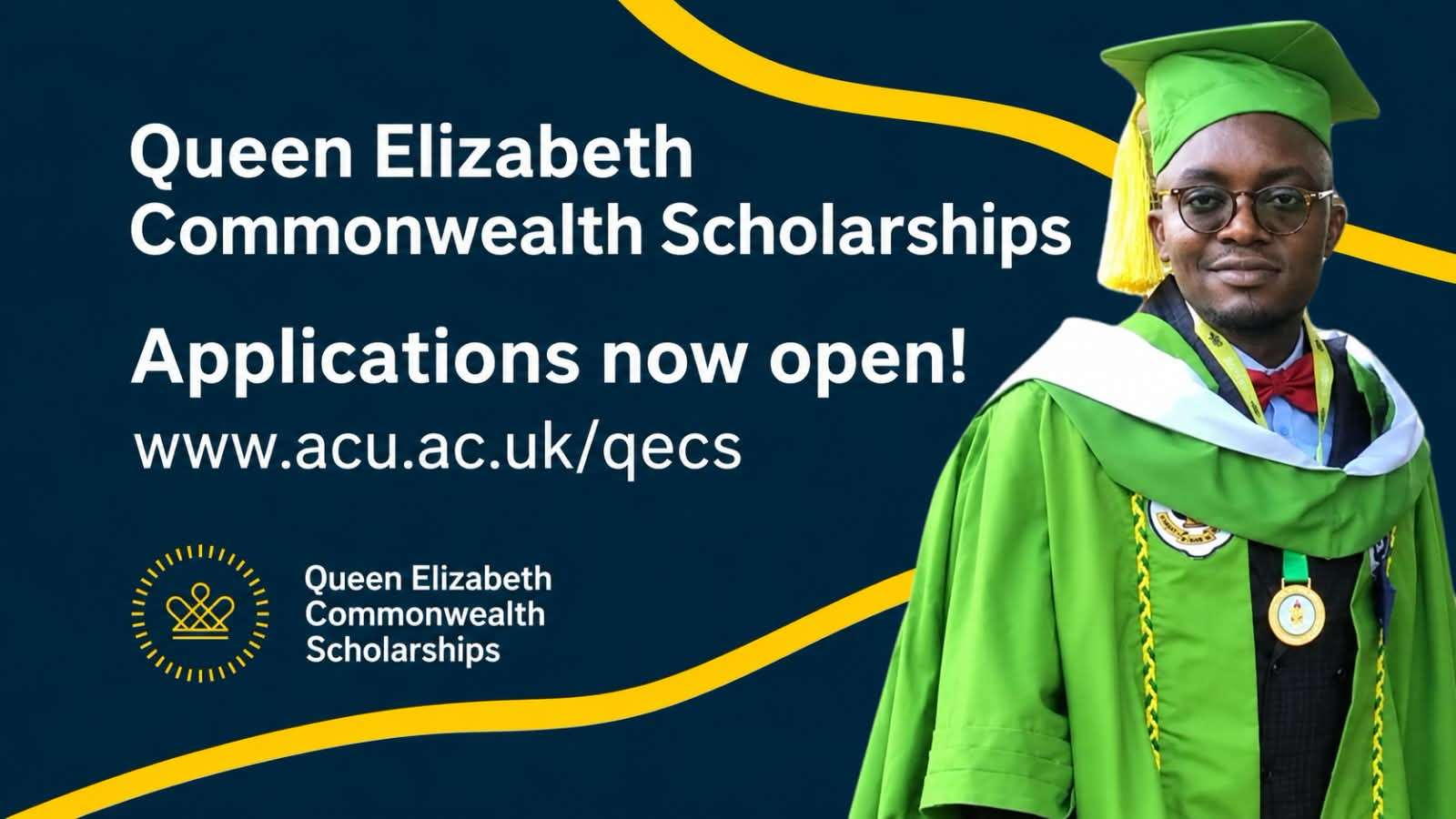
The Queen Elizabeth Commonwealth Scholarships (QECS) 2027 offer an outstanding opportunity for international students to pursue a fully funded two-year master’s degree at selected universities in low- and middle-income Commonwealth countries. These prestigious scholarships are designed for talented graduates who want to develop their academic knowledge, gain international experience, build global connections, and contribute positively to their communities.
Applications for the current QECS application cycle open on 26 November 2026 and close on 13 January 2027 at 15:00 UTC. Successful applicants can receive full tuition fee coverage, a living allowance throughout the scholarship period, return economy-class airfare, a one-time arrival allowance, and a research support grant (subject to approval).
The programme provides an opportunity to study in a different Commonwealth country, experience a new culture, collaborate with international academics, and become part of a worldwide network of scholars and professionals.
This is an especially valuable opportunity for graduates interested in fields such as public health, environmental management, renewable energy, agricultural economics, engineering, food science, biomedical research, and other development-related disciplines.
The Queen Elizabeth Commonwealth Scholarships are an international scholarship programme that supports students pursuing master’s-level education in eligible Commonwealth countries.
The programme is associated with the Association of Commonwealth Universities (ACU), an international university network established in 1913. The ACU connects more than 400 member universities across over 40 Commonwealth countries, promoting higher education, research collaboration, academic exchange, and international partnerships.
The QECS programme focuses on students who are committed to creating positive change in their communities. It encourages academic excellence, cultural exchange, international cooperation, and the development of practical solutions to shared global challenges.
Unlike scholarships that focus exclusively on studying in major developed countries, QECS offers students the opportunity to study in low- and middle-income Commonwealth countries and learn from different educational systems, societies, and development experiences.
Key Scholarship Details
-
Scholarship Name: Queen Elizabeth Commonwealth Scholarships (QECS)
-
Scholarship Cycle: 2026–2027 application cycle
-
Degree Level: Master’s Degree
-
Study Duration: Two years
-
Funding Type: Fully Funded
-
Host Institutions: Selected ACU member universities
-
Eligible Destinations: Participating low- and middle-income Commonwealth countries
-
Application Opening Date: 26 November 2026
-
Application Deadline: 13 January 2027
-
Application Method: Online application
-
Organising Network: Association of Commonwealth Universities (ACU)
2. What Are the Queen Elizabeth Commonwealth Scholarships?
The Queen Elizabeth Commonwealth Scholarships provide talented students with the opportunity to complete a two-year master’s degree in a participating Commonwealth country.
The scholarships are intended for individuals who want to use their education, professional knowledge, and international experience to make a meaningful contribution to society.
Through the programme, scholars can develop relationships with students, researchers, academics, and professionals from different countries. These connections can support future research, professional development, international collaboration, and community-focused initiatives.
The programme also promotes cultural understanding by allowing scholars to experience life and education in a country different from their own.
QECS scholars are encouraged to become active members of the wider Commonwealth network and contribute to addressing challenges affecting their home countries and host communities.
3. What Does the QECS Scholarship Cover?
The Queen Elizabeth Commonwealth Scholarships provide comprehensive financial support to successful applicants.
The scholarship package includes the following benefits:
3.1 Fully Funded Tuition Fees
Successful scholars receive full coverage of their tuition fees for the eligible master’s programme at their selected host university.
This means students do not have to pay the standard tuition costs for the approved course covered by the scholarship.
3.2 Living Allowance
Recipients receive a living allowance, also known as a stipend, throughout the duration of the scholarship.
This financial support is intended to help scholars manage their living expenses while studying in the host country.
3.3 Return Economy Flights
The scholarship covers return economy-class flights to the host country.
This support helps reduce the financial burden associated with international travel for students relocating to pursue their master’s studies.
3.4 One-Time Arrival Allowance
Successful applicants receive a one-off arrival allowance to help with initial expenses after reaching their host country.
This assistance can be useful when settling into a new environment and beginning university life.
3.5 Research Support Grant
A research support grant may also be available to scholars who need additional financial assistance for research-related activities.
However, this grant is available on request only and is subject to approval. Applicants should not assume that it is automatically included in every scholarship award.
4. Participating Countries and Universities for the 2027 Scholarship Cycle
For this application cycle, the Association of Commonwealth Universities lists participating institutions in eight Commonwealth countries.
Applicants must select an eligible university and one of the specifically listed master’s programmes. Not every course offered by a participating university is eligible for QECS funding.
Below is the detailed list of participating countries, universities, and eligible academic programmes.
4.1 Eswatini – University of Eswatini
Host University: University of Eswatini
The University of Eswatini is offering master’s-level opportunities in agricultural economics, conservation, and environmental resource management.
Eligible courses include:
-
MSc Agricultural and Applied Economics
-
MSc Environmental Resources Management
These programmes may be particularly relevant to graduates interested in agricultural development, environmental conservation, natural resource management, sustainability, and economic development.
Students who want to contribute to sustainable agricultural systems and environmental protection may find these academic pathways especially relevant.
4.2 Ghana – Kwame Nkrumah University of Science and Technology
Host University: Kwame Nkrumah University of Science and Technology (KNUST)
KNUST is offering postgraduate opportunities in public health-related research, food science, and renewable energy technology.
Eligible courses include:
-
MPhil Field Epidemiology and Applied Statistics
-
MPhil Food Science and Technology
-
MPhil Renewable Energy Technologies
Important application requirement:
Applicants applying to KNUST must submit a separate university admission application at the same time as their QECS scholarship application.
Therefore, applicants should prepare both applications and follow the university’s admission instructions carefully.
These programmes offer academic pathways for students interested in epidemiological research, public health data, food technology, food systems, sustainable energy, and scientific innovation.
4.3 Jamaica – The University of the West Indies (Mona Campus)
Host University: The University of the West Indies, Mona Campus
The University of the West Indies is offering several postgraduate opportunities in public health, food technology, and biomedical research.
Eligible courses include:
Master of Public Health programmes:
-
Master of Public Health – Gerontology
-
Master of Public Health – Health Education and Health Promotion
-
Master of Public Health – Health Management
Additional eligible programmes:
-
MSc Food and Agro-Processing Technology (FAPT)
These programmes are suitable for graduates interested in public health systems, healthcare management, health education, ageing populations, food processing, biomedical research, and improving healthcare outcomes.
The different public health specialisations allow applicants to select an academic direction that aligns with their previous education and professional interests.
4.4 Kenya – Technical University of Kenya
Host University: Technical University of Kenya
The Technical University of Kenya is offering master’s-level opportunities in engineering technology, design, interactive media, and physics.
Eligible courses include:
-
MTech Mechanical Engineering Technology
-
MTech Design and Interactive Media
These programmes may be particularly relevant to graduates interested in engineering innovation, mechanical systems, creative technology, digital design, interactive media, and scientific research.
Applicants should check the university’s course requirements to ensure that their previous academic qualifications meet the admission criteria.
4.5 Lesotho – National University of Lesotho
Host University: National University of Lesotho
The National University of Lesotho is offering two master’s programmes connected to water resource management and sustainable energy.
Eligible courses include:
-
MSc Integrated Catchment and Water Resources Management
These academic programmes are relevant to individuals interested in environmental sustainability, water resource planning, renewable energy, climate-related challenges, and sustainable development.
Graduates seeking careers in environmental research, energy development, and natural resource management may find these courses particularly valuable.
4.6 Sri Lanka – University of Kelaniya
Host University: University of Kelaniya
The University of Kelaniya is offering postgraduate opportunities in health economics and medical statistics.
Eligible courses include:
-
Master of Health Economics
-
Master of Medical Statistics
These programmes are relevant to graduates interested in healthcare financing, health policy, medical data analysis, statistical research, healthcare planning, and evidence-based decision-making.
Health economics and medical statistics are important disciplines for improving healthcare systems and supporting effective public health policies.
4.7 Uganda – Makerere University
Host University: Makerere University
Makerere University is offering the following eligible programme:
1. MSc Renewable Energy
Important application requirement:
Applicants must submit a university admission application at the same time as their QECS scholarship application.
This requirement means applicants should not complete only the scholarship application. They must also follow Makerere University’s separate admission procedure for their selected programme.
The MSc Renewable Energy programme is relevant to graduates interested in renewable energy systems, sustainable electricity generation, energy access, environmental protection, and technological solutions to energy challenges.
5. Eligibility Criteria for Queen Elizabeth Commonwealth Scholarships 2027
Applicants should carefully review the eligibility requirements before starting their applications.
Academic Qualification
Applicants must have attained a minimum of a 2:1 undergraduate degree or equivalent.
This means candidates should hold an undergraduate qualification that meets the required academic standard.
Applicants with qualifications from different educational systems should check how their degree classification compares with the university’s admission requirements.
Eligible Degree Level
The scholarship is intended for students pursuing a master’s degree.
Applicants should therefore select an eligible postgraduate programme from the official list of participating universities.
Eligible University and Course
Applicants must choose a participating university and one of the courses specifically listed for the current QECS application cycle.
Choosing a university that participates in the programme does not automatically make every course at that university eligible.
Commitment to Positive Change
QECS is aimed at students who are committed to creating positive change in their communities.
Applicants should be prepared to explain how their academic ambitions, professional experience, research interests, and future plans can contribute to addressing challenges in their communities.
Separate University Admission
Some universities require applicants to submit a separate admission application alongside their QECS scholarship application.
For this cycle, the supplied scholarship information specifically identifies this requirement for:
-
Kwame Nkrumah University of Science and Technology, Ghana.
-
Makerere University, Uganda.
Applicants should carefully check the relevant university’s admission instructions before submitting their applications.
6. Which Countries Can Apply for the Queen Elizabeth Commonwealth Scholarships?
The QECS programme is intended for students from eligible Commonwealth countries.
However, applicants should understand that the participating host countries and eligible applicant nationalities are two different things.
The countries listed in this scholarship cycle identify where students can study. They do not, by themselves, establish the complete list of eligible applicant nationalities.
Applicants must consult the official QECS eligibility guidance and confirm that their nationality meets the requirements for the selected scholarship destination.
Important information for Pakistani applicants:
Pakistan is a Commonwealth member country. However, Pakistani applicants should not assume eligibility for every participating university or destination without checking the official country and nationality eligibility requirements for this specific cycle.
The same advice applies to applicants from other Commonwealth countries.
7. How to Apply for Queen Elizabeth Commonwealth Scholarships 2027
The application process involves selecting an eligible course, checking the university’s admission requirements, creating an account if necessary, and submitting the scholarship application.
Follow these steps to apply.
Step 1: Explore Participating Countries and Universities
Start by reviewing the participating countries and universities listed for the current QECS application cycle.
Carefully examine the eligible master’s programmes offered by each institution.
Make a shortlist of courses that match your undergraduate education, academic background, and future career goals.
Step 2: Select an Eligible Master’s Programme
Choose your preferred university and course from the official list.
Remember that only the courses specifically listed for scholarship funding are eligible.
Before selecting a programme, review the university’s official course page to understand:
-
Required supporting documents.
-
Additional application procedures.
Step 3: Review University Admission Requirements
Visit the website of your selected university and read the admission instructions for your chosen master’s programme.
Check whether the institution requires a separate admission application alongside the QECS application.
Applicants selecting KNUST in Ghana or Makerere University in Uganda should pay particular attention to the simultaneous university application requirement.
Step 4: Create a myACU Account
Visit the official QECS application page and select the relevant Apply Now option.
You will be directed to a login page.
If you already have a myACU account, log in using your existing credentials.
If you do not have an account, create a new myACU account to begin the application process.
Step 5: Complete the QECS Application Form
Fill in the required information accurately.
Make sure your personal details, educational background, selected university, and chosen programme are correct.
Read each question carefully and provide complete information according to the application instructions.
Step 6: Submit Your University Admission Application
If your selected university requires a separate admission application, complete and submit it according to the institution’s instructions.
Do not assume that submitting the QECS scholarship application automatically completes the university admission process.
Step 7: Review and Submit Your Application
Before submitting your application, review all the information you have provided.
Check that:
-
Your selected university participates in the current scholarship cycle.
-
Your chosen course is included in the eligible programme list.
-
Your academic qualifications meet the minimum requirements.
-
You have followed the university’s admission instructions.
-
All required application sections have been completed.
-
Your application is submitted before the official deadline.
Submit your application through the official QECS application portal.
8. Important Documents and Preparation Before Applying
Applicants should consult the official application guidance and FAQs to identify the exact documents and information required for their applications.
Although the requirements may vary according to the university and programme, applicants should prepare their academic and personal information in advance.
Useful preparation may include:
-
Undergraduate degree certificate.
-
Details of previous educational institutions.
-
Information about the selected master’s programme.
-
Personal and academic background.
-
Relevant research or professional experience, where applicable.
-
Supporting information requested by the application form.
-
Any additional documents required by the host university.
Applicants should not rely on a general document checklist alone. The official QECS application guidance and the selected university’s admission instructions should be treated as the final authority.
9. Why Should Students Apply for QECS 2027?
The Queen Elizabeth Commonwealth Scholarships provide more than financial assistance for postgraduate education.
They offer students the opportunity to develop academically, professionally, and personally through international education.
Some of the major advantages include:
International Academic Experience
Students can complete their master’s degrees at selected universities in different Commonwealth countries and experience alternative academic environments.
Financial Support
Full tuition fee coverage, a living allowance, return economy flights, and an arrival allowance help reduce the financial barriers associated with international postgraduate education.
International Networking
Scholars can connect with academics, researchers, professionals, and fellow students from different countries.
These relationships may create opportunities for future research partnerships and professional collaboration.
Cultural Exchange
Living and studying in a different Commonwealth country provides an opportunity to experience another culture, understand different perspectives, and develop international awareness.
Research and Innovation
The programme supports academic collaboration and encourages scholars to contribute to solutions for shared development challenges.
Community Development
QECS places importance on creating positive change. Scholars are encouraged to use their education and experiences to benefit their communities and contribute to their countries’ development.
10. Important Application Dates and Deadline
Applicants should carefully note the official application dates for this scholarship cycle.
| Application information | Details |
|---|---|
| Applications open | 26 November 2026 |
| Application deadline | 13 January 2027 |
| Closing time | 15:00 UTC |
| Study level | Master’s |
| Programme duration | Two years |
Final deadline: 13 January 2027 at 15:00 UTC.
Applicants are strongly encouraged to begin preparing their applications well before the deadline.
Do not wait until the final day, particularly if you need to complete a separate university admission application.
11. Can Applicants Apply More Than Once?
The Queen Elizabeth Commonwealth Scholarships offer two application opportunities each year.
-
Cycle 1 generally opens in November or December.
-
Cycle 2 generally opens in March or April.
Applicants only need to submit one application for their chosen university and course in a particular application cycle.
However, candidates are welcome to apply more than once if they are interested in studying in another eligible country.
This provides flexibility for students who want to explore different participating universities and academic destinations.
Applicants should always check the official information for each cycle because available countries, universities, courses, and application dates may change.
12. About the Association of Commonwealth Universities (ACU)
The Association of Commonwealth Universities is one of the world’s oldest and largest international university networks.
Established in 1913, the organisation provides a platform for universities to exchange knowledge, share ideas, strengthen academic partnerships, and collaborate on higher education challenges.
The ACU has more than 400 member universities across over 40 Commonwealth countries.
Approximately 70% of its members are based in low- and middle-income countries.
Its work covers several important areas, including:
-
Higher education policy and advocacy.
-
International academic mobility.
-
Educational development programmes.
-
International scholarships and funding opportunities.
-
Knowledge exchange and professional collaboration.
Through its projects and programmes, the ACU works to strengthen the capacity of universities and support international cooperation in education and research.
The Queen Elizabeth Commonwealth Scholarships form part of this broader commitment to international academic exchange and educational development.
13. Stories and Achievements of QECS Scholars
The programme has supported scholars working across different academic disciplines and development priorities.
Past scholars have contributed to areas such as healthcare, artificial intelligence, environmental sustainability, energy access, public policy, and education.
Examples highlighted by the ACU include:
-
Yusuf Brima: Advancing artificial intelligence for healthcare and developing human capital in low-resource settings.
-
Hellen Kasila: Empowering women through research on governance and social structures.
-
Candice York: Strengthening indigenous communities and supporting youth climate action in the Caribbean.
-
Bruce Musoni: Promoting environmental and social sustainability in development projects in Rwanda.
-
Andrew Harvey: Preserving languages spoken in the Tanzanian Great Rift Valley.
-
Ajra Mohamed: Supporting e-learning and advocating for social change in Kenya.
These examples demonstrate the different ways scholars can use international education, research, and collaboration to address challenges in their communities.
14. Frequently Asked Questions (FAQs)
Is the Queen Elizabeth Commonwealth Scholarship fully funded?
Yes. The scholarship covers full tuition fees, provides a living allowance for the duration of the award, covers return economy flights, and includes a one-time arrival allowance. A research support grant may also be available on request, subject to approval.
What degree can I study under QECS 2027?
The scholarship supports eligible two-year master’s degree programmes offered by participating universities.
What is the minimum academic qualification?
Applicants must have attained a minimum undergraduate degree classification of 2:1 or equivalent.
How long does the scholarship last?
The scholarship supports a two-year master’s degree.
When do applications open?
Applications for the current cycle open on 26 November 2026.
What is the last date to apply?
The deadline is 13 January 2027 at 15:00 UTC.
Can Pakistani students apply?
Pakistan is a Commonwealth member country. Pakistani applicants should check the official nationality eligibility requirements and confirm eligibility for their selected host country and programme before applying.
Can I select any course at a participating university?
No. Only the courses specifically listed for the current QECS application cycle are eligible for scholarship funding.
Do I need to apply separately to the university?
Some universities require a separate admission application. For the current cycle, this requirement is specifically highlighted for KNUST in Ghana and Makerere University in Uganda.
Can I apply for more than one country?
The programme allows applicants to apply more than once if they are interested in studying in another country. Applicants should follow the application instructions for each relevant opportunity.
Where can I submit my application?
Applications are submitted through the official QECS application portal using a myACU account.
Conclusion
The Queen Elizabeth Commonwealth Scholarships 2027 provide an excellent opportunity for qualified graduates to pursue a fully funded two-year master’s degree at selected universities across eight Commonwealth countries.
With full tuition fee coverage, a living allowance, return economy flights, a one-time arrival allowance, and potential research support, the programme can help talented students access international postgraduate education without carrying the full financial burden themselves.
The participating universities offer academic opportunities in several important disciplines, including public health, agricultural economics, environmental management, renewable energy, engineering, food science, biomedical research, and medical statistics.
Students who meet the academic requirements and are interested in international education, research collaboration, and community development should carefully review the available programmes and official eligibility guidance.
Applications are open from 26 November 2026 until 13 January 2027 at 15:00 UTC. Interested candidates should select an eligible course, review the university’s admission requirements, prepare their documents, and submit their applications through the official application portal before the deadline.
The Queen Elizabeth Commonwealth Scholarships are an opportunity not only to earn an internationally recognised master’s qualification but also to become part of a global network committed to education, collaboration, and positive change.
Important Eligibility Clarification
The official ACU FAQs provide additional eligibility details that applicants should know:
-
Nationality: Citizens or individuals holding refugee status in a Commonwealth country may apply.
-
Home-country restriction: Applicants cannot apply for a scholarship hosted in their own country of citizenship.
-
Age limit: There is no age limit, provided applicants meet the other eligibility requirements.
-
Completed degree: Applicants must already have graduated with a minimum 2:1 undergraduate qualification or equivalent. Final-year undergraduate students who have not graduated are not eligible.
-
Study mode: The scholarship is for in-person, on-campus study, not distance learning.
-
Previous admission: Applicants do not necessarily need an admission offer before submitting the QECS application.
-
Application documents: Two references and supporting documents are required. Applicants should follow the official application guidance.
-
AI policy: AI may help applicants express their own ideas, but must not write all or substantial parts of their scholarship application.
For Pakistani applicants, this means they can consider eligible host universities outside Pakistan, provided they meet the remaining requirements.
Official Application and Relevant Links
Application safety: Use only official ACU websites and application systems. Avoid unofficial organisations or websites requesting personal information or supporting documents on behalf of the scholarship programme.