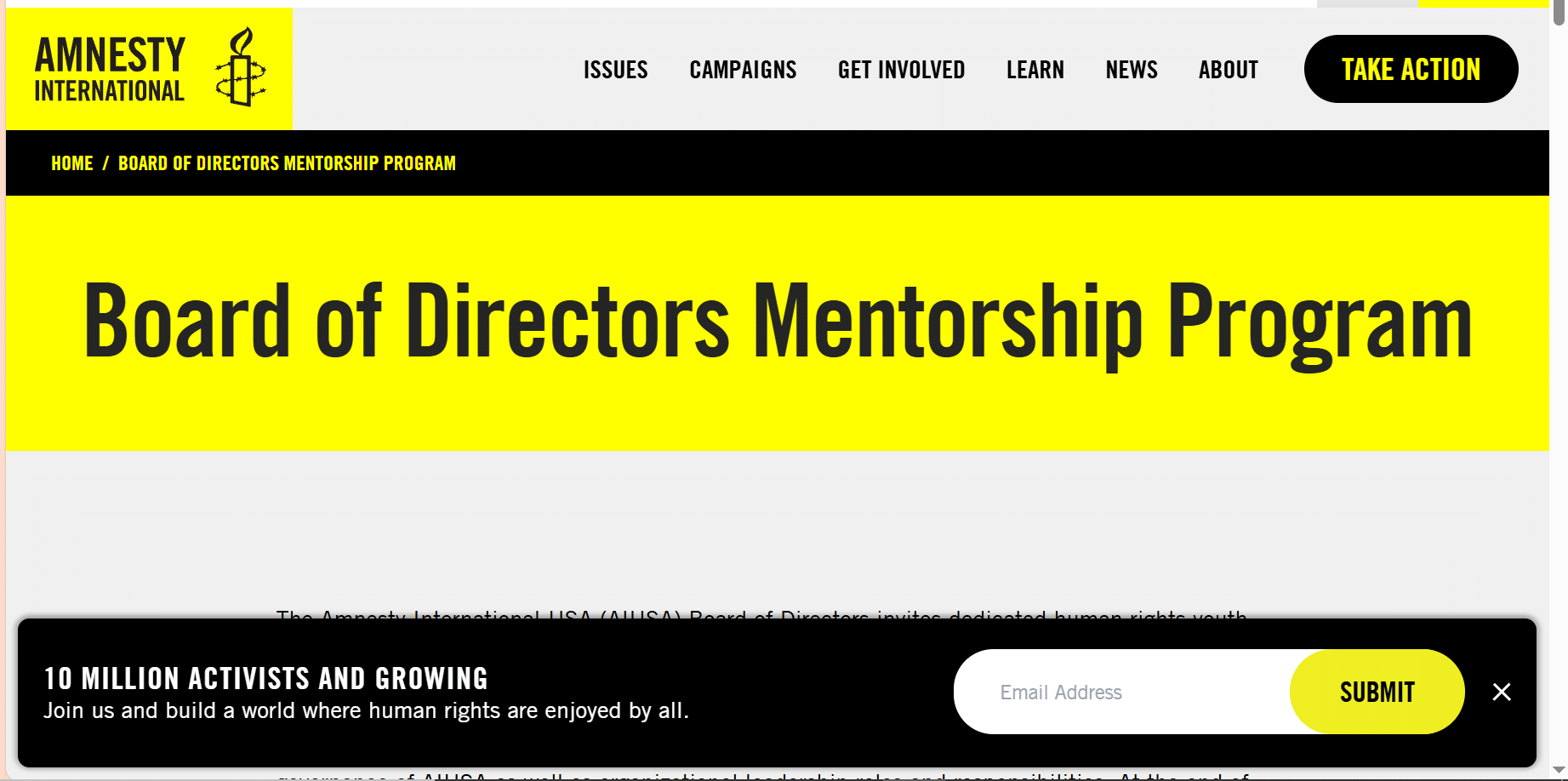
Are you a young human rights activist passionate about social justice, organisational leadership, governance, and making a difference in society? The Amnesty International USA (AIUSA) Board of Directors Mentorship Program 2027 offers an exciting opportunity to learn directly from experienced board members of one of the world’s most recognised human rights organisations.
The programme is designed to bring together up to five young human rights advocates and members of the Amnesty International USA Board of Directors for a unique mentorship and two-way learning experience. Through a series of virtual meetings, in-person gatherings, committee observations, and individual mentorship sessions, participants will gain first-hand exposure to how a major international human rights organisation is governed and managed.
Unlike conventional mentorship programmes that focus primarily on professional development, this initiative introduces young people to the practical responsibilities of nonprofit governance, strategic leadership, organisational decision-making, and board-level accountability. Participants will have the opportunity to understand how board members contribute to organisational direction, oversee institutional responsibilities, and support the advancement of human rights.
The programme also provides an opportunity for young people to engage with Amnesty International USA’s wider governance processes and interact with members of its executive leadership team.
An important feature of the initiative is its potential pathway towards future leadership. At the conclusion of the programme, interested participants may consider applying to run for a position on the Amnesty International USA Board of Directors.
Selected participants will also receive financial support for programme-related travel, with travel expenses covered by Amnesty International USA.
For young people interested in human rights advocacy, international development, nonprofit management, public policy, civil society leadership, and organisational governance, this mentorship programme offers valuable exposure to the internal workings of a major human rights institution.
Amnesty International USA is the United States section of Amnesty International, a global human rights movement committed to protecting and promoting the fundamental rights and freedoms of individuals around the world.
Amnesty International works to address human rights violations, challenge injustice, promote equality, and encourage governments and other powerful institutions to respect their human rights obligations.
Its work covers a broad range of issues, including:
-
Freedom of expression and freedom of peaceful assembly.
-
Protection against torture and other forms of cruel, inhuman, or degrading treatment.
-
Women’s rights and gender equality.
-
Refugee and migrant rights.
-
Racial justice and discrimination.
-
Protection of human rights defenders.
-
Accountability for human rights violations.
-
Economic, social, and cultural rights.
-
Justice and equality for marginalised communities.
Amnesty International USA contributes to this global mission through advocacy, campaigning, research, public education, mobilisation, and engagement with policymakers and communities.
The organisation also recognises that the future of human rights protection depends on developing a new generation of leaders who understand the importance of accountability, inclusion, effective governance, and responsible institutional leadership.
The Board of Directors Mentorship Program is one way of introducing young human rights advocates to these responsibilities and helping them understand how leadership structures support the work of a major nonprofit organisation.
About the Board of Directors Mentorship Program 2027
The Amnesty International USA Board of Directors Mentorship Program 2027 is a youth leadership development initiative organised by the organisation’s Board of Directors.
The programme will bring together up to five interested young people and experienced members of the AIUSA Board of Directors.
Its central objective is to create a two-way learning exchange through which young participants can gain practical knowledge of organisational governance while board members have the opportunity to learn from the perspectives, experiences, and contributions of younger human rights advocates.
The initiative is built around the understanding that young people should not only participate in human rights campaigns but should also have opportunities to understand and contribute to the leadership and governance structures that guide human rights organisations.
Through the programme, participants will gain exposure to:
-
How the Amnesty International USA Board of Directors operates.
-
The responsibilities and expectations of nonprofit board members.
-
Organisational leadership and strategic decision-making.
-
Governance structures and institutional accountability.
-
The work of different board committees.
-
The relationship between board leadership and executive management.
-
The importance of diversity, equity, inclusion, and accessibility in organisational governance.
-
The potential pathway towards future board leadership.
The programme is not simply an opportunity to observe senior leaders. It is structured to encourage active engagement, meaningful interaction, and the exchange of ideas between young advocates and experienced organisational leaders.
It also offers participants an opportunity to explore whether future service on the Amnesty International USA Board of Directors is something they would like to pursue.
Main Objectives of the Mentorship Programme
The programme has several interconnected objectives that focus on developing young people’s leadership capacity while strengthening their understanding of organisational governance.
1. Introducing Young Activists to Nonprofit Governance
One of the primary objectives is to introduce young human rights advocates to the governance responsibilities of Amnesty International USA.
Participants will learn how the Board of Directors contributes to the leadership and administration of the organisation.
This includes understanding:
-
The purpose and responsibilities of a nonprofit Board of Directors.
-
How board members establish organisational priorities.
-
How governance committees operate.
-
How board members contribute to strategic discussions.
-
How organisational policies are developed and implemented.
-
How board members provide oversight and accountability.
This exposure is particularly valuable for young people who want to move beyond grassroots activism and understand how major civil society organisations are led.
2. Building Relationships with Experienced Board Members
The programme will provide opportunities for participants to develop professional relationships with current AIUSA Board members.
Through individual mentorship sessions, committee meetings, and other engagements, participants will interact with experienced leaders who have responsibilities in organisational governance.
These relationships can provide valuable insights into leadership, institutional management, decision-making, and the practical realities of serving on a nonprofit board.
3. Connecting Current, Past, and Future Youth Leaders
Another objective is to strengthen connections between different generations of young leaders within Amnesty International USA.
The programme recognises that youth leadership development should not be an isolated activity.
By connecting previous participants, current mentees, and future youth leaders, the organisation hopes to encourage knowledge-sharing, collaboration, and continued participation in its governance structures.
4. Incorporating Young People’s Perspectives into Organisational Decisions
Young people often have experiences and perspectives that are important to the development of effective human rights programmes.
The mentorship programme provides an opportunity for youth participants to share their perspectives with board members and contribute to existing committee and working-group activities.
This two-way exchange allows experienced leaders to learn from younger activists while helping participants understand how their ideas can contribute to institutional development.
5. Preparing Young People for Future Board Leadership
The programme also seeks to develop a pipeline of future leaders for Amnesty International USA.
At the end of the mentorship experience, participants who develop an interest in organisational governance may consider applying to run for a position on the Board of Directors.
This makes the programme particularly valuable for young people who aspire to combine human rights advocacy with strategic leadership and institutional decision-making.
Who Is Eligible to Apply?
The programme is specifically designed for young human rights advocates and individuals interested in organisational governance.
However, applicants must satisfy specific age requirements to be eligible for the 2027 mentorship programme.
Age Requirements
Applicants must have been born between:
Participants must also be over 18 years old at the beginning of the programme and under 25 before the commencement of the September 2027 Board term.
This means that applicants must fall within the specified birth-date range to qualify.
The age requirements are important because the programme is connected to Amnesty International USA’s youth leadership and designated youth board representation arrangements.
Who Should Apply?
The organisation encourages applications from:
-
Young human rights activists.
-
Youth advocates interested in organisational governance.
-
Young people with an interest in nonprofit leadership.
-
Individuals interested in the management and oversight of civil society organisations.
-
Young leaders interested in human rights policy and institutional accountability.
-
Individuals interested in serving on nonprofit boards in the future.
Applicants do not necessarily need to have previous experience serving on a board. The programme is intended to introduce interested young people to governance and provide opportunities to develop their leadership knowledge.
However, applicants should be able to demonstrate a genuine interest in human rights and explain the skills, experiences, and perspectives they can contribute.
Can Previous Participants Apply?
Yes. Amnesty International USA welcomes applications from previous participants in the mentorship programme.
Current youth applicants to the AIUSA Board are also welcome to apply.
However, the organisation indicates that priority may be given to new participants.
This means previous participation does not automatically disqualify someone, although first-time applicants may receive preference during selection.
Is the Programme Open to International Applicants?
The programme is organised by Amnesty International USA and is centred on its governance structures, Board meetings, and leadership activities in the United States.
The published eligibility information specifies age and human rights engagement requirements but does not clearly state a blanket country-of-residence restriction.
Prospective applicants outside the United States should therefore confirm their eligibility directly with Amnesty International USA, particularly because attendance at the March gathering in Denver is compulsory.
Applicants should not assume that the programme is a fully remote international opportunity.
What Will Selected Participants Gain?
Being selected for the AIUSA Board of Directors Mentorship Program offers several valuable learning, leadership, and networking opportunities.
1. Direct Mentorship from Experienced Board Members
Participants will be assigned mentors from the Amnesty International USA Board of Directors.
These one-on-one mentorship relationships will allow young advocates to learn directly from individuals with experience in organisational leadership and governance.
Through these interactions, participants can gain insights into:
-
Leadership responsibilities.
-
Board-level decision-making.
-
Organisational accountability.
-
Institutional development.
The opportunity to engage directly with experienced board members is one of the programme’s most important benefits.
2. Exposure to Board Meetings and Decision-Making
Participants will attend selected Board meetings and have opportunities to observe and participate in certain sessions.
This experience will help them understand how board members discuss organisational priorities, evaluate institutional issues, and contribute to strategic decisions.
They will also gain exposure to the responsibilities associated with leading a large membership-based human rights organisation.
3. Participation in Board Committees and Working Groups
Participants will have opportunities to attend Board committee or working-group meetings based on their interests and scheduling availability.
The programme allows participants to engage with different aspects of the organisation’s governance work rather than limiting their experience to general board meetings.
4. Networking with Human Rights Leaders
The programme provides opportunities to connect with:
-
Current AIUSA Board members.
-
Other young human rights activists.
-
Amnesty International USA staff.
-
Members of the organisation’s executive team.
-
Participants involved in governance committees and working groups.
These connections can help participants expand their professional networks and develop a better understanding of leadership opportunities within the human rights sector.
5. Exposure to the Amnesty International Human Rights Conference and Annual General Meeting
During the March gathering in Denver, participants will attend the AIUSA Human Rights Conference and Annual General Meeting.
These events provide an opportunity to engage with the wider Amnesty International USA membership and human rights movement.
Participants will also have opportunities to interact with AIUSA staff and members of the Youth-Board Mentorship Working Group.
6. Potential Pathway to Future Board Membership
At the conclusion of the programme, interested participants may consider applying to run for a position on the Amnesty International USA Board of Directors.
This is particularly important for young people who want to develop long-term careers in human rights leadership, nonprofit governance, and civil society management.
7. Travel Expenses Covered by Amnesty International USA
One of the major benefits of the mentorship programme is its travel support.
Amnesty International USA will cover the travel costs associated with the compulsory in-person gathering in Denver, Colorado, from March 10–14, 2027.
The organisation specifically confirms coverage of:
This financial support helps remove some of the practical barriers that might prevent selected young people from participating in the in-person activities.
However, the published programme information does not identify a separate salary, stipend, or cash award for participants. The financial support described is for eligible programme travel expenses.
Programme Structure and Important Activities
The mentorship programme will run through a series of virtual meetings, in-person gatherings, committee engagements, and individual mentorship sessions.
Participants are expected to engage throughout the programme and complete the required activities.
Below is a detailed breakdown of the 2027 programme schedule.
2027 PROGRAMME CALENDAR
1. January 27, 2027 – Virtual Kickoff Meeting
Mandatory
The programme will officially begin with a virtual welcome and introductory meeting scheduled for:
-
Time: 8:00 p.m. Eastern Time.
-
Duration: Approximately 60 minutes.
During this meeting, participants will be introduced to the programme and receive an overview of Amnesty International USA’s governance structure.
The session will provide an opportunity to understand the objectives of the mentorship initiative, become familiar with the programme’s expectations, and begin engaging with other participants and programme representatives.
2. March 10–14, 2027 – In-Person Gathering in Denver, Colorado
Mandatory – In person
The March gathering is one of the most important components of the programme.
Participants will travel to Denver, Colorado, for five days of activities involving the AIUSA Board of Directors, staff members, and other human rights leaders.
Amnesty International USA will cover participants’ flights, accommodation, and food for this gathering.
The activities will include:
Youth participant reflection session
Participants will collectively reflect on Board documents and develop a better understanding of the information and responsibilities involved in organisational governance.
AIUSA Board meeting
Participants will attend a Board meeting as observers and participate in selected sessions.
This will provide first-hand exposure to how board members interact, discuss organisational matters, and carry out their responsibilities.
Networking with Board members
Participants will have opportunities to connect with multiple Board members and learn about their experiences in organisational leadership.
Human Rights Conference and Annual General Meeting
Participants will attend the Amnesty International USA Human Rights Conference and Annual General Meeting.
These events will expose them to wider human rights discussions, organisational activities, and the work of the broader Amnesty movement.
Engagement with AIUSA staff
Participants will also interact with selected staff members and members of the Youth-Board Mentorship Working Group throughout the weekend.
3. March–May 2027 – Committee and Working-Group Engagement
During this period, participants will attend meetings and engage with the committees or working groups they have been assigned to shadow.
The exact time commitment will depend on the activities and schedules of the relevant committees or working groups.
This component is important because it gives participants a closer understanding of how different governance responsibilities are handled within the organisation.
It also allows participants to explore areas of governance that match their interests and professional ambitions.
4. Meeting with a Member of the AIUSA Executive Team
Participants will also have a dedicated meeting with a member of the Amnesty International USA Executive Team.
The meeting will last approximately 45 minutes.
This interaction will provide an opportunity to understand the relationship between executive management and the Board of Directors.
It will also help participants appreciate the different responsibilities of board members and organisational executives in ensuring effective institutional leadership.
5. June 4–6, 2027 – Second Board Meeting
The programme includes another gathering scheduled for June 4–6, 2027.
The location is yet to be determined.
Participants will be expected to attend selected sessions of the Board meeting and engage in the activities specified for them.
Unlike the March gathering, in-person attendance at the June meeting is not compulsory.
Participants may attend the required sessions virtually or choose to travel and participate in person.
However, in-person participation is encouraged, and participants are welcome to attend the full meeting.
The organisation has not yet confirmed the location or final arrangements for this gathering.
6. June 2027 – Programme Feedback and Reflections
Towards the end of the programme, participants will be expected to provide feedback and reflections on their mentorship experience.
This will allow Amnesty International USA to understand what participants learned, assess the effectiveness of the programme, and identify areas that could be improved in future editions.
Time Commitment and Participant Responsibilities
Although this is a mentorship programme rather than a full-time position, participants are expected to dedicate sufficient time to the scheduled activities.
The organisation estimates an approximate commitment of:
-
10 hours of virtual meetings.
-
Five days of in-person activities in Denver, Colorado.
-
Additional time for committee and working-group meetings.
-
Preparation and reading of materials shared before meetings.
-
Participation in selected Board discussions and activities.
-
Programme feedback and reflection at the conclusion.
Participants are expected to:
-
Attend all the scheduled programme meetings.
-
Read documents and materials shared before meetings.
-
Participate in assigned Board committee or working-group activities.
-
Engage constructively in governance discussions.
-
Build relationships with mentors and other programme participants.
-
Provide feedback about the programme at its conclusion.
Participants are also encouraged to attend other Board meetings that are open to AIUSA members whenever their schedules permit.
Applicants should carefully consider their academic, professional, and personal commitments before accepting a place in the programme.
Areas of Board Governance and Committee Interests
As part of the application, candidates will be asked to indicate their preferred areas of Board work.
Applicants must rank their interests in order of preference.
The four available areas are:
1. Audit
The Audit area focuses on financial accountability, institutional oversight, and the processes used to ensure that an organisation operates responsibly.
Applicants interested in financial transparency, organisational controls, accountability, and risk oversight may find this area particularly relevant.
2. Finance
The Finance area concerns the financial management and oversight responsibilities of an organisation.
It provides an opportunity to understand how financial decisions support organisational sustainability and the implementation of strategic priorities.
3. Governance
The Governance area focuses on the structures, policies, responsibilities, and procedures that guide an organisation.
This is particularly relevant to individuals interested in nonprofit management, institutional leadership, accountability, and organisational development.
4. International Governance
International Governance offers exposure to governance-related matters involving the wider international human rights movement.
It may be particularly attractive to applicants interested in international relations, global institutions, international human rights systems, and cross-border organisational leadership.
Applicants should rank the four areas according to their genuine interests and explain how their experiences and ambitions relate to their preferred choices.
The programme notes that committee participation will depend on participants’ interests and scheduling availability.
Application Requirements and Questions
Applicants are required to complete the official online application form and provide personal information and written responses to the programme’s questions.
The application process is designed to assess applicants’ commitment to human rights, leadership potential, personal experiences, and ability to participate in the programme.
The following information is required.
1. Personal Information
Applicants will be required to provide:
-
Pronouns (where applicable).
Applicants will also be asked whether Amnesty International USA can send them text messages.
2. Interest and Commitment to Human Rights – Maximum 300 Words
Applicants must respond to the following question:
Describe your interest in and commitment to human rights.
The response should demonstrate a genuine understanding of human rights and explain why the applicant is interested in contributing to the work of Amnesty International USA.
Applicants may discuss:
-
Their involvement in human rights activities.
-
Their interest in social justice and equality.
-
Experiences that influenced their commitment to human rights.
-
Their participation in community advocacy.
-
Their interest in protecting vulnerable and marginalised populations.
-
Their future ambitions in human rights leadership.
The response must not exceed 300 words.
3. Skills, Talents, and Experiences – Maximum 250 Words
Applicants will be asked:
What skills, talents, or experiences will you bring to the program and how do you hope to grow?
This question is intended to help the selection team understand what each candidate can contribute.
Relevant experiences may include:
-
Leadership and coordination.
-
Research and policy analysis.
-
Communication and interpersonal skills.
-
Organisational administration.
-
Teamwork and collaboration.
-
Experience working with civil society organisations.
Applicants should also explain what they hope to learn from interacting with experienced Board members.
The response must not exceed 250 words.
4. Ranking Preferred Areas of Board Work
Applicants must rank their interests across the following four areas:
-
International Governance.
The application requires applicants to indicate their first, second, third, and fourth choices.
Candidates should select their preferences based on their interests, experience, and future leadership goals.
5. Diversity, Equity, Inclusion, and Accessibility Experience – Maximum 250 Words
Amnesty International USA places significant importance on diversity, inclusion, equity, accessibility, and allyship.
Applicants will therefore be asked:
Have you had any training, personal experiences, or other opportunities that taught you more about inclusion, diversity, equity and accessibility?
The organisation wants to understand whether applicants have developed an awareness of how their identities, experiences, and relationships with other people influence their understanding of inclusion.
Applicants can discuss relevant experiences such as:
-
Participation in diversity and inclusion training.
-
Working with marginalised communities.
-
Community development and human rights programmes.
-
Supporting people with disabilities.
-
Promoting equal opportunities.
-
Addressing discrimination and social exclusion.
-
Working with individuals from different cultural and socioeconomic backgrounds.
-
Personal experiences that strengthened their understanding of equity and accessibility.
The response should be no more than 250 words.
6. Time Commitment and Availability
Applicants must confirm that they can meet the programme’s time requirements.
The application specifies an approximate commitment of 10 hours of virtual meetings and five days of in-person activities in Denver from March 10–14, 2027.
It also recognises that portions of the June 4–6 Board meeting may be attended virtually.
Applicants must indicate whether they agree to the time commitment outlined in the programme description.
7. Balancing the Programme with Other Commitments – Maximum 100 Words
Applicants must answer:
How are you planning to balance your commitment to this program with your other commitments (e.g., academic, personal, professional)?
This question assesses whether candidates have considered the practical demands of the mentorship programme.
Applicants should explain how they intend to organise their schedules and ensure that their participation does not conflict with other important responsibilities.
The response must not exceed 100 words.
8. Travel Commitment
Applicants must confirm that they are willing and able to attend the AIUSA Annual General Meeting and Board meeting in Denver, Colorado, from March 10–14, 2027.
The application also explains that attendance at the June 4–6 gathering is encouraged but not compulsory in person.
Participants who travel for the compulsory March gathering will have their flights, accommodation, and food covered by Amnesty International USA.
9. Optional CV or Resume
Applicants may optionally upload a CV or resume as part of their application.
Important
Submitting a CV is not compulsory. Applications without a resume will receive full consideration.
This means applicants who do not have a professionally prepared CV can still receive equal consideration based on their application responses.
Nevertheless, candidates who have a relevant CV may choose to submit it to provide additional information about their education, volunteer work, leadership experience, and human rights activities.
The maximum permitted file size is 50 MB.
Important Application Instruction: Do Not Use Artificial Intelligence
One of the most important requirements of this application concerns the use of artificial intelligence.
Amnesty International USA explicitly instructs applicants:
Do not use artificial intelligence tools, including ChatGPT and similar platforms, to answer the application questions.
This instruction appears directly in the official application form.
Applicants should therefore prepare their written responses independently and ensure that their answers reflect their genuine experiences, personal perspectives, and motivations.
Although AI tools may be useful for understanding the programme’s requirements, applicants must respect the organisation’s explicit instruction when completing the application.
How Are Applications Evaluated?
Applications will be reviewed by a selection team consisting of:
-
Four members of the Amnesty International USA Board of Directors.
-
Multiple members of the AIUSA staff.
The selection team will assess applications based on the information provided by candidates and their suitability for the mentorship programme.
The application questions indicate that the organisation is particularly interested in understanding:
-
Applicants’ commitment to human rights.
-
Their skills, talents, and relevant experiences.
-
Their interest in organisational governance.
-
Their potential for leadership development.
-
Their understanding of diversity, equity, inclusion, and accessibility.
-
Their ability to meet the programme’s time and travel commitments.
The programme will select up to five young participants.
Applicants will be notified of the selection outcome in January 2027.
The organisation does not publish a guaranteed selection ratio or a fixed scoring system for the application.
Programme Deadline and Important Dates
Applicants should pay close attention to the following dates to avoid missing any important stage of the programme.
APPLICATION DEADLINE
December 14, 2026
11:59 p.m. Eastern Time
| Activity | Date |
|---|---|
| Application deadline | December 14, 2026 |
| Selection announcement | Early January 2027 |
| Virtual kickoff | January 27, 2027 |
| Denver in-person gathering | March 10–14, 2027 |
| Committee engagement | March–May 2027 |
| Second Board meeting | June 4–6, 2027 |
| Final programme reflections | June 2027 |
Deadline: December 14, 2026, at 11:59 p.m. Eastern Time.
Applications submitted after the deadline may not be considered. Interested candidates are encouraged to complete their applications well before the closing date.
Click HERE for more information
How to Apply for the Amnesty International USA Board of Directors Mentorship Program 2027
Interested candidates should complete the official online application form provided by Amnesty International USA.
The application process involves the following steps:
-
Confirm your eligibility: Check that your date of birth falls between September 1, 2002, and January 31, 2009, and that you meet the programme’s age requirements.
-
Review the programme schedule: Ensure that you can participate in the virtual meetings and attend the compulsory March 2027 gathering in Denver.
-
Prepare your personal information: Have your contact details, date of birth, and residential information ready.
-
Reflect on your human rights commitment: Prepare your own response explaining your interest in human rights and your motivation for joining the programme.
-
Identify your relevant skills and experiences: Consider your leadership, advocacy, volunteer, research, and community engagement experiences.
-
Rank your governance interests: Choose your preferred areas from Audit, Finance, Governance, and International Governance.
-
Prepare your inclusion and diversity response: Reflect on your experiences and understanding of diversity, equity, inclusion, and accessibility.
-
Confirm your availability: Ensure that you can meet the required programme commitments.
-
Submit your application: Complete and submit the online form before the deadline.
Remember that Amnesty International USA explicitly prohibits using artificial intelligence to answer the application questions.
Official Application
The application is submitted through the official Amnesty International USA Board of Directors Mentorship Program application page.
Why This Opportunity Is Particularly Valuable for Young Human Rights Advocates
Many young people participate in human rights campaigns, community development programmes, advocacy activities, and civil society initiatives. However, fewer have opportunities to understand how the organisations behind these activities are governed.
This mentorship programme addresses that gap.
It recognises that sustainable human rights movements require not only passionate activists but also individuals who understand organisational leadership, institutional accountability, financial oversight, and strategic decision-making.
For a young person interested in pursuing a career in international development, public administration, human rights, public policy, or nonprofit management, the experience can provide valuable exposure to the leadership responsibilities that shape civil society organisations.
It is also an opportunity to understand the relationship between grassroots activism and institutional governance.
A person may have experience organising community campaigns, educating people about their rights, investigating human rights violations, or working with vulnerable populations. However, understanding how a major organisation establishes policies, manages resources, and provides strategic oversight adds another important dimension to that experience.
The mentorship programme brings these different aspects of leadership together.
Frequently Asked Questions (FAQs)
1. What is the Amnesty International USA Board of Directors Mentorship Program?
It is a youth leadership and mentorship initiative that connects young human rights advocates with members of the Amnesty International USA Board of Directors to help them understand nonprofit governance, leadership, and institutional responsibilities.
2. How many participants will be selected?
The programme will select up to five young participants.
3. What is the age requirement?
Applicants must have been born between September 1, 2002, and January 31, 2009. They must be over 18 at the beginning of the programme and under 25 before the September 2027 Board term begins.
4. Can applicants from outside the United States apply?
The published programme description does not clearly establish a country-of-residence restriction. However, the programme is centred on AIUSA governance and requires attendance at an in-person gathering in Denver. International applicants should confirm their eligibility with the organisation.
5. Is the programme fully virtual?
No. It combines virtual meetings with compulsory in-person participation in Denver, Colorado, from March 10–14, 2027. The June gathering can be attended virtually, although in-person participation is encouraged.
6. Will Amnesty International USA cover travel expenses?
Yes. AIUSA will cover flights, accommodation, and food for the compulsory March gathering in Denver.
7. Is the mentorship programme paid?
The published programme description confirms travel support but does not advertise a salary, stipend, or cash award.
8. Do I need previous Board experience to apply?
The programme is intended to introduce young human rights advocates to governance. Previous Board experience is not listed as a compulsory eligibility requirement.
9. Can previous participants apply again?
Yes. Previous participants and current youth applicants to the Board are welcome to apply. However, priority may be given to new participants.
10. Is submitting a CV compulsory?
No. Applicants may optionally upload a CV or resume. Applications without a resume will receive full consideration.
11. Can I use ChatGPT to write my application answers?
No. Amnesty International USA explicitly prohibits applicants from using ChatGPT or similar artificial intelligence tools to answer the application questions.
12. When will successful applicants be notified?
Applicants will be notified of their acceptance into the programme in January 2027.
13. What happens after completing the programme?
Interested participants may consider applying to run for a position on the Amnesty International USA Board of Directors.
14. What is the application deadline?
The deadline is December 14, 2026, at 11:59 p.m. Eastern Time.
Conclusion
The Amnesty International USA Board of Directors Mentorship Program 2027 is an important leadership development opportunity for young people passionate about human rights, social justice, organisational governance, and nonprofit leadership.
By connecting up to five young advocates with experienced Board members, the programme provides a practical introduction to the responsibilities involved in leading and governing a major human rights organisation.
Participants will gain exposure to Board meetings, committee activities, executive leadership, strategic discussions, and the broader governance processes of Amnesty International USA. They will also have opportunities to build relationships with experienced human rights leaders, exchange ideas, and develop the skills and knowledge required for future leadership responsibilities.
The programme’s support for travel expenses is another significant advantage, ensuring that selected participants can attend the compulsory in-person gathering in Denver without having to personally cover the specified flights, accommodation, and food costs.
For young people interested in international development, public policy, human rights advocacy, civil society leadership, and nonprofit management, this mentorship programme offers an opportunity to understand how institutional leadership works in practice.
However, applicants should pay close attention to the age requirements, programme schedule, compulsory travel arrangements, and the organisation’s explicit prohibition on using artificial intelligence to answer application questions.
With applications closing on December 14, 2026, eligible young human rights advocates who are interested in developing their leadership and governance experience should consider submitting their applications before the deadline.
The programme is more than an opportunity to learn from established leaders; it is an invitation for young people to become more actively involved in shaping the future leadership and governance of the human rights movement.