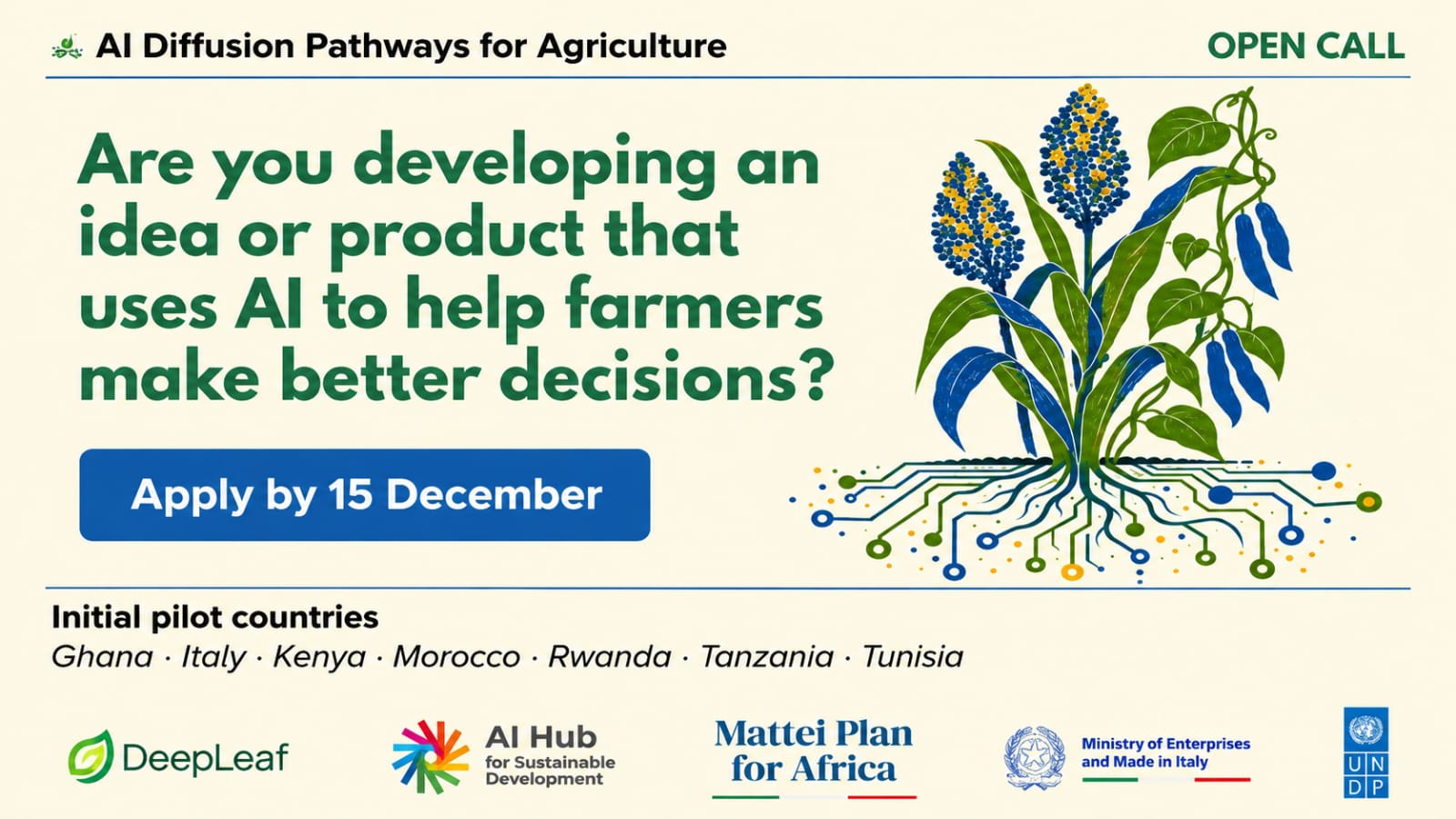
The AI Diffusion Pathways for Agriculture (AIDPA) 2027 programme is an international opportunity designed to support agritech ventures developing artificial intelligence (AI)-powered solutions for the agricultural sector. Led by the AI Hub for Sustainable Development, in collaboration with the Italian Ministry of Enterprises and Made in Italy (MIMIT) and the United Nations Development Programme (UNDP), this six-month initiative aims to make advanced AI technologies more accessible to farmers and agricultural businesses.
The programme will support selected ventures in adapting AI technologies to local agricultural needs, developing practical digital services, strengthening their business models, and testing their innovations with real farmers. Through access to shared AI infrastructure, technical expertise, specialised workshops, local partnerships, and pilot opportunities, participating ventures will have the resources to develop and scale solutions that address agricultural challenges.
Applications are open to startups, social enterprises, organisations, and eligible individual innovators working on AI-enabled agricultural services. The programme is available in seven pilot countries: Ghana, Italy, Kenya, Morocco, Rwanda, Tanzania, and Tunisia.
Interested applicants should submit their applications before 15 December 2026.
The AI Diffusion Pathways for Agriculture programme is a six-month initiative that seeks to accelerate the adoption of artificial intelligence in agriculture by connecting advanced technology with local agricultural knowledge and practical farming requirements.
The initiative is coordinated by the AI Hub for Sustainable Development, which is co-led by Italy’s Ministry of Enterprises and Made in Italy and the United Nations Development Programme. DeepLeaf serves as the programme’s delivery and platform partner.
Agriculture is increasingly affected by climate-related challenges, including changing weather patterns, unpredictable rainfall, rising temperatures, crop diseases, and other environmental pressures. Farmers need reliable, timely, and science-based information to make informed decisions about their crops, soil, water, and overall farm management.
Although valuable agricultural research and technical knowledge already exist, this information does not always reach farmers in an accessible and practical format. Many farmers continue to make important decisions without receiving the appropriate guidance when they need it.
Artificial intelligence and digital infrastructure can help address this problem by making agricultural information more accessible, personalised, and useful.
However, agritech ventures developing AI-powered agricultural services often face several challenges, including limited financial resources, insufficient technical capacity, difficulties accessing reliable local agricultural data, and a lack of partnerships with potential customers.
The AI Diffusion Pathways for Agriculture programme aims to address these barriers by providing selected ventures with access to shared AI technologies, technical support, business guidance, and opportunities to collaborate with local agricultural stakeholders.
Instead of requiring every venture to develop its own AI infrastructure from the beginning, the programme allows participants to build upon existing technologies and concentrate on adapting them to the needs of their target communities.
Main Objectives of the AI Diffusion Pathways for Agriculture Programme
The programme has several important objectives related to agricultural development, technology adoption, and sustainable business growth.
1. Expanding Access to Artificial Intelligence in Agriculture
One of the programme’s primary objectives is to make advanced AI technologies more accessible to agricultural innovators and businesses.
By providing access to shared AI platforms, software development kits, and application programming interfaces, the initiative helps ventures reduce the technical and financial barriers associated with developing AI-powered agricultural services.
2. Supporting Locally Relevant Agricultural Solutions
Agricultural conditions differ significantly between countries and communities. A technology developed for one farming environment may not automatically work in another.
The programme encourages ventures to adapt AI-powered solutions to local agricultural conditions, farming practices, languages, available data, and development priorities.
3. Improving Access to Agricultural Knowledge
The initiative aims to connect farmers with useful agricultural information and practical guidance.
AI-enabled services can help make scientific and agricultural knowledge more accessible, supporting farmers in making better-informed decisions about their farming activities.
4. Strengthening Agritech Businesses
Developing an innovative product is only one part of building a successful agritech business.
The programme also supports participating ventures in developing sustainable business models, identifying potential customers, building partnerships, and preparing their services for wider adoption.
5. Creating Reusable AI Diffusion Pathways
The programme will document the experiences of participating ventures to identify which technologies, implementation methods, partnerships, and capabilities can be replicated in other countries.
These findings will contribute to the wider ambition of the AI Hub and its partners to develop 100 AI Diffusion Pathways by 2030.
Benefits of the AI Diffusion Pathways for Agriculture 2027
Selected ventures will receive access to technology, practical training, technical assessments, specialised coaching, and opportunities to test their products with real users.
The programme is designed to help participants move from an initial concept or existing product towards a locally adapted and commercially sustainable agricultural solution.
The main benefits include the following:
1. Free Access to AI Platforms and Technology
Selected ventures will receive access to the programme’s AI platform, software development kits (SDKs), and application programming interfaces (APIs) at no cost.
This access will remain available until 31 July 2027.
Participants can use these technological resources to develop, integrate, and adapt AI-enabled agricultural services without having to build every technical component independently.
2. Cohort Workshops
Participants will take part in practical workshops conducted for the entire selected cohort.
These sessions will cover important areas such as:
- AI technology and its applications in agriculture.
- Product development and improvement.
- Technology integration and implementation.
- Building solutions around farmers’ requirements.
- Identifying potential customers and market opportunities.
- Developing strategies for reaching and engaging users.
These workshops will allow participating ventures to strengthen their technical and commercial knowledge while learning from other innovators.
3. Venture-Specific Workshops
In addition to group workshops, each selected venture will receive sessions tailored to its individual requirements.
The workshops will consider the venture’s existing technology, business model, development stage, technical challenges, and local market conditions.
This individualised support will help participants identify practical improvements and develop solutions that are appropriate for their target agricultural communities.
4. Technical Assessments and Product Development Support
The programme will provide technical assessments to help ventures build, integrate, and adapt their products.
This support is particularly important for startups and organisations that have promising agricultural ideas but need additional technical expertise to turn those ideas into functional services.
Participants can receive guidance on improving their products, integrating AI technologies, and addressing technical challenges that could prevent successful implementation.
5. Regular Progress Reviews
Selected ventures will participate in regular progress check-ups throughout the programme.
These reviews will help identify development challenges, assess progress, and determine the next steps required to achieve the programme’s objectives.
Regular monitoring will also help participants remain focused on product development, local adaptation, and practical implementation.
6. Pilot Opportunities and Customer Introductions
One of the most valuable components of the programme is the opportunity to test solutions with real users.
Selected ventures will receive access to potential pilot sites, farmers, local partners, and relevant agricultural knowledge.
The programme will also facilitate introductions to potential customers.
These opportunities can help participating ventures:
- Test their AI-powered agricultural services in real-world environments.
- Understand farmers’ practical requirements.
- Collect feedback from actual users.
- Identify weaknesses and opportunities for product improvement.
- Build relationships with local agricultural stakeholders.
- Explore potential business partnerships and customer relationships.
- Improve the commercial sustainability of their services.
Who Can Apply for the AI Diffusion Pathways for Agriculture Programme?
The programme is open to agritech ventures at different stages of development. Applicants do not necessarily need to operate an established or fully developed business, as early-stage ideas and more advanced agricultural technology solutions are also eligible for consideration.
The programme welcomes applications from the following categories:
1. Startups
Early-stage and established startups developing AI-enabled agricultural products, platforms, or services can apply.
Startups may be working on technologies that improve farming productivity, agricultural decision-making, crop management, access to agricultural information, or other relevant farming challenges.
2. Social Enterprises
Social enterprises using artificial intelligence and digital technologies to address agricultural and rural development challenges are eligible to apply.
Organisations focusing on improving farmers’ access to information, supporting rural communities, and strengthening agricultural sustainability may find the programme relevant.
3. Other Organisations
Organisations developing AI-powered services for agriculture can also apply.
Applicants should demonstrate how their proposed solutions address relevant agricultural problems and how they intend to develop, adapt, or scale their services.
4. Individual Innovators
Individual applicants may also be eligible if they present a compelling and credible plan for developing an AI-enabled agricultural service.
Individuals should be prepared to explain the agricultural problem they intend to address, their proposed solution, and how they plan to implement and test their idea.
Eligible Countries for the AI Diffusion Pathways for Agriculture 2027
The programme is currently available in seven pilot countries. Applicants must be based in, operate in, or demonstrate a credible commitment to working in at least one of these countries.
The eligible countries are:
- Ghana
- Italy
- Kenya
- Morocco
- Rwanda
- Tanzania
- Tunisia
One venture will be selected in each participating country.
This means the programme is designed to support country-specific agricultural innovation rather than selecting ventures without considering their connection to the target markets.
Applicants should clearly demonstrate their relationship with the country in which they intend to implement their proposed solution.
For example, an organisation based in one country may demonstrate its eligibility through existing operations, partnerships, local agricultural connections, or a credible commitment to developing its services in another eligible pilot country.
Important: Applicants based outside these seven countries should not assume that they are automatically eligible. They must demonstrate a credible commitment to working in at least one of the programme’s designated pilot countries.
Selection Criteria for the AI Diffusion Pathways for Agriculture Programme
Applications will be assessed according to the potential of the proposed solution, the applicant’s ability to implement the project, and its relevance to local agricultural development priorities.
The programme is particularly interested in ventures that understand a genuine agricultural problem and have a realistic plan for developing and testing an AI-enabled service within six months.
The main selection considerations include:
1. Ability to Implement the Proposed Plan
Applicants should demonstrate that they have the capabilities, resources, and commitment necessary to carry out their proposed activities.
A strong application should explain how the venture intends to use the programme’s resources to develop or improve its agricultural solution.
2. Relevance to Local Development Priorities
The proposed service should address a meaningful agricultural challenge in the relevant pilot country.
Applicants should demonstrate an understanding of local farming conditions and explain how their solution could contribute to agricultural development.
3. Access to Local Agricultural Knowledge
Applicants should demonstrate access to relevant agricultural knowledge, expertise, or local connections.
Understanding farmers’ needs and the agricultural environment is important for developing solutions that are practical and effective.
4. Product Readiness
The programme considers the development stage of the proposed solution.
Both early-stage concepts and more developed products can apply, but applicants should demonstrate a realistic pathway towards building, adapting, or testing their proposed service.
5. Responsible Data Use
Responsible use of data is an important consideration for AI-powered agricultural solutions.
Applicants should explain how they intend to use relevant data responsibly and ensure that their proposed services are developed with appropriate attention to data-related considerations.
6. Commercial Sustainability
The programme is also interested in ventures that can develop sustainable business models.
Applicants should demonstrate how their services could reach potential customers, create value for farmers, and continue operating beyond the programme period.
7. Connections with Farmers
The ability to reach farmers and understand their requirements is particularly important.
Applicants should have relevant connections or present a credible strategy for building relationships with farmers and other agricultural stakeholders.
Programme Duration and Important Dates
The AI Diffusion Pathways for Agriculture programme follows a defined application and implementation schedule.
Applicants should pay attention to the following dates to avoid missing the application deadline.
| Programme milestone | Planned date |
|---|---|
| Applications open | 3 November 2026 |
| Application deadline | 15 December 2026 |
| Programme begins | February 2027 |
| Programme concludes | July 2027 |
| Demo Day | 3 August 2027 |
| AI platform access ends | 31 July 2027 |
Final Application Deadline: 15 December 2026 at 23:59 CET.
Applicants are encouraged to complete their applications before the deadline rather than waiting until the final day.
How to Apply for the AI Diffusion Pathways for Agriculture 2027 Programme
Interested startups, social enterprises, organisations, and eligible individual innovators can apply through the official online application form.
Applicants should prepare to explain their agricultural innovation, the problem they intend to solve, their proposed AI-enabled service, and their connection to one of the seven eligible pilot countries.
A strong application should clearly demonstrate the following:
- Your organisation or venture: Introduce your startup, social enterprise, organisation, or individual innovation project.
- The agricultural problem: Explain the specific challenge your proposed service intends to address.
- Your AI-powered solution: Describe how artificial intelligence or digital technology will help solve the identified problem.
- Your target country: Identify the eligible pilot country in which you are based, operate, or have a credible commitment to work.
- Your connection to farmers: Explain how you will reach farmers, agricultural communities, and relevant local stakeholders.
- Your development plan: Describe how you intend to develop, improve, integrate, or test your solution during the six-month programme.
- Your sustainability strategy: Explain how the service could become commercially sustainable and continue benefiting its users after the programme.
Application Procedure
Follow these steps to submit your application:
- Visit the official AI Hub for Sustainable Development website.
- Open the AI Diffusion Pathways for Agriculture programme page.
- Review the eligibility requirements, programme benefits, and selection criteria.
- Access the official application form through the Apply Now link.
- Complete the required application information accurately.
- Explain your proposed agricultural innovation and its potential impact.
- Demonstrate your connection to at least one of the seven eligible pilot countries.
- Review your application carefully before submission.
- Submit the completed application before 15 December 2026 at 23:59 CET.
Applicants should ensure that the information provided is accurate, relevant, and consistent with the programme’s objectives.
Why the AI Diffusion Pathways for Agriculture Programme Matters
Agriculture plays an essential role in food security, economic development, and livelihoods across the world. However, farmers in many regions continue to face challenges associated with climate change, limited access to reliable information, and insufficient technical support.
Artificial intelligence has the potential to improve agricultural decision-making by making useful knowledge and data-driven recommendations more accessible.
Nevertheless, successful AI adoption requires more than simply introducing new technology. Solutions must be adapted to local conditions, developed around actual user requirements, and supported by sustainable business models.
The AI Diffusion Pathways for Agriculture programme addresses these requirements by connecting AI technology with local agricultural expertise and practical implementation opportunities.
For participating ventures, the initiative provides an opportunity to strengthen their technical capabilities, test their innovations, establish partnerships, and develop services that can deliver meaningful benefits to farmers.
By supporting one venture in each of its seven pilot countries, the programme also aims to generate practical knowledge about how AI innovations can be adapted and implemented across different agricultural environments.
Official Application and Relevant Links
Apply for the AI Diffusion Pathways for Agriculture 2027 Programme:
https://airtable.com/appr4OS1aCVyfKkI1/pagevj3X0JsyqFGzU/form
Official Programme Website:
https://aihubfordevelopment.org/ai-diffusion-pathways-for-agriculture
AI Hub for Sustainable Development:
https://aihubfordevelopment.org/
AI Hub Programmes:
https://aihubfordevelopment.org/ai-hub-programmes
AI Hub Contact Information:
United Nations Development Programme (UNDP):
Italian Ministry of Enterprises and Made in Italy (MIMIT):
Conclusion
The AI Diffusion Pathways for Agriculture 2027 programme is an important opportunity for startups, social enterprises, organisations, and eligible individual innovators developing AI-powered solutions for agriculture.
Through free access to AI platforms, technical assessments, cohort and venture-specific workshops, progress reviews, pilot opportunities, and customer introductions, the initiative provides practical support to ventures seeking to develop or scale agricultural innovations.
The six-month programme is particularly relevant for applicants who have identified a genuine agricultural challenge, understand the needs of local farmers, and can demonstrate a credible plan for implementing their solutions in Ghana, Italy, Kenya, Morocco, Rwanda, Tanzania, or Tunisia.
With one venture expected to be selected in each participating country, interested applicants should carefully review the eligibility and selection requirements before applying.
The application deadline is 15 December 2026 at 23:59 CET.
Eligible innovators and organisations are encouraged to submit their applications through the official application portal before the deadline.