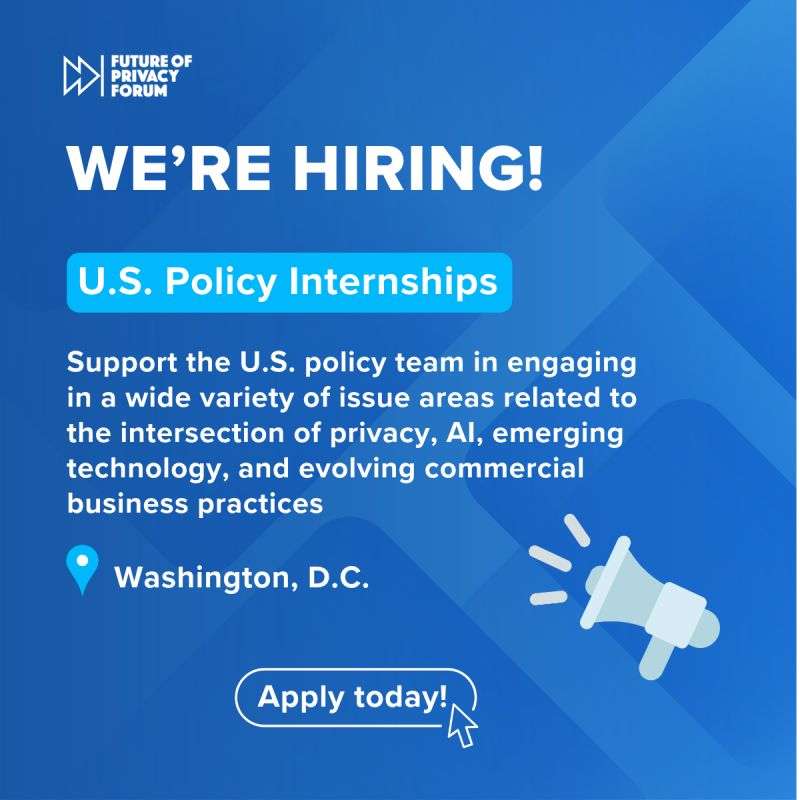
The Future of Privacy Forum (FPF) U.S. Policy Internships offer graduate-level students and qualified professionals an opportunity to gain practical experience in privacy policy, data protection, artificial intelligence, emerging technologies, and technology regulation. Through these internships, selected candidates will work alongside experienced policy professionals, contribute to research and policy development, and explore the challenges associated with the responsible use of data and emerging technologies.
The Future of Privacy Forum is currently accepting applications for its Summer 2027 Internship Program, while its Fall and Spring internship opportunities are also offered during the academic year on an as-needed basis. These opportunities are particularly relevant for individuals pursuing careers in law, public policy, technology, data protection, artificial intelligence governance, and related professional fields.
Unlike internships that focus exclusively on technical development or administrative responsibilities, FPF internships provide exposure to the relationship between technological innovation, privacy rights, commercial practices, and public policy. Interns will have the opportunity to support research, analyze emerging technologies, examine regulatory developments, and contribute to discussions about responsible data practices.
The internship programme offers different working arrangements depending on the academic semester. Summer internships typically run for 10 weeks on a full-time basis, while Fall and Spring internships generally last 14 weeks and involve part-time work. Candidates can participate remotely, subject to the applicable arrangements for each programme.
Applications are reviewed on a rolling basis, meaning interested candidates are encouraged to apply as early as possible. Spring applications have closed, while Summer 2027 applications are currently open. Final decisions for the Summer 2027 Internship Program are expected in January and February 2027.
1. About the Future of Privacy Forum (FPF)
The Future of Privacy Forum (FPF) is a nonprofit organization that serves as a catalyst for privacy leadership and scholarship. Its work focuses on advancing responsible data practices and developing privacy protections that support emerging technologies and innovation.
The organization brings together different stakeholders, including:
- Industry professionals and technology companies.
- Academic researchers and scholars.
- Consumer advocates.
- Privacy and data protection experts.
- Policymakers and other thought leaders.
- Professionals working in technology, law, and public policy.
By bringing these groups together, FPF seeks to address the complex challenges created by technological innovation and the increasing use of personal and organizational data.
Technology continues to develop rapidly, creating new opportunities for businesses, governments, researchers, and individuals. However, these developments also introduce concerns related to privacy, data security, individual rights, transparency, and responsible data management.
FPF works to address these challenges by promoting privacy protections, ethical standards, and practical business practices that allow organizations to benefit from technological innovation while managing potential risks.
The organization describes its approach as being guided by the belief that data can provide significant benefits to society when it is properly managed. This perspective recognizes the positive potential of data while emphasizing the importance of protecting individuals and consumers.
Through research, policy engagement, and collaboration, FPF contributes to discussions about how privacy principles can be applied to emerging technologies and evolving commercial practices.
2. Overview of the FPF U.S. Policy Internship Programme
The Future of Privacy Forum is seeking legal, policy, and technical interns to support its U.S. Policy team and policy staff.
The U.S. Policy team works across a broad range of issues involving the intersection of privacy, emerging technologies, and changing commercial business practices.
Interns will have opportunities to contribute to activities involving research, analysis, policy development, and engagement with different stakeholders.
The work may involve examining how new technologies affect individuals and organizations, understanding emerging data practices, researching regulatory developments, and supporting policy discussions.
Some of the major areas covered by the U.S. Policy team include:
A. Online Advertising
Online advertising relies on data collection and analysis to understand consumer interests, measure engagement, and deliver targeted advertisements.
However, these practices also create important privacy questions concerning how personal information is collected, processed, shared, and used.
Interns may support research and policy analysis related to online advertising practices and the privacy implications of data-driven advertising systems.
B. Deidentification Standards
Deidentification involves modifying or processing data to reduce the possibility of identifying individuals.
Although deidentified data can support research, innovation, and data analysis, it also raises questions about the effectiveness of different privacy protection methods.
The policy team examines issues related to deidentification standards and responsible data practices.
C. Artificial Intelligence
Artificial intelligence is increasingly being integrated into business operations, public services, research, and everyday applications.
However, AI systems can introduce significant privacy challenges involving personal data, automated decision-making, transparency, and accountability.
Interns may contribute to research and policy discussions concerning the relationship between artificial intelligence and privacy protection.
This area is particularly relevant for students and professionals interested in AI governance, responsible innovation, technology regulation, and data ethics.
D. Emerging Technology Regulation and Law
Technological innovation frequently develops faster than existing regulatory frameworks.
As a result, governments and policymakers must continuously evaluate whether current laws and regulations adequately address new technologies and emerging data practices.
The FPF policy team examines these developments and contributes to discussions about appropriate regulatory approaches.
Interns may support legal and policy research concerning new legislation, regulatory proposals, and the implications of technological developments.
These issue areas are examples rather than an exhaustive list. The specific responsibilities and projects assigned to interns may vary according to organizational priorities and available opportunities.
3. Internship Structure: Summer, Fall, and Spring Opportunities
FPF offers internship opportunities during three academic periods: Summer, Fall, and Spring.
Each programme has a different duration, weekly time commitment, and working arrangement.
A. Summer 2027 Internship Programme
The Summer Internship Programme is generally structured as a 10-week, full-time experience.
Key details include:
- Duration: Typically 10 weeks.
- Period: Early June to mid-August.
- Working hours: 40 hours per week.
- Location: Washington, DC, United States.
- Working arrangement: Hybrid, with remote participation also available.
- Office attendance: The Washington, DC office follows a policy requiring at least three in-person working days per week for those working from the office.
Summer interns are invited to participate in the programme from FPF’s Washington, DC office.
The organization recommends that interns consider coming to Washington, DC because of the social and professional experience associated with working alongside colleagues and participating in office activities.
However, FPF also welcomes fully remote candidates from anywhere in the United States.
This provides flexibility for eligible candidates who cannot relocate to Washington, DC for the internship period.
FPF operates as a hybrid workplace, and several policy leaders work remotely from different locations, including San Francisco, Denver, and the Orlando/Tampa areas.
Important compensation requirement for Summer 2027:
Summer 2027 internship opportunities are available to students who receive external funding, such as financial support from their educational institution, or who will receive academic credit for participating in the internship.
Applicants should therefore consider this requirement before submitting their applications.
The organization does not specify a general internship salary or stipend in the provided announcement.
B. Fall Internship Programme
Fall internships generally take place during the Fall academic semester.
Unlike the Summer Programme, these internships are structured as part-time opportunities designed to accommodate students’ academic responsibilities.
Key details include:
- Duration: Typically 14 weeks.
- Working hours: 10–20 hours per week.
- Period: During the Fall academic semester.
- Working arrangement: Often fully remote.
- Office participation: Candidates are also welcome to work from the Washington, DC office.
- Scheduling: Flexible start and end dates depending on the student’s academic calendar.
Thanksgiving Week is excluded from the standard 14-week internship period.
Fall interns are hired on an as-needed basis to support specific projects and organizational requirements.
This means that the availability of positions may depend on the projects requiring additional research and policy support during the semester.
The flexible structure makes the Fall Programme suitable for graduate-level students who want to gain professional experience while continuing their academic studies.
C. Spring Internship Programme
The Spring Internship Programme follows a similar structure to the Fall Programme.
Key details include:
- Duration: Typically 14 weeks.
- Working hours: 10–20 hours per week.
- Period: During the Spring academic semester.
- Working arrangement: Often fully remote.
- Office participation: Interns are welcome to work from the Washington, DC office.
- Scheduling: Flexible start and end dates based on the student’s academic calendar.
Spring Break is excluded from the standard internship period.
Like Fall internships, Spring positions are offered on an as-needed basis to support specific projects.
According to the current announcement, Spring applications have closed.
Candidates interested in future Spring opportunities should monitor the organization’s official careers page for announcements about upcoming application periods.
4. Who Can Apply? Academic Background and Professional Requirements
The Future of Privacy Forum welcomes applications from individuals with different graduate-level academic and professional backgrounds.
The organization does not limit its internship opportunities exclusively to law students or individuals studying computer science.
Instead, it welcomes candidates whose academic studies or professional experiences demonstrate an interest in privacy, data protection, and related policy issues.
Typical eligible backgrounds include:
Law Students
Students pursuing legal education may find the internship particularly relevant because of its focus on privacy laws, emerging regulations, data protection, and technology policy.
They may gain exposure to legal research, regulatory analysis, and discussions about how existing laws apply to emerging technologies.
Master’s Students
Students enrolled in master’s-level programmes, including MA and MBA programmes, are also among the backgrounds specifically welcomed by FPF.
Depending on their academic interests, these candidates may contribute to policy research, organizational analysis, technology governance, and other related activities.
PhD Students
Doctoral students studying policy-related fields may also apply.
Their research experience and academic knowledge can be relevant to examining complex issues involving privacy, data governance, technological innovation, and public policy.
Career Professionals
FPF also welcomes applications from career professionals with relevant interests and backgrounds.
Professionals who have experience in areas such as technology, policy research, legal analysis, data protection, and related fields may find the internship relevant to their professional development.
Important Academic Restriction
Undergraduate students are not currently eligible to apply.
FPF explicitly states that it is not accepting applications from undergraduate students.
Applicants should therefore ensure that they meet the graduate-level or professional background expectations before applying.
The Most Important Requirement: Interest in Privacy and Data Protection
According to FPF, the essential requirement is a demonstrated interest in privacy and data protection.
This means that applicants should be able to communicate their interest in the responsible use of data, individual privacy rights, emerging technologies, and the policy challenges associated with technological innovation.
Candidates from different academic and professional backgrounds may be considered, provided they demonstrate this interest and meet the programme’s other applicable requirements.
5. Internship Responsibilities and Potential Learning Areas
The internship programme is designed to support the work of FPF’s U.S. Policy team.
Although specific assignments may vary depending on the semester and organizational needs, the announcement identifies several major areas in which the policy team operates.
A. Legal Research and Analysis
Interns may contribute to research involving privacy laws, regulatory developments, and the legal implications of emerging technologies.
This can involve examining existing legal frameworks, reviewing policy proposals, and identifying issues that may affect individuals, businesses, and other stakeholders.
B. Technology and Privacy Research
The relationship between technology and privacy is one of the central areas of FPF’s work.
Interns may support research into how new technologies collect, process, store, and use data.
This can include examining the potential benefits of technological innovation alongside the privacy risks that may arise.
C. Policy Research and Thought Leadership
The organization conducts research and develops policy perspectives on emerging privacy issues.
Interns supporting this work may contribute to research activities and help examine questions involving data protection, responsible innovation, and technology governance.
D. Emerging Data Practices
Commercial organizations continuously develop new approaches to collecting and using data.
These practices can raise questions about transparency, consumer protection, privacy, and responsible business operations.
Interns may assist the policy team in understanding these developments and examining their broader implications.
E. Engagement with Policymakers and Partners
FPF brings together industry representatives, academics, consumer advocates, and policymakers.
The U.S. Policy team engages with policymakers and partners as part of its work.
Interns may gain exposure to the collaborative nature of privacy policy development and the importance of communication between different stakeholders.
The specific level of participation in these activities will depend on assigned projects and the needs of the policy team.
6. Application Requirements and Required Documents
Applicants must submit specific application materials through the Future of Privacy Forum Career Center.
The organization requires candidates to provide their documents in PDF format.
The following materials are required:
1. Cover Letter
Applicants must submit a cover letter explaining their interest in the internship and relevant academic or professional background.
The cover letter should communicate why the candidate is interested in privacy and data protection and how their experience relates to the work of FPF’s U.S. Policy team.
Candidates may highlight relevant interests in areas such as:
- Privacy and data protection.
- Artificial intelligence and emerging technologies.
- Technology policy and regulation.
- Legal and policy research.
- Responsible data practices.
- Digital rights and consumer protection.
- Technology governance.
Applicants should ensure that the cover letter is relevant to the internship rather than submitting a general statement of interest.
2. Resume
A resume is also required.
Candidates should use their resumes to present their academic background, professional experience, relevant skills, and other qualifications.
Relevant research, internships, professional activities, and projects may help demonstrate an applicant’s interest in privacy and technology policy.
3. Writing Sample (Optional)
Writing samples are optional.
Candidates who have relevant academic papers, research publications, policy analysis, or other writing materials may consider submitting a sample to demonstrate their research and communication abilities.
However, this document is not mandatory according to the announcement.
Important Document Instructions
FPF has provided the following application requirements:
- The cover letter must be submitted in PDF format.
- The resume must be submitted in PDF format.
- Writing samples are optional.
- Each document must be uploaded separately in the designated application field.
- Academic transcripts should not be submitted.
Do not submit academic transcripts, as the organization specifically states that they are not required.
Applications that do not follow the required document format may not be considered.
7. Application Process: How to Apply for the FPF Summer 2027 Internship
Interested candidates should apply through the official Future of Privacy Forum recruitment platform.
The application process involves the following steps.
Step 1: Visit the Official Application Portal
Access the official Summer 2027 internship application through the link below:
Candidates should ensure they are accessing the official recruitment platform before submitting personal information and application documents.
Step 2: Review the Internship Requirements
Before beginning the application, carefully review the eligibility requirements, internship structure, and application instructions.
Pay particular attention to the following:
- The programme is intended for graduate-level students and relevant career professionals.
- Undergraduate students are not currently accepted.
- Applicants must demonstrate an interest in privacy and data protection.
- Summer 2027 interns must have external funding or receive academic credit.
- All required documents must be submitted in PDF format.
Understanding these requirements can help candidates determine whether the opportunity matches their academic and professional circumstances.
Step 3: Prepare Your Application Documents
Prepare your cover letter and resume in PDF format.
Make sure that your documents clearly communicate your qualifications, academic background, and interest in the work of the Future of Privacy Forum.
If you decide to include a writing sample, prepare it in the appropriate format as well.
Remember that academic transcripts are not required.
Step 4: Complete the Online Application
Access the application portal and follow the instructions provided by the recruitment platform.
Enter the requested information and upload each document separately in the appropriate application field.
Review the information carefully before submitting your application.
Step 5: Submit Your Application Early
FPF reviews applications throughout the year on a rolling basis.
This means that applications are considered as they are received rather than waiting until one final application deadline.
The organization encourages candidates to apply early because available positions are filled according to organizational needs and project requirements.
Applicants should avoid waiting until the final stages of the recruitment period.
8. Application Deadline and Recruitment Timeline
The Future of Privacy Forum operates its internship recruitment according to different academic semesters.
The current application status is as follows:
Spring Internship
Spring applications have closed.
Candidates interested in future Spring opportunities should monitor FPF’s official recruitment announcements.
Summer 2027 Internship
Summer 2027 applications are currently open.
The organization has not provided a specific final application deadline in the announcement. Applications are reviewed on a rolling basis, and candidates are encouraged to apply early.
Final decisions regarding Summer 2027 internships will be made in January and February 2027.
Fall Internship
Fall internships are offered on an as-needed basis.
Application links are typically provided three to six months before the deadline for the relevant semester.
Candidates should regularly check the official FPF careers page for new opportunities.
Important Recruitment Information
If a candidate has previously submitted an application and wants it transferred to another semester or wants to add new application materials, FPF instructs them to contact its Human Resources team.
Email: HR@fpf.org
Applicants should also understand that the organization may recruit for specific projects depending on its needs.
Therefore, submitting an application does not automatically guarantee an internship placement.
9. Interview and Selection Process
After reviewing applications, FPF contacts its strongest candidates to proceed with the interview stage.
The organization uses a selection process designed to evaluate candidates’ academic and professional backgrounds, interests, and suitability for the internship.
Initial Application Review
Applications are reviewed throughout the year on a rolling basis.
The organization evaluates submitted materials to identify candidates who demonstrate relevant qualifications and an interest in privacy and data protection.
30-Minute Zoom Interview
Top candidates will be contacted with an invitation to participate in a 30-minute interview conducted through Zoom.
This provides an opportunity for the organization to learn more about candidates and assess their suitability for the available internship positions.
Additional Writing Assignment
Candidates applying for the FPF Center for AI or the Summer Internship Programme may also receive a short writing prompt assignment.
This additional assessment may help the organization evaluate candidates’ ability to understand an issue, organize information, and communicate ideas effectively.
Applicants should be prepared to demonstrate their research and writing abilities where required.
Important Information About Artificial Intelligence in Recruitment
FPF explicitly states that it does not use the AI screening features mentioned in the standard disclosure provided by its Career Center.
Although the recruitment platform may contain a general statement about the potential use of AI tools in screening applications, FPF confirms that it does not use these features.
10. Internship Location and Remote Working Opportunities
The internship programme provides different working arrangements depending on the academic semester.
Washington, DC Office
The organization’s office is located in Washington, DC, United States.
Summer interns are invited to work from this office, where the hybrid workplace policy requires at least three in-person working days per week for office-based participation.
Working from the office may provide opportunities to interact directly with colleagues and participate in the organization’s professional environment.
Remote Summer Internships
FPF also welcomes fully remote Summer 2027 candidates from anywhere in the United States.
This arrangement provides flexibility for eligible applicants who are unable to relocate to Washington, DC.
Remote Fall and Spring Internships
Fall and Spring internships are often fully remote.
However, candidates are also welcome to work from the Washington, DC office.
The exact working arrangement should be confirmed through the relevant internship application and recruitment process.
11. Compensation and Financial Support
One important consideration for applicants is the financial arrangement associated with the Summer 2027 Internship Programme.
According to the official announcement, Summer 2027 internship opportunities are available to students who meet at least one of the following conditions:
- They receive external funding, for example, financial support through their educational institution.
- They will receive academic credit for participating in the internship.
The announcement does not specify a standard salary, hourly wage, or general stipend for the Summer 2027 internships.
Candidates should therefore carefully consider their financial arrangements before applying.
For Fall and Spring internships, the provided announcement does not specify a separate compensation package or general financial support arrangement.
Applicants who need clarification about financial arrangements should contact FPF directly through its Human Resources email address.
12. Equal Opportunity and Diversity Commitment
The Future of Privacy Forum is an equal-opportunity employer committed to creating a diverse, equitable, and inclusive working environment.
The organization encourages applications from individuals representing different backgrounds and experiences.
Its equal-opportunity commitment includes individuals of different:
- Sex.
- Race.
- Ethnicity.
- Age.
- Religion.
- National origin.
- Sexual orientation.
- Gender identity or expression.
- Disability status.
- Veteran status.
- Other backgrounds protected by applicable law.
FPF also states that it supports applicants and employees through its employment practices and benefits offerings.
Candidates who require accommodations during the recruitment process are encouraged to contact the organization.
Human Resources Email: HR@fpf.org
13. Why Consider the Future of Privacy Forum Internship?
The FPF U.S. Policy Internship offers an opportunity to explore important issues shaping the future of technology, privacy, and data governance.
There are several reasons why eligible candidates may find this opportunity valuable.
Exposure to Emerging Technology Policy
Artificial intelligence, online advertising, and data-driven technologies are transforming businesses and societies.
The internship provides an opportunity to engage with policy questions arising from these developments.
Experience in Privacy and Data Protection
Privacy and data protection are increasingly important across different industries.
Working with FPF’s policy team can provide exposure to research and discussions concerning responsible data practices and privacy protections.
Interdisciplinary Professional Environment
FPF brings together individuals from industry, academia, consumer advocacy, and policy communities.
This interdisciplinary environment provides exposure to different perspectives on technological innovation and privacy.
Research and Analytical Development
The internship may provide opportunities to support legal, technical, and policy research.
These activities can help candidates strengthen their ability to examine complex issues and communicate research findings.
Understanding Technology Regulation
Candidates interested in the relationship between law, government, and technological innovation can gain exposure to emerging regulatory discussions and policy developments.
Flexible Internship Structures
The availability of full-time Summer internships and part-time Fall and Spring opportunities provides different participation arrangements.
Remote working options also offer flexibility for eligible candidates.
14. Official Application Links and Contact Information
Interested candidates should use the official resources below to learn more about the opportunity and submit their applications.
Summer 2027 Internship Application:
Official Future of Privacy Forum Website:
FPF Careers and Opportunities:
https://fpf.org/about/career-opportunities/
Human Resources Contact:
Candidates who have previously submitted applications and wish to move their applications to a different semester or provide updated materials should contact the Human Resources team.
For questions about recruitment accommodations, applicants may also contact the same email address.
Conclusion
The Future of Privacy Forum U.S. Policy Internships 2027 provide an opportunity for graduate-level students and qualified professionals to gain experience in privacy policy, data protection, artificial intelligence, emerging technologies, and technology regulation.
Through its U.S. Policy team, FPF works with industry professionals, academics, consumer advocates, policymakers, and other stakeholders to examine the challenges associated with technological innovation and responsible data practices.
The programme offers different internship structures throughout the year. Summer internships typically last 10 weeks and involve full-time participation, while Fall and Spring internships generally last 14 weeks and involve part-time work. Both office-based and remote working arrangements are available, depending on the semester and applicable programme requirements.
Applicants should remember that undergraduate students are not currently accepted. The organization welcomes graduate-level students from different academic backgrounds, including law, MA, MBA, and policy-related PhD programmes, as well as career professionals. Demonstrated interest in privacy and data protection is the essential requirement highlighted by FPF.
For Summer 2027, applicants must also have external funding or receive academic credit for the internship. The organization is currently accepting Summer applications and reviews candidates on a rolling basis. Final decisions are expected in January and February 2027.
Interested candidates are encouraged to prepare their cover letter and resume in PDF format, carefully review the application requirements, and submit their applications through the official recruitment portal as early as possible.