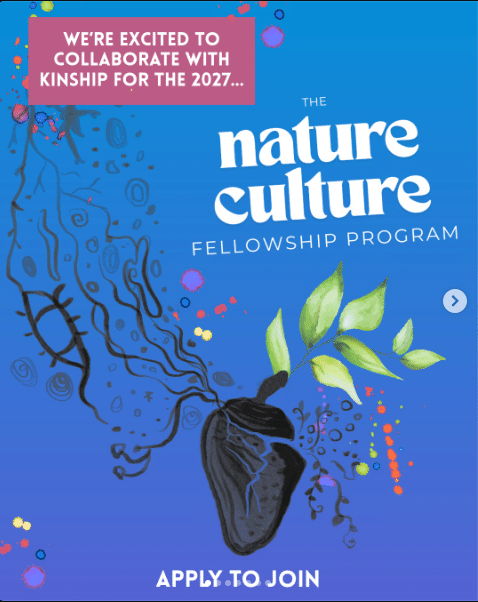
Applications are now open for the 2027 Nature Culture Fellowship (NCF), an international fellowship programme designed to bring together creative thinkers, community leaders, environmental advocates, artists, storytellers, cultural practitioners and other change-makers who are committed to building a more sustainable and equitable future.
Organised by Kinship, the Nature Culture Fellowship explores how storytelling, artivism, culture and creative expression can contribute to social and environmental transformation. The programme recognises that many of the challenges facing society and the natural world are deeply connected to cultural values, inherited narratives, social structures and the ways people relate to one another and the environment.
Through an immersive online Learning Journey and a subsequent Project Implementation phase, selected Fellows will explore the cultural and systemic roots of socio-ecological challenges, develop their capacity to influence change and translate their learning into practical community-based initiatives.
One of the most attractive aspects of the 2027 fellowship is that selected Fellows undertaking the project implementation phase will receive micro-grants ranging from US$1,000 to US$2,000, alongside professional mentorship to help develop and expand their projects. These resources are intended to support initiatives within participants’ existing work, organisations or newly established grassroots projects.
The 2027 programme will run from February to August 2027, bringing together a global community of individuals interested in using art, storytelling, culture and collective action to influence systems and create a future in which people and nature can thrive.
The Nature Culture Fellowship is a transformative learning and action programme that examines the relationship between culture, storytelling, creativity and environmental sustainability.
The fellowship is founded on the understanding that lasting social and environmental change requires more than policies, technical solutions and institutional reforms. It also requires changes in the stories people tell, the values they uphold, the beliefs that shape their decisions and the relationships they build with other people and the living world.
Stories influence how communities understand their identities, histories, responsibilities and relationships with nature. Cultural narratives can reinforce harmful practices and systems, but they can also inspire solidarity, environmental responsibility, social justice and alternative ways of living.
The Nature Culture Fellowship therefore creates a learning environment in which participants can examine the narratives and systems influencing contemporary socio-ecological challenges. Through storytelling, artivism, systems thinking, environmental and social activism, Fellows will explore how creative approaches can influence individuals, communities and wider institutions.
The programme also seeks to nurture a diverse global community of change-makers who can connect their learning to practical action in their respective communities.
2. Objectives of the 2027 Nature Culture Fellowship
The 2027 Nature Culture Fellowship aims to develop the capacity of individuals to use culture, creativity and storytelling as tools for meaningful social and environmental transformation.
Its broader objectives include:
Promoting culture-driven environmental and social change: The programme explores how cultural practices, collective identities, stories and shared values influence people’s relationships with nature and society. Participants will examine how these factors can be transformed to support more sustainable and inclusive communities.
Strengthening storytelling and narrative-change skills: Fellows will explore how inherited stories and the narratives communicated through art, media, community practices and other cultural expressions influence behaviour and attitudes towards the living world.
Encouraging creative approaches to activism: Through artivism and other creative practices, participants will examine how artistic expression can communicate complex social and environmental issues, challenge harmful systems and inspire collective action.
Developing systems-thinking capabilities: Participants will examine the deeper structures and relationships contributing to socio-ecological crises. This includes exploring systems of oppression and the cultural foundations of environmental and social inequalities.
Supporting community-led initiatives: The fellowship seeks to help participants identify their spheres of influence and develop practical projects that respond to challenges within their communities and wider networks.
Building a global network of change-makers: By bringing together people from different backgrounds, communities and professional experiences, the programme encourages collaboration, shared learning and the exchange of ideas across geographical and cultural boundaries.
Supporting practical implementation: Through professional mentorship and micro-grants, selected Fellows will have an opportunity to translate their learning into community projects and strengthen existing initiatives.
3. Structure of the 2027 Nature Culture Fellowship Programme
The 2027 Nature Culture Fellowship will take place through two main phases: the Learning Journey and Project Implementation.
The overall programme is scheduled to run from February to August 2027. Participants will first engage in an intensive online learning experience before moving into the practical project implementation stage.
Phase One: The Learning Journey
The first phase is an immersive online learning experience designed to help Fellows examine the relationship between culture, society, storytelling and the natural environment.
The Learning Journey will consist of a 10-session series delivered through weekly online sessions beginning on 5 February 2027. Sessions are scheduled to take place at 14:00 UTC, continuing through April 2027.
During this phase, participants will engage in guided discussions, deep listening, reflection, analysis and creative practices. They will be supported in examining the cultural and systemic factors contributing to current social and environmental challenges.
The Learning Journey will also bring participants into contact with thought leaders and practitioners working in areas such as:
- Storytelling and narrative change.
- Systems thinking.
- Art and creative expression.
- Environmental activism.
- Social activism.
- Cultural transformation.
- Community engagement and collective action.
These contributors will guide Fellows in exploring how cultural change can influence individual behaviour, strengthen community relationships and contribute to broader systemic transformation.
Key topics covered during the Learning Journey
The programme will explore several interconnected themes, including:
1. Stories and our relationship with the living world
Participants will examine how inherited stories, cultural narratives and the stories people tell about themselves and their communities influence their relationships with nature.
The discussions will consider how dominant narratives shape environmental attitudes, consumption patterns, social responsibilities and perceptions of the natural world. Fellows will also explore how alternative stories can encourage more reciprocal relationships between people and the environment.
2. Systems of oppression
The Learning Journey will examine the social, cultural and institutional systems that contribute to inequality and environmental challenges.
Participants will explore how historical and contemporary structures influence communities, access to resources, relationships with land and the distribution of social and environmental burdens.
3. Grief work and ceremony
The programme will explore the role of grief, collective reflection and ceremony in responding to environmental and social challenges.
This theme recognises that ecological destruction, social injustice and cultural disconnection can create emotional and collective experiences that deserve acknowledgement. Participants will consider how reflective and communal practices can support healing, connection and renewed commitment to positive change.
4. The power of art as activism
Art can communicate messages, challenge assumptions and encourage people to engage with issues that may otherwise be difficult to understand or discuss.
Fellows will explore artivism and the use of creative expression to promote social and environmental awareness. This may include examining how visual art, storytelling and other creative approaches can challenge harmful cultural narratives and inspire action.
5. Nature connection
Participants will examine the importance of rebuilding meaningful relationships with nature and recognising the interconnectedness of human communities and ecological systems.
The discussions will encourage a deeper understanding of the living world and the importance of developing more reciprocal and responsible relationships with the environment.
6. Deep listening
Deep listening will be explored as a practice for understanding different perspectives, experiences and relationships.
Participants will consider how listening can strengthen community engagement, create space for different voices and support collaborative responses to complex social and environmental challenges.
7. Imagining new futures
The programme will encourage Fellows to think beyond existing systems and imagine alternative futures in which people, communities and nature can thrive together.
Participants will explore how creative thinking, storytelling and collective imagination can help communities identify new possibilities and develop practical approaches to transformation.
Phase Two: Project Implementation
The second phase will focus on translating the knowledge, reflections and creative approaches developed during the Learning Journey into practical initiatives.
Selected Fellows will begin implementing their community projects from April to August 2027.
During this phase, participants will apply the fellowship’s approach to their existing work, organisations or newly developed grassroots initiatives. The objective is to move beyond theoretical learning and support practical action that contributes to social and environmental transformation.
Project implementation may take different forms depending on the participant’s interests, community context, project scope and local realities.
The programme will support Fellows in identifying opportunities for change, developing project strategies, strengthening their initiatives and examining how their work can influence wider cultural and social systems.
Activities covered during Project Implementation
The project phase will include several areas of support and development:
1. Understanding mechanisms of cultural change
Fellows will examine how cultural narratives, shared values, community practices and social relationships influence change. This will help them identify the factors that can support or prevent transformation within their communities.
2. Identifying spheres of influence
Participants will explore where they can make the greatest contribution to change. This involves identifying their existing networks, community relationships, organisations and opportunities to influence individuals or wider systems.
3. Programme strategy and case studies
Fellows will engage with programme strategy and relevant case studies to strengthen their understanding of how initiatives can be designed and implemented to achieve meaningful impact.
4. Project design and mentorship
Participants will receive professional mentorship to help them develop and strengthen their project ideas. This support will contribute to project planning, strategy development and the identification of practical approaches to implementation.
5. Research and project implementation
Fellows will undertake relevant research and apply their learning through practical project activities. The aim is to develop initiatives that respond to real community needs and contribute to wider social and environmental change.
The exact implementation schedule may vary depending on the scope of individual projects and local circumstances.
4. Fellowship Benefits: Micro-Grants of US$1,000–US$2,000 and Professional Mentorship
The Nature Culture Fellowship offers selected participants an opportunity to strengthen their knowledge, develop their creative approaches and implement practical projects.
One of the key benefits is the financial and professional support available during the Project Implementation phase.
1. Micro-grants of US$1,000–US$2,000
Selected Fellows receive micro-grants ranging from US$1,000 to US$2,000 to support their community projects.
The funding is intended to help participants expand their work, strengthen existing organisational initiatives or establish new grassroots projects that apply the principles and approaches explored during the fellowship.
This support can help Fellows move from ideas and learning to practical action. However, the source announcement does not specify individual grant amounts, payment schedules, eligible expenditure categories or a detailed grant disbursement process. Applicants should consult the official programme FAQs and application information for further details.
Importantly, the micro-grants are associated with selected Fellows and the project implementation phase. Applying for the fellowship does not automatically guarantee funding.
2. Professional mentorship
Selected Fellows will receive professional mentorship to support the development and implementation of their projects.
Mentorship is intended to help participants strengthen their project strategies, clarify their objectives, identify opportunities for impact and navigate the practical challenges associated with implementing community initiatives.
This support can be particularly valuable for individuals seeking to expand existing work or translate creative ideas into structured projects.
3. International learning experience
The fellowship brings together a diverse global community of change-makers.
Participants will have an opportunity to engage with individuals from different backgrounds and geographical contexts, exchange perspectives and learn from experiences addressing social and environmental challenges in different communities.
4. Learning from experienced practitioners
Through the 10-session Learning Journey, Fellows will engage with thought leaders and practitioners in storytelling, systems thinking, art, environmental activism and social activism.
This exposure will help participants explore different approaches to culture-driven change and understand how creative practices can contribute to broader transformation.
5. Practical project development
Unlike programmes focused exclusively on classroom-based learning, the Nature Culture Fellowship includes a dedicated implementation phase.
Participants will have an opportunity to apply their learning through projects that connect with their communities, organisations or areas of influence.
6. Opportunities to strengthen community impact
The fellowship encourages participants to identify how their work can contribute to change at local, regional and global levels.
By combining learning, mentorship, project design and implementation, the programme seeks to strengthen the capacity of individuals and grassroots initiatives to contribute to a more sustainable future.
5. Who Should Apply for the Nature Culture Fellowship?
The Nature Culture Fellowship is designed for individuals who are motivated to explore how storytelling, art, culture and creative expression can contribute to social and environmental transformation.
It is particularly relevant to people who are interested in addressing the deeper cultural and systemic roots of today’s socio-ecological challenges.
The programme is not presented as a conventional academic fellowship focused on a specific university degree or professional qualification. Instead, it emphasises personal commitment, creativity, community engagement, collaboration and an interest in cultural change.
Kinship identifies several characteristics it is looking for in prospective Fellows.
Rooted in community and committed to creating wider impact
Applicants should demonstrate an interest in their communities and an understanding of how local experiences connect to broader social and environmental challenges.
The programme is particularly relevant to people who want to contribute to positive change within their communities and create a wider impact through their work.
Self-motivated and committed
The fellowship is intended for individuals who can take initiative, remain committed to their learning and translate ideas into meaningful action.
Participants should be willing to engage actively throughout the Learning Journey and the subsequent project phase.
Open to unlearning and humble
The programme encourages participants to question assumptions, reflect on inherited beliefs and remain open to new perspectives.
Applicants should be willing to examine their own understanding of culture, society and the natural world while learning from other people’s experiences.
Connectors and compassionate individuals
The fellowship values people who can build relationships, listen to others and encourage collaboration.
Applicants should appreciate the importance of empathy, community engagement and collective action in addressing complex challenges.
Creative and courageous
Individuals who use creativity to communicate ideas, question existing systems and explore alternative solutions are encouraged to apply.
This may include artists, storytellers, cultural practitioners, activists and people using innovative approaches to community engagement.
Collaborative and generous
The programme seeks individuals who value shared learning, knowledge exchange and cooperation.
Applicants should be willing to contribute their experiences and perspectives while learning from the wider fellowship community.
Story-weavers and sense-makers
People interested in storytelling, cultural narratives and the ways stories influence social behaviour are particularly relevant to the programme.
Applicants do not necessarily need to identify as professional writers or artists; the central interest is in understanding and using stories as tools for change.
Future-oriented
The fellowship is designed for people who are interested in imagining and helping create more sustainable, inclusive and reciprocal relationships between people and the living world.
Applicants should be motivated to explore new possibilities and contribute to a future in which all life can thrive.
6. Who Can Benefit from the Nature Culture Fellowship?
Although the programme welcomes individuals with different experiences and interests, it is especially relevant to people working or engaging in areas such as:
- Environmental and climate activism.
- Social justice and community development.
- Arts, creative industries and cultural expression.
- Storytelling and narrative change.
- Grassroots organising and community leadership.
- Environmental education and awareness.
- Social entrepreneurship and community innovation.
- Systems thinking and sustainable development.
- Indigenous and community knowledge initiatives.
- Youth empowerment and collective action.
- Creative communication and public engagement.
- Organisations and initiatives promoting social and environmental transformation.
These are relevant areas of interest rather than a published list of mandatory professional qualifications.
7. Application Timeline for the 2027 Nature Culture Fellowship
Applicants should pay attention to the official programme dates to ensure that they submit their applications on time and prepare for the fellowship activities.
The key dates are as follows:
| Programme activity | Date |
|---|---|
| Applications open | 26 October 2026 |
| Application deadline | 1 December 2026, 23:59 UTC |
| Notification of selected Fellows | Mid-January 2027 |
| Learning Journey begins | 5 February 2027 |
| Community projects begin | April 2027 |
| Project Implementation phase | April–August 2027 |
| Overall programme period | February–August 2027 |
The weekly online Learning Journey sessions are scheduled for 14:00 UTC, beginning on 5 February 2027 and continuing through April 2027.
The project implementation schedule may change depending on the scope of individual projects and local circumstances.
Click HERE for more information about Nature Culture Fellowship 2027.
8. How to Apply for the Nature Culture Fellowship 2027
Interested applicants can submit their applications through the official Nature Culture Fellowship application portal.
Kinship provides application options in four languages to make the opportunity accessible to a wider international audience.
Applicants can choose from the following application forms:
- English: English application.
- Spanish: Aplicación en español.
- Portuguese: Aplicação em português.
- French: Candidature en français.
Application process
- Visit the official Nature Culture Fellowship website.
- Review the programme information to understand its objectives, structure, expectations and timeline.
- Read the Frequently Asked Questions relevant to your preferred application language.
- Select the appropriate application form in English, Spanish, Portuguese or French.
- Complete the application using the instructions provided on the official platform.
- Submit your application before the stated deadline of 1 December 2026 at 23:59 UTC.
Applicants are encouraged to explore the programme’s objectives and consider how their interests, experiences and community involvement connect with the fellowship’s focus on storytelling, artivism, culture and social environmental change.
Official application website
Visit the official Nature Culture Fellowship page to access the application forms and programme information:
Frequently Asked Questions
Kinship also provides Frequently Asked Questions in English, Spanish, French and Portuguese.
Prospective applicants are encouraged to consult the relevant FAQ before submitting their applications, particularly if they require clarification about programme participation, project implementation, micro-grants or other fellowship requirements.
For additional enquiries, applicants can contact the organising team through:
Email: connect@kinship.earth
9. Important Considerations Before Applying
Before submitting an application, prospective Fellows should consider the following:
- The fellowship is designed for individuals interested in culture-driven social and environmental transformation.
- The Learning Journey is conducted online, with weekly sessions beginning on 5 February 2027 at 14:00 UTC.
- The programme includes a 10-session learning series followed by a practical project implementation phase.
- Selected Fellows receive micro-grants of US$1,000–US$2,000 and professional mentorship for their projects.
- The project phase is expected to run from April to August 2027.
- The fellowship is looking for self-motivated, creative, collaborative and community-oriented individuals.
- Applications are available in English, Spanish, Portuguese and French.
- The application deadline is 1 December 2026 at 23:59 UTC.
- Applicants should review the official FAQs and application instructions for detailed eligibility requirements and any additional conditions.
The announcement does not provide a specific minimum educational qualification, age limit or nationality requirement. Applicants should therefore consult the official application guidance rather than assume that a particular degree, age group or country is required.
10. Why the Nature Culture Fellowship Matters
The Nature Culture Fellowship offers an approach to social and environmental change that places culture, creativity and human relationships at the centre of transformation.
Many environmental and social challenges are influenced by more than a lack of technical knowledge or resources. They are also connected to the beliefs, narratives, institutions and cultural practices that shape how people interact with each other and the natural world.
Addressing these challenges therefore requires approaches that encourage reflection, collective imagination, meaningful communication and community participation.
Through storytelling, artivism, systems thinking and creative engagement, the fellowship seeks to help participants examine existing systems and develop alternative approaches to building a more sustainable future.
Its combination of online learning, professional mentorship and micro-grant support also creates a pathway for selected participants to translate their ideas into practical community initiatives.
For artists, environmental advocates, community organisers, educators, storytellers and other creative change-makers, the programme presents an opportunity to strengthen their work, learn from a global community and contribute to social and environmental transformation.
Conclusion
The 2027 Nature Culture Fellowship by Kinship is an international learning and project implementation opportunity for individuals who want to explore the power of storytelling, artivism and culture in addressing social and environmental challenges.
Through its 10-session online Learning Journey, participants will examine themes such as narrative change, systems of oppression, art as activism, nature connection, deep listening and imagining alternative futures. Selected Fellows will then have an opportunity to implement community projects between April and August 2027, supported by professional mentorship and micro-grants of US$1,000–US$2,000.
The programme is particularly suited to self-motivated, creative, compassionate and collaborative individuals who are interested in strengthening their communities and contributing to a more sustainable relationship between people and nature.
Applications are open, and interested individuals should submit their applications before 1 December 2026 at 23:59 UTC