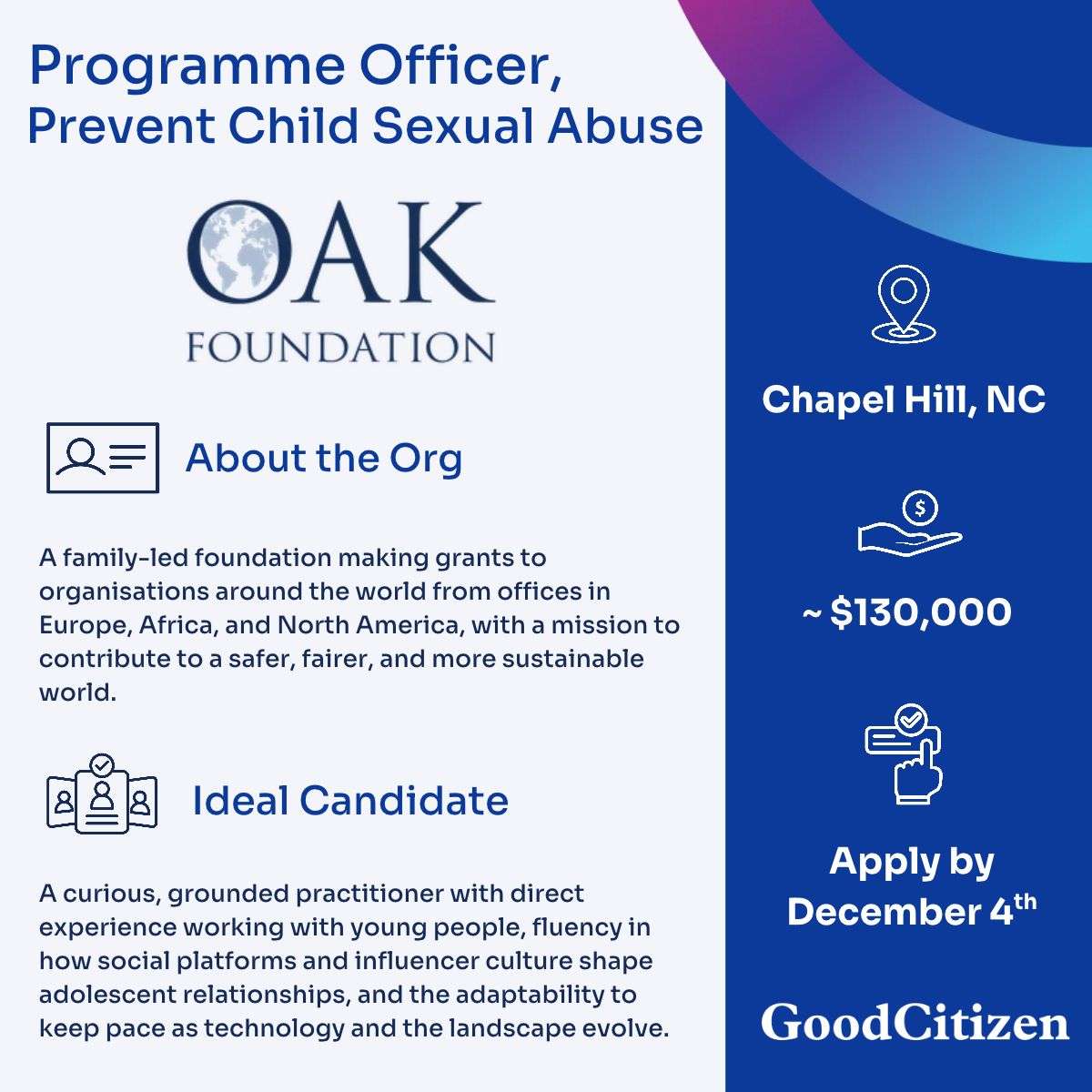
The Oak Foundation is seeking an experienced and passionate professional to join its Prevent Child Sexual Abuse Programme as a Programme Officer, with a particular focus on preventing sexual violence among adolescents. This is an exciting opportunity for an individual with a strong background in youth leadership, adolescent development, safeguarding, healthy relationships, digital safety, research, or related fields to contribute to a global effort to create safer environments for young people.
The successful candidate will help shape and implement the Foundation’s grant-making strategy, build relationships with youth-led organisations and other stakeholders, identify funding opportunities, manage grants, and translate research and evidence into practical recommendations that strengthen prevention initiatives.
The position offers an advertised salary of approximately US$130,000, alongside a comprehensive benefits package that includes health insurance, pension contributions, annual leave, life insurance, and opportunities for professional development. The position is based at Oak Foundation’s office in Chapel Hill, North Carolina, United States, under a hybrid working arrangement.
This opportunity is particularly suitable for established professionals with at least seven years of relevant experience who have demonstrated credibility with young people and a strong understanding of issues affecting adolescents. Applicants must be United States citizens or hold a valid US work permit.
Candidates who apply by Friday, 4 December 2026, will receive priority consideration. However, the position will remain open until filled.
1. Overview of the Oak Foundation Programme Officer Opportunity
The Programme Officer will contribute to the development and implementation of Oak Foundation’s work to prevent sexual violence among adolescents.
The role combines programme strategy, grant management, youth engagement, partnership development, research interpretation, and organisational learning. It is designed for a professional who understands how to work with young people and can build meaningful relationships with organisations, researchers, campaigners, practitioners, and other stakeholders working to prevent sexual violence.
One important feature of this opportunity is that the Foundation does not necessarily require the successful candidate to have previous grant-making experience. Although grant-making experience is desirable, Oak Foundation is willing to provide support and mentoring to help the selected candidate develop the technical skills needed to assess funding applications and manage a grant portfolio.
However, applicants must demonstrate substantial experience working with adolescents and young people, particularly in ways that support their development, wellbeing, leadership, participation, and protection.
Key opportunity details
| Category | Details |
|---|---|
| Organisation | Oak Foundation |
| Position | Programme Officer |
| Programme | Prevent Child Sexual Abuse Programme |
| Main focus | Preventing sexual violence among adolescents |
| Location | Chapel Hill, North Carolina, United States |
| Working arrangement | Hybrid |
| Salary | Approximately US$130,000 |
| Required experience | At least 7 years of relevant professional experience |
| Academic qualification | University degree in a related field |
| Advanced degree | May substitute for 1–2 years of experience |
| Work authorisation | US citizenship or a valid US work permit |
| Travel requirement | Approximately 20–25% of working time |
| Priority application deadline | Friday, 4 December 2026 |
| Vacancy status | Open until filled |
| Application documents | CV and motivation letter |
| Application method | Submit through the official recruitment platform using the “Become the Candidate” button |
2. About Oak Foundation
The Oak Foundation is a philanthropic organisation whose mission is to contribute to a safer, fairer, and more sustainable world.
The Foundation works with organisations across different countries and regions by providing grants to initiatives that address important social, environmental, and humanitarian challenges.
Through its grant-making activities, Oak Foundation supports organisations working to improve people’s lives, protect vulnerable communities, advance social justice, and promote sustainable development.
With offices in Europe, Africa, and North America, the Foundation works with a diverse range of organisations around the world. Its funding approach enables partner organisations to implement programmes, strengthen their institutional capacity, conduct research, influence policy, and develop solutions to complex social problems.
Oak Foundation’s work is organised around different programme areas, allowing it to support initiatives addressing specific global challenges.
Its broader mission reflects three important ambitions:
- A safer world: Supporting initiatives that protect people, particularly those exposed to abuse, exploitation, violence, and other forms of harm.
- A fairer world: Supporting efforts to address inequalities, strengthen justice, and improve opportunities for individuals and communities.
- A more sustainable world: Supporting organisations and initiatives that contribute to long-term social and environmental wellbeing.
The Programme Officer position sits within the Foundation’s Prevent Child Sexual Abuse Programme, which focuses on preventing sexual abuse and creating environments where children and young people can live safely and thrive.
3. About the Prevent Child Sexual Abuse Programme
The Prevent Child Sexual Abuse Programme is built around the understanding that child sexual abuse is preventable.
Despite increased awareness and prevention efforts, millions of children continue to experience sexual abuse and exploitation, both online and offline.
The programme supports organisations working to prevent abuse, protect children, improve safeguarding systems, and create environments where children and young people can develop safely.
Rather than focusing exclusively on responding to incidents after abuse has occurred, the programme emphasises prevention. This means supporting initiatives that address the conditions, behaviours, systems, and social attitudes that can contribute to sexual violence.
The programme works through six priority funding areas.
A. Building evidence and strengthening research
Effective prevention requires reliable information about the nature, causes, patterns, and consequences of child sexual abuse.
The Foundation supports organisations that generate evidence, conduct research, improve data collection, and make information available to people responsible for designing prevention interventions.
High-quality evidence can help policymakers, practitioners, educators, youth organisations, and other stakeholders understand what works and where additional interventions are required.
B. Promoting healthy and safe relationships
Healthy relationships are essential to the wellbeing and development of children and adolescents.
This funding area supports initiatives that promote respect, trust, consent, communication, emotional wellbeing, and safe interactions.
The objective is to help children and young people develop relationships that protect their dignity, support their wellbeing, and reduce their exposure to sexual violence.
C. Creating safe digital environments
Digital platforms provide children and adolescents with opportunities to learn, communicate, develop relationships, and participate in society.
However, online spaces can also expose young people to sexual exploitation, harassment, grooming, coercion, and other forms of abuse.
The programme therefore supports initiatives that make digital environments safer and encourage greater accountability among technology platforms and other relevant stakeholders.
D. Advancing safety in competitive sport
Sports can provide important opportunities for young people to develop confidence, teamwork, discipline, and leadership.
However, competitive sporting environments can also expose children and adolescents to abuse where safeguarding systems are inadequate.
This funding area supports initiatives that improve safeguarding practices and help create sporting environments where young people are protected from sexual abuse and exploitation.
E. Advancing justice
Children and adolescents who experience sexual abuse need access to systems that recognise their rights, protect their dignity, and respond appropriately to their experiences.
This priority area supports efforts to improve justice systems, strengthen accountability, and promote approaches that better address the needs of children and survivors.
F. Strengthening the field for prevention
Preventing child sexual abuse requires cooperation across different sectors.
Governments, civil society organisations, researchers, youth groups, practitioners, and other stakeholders all have important roles to play.
This priority area supports efforts to strengthen the broader prevention field through collaboration, knowledge sharing, capacity development, and improved coordination.
4. The Programme Officer’s Focus: Preventing Sexual Violence Among Adolescents
The Programme Officer will have a specific focus on preventing sexual violence among adolescents.
Adolescence is an important stage of human development. During this period, young people experience significant physical, emotional, social, and psychological changes. They develop relationships, explore their identities, establish personal values, and begin making decisions that can influence their future wellbeing.
However, adolescents can also face increased exposure to different forms of sexual violence, coercion, exploitation, online abuse, and unhealthy relationships.
The Foundation’s vision is to create a world where adolescents can develop relationships free from sexual violence and where those relationships promote connection, wellbeing, and a positive sense of self.
The Programme Officer will contribute to this vision by supporting organisations and initiatives working in several interconnected areas.
A. Youth leadership and engagement
Young people should not simply be viewed as beneficiaries of programmes designed by adults. They should also have meaningful opportunities to influence decisions, contribute ideas, identify challenges, and participate in developing solutions.
Oak Foundation recognises the importance of youth leadership in preventing sexual violence.
The Programme Officer will therefore work with youth-led organisations, young campaigners, youth advisory groups, and other youth-focused initiatives.
This work will help ensure that young people’s perspectives are meaningfully incorporated into programme decisions and funding priorities.
B. High-quality and actionable data
Reliable data is essential for understanding the challenges affecting adolescents and identifying effective prevention strategies.
The Programme Officer will support organisations that collect and interpret relevant data, conduct research, and translate findings into practical recommendations.
The emphasis will be on evidence that can inform real-world interventions rather than research that remains disconnected from policy and practice.
C. Healthy relationship programmes
The Foundation supports initiatives that help adolescents develop healthy relationships based on respect, mutual understanding, safety, and positive communication.
The Programme Officer will help identify and support organisations working to promote these values.
Such programmes may contribute to preventing sexual violence by helping young people understand boundaries, recognise unhealthy behaviour, communicate effectively, and develop positive relationships.
D. Digital safety and platform accountability
Online environments are increasingly important in the lives of adolescents.
However, the digital world also presents risks that require coordinated responses from technology companies, policymakers, educators, civil society, and young people themselves.
The Programme Officer will support initiatives that address digital safety, online harms, and accountability among digital platforms.
E. Positive narratives and changing social attitudes
The way society discusses relationships, gender, sexuality, consent, and violence can influence how young people understand themselves and interact with others.
The programme therefore supports initiatives that promote positive narratives and healthier ways of relating.
The Programme Officer will help identify and support organisations working to influence public attitudes, challenge harmful narratives, and encourage respectful relationships.
5. Purpose of the Programme Officer Role
The central purpose of the role is to help shape and deliver Oak Foundation’s growing grant-making portfolio focused on preventing sexual violence among adolescents.
The successful candidate will contribute to programme strategy, identify organisations that can deliver meaningful prevention initiatives, manage funding relationships, assess programme effectiveness, and ensure that young people’s perspectives remain central to the Foundation’s work.
The Foundation is particularly interested in candidates who have strong credibility with young people and understand emerging issues affecting adolescents.
This means the successful applicant should be able to engage respectfully with young people, understand the realities they face, and build trusted relationships with organisations working to improve their lives.
Is previous grant-making experience compulsory?
No. Grant-making experience is desirable but is not an absolute requirement.
Oak Foundation recognises that an experienced youth development or prevention professional may not necessarily have worked directly in philanthropy or grant management.
The organisation is prepared to provide mentoring and support to help the selected candidate develop the necessary grant-making and portfolio-management skills.
However, applicants must have demonstrated professional experience working with adolescents and young people and helping them thrive.
This distinction is important: the Foundation is open to candidates transitioning into grant-making, but it is not seeking someone without substantial experience in youth-related work.
6. Main Responsibilities of the Programme Officer
The successful candidate will undertake a broad range of strategic, technical, administrative, and partnership-related responsibilities.
These responsibilities are explained below.
6.1 Contribute to programme strategy and implementation
The Programme Officer will support the development and implementation of the Prevent Child Sexual Abuse Programme’s strategy, particularly its work on preventing sexual violence among adolescents.
This will involve contributing ideas, identifying emerging challenges, assessing programme priorities, and helping translate the Foundation’s strategic objectives into practical funding activities.
The successful candidate will also help prepare submissions and reports for Oak Foundation’s Board.
This responsibility requires strategic thinking, effective communication, and the ability to present complex programme information in a clear and structured manner.
6.2 Build relationships with youth-led organisations and other stakeholders
Building trusted relationships will be a central part of the position.
The Programme Officer will engage with:
- Youth-led organisations.
- Young campaigners and advocates.
- Researchers and academics.
- Practitioners working in prevention.
- Organisations promoting healthy relationships.
- Digital safety and child protection experts.
- Other stakeholders working to prevent sexual violence.
The objective is to develop meaningful partnerships and ensure that young people’s perspectives influence the Foundation’s work.
The successful candidate must therefore be approachable, respectful, collaborative, and capable of building relationships with people from different professional and social backgrounds.
6.3 Identify and develop funding opportunities
The Programme Officer will identify organisations and initiatives that align with the Foundation’s funding priorities.
This will involve exploring funding opportunities in areas such as:
- Youth leadership and engagement.
- Prevention of sexual violence.
- Healthy relationships.
- Adolescent development and wellbeing.
- Digital safety and online harms.
- Positive narratives and social change.
- Systems reform.
- Research and evidence mobilisation.
The candidate will need to understand the challenges affecting adolescents and identify organisations capable of developing effective responses.
This responsibility requires research, networking, strategic judgement, and an understanding of how philanthropic funding can support long-term social change.
6.4 Manage the full grant-making cycle
A major component of the role will involve managing grants from the initial inquiry stage through to assessment, approval, monitoring, reporting, and closure.
The Programme Officer will be responsible for ensuring that grant management activities comply with Oak Foundation’s procedures and internal systems.
The grant-making process will include several activities.
Initial inquiries and assessment
The Programme Officer will receive and review funding inquiries from organisations interested in receiving support.
This may involve examining an organisation’s mission, proposed activities, experience, capacity, and alignment with the Foundation’s programme priorities.
Developing funding recommendations
After assessing a potential funding opportunity, the Programme Officer will help prepare recommendations for consideration through the Foundation’s internal decision-making processes.
This requires sound judgement and the ability to assess whether a proposed initiative is relevant, feasible, and likely to contribute to the programme’s objectives.
Conducting site visits
The role may involve visiting organisations and programme locations to understand their work, assess implementation, and build relationships with partners.
Site visits can provide valuable insight into an organisation’s operations, achievements, challenges, and capacity needs.
Supporting organisational capacity development
The Programme Officer will identify capacity-strengthening needs among funded organisations and propose appropriate measures.
This could involve recognising weaknesses in organisational systems, programme delivery, monitoring, reporting, financial management, or other areas that affect an organisation’s ability to achieve its objectives.
Monitoring grant implementation
Once funding has been approved, the Programme Officer will monitor implementation to assess progress against agreed objectives.
This includes reviewing partner updates, understanding challenges, identifying implementation risks, and determining whether additional support or adjustments are necessary.
Grant reporting and closure
The candidate will also oversee reporting and grant closure activities.
This involves reviewing final reports, assessing achievements, documenting outcomes, and ensuring that the grant has been managed according to the Foundation’s procedures.
Evaluation and learning
The Programme Officer may evaluate current or previous grants according to programme needs.
This will help the Foundation understand what worked, what did not work, and what lessons can inform future funding decisions.
6.5 Assess organisational capacity and enhancement needs
The Programme Officer will assess the capacity of organisations receiving or seeking funding.
This involves understanding whether potential partners have the leadership, staffing, systems, governance arrangements, and technical abilities required to implement their proposed activities.
Where weaknesses are identified, the Programme Officer will recommend suitable capacity-strengthening measures.
This responsibility is important because effective grant-making involves more than providing financial resources. It also requires supporting organisations to become stronger, more sustainable, and better equipped to deliver results.
6.6 Collaborate with Oak Foundation’s internal teams
The Programme Officer will work closely with colleagues in operations, communications, and programme management.
This collaboration will support the smooth implementation of grant-making activities, monitoring, reporting, administration, and communications.
The candidate must therefore be able to work across teams, share information, coordinate activities, and contribute to organisational objectives.
6.7 Convene grantees, experts, governments, and other foundations
Depending on programme requirements, the Programme Officer may organise or facilitate meetings involving:
- Grant recipient organisations.
- Technical experts.
- Government representatives.
- Researchers.
- Practitioners.
- Representatives of other philanthropic foundations.
- Other relevant stakeholders.
These engagements will help strengthen collaboration, encourage knowledge sharing, and support the implementation of programme priorities.
The ability to bring different stakeholders together around shared objectives will be important.
6.8 Interpret research and evaluate evidence
The successful candidate will work with research findings and data to support funding decisions and programme strategy.
This involves assessing the quality, relevance, and strength of available evidence.
The candidate should be able to ask critical questions, identify gaps in research, distinguish credible findings from weak evidence, and determine how research can inform practical interventions.
For example, evidence about adolescent relationships, online risks, or prevention programmes may help the Foundation determine which organisations and approaches deserve support.
6.9 Contribute to programme budgets and funding allocation
The Programme Officer will contribute to programme budgets and provide input into how funding should be allocated.
This responsibility requires an understanding of programme priorities, funding requirements, and the financial implications of different grant-making decisions.
Familiarity with financial reporting and budgeting will therefore be an advantage.
6.10 Represent the programme at professional events and networks
The successful candidate will represent the programme in relevant networks, peer groups, meetings, convenings, and public events.
This may involve communicating Oak Foundation’s priorities, participating in discussions, sharing programme learning, and engaging with organisations working in adolescent wellbeing and sexual violence prevention.
The candidate must be comfortable communicating with different audiences, including young people.
6.11 Contribute to reporting and organisational learning
The Programme Officer will contribute to monthly and annual reports, Advisory Panel materials, and organisation-wide learning activities.
This includes documenting programme developments, summarising grant progress, identifying emerging lessons, and sharing relevant information with colleagues.
The candidate will also help document and communicate lessons from funded partners and groups of grants.
These lessons will help inform future programme decisions and potentially influence wider policy and professional practice.
7. Eligibility Requirements and Qualifications
Oak Foundation is looking for an experienced professional with a combination of academic qualifications, practical youth engagement experience, strategic thinking, and strong communication skills.
Applicants should carefully review the following requirements before applying.
7.1 Academic qualification
Applicants must hold a university degree in a relevant field.
The vacancy does not restrict applicants to one specific academic discipline. However, qualifications related to areas such as the following may be relevant:
- Social Sciences.
- Psychology.
- Sociology.
- Political Science.
- Public Policy.
- International Development.
- Social Work.
- Education.
- Gender Studies.
- Human Rights.
- Public Health.
- Child Protection.
- Youth Development.
An advanced degree may substitute for one to two years of the required professional experience.
7.2 At least seven years of relevant professional experience
Applicants must have a minimum of seven years of relevant professional experience.
The experience should demonstrate a strong understanding of youth leadership, youth engagement, adolescent development, prevention, or another relevant area identified in the vacancy.
This is a senior professional opportunity, not an entry-level internship or graduate position.
Candidates should be able to demonstrate substantial experience working with young people and helping them thrive.
7.3 Experience in youth leadership and engagement
Relevant professional experience in youth leadership and engagement is particularly important.
The Foundation wants someone who understands how to work with young people respectfully and meaningfully.
Applicants should ideally demonstrate experience in areas such as:
- Designing and implementing youth programmes.
- Supporting youth-led initiatives.
- Coordinating youth advisory groups.
- Facilitating youth participation in decision-making.
- Working with youth campaigners and movements.
- Supporting adolescent leadership and development.
- Building partnerships with youth organisations.
- Promoting youth wellbeing and protection.
The successful candidate should be credible with young people and capable of understanding the issues affecting adolescents.
7.4 Relevant experience in at least one specialist area
In addition to youth leadership and engagement, applicants should have relevant experience in one or more of the following areas:
Prevention of sexual violence and healthy relationships: Experience supporting initiatives that prevent sexual violence, promote consent, encourage safe relationships, or strengthen safeguarding.
Adolescent development and wellbeing: Experience working on issues affecting adolescents’ physical, emotional, psychological, and social development.
Digital safety and online harms: Experience addressing online exploitation, digital abuse, internet safety, online safeguarding, or platform accountability.
Communications and narrative change: Experience developing communications strategies, influencing public narratives, promoting positive social attitudes, or supporting advocacy campaigns.
Research and evidence mobilisation: Experience conducting research, interpreting evidence, communicating findings, and translating research into practical recommendations.
Applicants do not necessarily need experience in every area. Demonstrated expertise in one or more of these fields will be relevant.
7.5 Credibility with young people
The Foundation places significant importance on the candidate’s ability to build relationships with young people.
Applicants should demonstrate experience working respectfully with youth-led organisations, youth advisory groups, campaigners, or youth movements.
The successful candidate should understand that young people have valuable knowledge and perspectives that should influence decisions affecting their lives.
7.6 Strategic and curious mindset
The role requires someone who can understand how different approaches contribute to wider social and institutional change.
The successful candidate should be able to recognise the connections between:
- Programmes and service delivery.
- Public policy and government action.
- Communications and narrative change.
- Litigation and access to justice.
- Research and evidence.
- Community organising and advocacy.
- Institutional and systems reform.
This requires curiosity, strategic thinking, and the ability to examine social challenges from different perspectives.
7.7 Relationship-building and partnership skills
Applicants must demonstrate excellent relationship-building and partnership skills.
The role involves working with a broad range of people and organisations, often with different priorities, experiences, and approaches.
Oak Foundation is looking for someone who demonstrates humility, sound judgement, a willingness to listen, and an ability to learn from others.
7.8 Grant-making experience
Previous grant-making experience is desirable but not compulsory.
Candidates with experience assessing funding proposals, managing grants, monitoring projects, preparing funding recommendations, or evaluating funded programmes may have an advantage.
However, professionals who have strong youth engagement and prevention experience but are new to grant-making are also encouraged to consider the position.
Oak Foundation will provide mentoring and support to develop the necessary grant-management skills.
7.9 Research and evidence assessment
The ability to interpret evidence, ask critical questions, and recognise high-quality research is desirable.
Applicants should understand the importance of using reliable evidence to guide programme design, funding decisions, and strategic planning.
7.10 Excellent communication skills
Candidates must have excellent written and oral communication skills in English.
The successful applicant will prepare reports, communicate with partners, contribute to board and advisory materials, and represent the programme at meetings and events.
The ability to explain complex ideas clearly to different audiences, including young people, is particularly important.
7.11 Ability to work independently and collaboratively
The role requires someone who can manage competing priorities, work independently, and contribute effectively as part of a team.
The successful candidate should be organised, responsible, adaptable, and capable of handling multiple programme activities simultaneously.
7.12 Understanding of nonprofit and government organisations
Applicants should understand how nonprofit and/or governmental organisations operate.
This knowledge will be useful when assessing grant applications, evaluating organisational capacity, building partnerships, and understanding the institutional environments in which funded organisations work.
Familiarity with financial reporting and budgeting is an additional advantage.
7.13 Computer and workplace software skills
Candidates should be comfortable using contemporary workplace software, including:
- Microsoft Word.
- Microsoft Excel.
- Microsoft PowerPoint.
- Email and other workplace communication tools.
These skills will be important for preparing reports, managing information, reviewing budgets, developing presentations, and communicating with partners.
7.14 Willingness to travel internationally
The position involves international travel of approximately 20–25% of working time.
Travel will primarily involve visits to partners in:
- The United States.
- Europe.
- The United Kingdom.
- East Africa.
The successful candidate must also participate in two one-week team meetings in Geneva every year.
One meeting will focus on planning, while the other will focus on learning.
Applicants should therefore be comfortable with regular international travel as part of their professional responsibilities.
7.15 Commitment to Oak Foundation’s values
Applicants must demonstrate a commitment to the values of Oak Foundation.
The Foundation seeks employees who are aligned with its mission of contributing to a safer, fairer, and more sustainable world.
Candidates should review the organisation’s values and understand how they relate to its work before submitting an application.
7.16 US citizenship or valid US work permit
Applicants must be United States citizens or hold a valid US work permit.
This is a mandatory eligibility requirement.
The role is based in Chapel Hill, North Carolina, and applicants must have the legal right to work in the United States.
International candidates who do not hold US citizenship or a valid US work permit should not assume that the Foundation will sponsor a work visa. The vacancy does not indicate that visa sponsorship is available.
8. Salary and Benefits
Oak Foundation offers an advertised salary of approximately US$130,000 for the Programme Officer position.
In addition to the salary, the organisation provides a benefits package designed to support employees’ financial security, health, wellbeing, and work-life balance.
8.1 Competitive salary
The position offers a salary of around US$130,000.
This reflects the professional experience and responsibilities expected of the successful candidate, including programme strategy, grant management, partnership development, and international representation.
The vacancy describes the salary as approximate. Applicants should confirm the final compensation details directly with the recruitment team.
8.2 Pension contribution
Oak Foundation provides a 10% pension contribution.
This is an important long-term employment benefit that supports employees in preparing for retirement.
8.3 Comprehensive health insurance
The benefits package includes comprehensive health insurance for the employee.
This provides access to health coverage as part of the organisation’s employment benefits.
8.4 Life and accidental death and dismemberment insurance
Employees are also provided with life insurance and accidental death and dismemberment (AD&D) insurance.
These benefits provide additional financial protection in the circumstances covered by the relevant insurance policies.
8.5 Annual leave
The organisation offers 23 days of annual leave per year.
Employees also receive local public holidays and the office closure period between Christmas and New Year.
This provides additional opportunities for rest and personal time.
8.6 Remote work opportunities
Although the position follows a hybrid working arrangement, employees may work remotely for up to two weeks per year.
This is an additional flexibility benefit separate from the regular weekly hybrid schedule.
8.7 Sabbatical leave
Employees become eligible for a sabbatical after 10 years of service.
This benefit provides an opportunity for longer-term professional and personal renewal after an extended period with the Foundation.
9. Location and Working Arrangement
The Programme Officer position is based at Oak Foundation’s office in Chapel Hill, North Carolina, United States.
The office operates a hybrid working arrangement that combines office-based and remote work.
Weekly hybrid schedule
The stated schedule is:
| Day | Working arrangement |
|---|---|
| Monday | Remote work |
| Tuesday | Office-based |
| Wednesday | Office-based |
| Thursday | Office-based |
| Friday | Remote work |
Employees are therefore expected to work from the office three days each week and remotely on Mondays and Fridays.
The role is not advertised as a fully remote position. Applicants should be prepared to work from the Chapel Hill office according to the Foundation’s hybrid schedule.
International travel
The position requires travel for approximately 20–25% of working time.
The successful candidate will primarily travel to partner organisations in the United States, Europe, the United Kingdom, and East Africa.
In addition, two one-week team meetings will take place in Geneva annually.
One meeting will be dedicated to programme planning, while the other will focus on organisational learning and reflection.
This international component makes the role particularly relevant to professionals who are comfortable working across countries, cultures, and institutional environments.
10. Child Safeguarding and Background Checks
Oak Foundation is committed to safeguarding and promoting the welfare of children.
The organisation expects all employees to share this commitment and comply with its child safeguarding policy.
Because the position is part of a programme focused on preventing child sexual abuse, safeguarding is particularly important.
The successful candidate will be expected to demonstrate an understanding of the importance of protecting children and adolescents from abuse, exploitation, and other forms of harm.
Reference checks
The successful candidate will undergo reference checks as part of the recruitment process.
Applicants should therefore ensure that the professional references they provide can confirm their relevant experience, conduct, and suitability for the role.
Police record requirement
The successful candidate will also be required to provide a police record before starting employment.
This is part of the Foundation’s safeguarding and recruitment procedures.
Applicants should review the organisation’s child safeguarding policy to understand its expectations.
11. Equal Employment Opportunity
Oak Foundation is an Equal Opportunity Employer.
The organisation welcomes applications from all qualified candidates and states that it complies with applicable laws and regulations governing recruitment and employment.
These include the Americans with Disabilities Act (ADA) and relevant state disability laws.
The Foundation’s recruitment practices are intended to ensure that qualified candidates are considered in accordance with applicable employment requirements.
12. How to Apply for the Oak Foundation Programme Officer Position
Interested and qualified candidates must submit two key application documents:
- A current Curriculum Vitae (CV).
- A motivation letter clearly outlining their experience working with young people.
Step 1: Review the position requirements
Before applying, carefully examine the job description and confirm that your academic background, professional experience, and work authorisation meet the requirements.
Pay particular attention to the minimum seven years of relevant professional experience and the requirement for US citizenship or a valid US work permit.
Step 2: Prepare your CV
Your CV should clearly demonstrate your professional experience in youth leadership, adolescent development, prevention, safeguarding, or other relevant fields.
Highlight experience such as:
- Designing and implementing programmes for adolescents and young people.
- Working with youth-led organisations.
- Supporting youth leadership and participation.
- Developing partnerships with nonprofit organisations.
- Coordinating advocacy and prevention initiatives.
- Conducting research and interpreting evidence.
- Managing projects and monitoring programme implementation.
- Preparing reports and strategic documents.
- Supporting organisational capacity development.
- Working with government institutions and civil society organisations.
Where possible, include measurable achievements to demonstrate the results of your work.
Step 3: Write your motivation letter
Your motivation letter is an important part of the application.
Oak Foundation specifically asks candidates to explain their experience working with young people.
The letter should clearly demonstrate:
- Why you are interested in the Programme Officer position.
- Your professional experience working with adolescents and young people.
- Your understanding of youth leadership and engagement.
- Your experience in one or more of the programme’s specialist areas.
- How your experience aligns with the Foundation’s mission.
- What you would contribute to preventing sexual violence among adolescents.
Important application instruction: Oak Foundation asks applicants not to use AI when preparing their motivation letter.
Candidates should respect this instruction and write their motivation letters themselves, using their own experiences, reflections, and professional judgement.
Step 4: Submit your application
Once your CV and motivation letter are ready, visit the official vacancy page and select the “Become the Candidate” button.
Follow the instructions on the recruitment platform to submit your application.
Ensure that the documents clearly communicate your qualifications and suitability for the position.
Step 5: Observe the priority consideration deadline
Applicants who submit their applications by Friday, 4 December 2026, will receive priority consideration.
However, the position remains open until filled. Candidates are therefore encouraged to apply as early as possible rather than waiting until the final day.
13. Recruitment Timeline and Selection Process
Oak Foundation has provided an indicative recruitment timeline for the position.
| Recruitment stage | Expected period |
|---|---|
| Priority application deadline | Friday, 4 December 2026 |
| First-round interviews with GoodCitizen | Through early January 2027 |
| First client interview round | Late January to early February 2027 |
| Second client interview round | Late January to early February 2027 |
| Expected job offer | Mid-February 2027 |
The recruitment process will involve interviews with the GoodCitizen team and two rounds of interviews with Oak Foundation’s client team.
Candidates should be prepared to discuss their professional experience, youth engagement work, strategic thinking, understanding of adolescent issues, and ability to contribute to the programme’s objectives.
The Foundation hopes to make an offer in mid-February 2027.
These dates are indicative and may be subject to change during the recruitment process.
14. Important Information for International Applicants
Although Oak Foundation supports organisations around the world and works with partners in different regions, this particular Programme Officer position is based in the United States.
The vacancy explicitly requires candidates to have US citizenship or a valid US work permit.
This means that the opportunity is not automatically open to every international applicant simply because the Foundation has offices and programmes in multiple countries.
Applicants living outside the United States should first establish whether they meet the work-authorisation requirement.
Can applicants from Africa apply?
Applicants from African countries may apply if they satisfy the stated eligibility requirements, including the US citizenship or valid US work permit requirement.
The vacancy does not indicate that international relocation or work visa sponsorship will be provided.
Is this a remote position?
No. The role is based in Chapel Hill, North Carolina, and follows a hybrid schedule.
Employees work in the office on Tuesdays, Wednesdays, and Thursdays, and remotely on Mondays and Fridays.
Is grant-making experience compulsory?
No. Grant-making experience is desirable but not mandatory.
The Foundation is prepared to provide mentoring and support to help the successful candidate develop grant-making and portfolio-management skills.
However, applicants must demonstrate substantial relevant experience working with adolescents and young people.
15. Frequently Asked Questions (FAQs)
1. What is the Oak Foundation Programme Officer job about?
The position involves supporting the Foundation’s Prevent Child Sexual Abuse Programme, particularly its work to prevent sexual violence among adolescents. Responsibilities include programme strategy, grant management, youth engagement, partnership development, research interpretation, and reporting.
2. What is the salary for the position?
The advertised salary is approximately US$130,000.
3. Where is the job located?
The position is based at Oak Foundation’s office in Chapel Hill, North Carolina, United States.
4. Is the position fully remote?
No. It follows a hybrid schedule, with office attendance from Tuesday to Thursday and remote work on Monday and Friday.
5. How many years of experience are required?
Applicants must have at least seven years of relevant professional experience. An advanced degree may substitute for one to two years of experience.
6. What academic qualification is required?
Applicants must hold a university degree in a related field. The vacancy does not specify one compulsory academic discipline.
7. Is a Master’s degree compulsory?
The stated requirement is a university degree in a related field. An advanced degree may substitute for one to two years of professional experience. The advert does not state that a Master’s degree is compulsory.
8. Is grant-making experience required?
No. It is desirable, but the Foundation is willing to provide mentoring and support to help the successful candidate develop grant-making and portfolio-management skills.
9. Can international applicants apply?
Yes, provided they meet the stated eligibility requirements. However, applicants must be US citizens or hold a valid US work permit.
10. Does Oak Foundation provide visa sponsorship?
The vacancy does not state that visa sponsorship is available. Applicants should not assume that the Foundation will sponsor a work permit.
11. What documents are required?
Applicants must submit a CV and a motivation letter that clearly outlines their experience working with young people.
12. Can applicants use AI to write their motivation letter?
No. Oak Foundation specifically asks applicants to refrain from using AI for their motivation letter. Applicants should prepare the letter themselves.
13. What is the application deadline?
Candidates applying by Friday, 4 December 2026, will receive priority consideration. The position remains open until filled.
14. When will interviews take place?
First-round interviews with the GoodCitizen team will take place through early January 2027. Two rounds of interviews with Oak Foundation’s client team are expected from late January through early February 2027.
15. When is the successful candidate expected to be selected?
Oak Foundation hopes to make an offer in mid-February 2027.
16. Official Application Details
Interested candidates should review the full vacancy details and submit their applications through the recruitment platform.
- Organisation: Oak Foundation
- Position: Programme Officer
- Programme: Prevent Child Sexual Abuse Programme
- Location: Chapel Hill, North Carolina, United States
- Salary: Approximately US$130,000
- Experience: At least seven years of relevant professional experience
- Work authorisation: US citizenship or valid US work permit
- Application documents: CV and motivation letter
- Priority deadline: Friday, 4 December 2026
- Vacancy status: Open until filled
How to apply: Visit the official Oak Foundation vacancy announcement and click the “Become the Candidate” button to submit your CV and motivation letter.
Click HERE for more information
Recruitment enquiries: oak-po@goodcitizen.com
Additional information: Applicants should read Oak Foundation’s job applicant data privacy notice and child safeguarding policy before applying.
17. Conclusion
The Oak Foundation Programme Officer opportunity represents an important career opportunity for experienced professionals committed to youth leadership, adolescent wellbeing, child protection, and the prevention of sexual violence.
The successful candidate will contribute to a programme that seeks to create safer environments for adolescents by supporting youth-led organisations, promoting healthy relationships, strengthening digital safety, improving the use of research and evidence, and influencing wider systems and policies.
Beyond the opportunity to contribute to meaningful social change, the position offers an attractive salary of approximately US$130,000, a 10% pension contribution, comprehensive health insurance, 23 days of annual leave, and a hybrid working arrangement.
However, applicants should carefully consider the eligibility conditions. The role requires at least seven years of relevant professional experience, a university degree in a related field, demonstrated credibility with young people, and US citizenship or a valid US work permit. Previous grant-making experience is desirable but not compulsory, as the Foundation will provide mentoring to develop these skills.
Candidates who meet the requirements and are interested in advancing the prevention of sexual violence among adolescents should prepare their CV and personally written motivation letter.
The priority application deadline is Friday, 4 December 2026, and the position will remain open until filled. Interested professionals are encouraged to apply early and take advantage of this opportunity to contribute to Oak Foundation’s mission of building a safer, fairer, and more sustainable world.