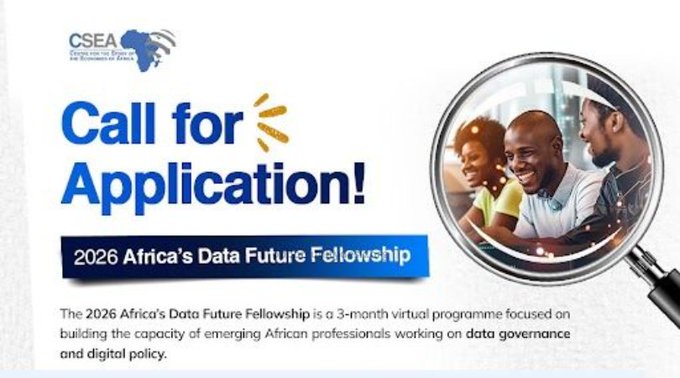
The Centre for the Study of the Economies of Africa (CSEA) is inviting applications for the 2026 Africa’s Data Future Fellowship, a three-month remote capacity-building programme designed for emerging leaders working at the intersection of data governance, digital policy, technology and development across Africa.
Beginning in October 2026, the fellowship will provide selected participants with opportunities to strengthen their expertise, engage with leading sector experts and contribute practical research and policy perspectives to Africa’s evolving digital ecosystem.
Fellowship Overview
The 2026 Africa’s Data Future Fellowship will be delivered virtually over a three-month period. Fellows will participate in bi-weekly virtual expert brainstorming sessions, masterclasses and sector engagements, while developing an individual fellowship output focused on a pressing data governance or digitalisation issue.
The programme will be conducted in English and French, making it accessible to professionals across Africa’s diverse policy and technology landscape.
As part of the fellowship, participants are also expected to engage with a relevant institution within the data and digital policy ecosystem in their respective countries. This institutional placement will provide an opportunity for fellows to disseminate and discuss the findings of their fellowship outputs with relevant stakeholders.
Key Thematic Areas
Applicants will explore one or more of the fellowship’s six priority thematic areas:
• Digital Rights
• Data Sharing
• Data Value Chain
• Digital Public Infrastructure
• Regulatory Interoperability
• Data Sovereignty
These areas reflect some of the most important policy questions shaping Africa’s digital transformation, including how data is governed, shared, protected and converted into economic and social value.
Fellowship Benefits
Successful fellows will gain access to a combination of financial support, professional development and Pan-African networking opportunities.
Key benefits include:
• A stipend of up to US$1,500 upon successful completion of the fellowship
• Bi-weekly virtual masterclasses and expert sessions with sector leaders
• Opportunities to engage with professionals and experts in data governance and digital policy
• Selected fellowship work featured on CSEA’s platforms
• Access to a Pan-African professional network of practitioners, researchers and emerging leaders
The fellowship is particularly valuable for professionals seeking to strengthen their policy research, thought leadership and stakeholder engagement capabilities within Africa’s rapidly evolving digital economy.
Expected Fellowship Outcomes
Each fellow will be required to produce substantive written work addressing a relevant challenge within the selected thematic area.
By the end of the programme, fellows are expected to develop:
• A detailed policy brief addressing a relevant data governance or digitalisation issue
• A blog post based on one of the fellowship’s thematic areas
• A presentation of their work at a dedicated fellowship workshop
The programme therefore combines capacity building with practical research and policy communication, enabling fellows to translate their knowledge into outputs that can contribute to ongoing discussions around Africa’s digital future.
Eligibility Requirements
The fellowship is open to qualified applicants who meet the following minimum requirements:
• Hold a postgraduate degree and have at least one year of professional experience in social sciences, law, technology, data policy or a related field
• Be from and currently resident in an African country
• Be professionally engaged in data governance, digital policy, Artificial Intelligence, technology or a related field
• Currently work or engage professionally within sectors such as government, private companies, AI start-ups, fintech, edtech, healthtech, agritech, research institutions, policy think tanks, universities or civil society organisations
• Demonstrate an interest in or experience related to the public sector, data governance, digital policy and/or technology
• Be able to commit at least two hours per week throughout the three-month fellowship
• Have reliable internet access and a functional computer for the duration of the programme
Application Requirements
The fellowship will be awarded through a competitive selection process based on applications submitted by eligible candidates.
All applications must be completed through the designated online application system and submitted in English.
Applicants are required to provide:
• A completed application form
• A CV of no more than two pages
• A statement of interest of no more than 300 words, explaining their interest in the selected fellowship thematic areas
• A problem statement of no more than 300 words, outlining a data governance or digitalisation challenge in their sub-region related to one or more of the fellowship’s thematic areas
• A writing sample, such as a policy brief or research paper, addressing data governance, Artificial Intelligence, digital policy or a related subject
Applicants should ensure that their submissions clearly demonstrate relevant professional experience, strong analytical and writing abilities, and a genuine interest in shaping Africa’s data and digital policy landscape.
Application Deadline
The application deadline for the 2026 Africa’s Data Future Fellowship is 18 September 2026.
Prospective applicants are encouraged to prepare their CV, statement of interest, problem statement and writing sample in advance to ensure that their application is complete and submitted before the deadline.
For additional information and enquiries, applicants can contact [email protected].
An Opportunity to Shape Africa’s Digital Future
The 2026 Africa’s Data Future Fellowship offers an opportunity for emerging African professionals to deepen their understanding of critical data governance and digital policy issues while connecting with experts and peers from across the continent.
Through its focus on digital rights, data sharing, data value chains, digital public infrastructure, regulatory interoperability and data sovereignty, the programme seeks to strengthen the capacity of professionals who can contribute to more effective, inclusive and sustainable digital governance in Africa.
With a three-month virtual structure, expert-led learning, practical policy outputs, institutional engagement and a stipend of up to US$1,500, the fellowship provides a strong platform for professionals looking to expand their influence in Africa’s data and digital policy ecosystem.