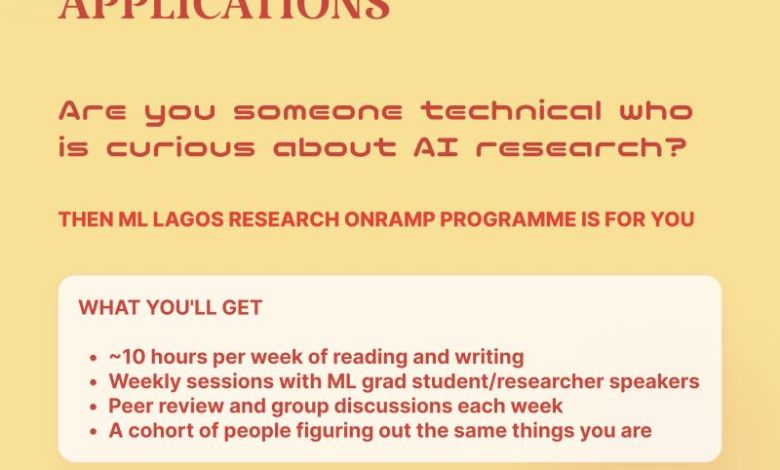
The ML Lagos Research Onramp Programme offers an opportunity for students, software developers and technically minded learners who are interested in artificial intelligence research but are unsure how to get started.
The eight-week programme is specifically designed for absolute beginners in AI research, providing structured exposure to research papers, analysis, research questions and collaborative learning.
Unlike advanced AI research programmes, the Research Onramp is intended for participants who may already have technical or machine learning experience but have limited experience with the research process. It provides a practical introduction to what AI research involves and helps participants determine whether pursuing research is the right next step for them.
The programme is structured around approximately 10 hours of learning and independent work per week over eight weeks. Participants will read real AI research papers, analyse research ideas, write their own reflections and review the work of other participants.
Each week introduces participants to a different area of artificial intelligence through guided readings, practical tasks and structured discussions. Participants will also have opportunities to learn from ML graduate students and researchers who can provide guidance throughout the programme.
The programme does not follow a conventional classroom format. Instead, participants learn through a combination of reading, writing, reflection, peer review and discussion.
This approach is designed to help learners develop the habits required for research while allowing them to explore different areas of AI before making longer-term decisions about their careers or studies.
What Participants Can Expect
Participants should expect to dedicate around 10 hours each week to independent reading and writing. The programme is designed to fit alongside full-time employment or academic studies, although consistent participation is required.
Key components of the programme include:
- Approximately 10 hours of independent reading and writing each week
- Flexible learning that can be combined with work or study
- Guided exposure to major areas of AI research
- Weekly sessions with ML graduate students and researchers
- Peer review and group discussions
- Practical research-analysis tasks
- Development of a final research proposal
- Guidance on potential future opportunities
- Participation in a cohort of other aspiring AI researchers
The combination of independent work and group interaction allows participants to develop research skills while receiving support from people with experience in machine learning research.
Who Can Apply?
The ML Lagos Research Onramp Programme is aimed at people who have technical foundations but are new to AI research.
Potential participants include:
- Software developers interested in exploring machine learning research
- Undergraduate students studying computer science or related technical disciplines
- Postgraduate students seeking an introduction to AI research
- Self-taught learners with demonstrable technical foundations
- Technical professionals considering a transition towards AI research
Applicants should be prepared to participate consistently throughout the eight-week programme and take responsibility for completing the required reading, writing and research activities.
The programme may be particularly useful for someone who understands programming or machine learning concepts but has never learned how to systematically read academic papers, analyse research findings or formulate research questions.
Prerequisites for the Programme
A formal research background is not required. However, applicants should have technical foundations in computer science, machine learning or a related field.
These foundations may come from a university degree, professional experience, self-study or a combination of different learning experiences.
Self-taught applicants are encouraged to demonstrate their technical commitment through something concrete. Examples may include:
- A software or machine learning project
- A completed technical course
- A technical article
- Code they have written
- Other evidence of sustained technical learning
The emphasis is therefore on having a sufficient technical foundation rather than already possessing academic research experience.
Who Should Not Apply?
The programme is deliberately introductory and may not be suitable for people who already have substantial AI research experience.
It is unlikely to be the right fit for individuals who already regularly conduct AI research, critically analyse research papers, develop research questions or have published AI research.
Similarly, people looking specifically for advanced implementation training or publication support may find the programme too introductory.
The programme is instead designed to answer an important question for beginners: Is AI research a path worth pursuing?
What Happens After the Programme?
One of the programme’s objectives is to help participants make informed decisions about their next steps.
By the end of the eight weeks, participants should have a clearer understanding of AI research, their own interests and whether they genuinely want to continue pursuing research.
Participants who decide to continue will receive guidance on relevant courses, communities, programmes and other opportunities in Nigeria and beyond. Where possible, the programme may also help participants connect with people and organisations working in areas related to their interests.
The programme recognises that not everyone who explores AI research will ultimately want to become a researcher. Participants may discover that they prefer software engineering, AI systems development or another technology pathway. This exploration is considered a useful outcome in itself.
Final Research Proposal
A key component of the Research Onramp experience is the development of a final research proposal.
This gives participants an opportunity to apply the research-reading and analysis skills developed throughout the programme. It can also help participants identify areas of AI that they find particularly interesting and provide a starting point for future learning.
The proposal is therefore part of the broader goal of helping beginners move from general curiosity about AI research towards a clearer understanding of possible research directions.
Why Consider the ML Lagos Research Onramp Programme?
For technically trained students and professionals, moving from machine learning implementation to research can be difficult without knowing where to begin. Academic papers can be challenging to interpret, and developing meaningful research questions requires skills that are not always taught through conventional programming or machine learning courses.
The ML Lagos Research Onramp Programme addresses this gap by providing structure, guidance, peer interaction and exposure to real research.
Over eight weeks, participants can gain practical experience with research-oriented reading and writing while learning alongside other people interested in AI.
Most importantly, the programme is designed to provide clarity rather than simply another certificate or completed course. Participants can use the experience to determine whether AI research aligns with their interests and, if so, identify realistic next steps for continuing their development.
Conclusion
The ML Lagos Research Onramp Programme provides an introductory pathway for technically capable beginners who want to explore AI research. With eight weeks of guided learning, approximately 10 hours of weekly work, researcher-led sessions, peer review and a final research proposal, the programme offers a structured way to understand what AI research actually involves.
For students, developers and self-taught technical learners who are curious about research but have not yet developed research skills, the programme can provide an opportunity to explore the field before committing to a longer academic or professional pathway.
Those interested should ensure they meet the technical prerequisites and are able to participate consistently throughout the eight-week programme.