
A polished study listing isn’t the final word on an opportunity. To find verified study opportunities in 2026, use listings to discover relevant options, then compare their details with the responsible institution’s current information before you apply.
It’s reasonable to be cautious: search results can mix degree levels, eligibility rules, study formats, and funding arrangements. Deadlines and application instructions may also change after publication. This guide will help you narrow your search, assess whether an opportunity fits your circumstances, and understand what its stated funding covers.
Opportunity For Africa shares verified opportunities for Africans, with listings across scholarships, undergraduate and postgraduate study, courses, training, conferences, and research opportunities. Use these listings to discover options, then confirm eligibility, deadlines, financial coverage, and application steps with the responsible provider. A clear record of what you’ve checked will make it easier to compare opportunities and plan your next step.
Key Takeaways
- To find verified study opportunities, start with your study goal and use focused criteria to narrow your search.
- Compare each listing with the provider’s current opportunity page, including the title, eligible applicants, study level, subject, and format.
- Compare degree study, courses, training, research, and conferences by purpose and eligibility before deciding which options fit.
- Keep a shortlist that records each provider, opportunity type, deadline, funding terms, and source reviewed.
- Use Opportunity For Africa to discover scholarships, study pathways, courses, training, and research opportunities for Africans.
Find verified study opportunities by starting with your study goal
To find verified study opportunities, begin with a clear goal rather than a broad search. A verified opportunity is one whose key details, such as the provider, eligibility, and application route, can be checked against information from the responsible institution or organization. This is about verifying the opportunity itself, not independently confirming a student’s academic credentials.
Discovery platforms help surface options across institutions and fields, but a listing is a starting point, not the final authority on an application. The provider’s current information determines who qualifies, what the opportunity involves, and whether its instructions or dates have changed. A focused search makes it easier to find relevant options and compare them consistently.
Before searching, write down what you want to study, the level you’re prepared for, and the outcome you’re working toward. Someone aiming to enter a degree programme, for example, will need a different search from a learner seeking a short course to build a specific skill. If scholarships are part of your search, understanding the range of types of educational scholarships can help you identify which award descriptions need closer review.
Set your study level, subject, and preferred format
Define your search using three practical filters: study level, subject, and format. Consider whether you’re seeking undergraduate, postgraduate, doctoral, short-course, or research opportunities. Then identify a subject area that connects your academic background with your next step, whether that’s further study, a research pathway, or professional development.
Choose a format that fits your circumstances and goals: in-person study, online learning, training, or a research placement. Write down your preferences before searching. They’ll help you distinguish a relevant listing from one that shares a subject keyword but offers a different level, delivery format, or outcome.
Know what a verified opportunity does and does not mean
A verification label is a useful discovery cue, but it doesn’t replace checking the provider’s current information. Confirm that the opportunity is active and that its eligibility requirements, format, benefits, deadlines, and application instructions match the provider’s latest details. A listing may not reflect a later update.
Opportunity verification is separate from academic-record verification. The first concerns whether an opportunity’s details can be checked with its responsible provider. The second concerns confirming a person’s degree, enrollment, attendance, or transcript, typically through the institution that holds those records. One does not establish the other.
Use that distinction to guide your next step: treat directories as tools for discovering possibilities, then rely on the responsible provider’s current page for application decisions. With your study goal defined, you can assess each option by fit before spending time on its application requirements.
How to verify study opportunity details before you apply
Before investing time in an application, compare the listing with information from the organization responsible for the opportunity. Follow these checks in order and note what you confirm. A directory can help you identify an option, but current provider information should guide your application decisions.
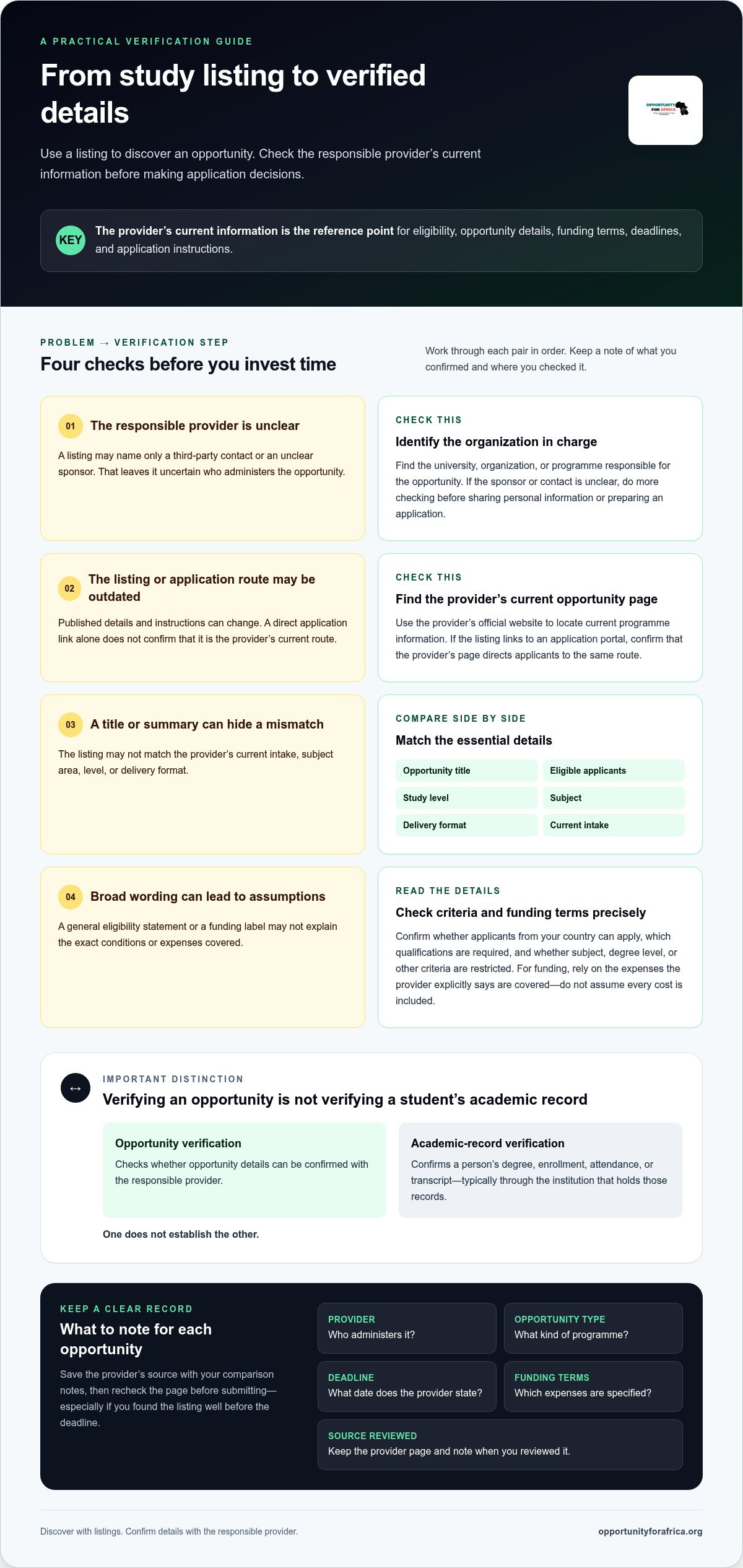
- Identify the responsible provider. Determine which university, organization, or programme administers the opportunity. If a listing names only a third-party contact or an unclear sponsor, do more checking before sharing personal information or preparing an application.
- Locate the provider’s current opportunity page. Use the provider’s official website to find current programme information. If the listing links directly to an application portal, confirm that the provider’s page directs applicants to the same route.
- Compare the essential details. Check that the title, eligible applicants, study level, subject, and delivery format match. Then review the deadline, application steps, required documents, and any stated funding coverage.
Match the listing to the provider’s current information
Compare details side by side rather than relying on memory. A listing may describe a postgraduate research placement, while the provider’s current page specifies a different intake or subject area. Note when you reviewed the provider page and save its link with your application records. Recheck it before submitting, especially if you found the listing well before the deadline.
Check eligibility, funding terms, and application requirements
Read eligibility conditions precisely. Confirm whether applicants from your country can apply, which academic qualifications are required, whether a subject or degree level is restricted, and whether the opportunity has other stated criteria. Don’t infer eligibility from a general description such as “open to international students.” Look for the provider’s detailed applicant requirements.
Review funding language just as carefully. “Fully funded,” “partially funded,” and “unfunded” should be understood through the expenses the provider explicitly says are covered. A scholarship description may specify tuition support without explaining other costs, so don’t assume every expense is included. For general background on awards and eligibility, Federal Student Aid provides guidance on finding legitimate scholarships and study aid. Its guidance is U.S.-focused, so use the relevant provider’s terms for opportunities elsewhere.
Check the application route and document list against the provider’s instructions. Record whether you need a form, academic documents, references, a research proposal, or other materials only when the provider states that requirement. Save the deadline with its time zone if one is given, and note any separate dates for different application stages.
Pause if core details conflict, remain unclear, or aren’t available in the provider’s information. Don’t submit documents or make decisions based on an unresolved mismatch in the opportunity title, eligibility, funding, deadline, or application route. Return to the provider’s current information and resolve the discrepancy first. To continue your search, browse study opportunity listings, then compare relevant options with the responsible provider’s latest details.
Compare study opportunity types and choose relevant options
Study opportunities serve different goals, schedules, and academic stages. Compare the format and expected outcome before prioritizing an option: a degree programme, a short course, a research placement, and an academic conference aren’t interchangeable, even when they share a subject area. Funding also varies by opportunity, so assess the stated coverage rather than assuming support is available or comprehensive.
| Opportunity type | Typical purpose | Eligibility clues | Details to verify |
|---|---|---|---|
| Degree study | Earn an undergraduate, postgraduate, or doctoral qualification. | Prior education, academic results, subject background, and degree level. | Credential awarded, programme structure, format, duration, admission requirements, and funding coverage. |
| Short course | Build knowledge or skills in a defined subject area. | Prerequisite knowledge, professional background, or target learner group. | Learning objectives, schedule, completion credential, delivery format, and any stated costs or support. |
| Online course | Study remotely, often alongside other commitments. | Subject prerequisites and access to the stated online learning requirements. | Live or self-paced format, time commitments, assessment, credential, and access conditions. |
| Training | Develop practical or professional capabilities. | Relevant experience, role, career stage, or specified participant group. | Skills covered, participation requirements, schedule, delivery method, and completion outcomes. |
| Research opportunity | Contribute to or develop work on a research project. | Academic stage, subject expertise, methods experience, or project-specific prerequisites. | Project scope, supervisor or host, expected contribution, duration, location, and funding terms. |
| Academic conference | Present or discuss work and engage with a scholarly field. | Student or researcher status, relevant topic, and any submission criteria. | Attendance or presentation format, abstract deadlines, participation conditions, and stated support. |
Compare the pathway with your next step
Degree study usually follows a structured curriculum toward a formal qualification. Short courses and training focus on a narrower learning objective, while online courses describe a delivery format that can apply to different kinds of learning. Research opportunities vary: some are designed for students building experience, while others require advanced subject knowledge or a defined research proposal. Conferences may support learning and scholarly exchange, but they aren’t substitutes for a degree or course credential.
Ask what the opportunity will help you do next. If you want a formal qualification, check the degree level and credential. If you need a specific skill, compare course objectives and schedules. For research or conference options, look for a clear match between your experience, the project or topic, and any participation requirements.
Assess funding and participation conditions
Read funding descriptions for named expenses, exclusions, and payment arrangements. A scholarship label alone doesn’t show whether tuition, travel, accommodation, or other expenses are covered. Record only what the opportunity explicitly states, and treat unspecified costs as unanswered rather than included.
Then check how participation works. Confirm whether attendance is in person, online, or a combination, whether travel is required, and whether the schedule fits your existing commitments. This comparison helps you find verified study opportunities that fit your qualifications, goals, and practical circumstances, then focus on options that support your next academic or professional step.
Build a focused search and application shortlist
A shortlist turns scattered search results into a manageable set of options you can assess and act on. Use the same workflow for degree programmes, courses, training, research, and conferences: define your criteria, search with purpose, record promising options, compare provider information, and prioritize the best fits. This keeps your attention on opportunities that match your goals, not simply those with the most prominent name or broadest funding language.
Use search terms that reflect your qualifications and goals
Combine the details that matter: study level, subject, applicant eligibility, and format. For example, search for a postgraduate subject area alongside your intended qualification, or pair a research topic with your current academic stage. Add “scholarship” when funding is relevant. Otherwise, include terms such as “online course,” “training,” or “research placement.” Refine your search with the outcome you want, such as a degree, a specific skill, or research experience.
Keep searches specific enough to filter out mismatched results, but not so narrow that you miss opportunities described with different terminology. Try a few variations, then assess each result against the criteria you set at the start. If you’re seeking a course, for instance, include both the subject and the skill you aim to develop. To find verified study opportunities efficiently, treat search terms as filters for relevance, not as proof that a listing is current or suitable.
Turn search results into an application-ready shortlist
Record each promising option in one document or spreadsheet. Capture the provider, opportunity type, eligibility, deadline, funding terms, link to the provider’s current information, and the date you reviewed it. Add a status such as “ready to assess,” “needs clarification,” or “not a fit” so your next action is visible. Recheck time-sensitive details with the provider before acting.
Use a simple, repeatable process:
- Define your criteria. Note the level, subject, format, eligibility, intended outcome, and whether funding is necessary.
- Search across relevant categories. Look beyond scholarships when courses, training, research, or conferences could also meet your goal.
- Record plausible options. Add the provider and the information needed to compare each listing consistently.
- Review fit and readiness. Compare your qualifications and schedule with the provider’s requirements, and mark unresolved questions.
- Prioritize the next action. Focus first on options with a clear fit, requirements you can meet, and an application route you can follow.
Rank options by suitability and readiness, not prestige or a “fully funded” label alone. An opportunity may sound attractive but be a poor match for your study level, subject, schedule, or qualifications. A less prominent course or research placement may directly support your next step. Keep unclear eligibility or funding terms flagged until the provider’s information resolves them; don’t treat missing details as confirmation.
Build your shortlist from opportunities relevant to your goals, then use Opportunity For Africa’s study and learning listings to discover options for Africans.
Discover study options via Opportunity For Africa
Opportunity For Africa shares verified opportunities for Africans across study and learning categories. Its listings include scholarships, undergraduate and postgraduate study, short courses, online courses, training, conferences, and research opportunities. This range helps you explore options beyond a single degree level or type of funding while keeping your search focused on opportunities intended for Africans.
Use the platform to discover possibilities that match your goal, then assess each relevant listing against the responsible provider’s current information. Opportunity For Africa is a discovery platform, not the institution that sets a programme’s admission requirements or application terms. The provider’s information remains essential for confirming eligibility, deadlines, application instructions, and stated financial coverage before you decide to apply.
Explore opportunity categories that match your next step
Start with the category closest to your intended outcome. If you’re pursuing a formal qualification, explore undergraduate or postgraduate study and scholarships linked to relevant programmes. If you want to build a specific skill, compare short courses, online courses, and training by subject, format, and stated learning outcomes. Research opportunities may suit learners looking to develop experience in a field, while conferences offer a different route for academic exchange and participation.
Keep these pathways distinct. A course or training opportunity may support professional development without awarding a degree; a conference is not a substitute for a study programme. Before adding an option to your shortlist, consider whether its level, format, subject, and requirements align with your qualifications, schedule, and next step. If the listing describes an award, don’t assume that funding covers every expense. Check exactly what the responsible provider says is included.
Move from discovery to a prepared application
Once you identify a promising listing, open the responsible provider’s current information and compare it with the listing. Recheck eligible applicants, academic or subject requirements, the application route, required documents, deadline, and funding terms. If a detail is missing or conflicts with the provider’s information, resolve that before relying on it or preparing an application.
Keep your shortlist organized by recording the provider, opportunity category, eligibility, deadline, funding terms, source reviewed, and date checked. Prioritize options with a clear fit and requirements you can address, rather than ranking them by reputation or funding language alone. This makes it easier to see which opportunities are ready for your attention and which need further review.
To find verified study opportunities without starting from broad, unfiltered searches, explore categories that match your goal and use provider information to confirm the details. Explore verified study opportunities for Africans, then select a relevant listing and verify its current application requirements.
Take the next step toward your study goal
Your search becomes more useful when it leads to one clear action. Choose an opportunity that fits your academic or professional direction, then set aside time to review its provider information and prepare the next required step. If the timing or requirements aren’t right, keep it on your shortlist for reference and move to an option you can act on now.
To find verified study opportunities, stay focused on fit and ground your decisions in current information from the responsible provider. A considered application starts with a realistic match between your goals and the opportunity, not pressure to pursue every listing that looks promising.
Opportunity For Africa gives you a place to continue your discovery. Explore verified study opportunities for Africans and identify an option that aligns with your next step. Start with a focused search, review the provider’s details, and shortlist the opportunity that best fits your goals.
Frequently Asked Questions
How can I find verified study opportunities online?
To find verified study opportunities online, define your study level, subject, preferred format, and eligibility before searching. Try combinations such as “postgraduate public health research opportunity” or “online data analysis course” to make results more relevant. Use directories and opportunity platforms to discover options, then identify the responsible institution or organization. Keep a shortlist with source links and review dates, and revisit provider information before applying if the opportunity is time-sensitive.
How do I check whether a study opportunity is legitimate?
Check whether the organization responsible for the opportunity publishes matching information through its official channels. Compare the opportunity name, eligibility criteria, application instructions, and funding description with the listing. If an application link leads to another site, check whether the responsible provider identifies that site as part of its application process. Treat missing or conflicting core details as a reason to pause, not as proof that the listing is reliable.
What does fully funded mean in a study opportunity?
“Fully funded” describes an opportunity’s stated financial support, but the phrase alone doesn’t tell you which expenses are covered. Read the provider’s terms for named costs, conditions, exclusions, and how support is provided. For example, tuition coverage doesn’t automatically establish that travel or living expenses are included. If the information doesn’t specify a cost, don’t count it as covered in your planning. Use the provider’s written terms to assess your likely funding needs.
Can African students apply for international study opportunities?
Yes, African students can apply for international opportunities when they meet the specific eligibility conditions. Those conditions may vary by country, academic qualification, subject, and study level, so a broad description such as “international applicants” may not answer whether you qualify. Check whether your country and background meet the provider’s current criteria. If eligibility wording leaves a material question unanswered, resolve it with the responsible provider before spending time on application documents.
What information should I compare before applying for a study opportunity?
Compare the provider, opportunity title, eligible applicants, study level, subject, format, application route, required documents, deadline, and stated funding coverage. Also note differences in wording between the listing and provider page, such as a programme name that appears under a department or faculty. Record when you checked the information. This gives you a clear reference if details change while you prepare your application.
Are online courses and short courses considered study opportunities?
Yes. Structured learning opportunities include online and short courses, as well as degree study, training, and research. Their purpose and outcomes differ: a short course may focus on a defined topic, while an online course describes how learning is delivered. Before choosing one, check its intended learners, schedule, participation requirements, and whether a credential is stated. Compare those details with your goal rather than assuming every course offers the same academic or career value.
What should I do if a listing has different details from the provider’s page?
Use the responsible provider’s current information as your reference for application decisions, and pause if important details don’t match. Compare the deadline, eligibility, funding conditions, and application route, then update your notes with the information you can verify and the date you reviewed it. Don’t rely on an older listing to prepare or submit an application. Recheck the provider’s instructions before acting, especially if you saved the opportunity some time ago.