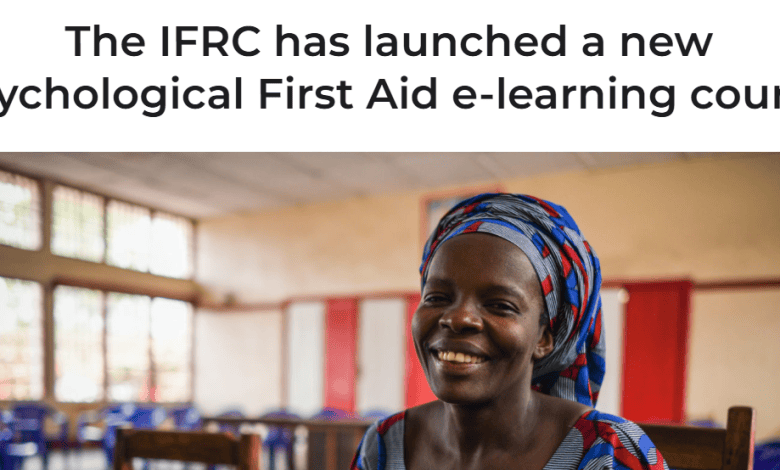
The International Federation of Red Cross and Red Crescent Societies (IFRC) has launched a Psychological First Aid (PFA) e-learning course designed to give people around the world practical introductory skills for supporting individuals experiencing distress during or after crises.
Developed by the IFRC in collaboration with the Danish Red Cross, the course is available through the IFRC Learning Platform and takes approximately 90 minutes to complete. It is self-paced, allowing learners to work through the training according to their own schedule.
The course forms part of the broader “Psychological First Aid for All” initiative, which aims to increase access to psychological first aid knowledge and strengthen global capacity to provide psychosocial support.
Psychological First Aid is an approach used to provide humane, supportive and practical assistance to people experiencing distress following emergencies, crises or other difficult events.
The new IFRC course provides an introductory learning experience for people who want to understand the principles of PFA and learn practical ways of responding to someone who may be experiencing emotional distress.
According to the MHPSS Hub, the course is designed to introduce learners to practical guidance that can be applied when supporting people affected by challenging circumstances.
Rather than requiring participants to attend a classroom-based training programme, the course is delivered online and can be completed independently.
What Does the Course Cover?
The 90-minute e-learning course introduces several important aspects of Psychological First Aid and provides practical guidance that learners can apply when interacting with someone experiencing distress.
Key areas covered include:
- How to comfort someone experiencing distress
- Ways to help a person feel safe and calm
- Common patterns of reactions to crises
- How to help individuals connect with additional support
- Self-care practices for people providing support
These areas are intended to give learners a foundation for understanding how psychological first aid can be used appropriately in crisis and humanitarian contexts.
The training also highlights the importance of helping people connect with further support where necessary rather than attempting to address every need independently.
Who Can Benefit From the Training?
The course is intended to make Psychological First Aid knowledge more accessible to people worldwide.
Because it is an online, self-paced course, it may be useful to individuals who cannot easily access physical training events. Learners interested in humanitarian work, community support, emergency response, health-related fields or psychosocial support may find the introductory training particularly relevant.
Potential learners may include:
- Humanitarian workers
- Volunteers
- Community-based workers
- Students
- People interested in psychosocial support
- Individuals involved in emergency response
- Red Cross and Red Crescent Movement personnel
- Professionals seeking introductory PFA knowledge
The course can also serve as an accessible introduction for people who want to understand Psychological First Aid before pursuing more advanced training.
Self-Paced Online Learning
One of the key features of the programme is its self-paced format. Learners do not need to attend a scheduled classroom session and can complete the approximately 90-minute course through the IFRC Learning Platform.
This format can make the training easier to fit around work, studies, volunteering or other responsibilities.
The availability of online learning is also consistent with the broader objective of expanding access to Psychological First Aid training for people who may not be able to participate in face-to-face programmes.
Psychological First Aid for All Initiative
The e-learning course contributes to the “Psychological First Aid for All” pledge, an initiative focused on increasing global capacity for Psychological First Aid through advocacy, training and integration.
The pledge was jointly submitted in December 2019 by the Danish Red Cross, Netherlands Red Cross, IFRC and IFRC Psychosocial Centre during the 33rd International Conference.
According to the MHPSS Hub, the commitment was endorsed by 25 National Societies and one State.
The initiative seeks to expand access to PFA knowledge and resources, supporting efforts to integrate psychological first aid into broader humanitarian and community-based responses.
International Access to the Course
The initiative is designed with a global audience in mind. The course was launched in English through the IFRC Learning Platform, with plans announced for availability in Spanish, French and Arabic later in the year.
Making the course available in multiple languages is intended to broaden access to Psychological First Aid resources across different regions and communities.
For individuals working in international development and humanitarian environments, access to introductory PFA training can complement other professional and volunteer skills.
Why Psychological First Aid Skills Matter
Emergencies, disasters, displacement, conflict and other crises can have significant effects on people’s emotional and psychological wellbeing. People providing humanitarian or community support may therefore encounter individuals who are distressed or struggling to cope.
Psychological First Aid focuses on providing appropriate immediate support while helping people connect with additional assistance when needed.
The IFRC course introduces learners to practical approaches for responding to distress while also highlighting self-care for those providing support.
This makes the training relevant not only to the person receiving assistance but also to people involved in supporting others during challenging circumstances.
How to Access the Course
Interested learners can access the Psychological First Aid e-learning course through the IFRC Learning Platform.
The training takes approximately 90 minutes and is designed to be completed at the learner’s own pace. Participants should review the course information and follow the registration or access instructions provided on the learning platform.
The course is particularly relevant for people seeking an accessible introduction to Psychological First Aid without having to attend a physical training event.
Conclusion
The IFRC Psychological First Aid e-learning course provides a short and accessible way for individuals worldwide to gain introductory knowledge of psychological first aid. Developed with the Danish Red Cross, the approximately 90-minute self-paced course covers supporting people in distress, helping individuals feel safe and calm, understanding common crisis reactions, connecting people with further support and practising self-care.
As part of the broader Psychological First Aid for All initiative, the course contributes to efforts to expand access to PFA training internationally.
For students, volunteers, humanitarian workers, community workers and others interested in psychosocial support, the online course offers an opportunity to develop foundational knowledge that can complement existing professional or community-based skills.