Dreaming of a PhD in the UK without worrying about tuition? Durham University, one of Britain’s most respected universities, has opened a competition for up to eleven fully funded PhD studentships in Transformative Humanities. The studentships start in October 2027, and international students are eligible. This guide covers what the funding includes, who can apply, and how to submit a strong application before the deadline.
What Is the Transformative Humanities PhD Studentship?
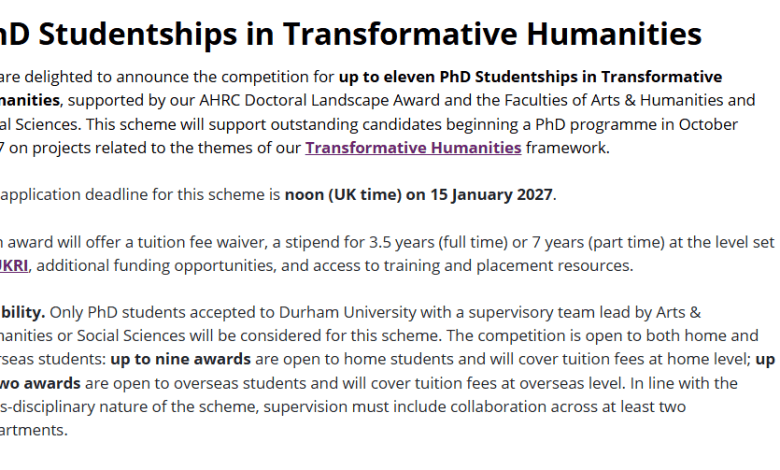
The scheme is supported by Durham’s AHRC Doctoral Landscape Award and the Faculties of Arts and Humanities and Social Sciences. It backs outstanding candidates whose projects fit the university’s Transformative Humanities framework. This approach combines rigorous, interdisciplinary humanities research with a commitment to addressing real-world challenges and creating impact beyond the academy.
In plain terms, Durham wants research that is intellectually serious and also matters to society.
What Does the Funding Cover?
Each award offers:
- A tuition fee waiver
- A stipend at the level set by UKRI, for 3.5 years (full-time) or 7 years (part-time)
- Additional funding opportunities
- Access to training and placement resources
Who Can Apply? Eligibility Explained
The competition is open to both home and overseas students:
- Up to 9 awards for home students, covering tuition at the home rate
- Up to 2 awards for overseas students, covering tuition at the overseas rate
Two other conditions apply:
- You must be accepted to a Durham PhD programme with a supervisory team led by Arts and Humanities or Social Sciences.
- Your supervision must involve collaboration across at least two departments, reflecting the scheme’s cross-disciplinary nature.
Overseas places are limited to two, so competition will be strong. That makes a polished, well-matched proposal essential.
Spotlight: Visual and Material Culture Meets Medical Humanities
One Durham academic has publicly invited applications for projects that bring visual and material culture into dialogue with the medical and health humanities. If your idea involves medical imagery, objects of care, the history of the body, health narratives, or how illness and healing are represented, this is a strong fit. This invitation comes from an individual academic, so the scheme as a whole is open to any project that fits the Transformative Humanities themes.
How to Apply: Step by Step
- Contact potential supervisors first. Durham recommends discussing your project with them before applying.
- Choose the lead supervisor’s department. Applications go to that department’s PhD programme: Classics and Ancient History, English Studies, History, Modern Languages and Cultures, Music, Philosophy, or Theology and Religion.
- Flag the scheme. Under “Scholarship details” in the funding section, type “Transformative Humanities”. List any other schemes you want to be considered for.
- Prepare your documents:
- A research proposal of up to 1,000 words including footnotes, excluding bibliography. It should define your research questions and context, your approach and methods, why your project is relevant to transformative humanities, and why Durham is the right fit.
- A CV of no more than two pages.
- An equal opportunities monitoring form. You’ll receive a code after submitting it, so keep it as proof.
- Contact details for two referees.
The application link is expected to appear on the official Durham page in October.
Key Dates to Save
| Event | Date |
|---|---|
| Online info and Q&A session (Teams) | 10 November 2026, 11am UK time |
| Application deadline | 15 January 2027, noon UK time |
| Outcome notification | March 2027 |
For readers in Southern Africa (CAT), the info session is at about 1pm and the deadline is 2pm local time on the day.
Tips for a Winning Application
Start with the supervisor. A supportive, well-matched supervisory team is the foundation of the application, and the cross-department requirement means you need to plan early.
Use your 1,000 words carefully. Each sentence should serve a purpose: your question, your method, your contribution, and why Durham. Skip the filler.
Show real-world impact. The scheme is about transformation, so explain who beyond academia could benefit from your findings.
Attend the info session. It’s your chance to ask questions directly, and it’s free.
Apply early. Referees and forms take time, and a noon deadline leaves no room for last-minute problems.
Final Thoughts
A fully funded PhD at Durham University is rare. With tuition covered, a UKRI-level stipend, and training support, this scheme lets researchers focus on ideas that matter. If your project fits, start emailing supervisors this week.
Questions? Contact the Arts and Humanities PGR team by email
Know a researcher who should see this? Share this article with them today.
Always confirm details on Durham University’s official studentship page before applying.