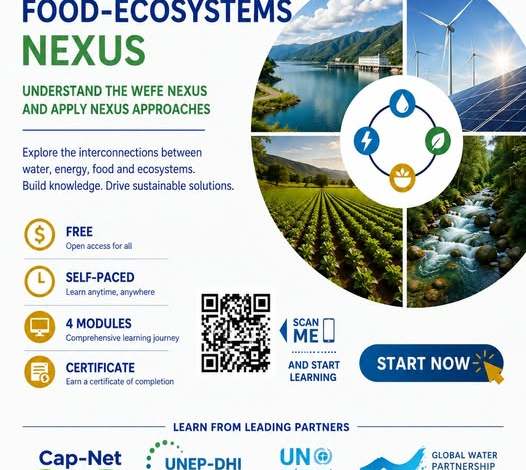
Professionals and practitioners working in water, energy, food systems, ecosystems, climate change and sustainable development can now access a free global training course on the Water-Energy-Food-Ecosystems (WEFE) Nexus.
The Global Dimensions of the Water-Energy-Food-Ecosystems Nexus course expands a training initiative originally developed for the Mediterranean region into a global learning opportunity. The course brings together examples, case studies and perspectives from Africa, Asia, Europe, Latin America, the Middle East and Small Island Developing States.
The training was developed by the Global Water Partnership Mediterranean (GWP-Med), implemented through Cap-Net UNDP and supported by the UNEP-DHI Centre. It builds on work undertaken through the Global Environment Facility (GEF)/UNEP-MAP MedProgramme.
Participants can explore how water, energy, food and ecosystems are interconnected and how integrated approaches can help identify synergies, manage trade-offs and develop more sustainable solutions.
What Is the Global WEFE Nexus Course?
The WEFE Nexus approach recognises that water, energy, food and ecosystems cannot always be managed effectively as separate sectors.
A decision affecting one resource can have consequences for the others. For example, agricultural production depends on water and energy, while water and energy infrastructure can affect ecosystems. Climate change and resource pressures can further intensify these interconnections.
The course introduces participants to approaches for understanding these relationships and using them to support more coordinated decision-making.
The global version builds on the experience of a Mediterranean training programme that was originally designed to strengthen the capacity of policymakers and experts across the region.
It now extends that learning to a wider international audience.
What Will the Course Cover?
The training explores the practical application of the WEFE Nexus approach and how stakeholders can move from identifying interconnections to developing integrated responses.
Key areas covered include:
- WEFE Nexus concepts and frameworks
- Interlinkages between water, energy, food and ecosystems
- Synergies and trade-offs between different sectors
- Climate change impacts
- Scenario development
- Indicators and evidence
- Governance and institutional coordination
- Stakeholder engagement
- Financing integrated solutions
- Operationalising WEFE Nexus approaches
- Sustainable and resilient resource management
The course also uses examples and case studies from different geographical contexts.
This global perspective is intended to demonstrate that while countries and regions face different environmental, economic and institutional circumstances, many of the underlying challenges associated with interconnected resources are shared.
Why the WEFE Nexus Matters
Water, energy, food and ecosystems are facing growing pressures from climate change, population growth, resource scarcity and environmental degradation.
Managing these pressures can be difficult when institutions and sectors operate independently.
The Nexus approach encourages decision-makers and practitioners to consider interactions between sectors before developing policies, investments or projects.
This can help identify potential benefits while also recognising trade-offs. An integrated approach can support more efficient use of resources and help reduce risks to ecosystems and communities that depend on them.
For professionals working on sustainable development, climate resilience or natural resource management, understanding these interconnections can therefore be relevant to policy development, project design and stakeholder coordination.
From Mediterranean Experience to Global Learning
The course has its roots in the Mediterranean region.
It was originally developed under the GEF/UNEP-MAP MedProgramme, where GWP-Med worked to strengthen capacity among policymakers and experts from MedProgramme beneficiary countries.
The original training focused on the particular environmental and resource-management challenges faced by Mediterranean countries.
The new global course retains the core objective of understanding interconnections and promoting joint solutions while expanding the geographical scope of its learning materials.
Examples from Africa, Asia, Europe, Latin America, the Middle East and Small Island Developing States allow participants to explore how WEFE challenges vary between regions.
The initiative demonstrates how knowledge and experience developed through a regional programme can be adapted and shared with a wider global community.
Who Can Benefit From the Course?
The free course can be relevant to a broad range of professionals and practitioners working on interconnected environmental and development issues.
Potential participants include:
- Water resources professionals
- Environmental specialists
- Climate change practitioners
- Energy professionals
- Food and agricultural specialists
- Ecosystem and conservation practitioners
- Policymakers and government officials
- Researchers and academics
- Sustainable development professionals
- Project managers
- Development practitioners
- Stakeholder engagement specialists
- Professionals working on climate adaptation and resilience
The course may also be useful for professionals seeking to strengthen their understanding of integrated approaches to resource management.
Skills and Knowledge Participants Can Develop
Through the training, participants can strengthen their understanding of how to analyse complex relationships between resource systems and environmental objectives.
The course’s focus on scenario development, indicators, evidence, governance, stakeholder engagement and financing also provides a practical dimension.
Rather than considering water, energy, food and ecosystems in isolation, participants are introduced to methods for examining their interactions and considering how different interests can be brought together.
This knowledge can be applied to policy discussions, development planning, environmental projects and resource-management initiatives.
How to Register for the Free Course
Interested participants can register through the official Cap-Net platform, where the global WEFE Nexus course is hosted.
Applicants should:
1. Visit the official course registration page
Go to the WEFE Global course page provided by Cap-Net.
2. Review the course information
Read the available information about the training, its objectives and intended participants before registering.
3. Complete the registration
Follow the instructions on the official platform to register for the learning opportunity.
4. Access the course
Once registration is completed according to the platform’s requirements, participants can access the available learning materials and training activities.
The course is presented as a free learning opportunity, making it accessible to practitioners interested in strengthening their knowledge of integrated water, energy, food and ecosystem management.
A Global Opportunity for Sustainable Development Practitioners
The expansion of the WEFE Nexus course provides an opportunity for professionals across different regions to learn from both Mediterranean experience and international case studies.
By connecting knowledge from different geographical and institutional contexts, the course highlights the importance of collaboration when addressing complex environmental challenges.
Participants can use the learning experience to deepen their understanding of integrated resource management and explore approaches for addressing synergies and trade-offs between water, energy, food and ecosystem objectives.
Key Details at a Glance
Course: Global Dimensions of the Water-Energy-Food-Ecosystems Nexus
Format: Online learning opportunity
Cost: Free
Focus: Water, energy, food and ecosystems
Geographical scope: Global
Examples: Africa, Asia, Europe, Latin America, Middle East and Small Island Developing States
Developed by: Global Water Partnership Mediterranean
Implemented through: Cap-Net UNDP
Supported by: UNEP-DHI Centre
Original initiative: GEF/UNEP-MAP MedProgramme
Target audience: Policymakers, experts, practitioners and others working on WEFE-related issues
Professionals interested in climate resilience, sustainable development and integrated resource management can use the Global Dimensions of the WEFE Nexus course to develop a broader understanding of how interconnected resource systems can be addressed through coordinated approaches.