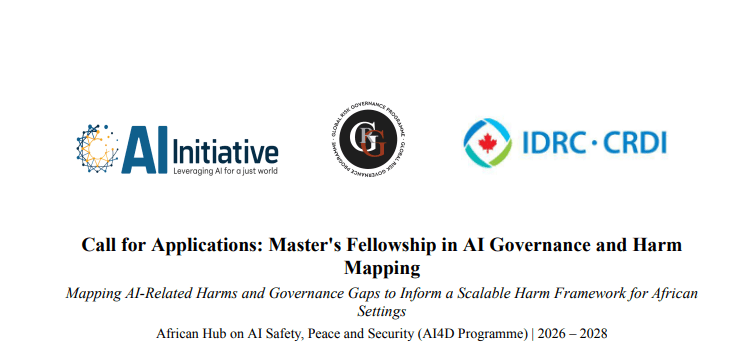
Applications are now open for a Master’s Fellowship in AI Governance and Harm Mapping, offering an opportunity for an emerging African researcher to investigate how artificial intelligence-related harms are experienced across African contexts and identify governance gaps that leave these risks insufficiently addressed.
Based at the African Hub on AI Safety, Peace and Security under the Artificial Intelligence for Development (AI4D) Programme, the fellowship will support a Master’s student undertaking research at the intersection of artificial intelligence, governance, regulation, risk, public policy, and social justice.
The selected fellow will receive funding of approximately R150,000 per annum for two years, representing total support of around R300,000. The funding is intended to contribute towards tuition, living costs, and research support.
The research will be supervised by Dr Annette Hübschle and Professor Jonathan Shock at the University of Cape Town.
Applications are considered on a rolling basis until the position is filled, making early applications particularly important for eligible candidates.
A Research Opportunity Focused on Africa’s Emerging AI Challenges
Artificial intelligence is increasingly influencing societies, economies, governments, and public services around the world. While AI technologies may create significant opportunities, their development and deployment can also produce or reinforce different forms of harm.
The Master’s Fellowship in AI Governance and Harm Mapping seeks to examine these challenges specifically within African contexts.
The selected student will investigate how AI-related harms manifest across Africa and explore the governance and regulatory gaps that may allow such harms to remain unaddressed.
Rather than viewing harm only as a series of isolated incidents, the proposed research will draw on harmscapes thinking. This approach seeks to understand harm as layered, interconnected, and structural.
This perspective could help researchers examine how technological risks interact with wider systems, institutions, inequalities, and social conditions.
The research is expected to contribute towards the development of a scalable AI safety risk framework that is appropriate for resource-constrained African settings.
What Is Harmscapes Thinking?
A central feature of the proposed research is its use of a harm-based and structural approach to understanding AI risks.
AI-related harms can take many forms and may affect different communities in different ways. Some risks may be immediately visible, while others may develop gradually through systems, policies, institutional practices, or unequal access to resources and opportunities.
The fellowship will encourage the selected researcher to explore these interconnected dimensions.
By examining harms as part of a broader landscape rather than as isolated events, the research aims to identify patterns and governance gaps that may otherwise be overlooked.
This approach is especially relevant in the context of rapidly evolving AI technologies, where regulatory frameworks and governance systems may struggle to keep pace with technological development.
The findings could help inform approaches to AI safety, risk governance, regulatory analysis, and responsible technology development in African contexts.
About the African Hub on AI Safety, Peace and Security
The fellowship is based at the African Hub on AI Safety, Peace and Security, which forms part of the Artificial Intelligence for Development (AI4D) Programme.
The opportunity provides a research environment for examining the relationship between AI technologies and major governance, safety, peace, and security questions affecting African societies.
The selected Master’s student will have an opportunity to focus on a rapidly growing area of research while contributing to discussions around how AI governance frameworks can respond more effectively to the realities of African countries and communities.
The fellowship may therefore be particularly relevant to candidates interested in ensuring that AI policy and safety discussions reflect local contexts, structural inequalities, institutional realities, and resource constraints.
Who Should Apply?
The fellowship is open to candidates with an Honours degree or an equivalent qualification in a relevant discipline.
Suitable academic backgrounds include:
- Law
- Governance
- Public policy
- Criminology
- International relations
- Related social science disciplines
Applicants should demonstrate a strong interest in areas connected to:
- AI governance
- Artificial intelligence policy
- Regulatory analysis
- Technology governance
- AI safety
- Risk analysis
- Structural approaches to harm
- Harm-based approaches to risk
- Public policy and emerging technologies
Candidates should also possess strong analytical, communication, and organisational skills.
Because the fellowship focuses on an emerging and interdisciplinary research area, applicants with the ability to connect questions of technology with law, governance, society, policy, and risk may be particularly well positioned.
Funding Worth Approximately R300,000
The successful candidate will receive funding of approximately R150,000 per annum over two years.
The total fellowship support is approximately R300,000 over the full two-year period.
The funding is intended to support:
- Tuition costs
- Living expenses
- Research-related activities
This financial support is designed to enable the selected Master’s student to focus on conducting substantial research into AI governance and harm mapping.
Prospective applicants should carefully review the full call for applications for detailed information regarding how the funding will be administered and any conditions attached to the studentship.
Supervision at the University of Cape Town
The Master’s research will be supervised by Dr Annette Hübschle and Professor Jonathan Shock at the University of Cape Town.
The selected student will undertake research in an interdisciplinary environment addressing questions related to AI, risk, governance, safety, and African development.
For candidates seeking to develop specialist expertise in AI governance, the fellowship offers an opportunity to undertake focused research on a topic that is becoming increasingly important for policymakers, governments, researchers, technology institutions, and civil society.
The growing adoption of AI across different sectors has also increased demand for research capable of examining not only technological capabilities but also the governance systems required to identify, prevent, and respond to potential harms.
African Applicants Strongly Encouraged
Applications are particularly encouraged from South African and other African nationals.
The call also places particular emphasis on encouraging applications from candidates from previously disadvantaged groups.
This focus reflects the importance of ensuring that research and policy discussions concerning AI safety and governance include perspectives rooted in the communities and contexts where these technologies are increasingly being developed and deployed.
The fellowship presents an opportunity for an African researcher to contribute directly to shaping discussions around the future of responsible and accountable AI.
How to Apply
Interested applicants should carefully review the full call for applications for complete information on eligibility requirements, funding arrangements, research expectations, and the application process.
Candidates should ensure that they meet the academic requirements and demonstrate a clear interest in AI governance, regulatory analysis, or structural and harm-based approaches to risk.
Because applications are reviewed on a rolling basis until the position is filled, eligible candidates are strongly encouraged to submit their applications as early as possible.
Fellowship at a Glance
Programme: Master’s Fellowship in AI Governance and Harm Mapping
Research Area: AI governance, AI safety, harm mapping and risk
Host: African Hub on AI Safety, Peace and Security
Programme: Artificial Intelligence for Development (AI4D) Programme
University: University of Cape Town
Funding: Approximately R150,000 per annum
Total Funding: Approximately R300,000 over two years
Funding Covers: Tuition, living costs and research support
Eligibility: Honours degree or equivalent in a relevant discipline
Preferred Applicants: South African and other African nationals
Application Review: Rolling basis
Closing Date: Until the position is filled
Interested candidates should consult the official call for applications for complete eligibility and application instructions before applying.