The Center of Research for Environment, Energy and Water (CREEW) has opened applications for the 18th CREEW Research Grant Program (CREEW-RGP) 2026/2027, supporting Master’s students in Nepal undertaking research in water, environment, natural resources, energy, climate change, and related fields.
The program is implemented with financial support from the Kurita Water and Environment Foundation (KWEF), Japan, and aims to strengthen scientific research and evidence-based development in Nepal. The application deadline is 20 November 2026.
About the CREEW Research Grant Program
CREEW is a non-profit, non-governmental organisation dedicated to scientific research and development in Nepal. Since its establishment in 2009, the organisation has undertaken self-initiated and collaborative research addressing environmental, water, energy and natural resource challenges.
The CREEW Research Grant Program provides financial support to eligible Master’s students developing their graduate thesis research. In addition to funding, selected researchers receive technical mentorship and feedback from CREEW-associated scientists, experts, senior researchers and professionals.
Grant recipients participate in three key research presentations: the initial research proposal presentation, a mid-term presentation and a final presentation. These engagements enable researchers to refine their methodology, discuss progress and strengthen their research findings.
Eligibility Requirements
Applicants must satisfy all of the following conditions:
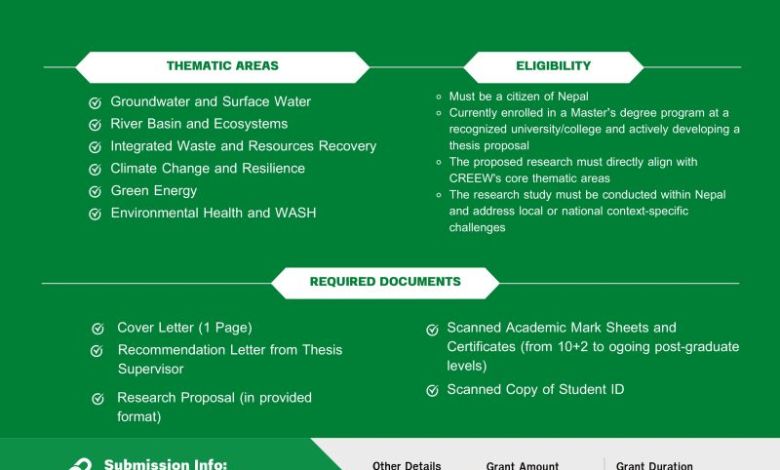
- Be a citizen of Nepal.
- Be currently enrolled in the second year of a Master’s degree at a recognised university or college.
- Be actively developing a Master’s thesis proposal.
- Propose research that aligns directly with one or more of CREEW’s priority thematic areas.
- Conduct the research within Nepal and address a local or national context-specific challenge.
Priority Research Areas
CREEW encourages proposals addressing issues related to groundwater and surface water, including water quality, pollution, hydrogeology, groundwater management, water resource assessment and sustainable hydropower.
Other priority areas include river basins and ecosystems, covering integrated water resources management, hydrology, watershed health, river restoration, biodiversity and ecosystem management.
The program also welcomes research on integrated waste management and resource recovery, including recycling, waste treatment, circular economy, waste-to-energy, e-waste, hazardous waste, landfill engineering and greenhouse gas emissions.
Under climate change and resilience, eligible themes include climate impacts, adaptation and mitigation, climate modelling, climate finance, disaster risk reduction, disaster risk management and climate resilience.
Research involving green energy may focus on solar, wind, biomass, biogas, hydropower, energy mixes, carbon footprints, green economy and waste-to-energy solutions.
The environmental health and WASH theme covers water quality, household water treatment, WASH in schools, menstrual hygiene, environmental health risks, emerging pollutants, nutrition, maternal and child health, and transboundary pollution.
Required Application Documents
Applicants must combine the required materials into one PDF file, arranged in the prescribed order. The application should include:
- A maximum one-page cover letter explaining the proposed research and its relevance to CREEW’s thematic areas.
- A research proposal prepared according to CREEW’s required format.
- Academic mark sheets and certificates from 10+2, undergraduate study and the ongoing Master’s program, including first- and second-semester records.
- A valid student identification card.
- A signed supervisor consent and recommendation letter, together with a one- to two-page supervisor CV.
The supervisor must send the recommendation directly to [email protected] using the subject line “CREEW Grant 2026/27 Recommendation and Consent Letter for Students Name.” Each supervisor may recommend a maximum of two students.
Research Proposal Format
The main proposal must not exceed nine pages, excluding the prescribed preliminary components where applicable. It should contain a cover page, table of contents and the main proposal.
The proposal should include a summary of no more than 250 words, introduction, research background, problem statement, research questions, objectives, materials and methods, study-area description, data-collection methods, data analysis, methodological flow chart, research matrix, expected results, research plan and schedule, detailed research budget and references.
The main proposal should use Times New Roman, with Heading 1 in 12-point bold, Heading 2 in 11-point bold, Heading 3 in 11-point italic and normal text in 12-point font with 1.5 line spacing. APA 7th Edition should be used for citations and references.
Grant Period and Conditions
Successful applicants are expected to complete their research during the January to June 2027 CREEW Research Grant Program period.
Selected grantees and their supervisors must participate in person in the proposal, mid-term and final research presentations. CREEW may also appoint a co-supervisor where it considers this necessary.
Applications that fail to comply with the specified guidelines may be disqualified. Only shortlisted applicants will be contacted.
How to Apply
Eligible applicants should submit their applications online through the official CREEW application portal.
The application PDF should follow the required naming convention:
Application Deadline: 20 November 2026
Research Location: Nepal
Program Period: January–June 2027
Target Applicants: Second-year Master’s students who are citizens of Nepal
Applicants should carefully review the proposal requirements and ensure that every required document is included before submission. Strong applications should clearly demonstrate the relevance of the proposed research to Nepal’s environmental, water, energy, climate or natural resource challenges.
Why This Grant Is Valuable
The CREEW Research Grant provides Master’s students with an opportunity to strengthen their thesis research through financial assistance, technical guidance and interaction with experienced researchers and professionals. The structured presentations also give grantees opportunities to receive feedback at different stages of the research process.
For students working on practical environmental and development challenges in Nepal, the program can provide an avenue to develop evidence-based research while building academic and professional research experience.
Official Application Information
Applicants should use the CREEW online application platform and carefully follow all instructions contained in the official call for proposals. They should also verify eligibility, documentation, formatting, proposal length and submission requirements before the 20 November 2026 deadline.