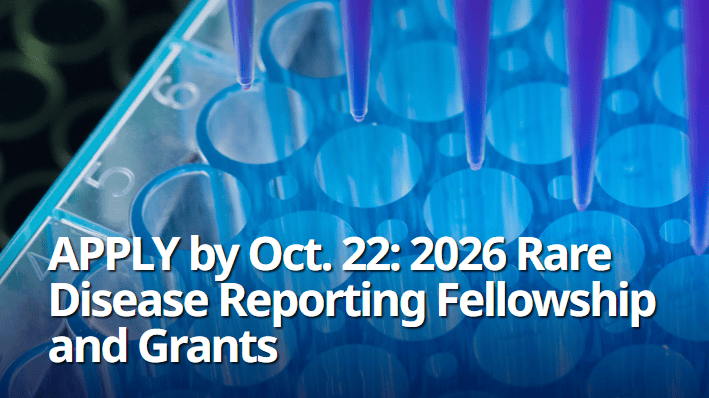
The National Press Foundation (NPF) has opened applications for the 2026 Rare Disease Reporting Fellowship and Grants, a journalism training opportunity for professional journalists worldwide. Supported by Fondation Ipsen, the programme will provide intensive online training focused on rare disease reporting, emerging biotechnology, healthcare access, and the experiences of people living with rare diseases.
The fellowship will run from 16 to 20 November 2026, with virtual sessions held daily from 8:00 a.m. to 12:00 p.m. Eastern Time. The application deadline is 22 October 2026 at 11:59 p.m. ET.
About the Rare Disease Reporting Fellowship
The National Press Foundation is offering the fellowship as part of its efforts to help journalists improve coverage of complex health and science issues. Rare diseases affect an estimated 300 million people globally, while thousands of identified conditions continue to present challenges related to diagnosis, treatment, research, healthcare access, and inclusion.
The 2026 fellowship will give selected journalists an opportunity to engage directly with medical experts, researchers, patient advocates, and experienced journalists. The programme will examine developments in biotechnology and their potential implications for patients and families, while equipping participants with information and reporting approaches for producing accurate and impactful stories.
Fellowship Training Programme
The online training will feature on-the-record expert briefings and question-and-answer sessions covering a range of rare disease topics. Key areas will include rare disease research in Africa, AI-driven drug development, childhood genetic testing and screening, and the importance of more inclusive clinical trials.
Participants will also hear from leaders of international patient advocacy organizations and veteran journalists who cover rare diseases and related healthcare issues.
All accepted fellows are required to attend every training session. The programme will be conducted in English, meaning applicants working in any language or medium must demonstrate fluency in English.
Reporting Grants for Journalists
In addition to the journalism training, the National Press Foundation will provide up to $2,000 in reporting grants to 20 journalists. The grants are intended to support expenses such as travel and time required to develop and complete an original rare disease reporting project.
Eligible grant recipients will receive $1,000 after completing the fellowship training and a further $1,000 after submitting their completed work.
Grant-supported projects must be published no later than 1 March 2027. The work will first appear through the journalist’s selected publication or media outlet before being reprinted in a compilation book produced by Fondation Ipsen.
Who Can Apply?
The fellowship is open to professional journalists based in any country. Applicants may work in a variety of media, including:
- Print journalism
- Broadcast journalism
- Online media
- Social media journalism
Journalists may work in any language, but they must be fluent in English because all fellowship sessions will be delivered in English.
The programme is competitive, and applicants should demonstrate professional journalism experience and an interest in reporting on rare diseases, healthcare, biotechnology, science, medicine, or related issues.
Employment and Editorial Requirements
Employed journalists must provide a letter of support from their editor. The letter should confirm that the journalist will be allowed to take approximately four hours away from regular work each day from 16 to 20 November 2026 to participate fully in the training.
Freelance journalists must submit a letter from an editor indicating interest in publishing their proposed rare disease reporting project.
Applicants should therefore arrange the required editorial documentation before submitting their fellowship application.
Fellowship Benefits
Selected participants will gain access to specialized journalism training, direct engagement with leading experts, and insights into emerging developments in rare disease research and treatment. Grant recipients will additionally receive up to $2,000 in reporting support for eligible projects.
The programme can also provide journalists with opportunities to strengthen their health and science reporting skills, develop specialist knowledge, and produce stories that increase public understanding of rare diseases and the issues affecting patients and families.
Application Deadline and How to Apply
The application deadline is 22 October 2026 at 11:59 p.m. ET. Interested journalists should complete the official online application and ensure that any required editor or publication support letter is included.
Applicants should carefully review the fellowship requirements before submitting their applications. Questions about the programme can be directed to Celia Milch by email.