£12 Million FCDO Funding for SRHR Research 2026
Research institutions in low- and middle-income countries (LMICs) have an opportunity to lead a major international research initiative through the Sexual and Reproductive Health and Rights (SRHR) Applied Research Centre, commissioned by the UK Foreign, Commonwealth and Development Office (FCDO).
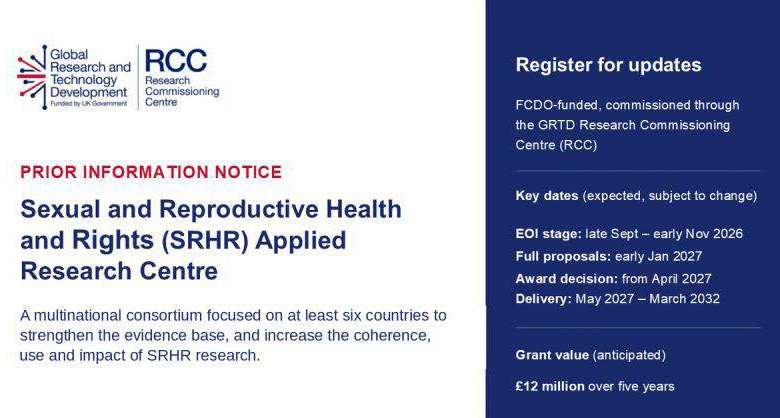
The competition offers an accountable grant worth up to £12 million to establish a research centre focused on improving sexual and reproductive health and rights, strengthening evidence-based policymaking and addressing gaps in the delivery of effective health services across diverse country settings.
The centre will be led by an eligible LMIC institution or an eligible institutional partnership involving LMIC organisations, with the research consortium expected to work across at least six low- and middle-income countries. The initiative is designed to strengthen locally led research, support equitable international partnerships and improve the practical use of research evidence.
Expressions of Interest (EOIs) must be submitted by 30 November 2026 at 17:00 GMT.
SRHR Applied Research Centre Funding: Key Details
- Funding opportunity: SRHR Applied Research Centre
- Commissioning organisation: UK Foreign, Commonwealth and Development Office (FCDO)
- Research commissioning centre: Global Research and Technology Development (GRTD) Research Commissioning Centre (RCC), co-led by 3ie and the University of Birmingham
- Maximum grant value: Up to £12 million
- Funding type: Accountable grant
- Programme period: July 2027 to March 2032
- Application deadline: 30 November 2026, 17:00 GMT
- Target applicants: Eligible public universities, non-profit research organisations and qualifying private universities with clearly defined non-profit divisions
- Geographical focus: At least six diverse low- and middle-income countries
- Competition format: Two stages — Expression of Interest followed by Full Proposal
- Proposal development support: Up to £30,000 for shortlisted applicants progressing to the Full Proposal stage, subject to due diligence and contracting
- Official information: GRTD Research Commissioning Centre funding page
About the SRHR Applied Research Centre
The research centre aims to address persistent gaps in the evidence on comprehensive sexual and reproductive health and rights. Although evidence supports many effective SRHR interventions, important questions remain about why proven services are not consistently delivered, accessed or taken up by particular populations and in specific geographical settings.
The proposed centre will bring together researchers and institutions across disciplines and SRHR specialisms to generate policy-relevant evidence, strengthen research partnerships and support improvements in service access, choice, quality and sustainability.
The initiative also contributes to the UK’s International Women and Girls’ Strategy 2023–2030.
The selected consortium will demonstrate LMIC thought leadership while developing inclusive, equitable and mutually beneficial research partnerships. Its work will cover several areas of comprehensive SRHR rather than necessarily addressing every domain.
Research Priorities and Thematic Areas
The competition identifies several areas of interest for the proposed research centre.
1. Access to high-quality, person-centred SRHR services
Research may explore the barriers that prevent people from accessing appropriate sexual and reproductive health services, including differences in service availability, quality and uptake across population groups.
2. Health systems and implementation evidence
The centre will investigate how health systems can better deliver effective interventions and services. This includes generating practical evidence that policymakers and programme implementers can use to improve service delivery.
3. Equality, inclusion and rights
Research will address questions concerning equitable access to SRHR services, the protection of rights and the experiences of different population groups.
4. Fragile and conflict-affected settings
The initiative highlights research in fragile and conflict-affected contexts, where health systems and access to essential services may face particular challenges.
5. Digital technologies and innovation
Applicants may consider how digital approaches and other innovations can contribute to improved SRHR services and outcomes, where aligned with the consortium’s proposed research priorities.
The research priorities will be identified by the applying consortium and should respond to relevant questions across its selected country contexts.
How the Research Centre Will Operate
The proposed centre will have two complementary pillars.
Pillar 1: Applied Research, Evidence Synthesis and Knowledge Mobilisation
Approximately 80% of the funding is expected to support this core function. It will generate and mobilise evidence to improve SRHR outcomes in low- and middle-income countries.
Activities will include multidisciplinary, policy-relevant research, evidence curation, communications and convening. The emphasis is on ensuring that research addresses important evidence gaps and is used to inform policy and practice.
Pillar 2: Responsive Evidence, Advisory Support and Rapid Research
Approximately 20% of the funding is expected to support rapid-response research and advisory services for FCDO policy teams, country offices and partners.
This pillar will help decision-makers access timely evidence and specialist expertise as policy and programming needs emerge. It is expected to begin as a pilot lasting approximately six to twelve months, with its approach refined according to demand and lessons learned.
The stated funding proportions are indicative and may change.
Who Is Eligible to Apply?
The competition is designed for institutional consortia rather than individual researchers applying independently.
Eligible consortium leads must be one of the following:
- A public university.
- A non-profit research organisation.
- A private university with a clearly defined non-profit division.
The lead institution must be registered as a legal entity in the relevant country. Other eligible non-profit organisations from low-, middle- and high-income countries may participate as consortium members but cannot serve as leads under the stated criteria.
The consortium must have at least one and no more than two lead organisations. A consortium of approximately six to eight organisations is recommended, with a maximum of ten.
The lead must be an LMIC institution or an eligible partnership involving LMIC institutions. The proposed research centre must focus on at least six diverse LMICs, including countries in Africa and/or South or Southeast Asia, with some fragile or conflict-affected settings included in the geographical scope.
An organisation may lead or co-lead only one Expression of Interest and may participate in up to three applications in total.
Important eligibility update: The call guidance was updated on 8 October 2026 to clarify that for-profit research organisations are not eligible for this competition. Applicants should download and follow the latest version of the official call document.
Funding Amount and Duration
The selected research centre may receive an accountable grant of up to £12 million for the programme period running from July 2027 to March 2032.
In addition, applicants shortlisted for the Full Proposal stage may receive up to £30,000 in proposal development support to help develop their full submissions. This support is subject to light-touch due diligence and contracting with the Research Commissioning Centre.
The £30,000 is proposal development support, not an automatic additional award for every applicant. Eligibility for this support depends on progressing to the relevant stage and meeting the applicable conditions.
The final grant award and ongoing management of the selected research centre will be led directly by FCDO.
How Applications Will Be Evaluated
Expressions of Interest will be assessed against four equally weighted criteria:
- Alignment with the call scope and intended impact — 25%
- Research quality — 25%
- Expertise and capabilities of consortium leads and members — 25%
- Consortium structure and governance arrangements — 25%
Applicants should ensure that their proposed research aligns closely with the call’s objectives, demonstrates a credible approach to research quality and policy impact, and establishes clear roles and governance arrangements across the consortium.
The full call document provides the detailed assessment requirements and should be consulted before preparing an application.
Important Application Dates
Applicants should plan around the following indicative competition timeline:
- 30 September 2026: Expression of Interest competition launched.
- 6 October 2026: Virtual question-and-answer webinar.
- 6 November 2026: Deadline for submitting questions.
- 30 November 2026, 17:00 GMT: Expression of Interest deadline.
- 8 January 2027: Applicants notified of shortlisting decisions.
- 26 January 2027: Indicative completion of due diligence and contracting for proposal development grants.
- 1 February 2027: Full Proposal phase launched.
- 16 April 2027, 17:00 GMT: Full Proposal deadline.
- 28 May 2027: Funding decision to the preferred bidder.
- Early June 2027: Accountable grant expected to be signed.
- July 2027–March 2032: Planned programme period.
Dates may be revised, so applicants should monitor the official competition page for updates.
How to Apply for the SRHR Applied Research Centre
Eligible organisations wishing to compete should follow these steps:
- Read the updated call guidance. Review the full Call for Expressions of Interest document and all eligibility requirements.
- Build an eligible consortium. Identify an appropriate LMIC lead or co-leads and assemble research and non-profit partners with complementary expertise.
- Develop the research concept. Identify priority SRHR evidence gaps and explain how the proposed work could influence policy, improve services and support outcomes across at least six LMICs.
- Review the evaluation criteria. Ensure that the proposed research, consortium capabilities and governance arrangements respond to all four assessment categories.
- Prepare the Expression of Interest. Follow the official application template and instructions. A full research centre budget is not required at the EOI stage.
- Submit through SmartSimple. Applications must be submitted through the RCC grant management platform by 17:00 GMT on 30 November 2026. Late applications will not be considered.
The official competition page provides the call document, application templates, grant management system, user guide, proposal development guidance, FAQs and relevant FCDO policies.
Applicants should use the GRTD Research Commissioning Centre’s official SRHR Applied Research Centre competition page to access the current call documents and SmartSimple application platform. If the direct page is not readily accessible, the RCC team can be contacted at [email protected].
For clarification questions, use the subject line “SRHR – Request for clarification” and submit questions by 6 November 2026. To request the Q&A webinar recording and slides, use the subject line “SRHR – Webinar and Slides”.
Final Thoughts
The SRHR Applied Research Centre competition represents a major opportunity for eligible LMIC-led research consortia to shape international evidence and policy on sexual and reproductive health and rights. With funding of up to £12 million and a planned programme period extending to March 2032, the initiative is intended to support sustained, policy-relevant research across diverse country settings.
Eligible universities and non-profit research institutions should begin consortium discussions early, examine the latest guidance and ensure their Expressions of Interest are submitted before the 30 November 2026 deadline.
The competition is institutional and consortium-based, so individual researchers should explore participation through an eligible organisation rather than assume they can apply independently.