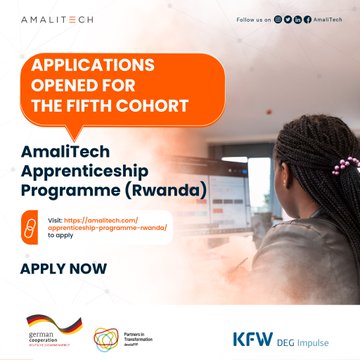
AmaliTech is offering a paid Apprenticeship Programme in Rwanda to help aspiring technology professionals develop practical software development and data engineering skills. Funded by DEG Impulse, the programme combines technical training, mentorship and real-world project experience to prepare participants for careers in the global technology sector.
The programme is delivered in Kigali and offers two entry pathways: a six-month apprenticeship for early-career talent and recent graduates, and a four-month apprenticeship for mid-level professionals with at least two years of experience. Both pathways require full-time participation.
Participants can specialise in areas including Java Backend Development, Python Backend and AI Application Development, JavaScript Full Stack Development, Data Engineering, Quality Assurance (QA) and DevOps.
About the AmaliTech Apprenticeship Programme
The AmaliTech Apprenticeship Programme is designed to bridge the gap between academic learning and professional technology employment. Through practical projects and structured learning, apprentices develop technical competencies and gain experience relevant to software engineering and digital service delivery.
The programme focuses on preparing participants to work on technology projects for global clients. It is suitable for eligible candidates who want to strengthen their technical expertise, develop professional working habits and establish long-term careers in technology.
Available Specialisations
Applicants can pursue one of several technical pathways, depending on the programme level and available opportunities.
1. Data Engineering
Participants develop skills in SQL, Python, extract-transform-load (ETL) processes and cloud platforms such as Amazon Web Services (AWS) and Microsoft Azure. The specialisation focuses on transforming raw data into useful insights for organisations.
2. Python Backend and AI Application Development
This pathway covers Python, Flask, Django and introductory artificial intelligence and machine learning concepts. Participants learn to build scalable backend applications and explore the development of intelligent software solutions.
3. Java Backend Development
Apprentices develop skills in Java, Spring Boot and enterprise software systems, with an emphasis on building reliable and scalable backend applications.
4. Quality Assurance (QA)
The QA specialisation introduces software testing, test-case development, bug tracking and continuous integration and continuous delivery (CI/CD) practices. These skills help ensure software reliability and performance.
5. JavaScript Full Stack Development
Participants learn web technologies such as HTML, CSS, JavaScript, React and Node.js to build applications covering both frontend and backend development.
6. DevOps
This pathway focuses on Linux, Git, CI/CD workflows and cloud technologies, including AWS and Azure. Participants learn practices that support efficient software deployment and delivery.
Apprenticeship Levels and Duration
The programme offers two full-time pathways.
Entry-Level Apprenticeship
- Duration: Six months.
- Location: Kigali, Rwanda.
- Commitment: Full-time.
- Target group: Early-career technology talent and recent graduates.
This pathway is designed for candidates who are beginning their professional technology careers and want structured training, mentorship and practical project experience.
Mid-Level Entry Apprenticeship
- Duration: Four months.
- Location: Kigali, Rwanda.
- Commitment: Full-time.
- Experience requirement: At least two years of experience.
This pathway is intended for professionals with previous experience who want to strengthen their technical capabilities and prepare for more advanced responsibilities.
Both pathways are advertised as paid apprenticeships. The source announcement does not specify the exact salary or stipend.
Eligibility Requirements
Applicants must meet the following criteria:
- Be currently based in Rwanda or willing to relocate there.
- Be available to participate full-time for the entire programme.
- Be a final-year university student or recent graduate in Computer Science, Information Technology, Engineering, Data Science or a related field.
- Have at least six months of practical programming experience gained through training, internships, university work, personal projects, hackathons, online courses or similar activities.
- Demonstrate a genuine interest in software development and a commitment to building a long-term technology career.
- Be able to work independently, take initiative and complete assigned tasks with minimal supervision.
- Demonstrate adaptability, accountability and a willingness to learn continuously.
- Possess strong problem-solving, teamwork and communication skills.
- Be fluent in written and spoken English.
The mid-level pathway additionally targets professionals with at least two years of experience. Applicants should confirm any further requirements through the relevant application form.
Application and Selection Process
AmaliTech uses a multi-stage recruitment process to assess candidates’ eligibility, technical ability and suitability for the programme.
Stage 1: Screening and Shortlisting
Applications are reviewed against the minimum eligibility criteria. Candidates who meet the requirements may progress to the assessment stage.
Stage 2: Assessment
Shortlisted applicants receive an email invitation to complete computer-based assessments. These include a General Coding Assessment (GCA), a cognitive test and a project challenge.
Stage 3: Interviews
Candidates who pass the assessments may be invited to an in-person interview day at AmaliTech Rwanda in Kigali. The process consists of a technical interview and a culture-fit interview.
Stage 4: Offer and Onboarding
Successful candidates proceed to offer preparation, communication, acceptance and documentation before being handed over to the programme team for onboarding.
Applicants should monitor their email regularly throughout the selection process.
How to Strengthen an Application
Applicants should prepare examples of practical programming experience, including personal projects, university assignments, internships, hackathons or work completed through online courses.
Candidates should select a specialisation that aligns with their existing skills and career goals. Reviewing core concepts in their chosen field may also help them prepare for the coding assessment and project challenge.
Strong applications should demonstrate problem-solving ability, teamwork, communication skills and a willingness to learn. Applicants should also be prepared to explain their projects, describe their individual contributions and discuss how the apprenticeship fits into their long-term career plans.
Why Consider the AmaliTech Apprenticeship?
The programme offers an opportunity to gain paid, practical technology training while developing skills in areas relevant to software engineering and data-driven business operations. Its emphasis on mentorship, technical assessments and real-world projects can help eligible candidates strengthen their readiness for professional technology roles.
For candidates based in Rwanda, or those willing to relocate to Kigali, the apprenticeship provides a structured route to developing specialised technical skills and gaining experience in a professional environment.
Application Deadline and Official Application Link
The supplied programme information does not specify an application deadline or provide a direct application-form URL. Applicants should visit AmaliTech’s official website to check whether applications are currently open and identify the correct form for their preferred programme level.
VISIT OFFICIAL WEBSITE TO APPLY
Applicants can also contact Theogene Muhire, Recruitment Manager in Rwanda, through the contact options provided on the official website.