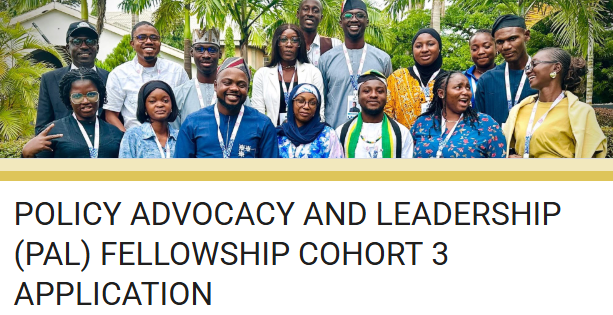
The Policy Advocacy and Leadership (PAL) Fellowship Cohort 3 is inviting applications from young professionals interested in policy development, research, advocacy, governance, and public leadership across Nigeria’s 19 Northern States and the Federal Capital Territory (FCT).
Organised by CYPA AFRICA, the PAL Fellowship is designed to develop a new generation of policy thinkers, researchers, advocates, and public-sector leaders capable of contributing to evidence-based policymaking and governance at the subnational level.
About the PAL Fellowship
The PAL Fellowship is built on six interconnected pillars: Policy, Research, Strategy, Advocacy, Leadership, and Ideas. The programme recognises that many challenges affecting communities require more than effective implementation. They also require strong ideas, capable leadership, institutional capacity, rigorous research, and practical policy solutions.
Through an intensive learning experience, selected Fellows will engage with policymakers, academics, legislators, development practitioners, and governance experts. Participants will strengthen their ability to analyse complex public problems, develop evidence-based recommendations, communicate policy ideas, and influence decision-making.
A central component of the Fellowship is the preparation of an individual evidence-based policy brief. Each Fellow will identify an important policy challenge affecting their state or community and develop practical, context-specific recommendations. Selected policy briefs may be presented to policymakers and compiled for dissemination to relevant state governments to support policy dialogue and reform.
PAL Fellowship Cohort 3
The 2025/2026 PAL Fellowship Cohort 3 represents another stage in the programme’s development following two previous cohorts.
The programme will select only 24 Fellows through a competitive, merit-based process. Applications are open to young professionals aged 18 to 35 from Nigeria’s 19 Northern States and the Federal Capital Territory.
The Fellowship is scheduled to run from September to December 2026. It will combine virtual learning sessions with an intensive residential policy bootcamp in Jos, Plateau State.
The residential component is expected to provide opportunities for policy simulations, debates, policy laboratories, institutional learning visits, leadership discussions, and engagement with senior policymakers and governance institutions, including the National Institute for Policy and Strategic Studies (NIPSS).
Fellowship Benefits and Commitments
Accommodation and feeding during the residential programme will be covered by the Fellowship. However, successful applicants will be responsible for arranging and financing their transportation to and from Jos.
Fellows will also be expected to demonstrate a strong commitment throughout the programme. Participation will include attending virtual sessions, completing assignments, contributing to programme activities, developing an individual policy brief, and participating in the residential bootcamp.
Applicants should therefore apply only if they can commit adequately to the programme requirements from September through December 2026.
Eligibility Requirements
Applicants should meet the following key requirements:
- Be between 18 and 35 years old.
- Be from one of Nigeria’s 19 Northern States or the Federal Capital Territory.
- Demonstrate an interest in policy, governance, research, advocacy, leadership, or public service.
- Be available to participate fully in the Fellowship from September to December 2026.
- Have access to a laptop, which will be required for Fellowship coursework.
- Be prepared to attend the residential bootcamp in Jos.
- Be willing to develop an evidence-based policy brief during the Fellowship.
Selection will be based on merit while also considering diversity, gender balance, and inclusion of underrepresented groups.
What Applicants Need to Submit
Applicants will be required to provide personal, educational, professional, and contact information. The application also asks candidates to explain their motivation for joining the Fellowship and respond to a policy scenario.
One major application question asks candidates to imagine serving as a Policy Advisor to their state government for six months and identify the first policy issue they would prioritise, explain why it matters, and recommend practical interventions. Applicants may subsequently be required to develop a policy brief around this issue.
Candidates must also provide links to relevant social media profiles and any policy-related articles or writings they have produced.
Additional requirements include a one-minute introductory video, a CV, and acceptance of the Fellowship’s participation and accommodation arrangements.
How to Strengthen the Application
Applicants can improve their competitiveness by demonstrating clear knowledge of a specific policy challenge affecting their state or community. Strong responses should move beyond general statements and identify the causes, affected populations, institutional responsibilities, and realistic solutions.
The policy question should demonstrate analytical thinking, evidence-based reasoning, feasibility, and an understanding of the local context. Applicants should avoid presenting overly broad problems without explaining how government could practically address them.
The one-minute video should be concise, confident, and authentic. Candidates should clearly introduce themselves, explain their interest in policy leadership, and demonstrate what they hope to contribute to the Fellowship.
A well-structured CV should highlight relevant education, professional experience, leadership activities, research, advocacy, volunteering, community initiatives, publications, and other evidence of public-impact engagement.
Why the PAL Fellowship Is Valuable
The PAL Fellowship offers young professionals an opportunity to develop practical skills at the intersection of policy research, advocacy, strategy, and leadership. Its emphasis on producing policy briefs and engaging with policymakers can help participants understand how evidence and ideas can be translated into public-sector action.
The Fellowship also provides access to a growing network of young professionals working across government, development, research, technology, and public service.
Application Deadline
The application deadline is 24 August 2026. Only shortlisted applicants will be contacted.
Prospective applicants should carefully review all questions, provide accurate information, prepare the required documents and video, and ensure that their application demonstrates a clear commitment to policy, public service, and positive change.