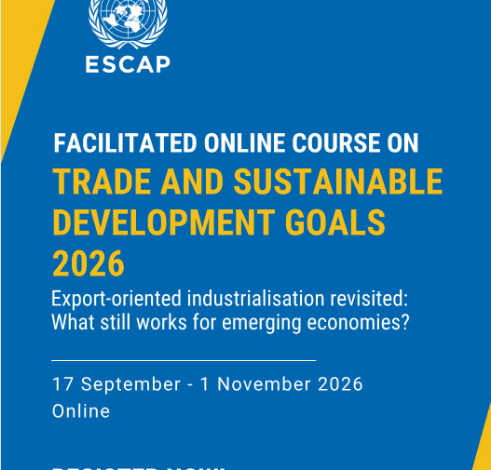
The United Nations Economic and Social Commission for Asia and the Pacific (UN ESCAP) offers a free, self-paced e-learning course on Trade and Sustainable Development Goals (SDGs) for anyone interested in trade, globalization and sustainable development.
The online course provides participants with foundational knowledge of how trade and trade policy can contribute to sustainable development and the achievement of the SDGs. It uses a non-technical approach, making it accessible to participants who may not have an advanced economics or trade background.
Participants who successfully complete the required module quizzes with a score of at least 75% can receive a free certificate from UN ESCAP. Certificates are sent to the registered email address within 30 days.
The course can be particularly useful for students, development professionals, public policy practitioners, researchers and anyone interested in understanding the relationship between international trade and sustainable development.
About the UN ESCAP Trade and SDGs Course
The e-learning course examines both the opportunities and limitations of trade and globalization in supporting sustainable development.
Rather than focusing exclusively on technical trade theory, the programme aims to build an informed and critical understanding of how trade can contribute to development outcomes.
The course encourages participants to consider how trade interacts with issues such as poverty, hunger, climate change, decent work, innovation, responsible consumption and production, health and global value chains.
The training is self-paced, allowing learners to progress through the material according to their own schedules.
What You Will Learn
By completing the course, participants will develop an understanding of several important aspects of trade and sustainable development.
The course aims to help learners:
- Understand the potential role of trade in helping developing countries achieve the SDGs.
- Identify factors that can limit the effective use of trade as a means of implementing development objectives.
- Recognize cross-cutting issues that can affect the effectiveness of trade as an instrument for sustainable development.
- Understand why holistic policy approaches are important for using trade to support inclusive growth and sustainable development.
- Examine the opportunities and challenges associated with trade and globalization.
The course therefore provides a broad introduction for learners seeking to understand the relationship between economic policy and sustainable development.
Who Can Take the Course?
The UN ESCAP e-learning course is open to anyone interested in trade, globalization and sustainable development.
There are no restrictions indicated on nationality or professional background in the course description.
The programme may be particularly relevant to people who work, study or have an interest in:
- Public policy
- International development
- Economics
- Trade policy
- Sustainable development
- Globalization
- Development studies
- International relations
- Government and public administration
- Research and academia
Because the course uses a non-technical approach, it can also serve as an introductory learning opportunity for participants who are new to trade and sustainable development issues.
Course Structure
The course consists of 15 modules divided into three broad sections.
Part A: Introduction
The introductory section contains four mandatory modules covering foundational concepts related to trade and sustainable development.
Part B: Trade and Sustainable Development
The intermediate section explores the connections between trade and several development priorities.
Topics include:
- Trade, poverty, hunger and inclusive growth
- Trade, climate change and sustainable growth
- Trade, decent work, innovation and responsible consumption and production
- Trade, institutions and cooperation
Part C: Selected Issues
The final section examines selected issues concerning trade and the SDGs, including:
- Trade and health
- Trade and global value chains (GVCs)
Each module includes video lectures that generally take approximately 15–20 minutes to complete. Learners can study at their own pace and are encouraged to consult the recommended readings and reference materials to deepen their understanding.
One of the key benefits of the course is the opportunity to earn a certificate from the United Nations ESCAP at no cost.
Participants must complete the relevant quizzes and achieve a minimum score of 75%.
After meeting the required score, certificates will be sent to the participant’s registered email address within 30 days.
Learners should therefore ensure that the email address used during registration is accurate and accessible.
Is There a Deadline?
The course is presented as a self-paced e-learning course, and the course page does not specify a fixed application deadline for registration.
This means interested learners can access the course through the UN ESCAP Community platform and study the available modules at their own pace.
Participants should nevertheless check the official course platform for any updated registration or access information.
How to Register
Interested participants can register for the UN ESCAP E-Learning Course on Trade and Sustainable Development Goals through the ESCAP Community platform.
The course is designed to provide accessible learning on trade and sustainable development while allowing participants to study independently.
Learners should complete the modules and required quizzes to qualify for the certificate.
Course: E-learning Course on Trade and Sustainable Development Goals
Provider: United Nations Economic and Social Commission for Asia and the Pacific (UN ESCAP)
Format: Online and self-paced
Cost: Free
Certificate: Yes, upon achieving at least 75% in the required quizzes
Certificate Issuer: UN ESCAP
Modules: 15
Language: English
Eligibility: Open to anyone interested in trade and sustainable development
Deadline: No fixed deadline stated on the course page
How the Course Was Developed
The course was developed by the Trade Policy and Facilitation Section (TPFS) of the Trade, Investment and Innovation Division (TIID) at UN ESCAP.
The course involved contributors, reviewers and advisers from universities, research institutions and international organizations. Its advisory board included experts working in economics, trade, development, health and related fields.
The course is intended to help learners develop a more informed and critical perspective on the relationship between trade policy and the SDGs.
Start Learning
People interested in trade, sustainable development, globalization and public policy can use this free UN ESCAP course to build foundational knowledge without needing to commit to a traditional classroom-based programme.
The self-paced structure also allows students and working professionals to fit the training around their existing schedules.
To begin, participants should register through the UN ESCAP Community platform, access the course modules, complete the required quizzes and meet the 75% threshold to qualify for the certificate.