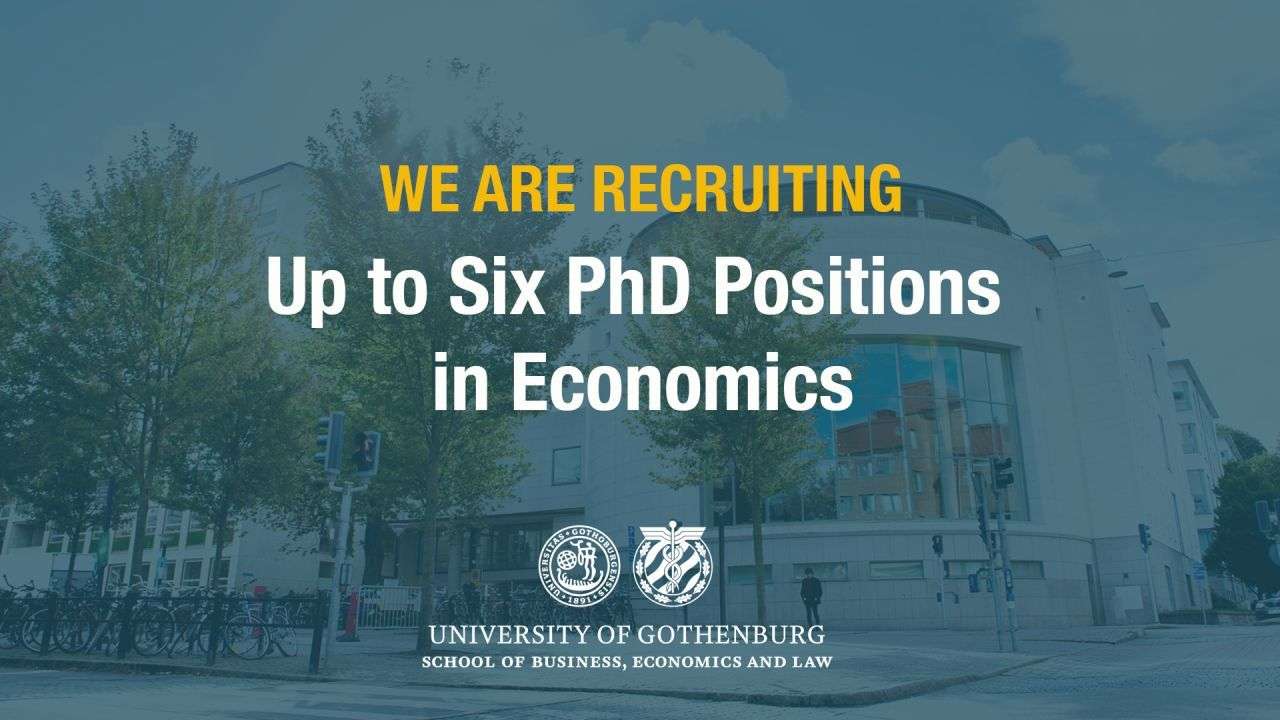
The University of Gothenburg in Sweden is inviting applications for up to six fully funded PhD positions in Economics for its September 2027 intake. These doctoral positions offer an excellent opportunity for aspiring researchers to pursue advanced studies in economics within an internationally recognized academic environment, supported by comprehensive doctoral training, faculty supervision and funding for approximately five years.
The positions are offered through the Department of Economics at the university’s School of Business, Economics and Law. The programme combines rigorous academic coursework in economic theory, quantitative methods and econometrics with independent research, preparing doctoral candidates for careers in academia, international research institutions and other research-oriented organizations.
Candidates with academic backgrounds in Economics or closely related disciplines who meet the specified credit requirements are encouraged to apply. International applicants are welcome, provided they satisfy the university’s academic eligibility criteria.
Applications must be submitted online, with the final deadline set for 1 February 2027.
1. Overview of the PhD Opportunity
| Particulars | Details |
|---|---|
| Host Institution | University of Gothenburg |
| Department | Department of Economics |
| School | School of Business, Economics and Law |
| Opportunity | Up to 6 PhD Positions in Economics |
| Reference Number | PAR 2026/802 |
| Country | Sweden |
| Location | Gothenburg |
| Degree | Doctor of Philosophy (PhD) in Economics |
| Funding | Fully funded |
| Duration | Approximately 5 years |
| Starting Date | 1 September 2027 |
| Study Mode | Full-time, campus-based |
| Language of Application | English or a Scandinavian language |
| Application Deadline | 1 February 2027 |
| Application Method | Online application |
The University of Gothenburg is one of Sweden’s major higher education and research institutions. It brings together approximately 58,000 students and 6,800 employees, creating a diverse academic environment that encourages research, innovation, interdisciplinary learning and international collaboration.
The university is committed to addressing important societal challenges through research, education and the development of new knowledge. Its academic programmes attract students and researchers from different parts of the world, providing opportunities to engage with international perspectives and contemporary research.
The PhD positions are offered through the School of Business, Economics and Law, which has approximately 8,000 students and 500 employees.
The School brings together three major academic disciplines:
It maintains an international research and teaching environment and has established strong connections with society, businesses and academic institutions.
An important feature of the School is its prestigious Triple Crown accreditation, which includes:
These three international accreditations recognize the School’s commitment to academic quality and excellence in business and management education.
Click HERE for further information, visit the School of Business, Economics and Law.
3. About the Department of Economics
The Department of Economics has approximately 100 employees and provides an active research and academic environment covering several important areas of economics.
Its research activities extend across a broad range of subjects, including:
1. Labor Economics: Research examining employment, wages, labor markets, working conditions and economic inequalities.
2. Environmental Economics: Research on environmental policies, climate change, sustainability, natural resources and the economic implications of environmental challenges.
3. Development Economics: Research concerning economic development, poverty, inequality, institutional development and economic transformation.
4. Health Economics: Research investigating healthcare systems, healthcare financing, health inequalities and the relationship between health and economic outcomes.
5. Behavioral Economics: Research exploring how individuals and institutions make economic decisions and how behavioral factors influence markets and public policy.
6. Financial Economics: Research focusing on financial markets, investment, financial institutions and economic decision-making.
The Department has an international faculty and regularly organizes seminars, research workshops and academic discussions involving visiting researchers and doctoral candidates.
PhD students become part of this research community and have opportunities to exchange ideas, present their work and establish connections with scholars from different countries.
Click HERE to explore the Department of Economics.
4. Details of the PhD Programme and Research Opportunities
The Department of Economics is offering up to six fully funded doctoral positions, with an expected starting date of 1 September 2027.
The programme is designed to provide doctoral students with a strong foundation in economic theory, quantitative research methods and independent academic research.
Successful candidates will undertake structured coursework, participate in academic activities and work towards producing original research that contributes to the field of economics.
The PhD programme has two broad stages.
First Stage: Coursework and Advanced Academic Training
During the first two years, doctoral candidates will complete core courses designed to strengthen their theoretical and methodological knowledge.
The principal subjects include:
-
Specialized field courses in economics
Microeconomics examines the economic behavior of individuals, households, firms and markets. It provides the theoretical foundation for understanding resource allocation, consumer behavior, production and market structures.
Macroeconomics focuses on the economy as a whole, including economic growth, inflation, unemployment, monetary policy, fiscal policy and international economic developments.
Econometrics introduces the quantitative and statistical methods used to analyze economic data, test hypotheses and evaluate economic relationships.
Following the core courses, students undertake specialized field courses that allow them to develop expertise in their preferred research areas.
Second Stage: Independent Research and Thesis Development
The remaining years of the programme are primarily dedicated to independent research, academic writing and the preparation of the doctoral thesis.
During this stage, students will:
-
Develop independent research questions.
-
Conduct original economic research.
-
Work under the guidance of academic supervisors.
-
Analyze economic data and apply relevant research methodologies.
-
Prepare academic papers and research outputs.
-
Participate in departmental seminars and research workshops.
-
Present their research findings and receive feedback from faculty members.
-
Engage with other doctoral researchers and visiting academics.
The programme also encourages doctoral students to undertake research visits at universities abroad.
These international research opportunities can help candidates establish academic networks, develop research collaborations and gain exposure to different research environments.
5. Funding and Financial Support
Fully funded positions
One of the major advantages of this opportunity is that all selected doctoral candidates will receive funding for approximately five years.
The funding covers the doctoral employment period, including time allocated to departmental responsibilities such as teaching.
The positions are funded in accordance with the applicable provisions of Chapter 5 of the Swedish Higher Education Ordinance.
The programme is structured as doctoral employment rather than simply an unfunded study opportunity.
Candidates should note that the funding arrangements are governed by the university’s employment conditions and applicable Swedish regulations.
Click HERE for additional information about the employment framework.
6. Eligibility Criteria
Applicants must satisfy both the basic and special eligibility requirements established by the Department of Economics.
The university indicates that these requirements are typically met by candidates holding a master’s degree in Economics or a closely related field, provided that they have completed the required number of academic credits.
A. Basic Eligibility
Applicants must meet at least one of the following requirements:
-
Hold a degree at an advanced level, such as a master’s degree.
-
Have completed at least 240 higher education credits, of which at least 60 credits must be at the advanced level.
-
Possess qualifications considered equivalent to the above requirements.
B. Special Eligibility
Applicants must also satisfy at least one of the following Economics-related academic requirements:
-
Have completed at least 90 higher education credits in Economics.
-
Have completed at least 30 higher education credits in Economics at the advanced level.
-
Possess qualifications considered equivalent to these requirements.
These requirements ensure that candidates have sufficient academic preparation to undertake advanced doctoral research in Economics.
C. Applicants Completing Their Qualifications in 2027
Candidates who are currently completing their academic qualifications are also welcome to apply.
Applicants expecting to satisfy all eligibility requirements by August 2027 may submit an application.
However, candidates must fulfil the required academic conditions by the time of admission.
7. Required Application Documents
Applicants must submit all application materials in English or a Scandinavian language.
The university requires a comprehensive application demonstrating the candidate’s academic background, research interests, previous research experience and potential to undertake independent doctoral research.
The following documents must be prepared:
1. Personal Statement (1–2 Pages)
Applicants must submit a personal statement explaining:
-
Their academic background and previous educational qualifications.
-
Their research interests within Economics.
-
Their motivation for pursuing a PhD.
-
Why they wish to undertake doctoral studies at the University of Gothenburg.
-
Their academic and professional objectives.
The personal statement should clearly demonstrate the applicant’s interest in economic research and explain how the doctoral programme aligns with their future academic or professional plans.
2. Summary Page
Applicants must prepare a summary page containing:
-
A list of all submitted application documents.
-
Their personal identity number, if applicable.
-
The names of one to three referees.
-
The contact details of the referees.
This document helps the admissions committee identify the materials included in the application and contact the relevant academic references.
3. Curriculum Vitae (CV)
Applicants must provide an updated academic CV highlighting their educational qualifications and relevant experience.
The CV should include:
-
Academic qualifications and degrees.
-
Employment and professional experience.
-
Academic publications, if applicable.
-
Relevant technical and quantitative skills.
-
Other academic achievements and qualifications.
Applicants may also submit English proficiency certificates, such as TOEFL or IELTS. However, these certificates are not mandatory application documents according to the announcement.
4. Degree Certificates
Applicants must provide copies of their degree certificates or diplomas.
These documents should demonstrate the academic qualifications required for admission.
5. Official Academic Transcripts
Applicants must submit official academic transcripts documenting their completed courses and grades.
The transcripts will allow the admissions committee to assess academic performance and determine whether the candidate meets the required credit criteria.
6. Master’s Thesis or Other Research Work
Applicants must submit a master’s thesis or other academic research papers.
This is an important part of the application because the admissions committee will assess the quality of the candidate’s previous research.
Candidates submitting more than one research paper or academic work must identify which document they consider most representative of their research ability.
Applicants should therefore select their strongest academic research work and ensure that it demonstrates their analytical abilities, research methodology and capacity for independent academic investigation.
7. GRE Scores (Recommended but Not Mandatory)
GRE scores are recommended but are not compulsory.
Applicants who have already taken the Graduate Record Examination are encouraged to submit their scores as additional supporting evidence of their academic preparation.
The institutional code for submitting GRE scores is:
Institutional Code: 6285
Candidates who have not taken the GRE can still apply.
8. Letters of Recommendation
Applicants must arrange between one and three recommendation letters from academic or professional referees.
There are specific submission requirements:
-
Recommendation letters must be submitted directly by the referees.
-
Letters must be sent to the Department of Economics.
-
Referees must complete the university’s evaluation form.
-
Both recommendation letters and evaluation forms must reach the university by 1 February 2027.
Important: Applicants must not upload or submit recommendation letters themselves. Letters submitted directly by applicants will not be considered.
Referees must send their documents to:
phdreference@economics.gu.se
The required PhD Evaluation Form must also be completed by the referees.
Applicants are responsible for informing their referees about the submission procedure and ensuring that all documents arrive before the deadline.
8. How Will Applications Be Evaluated?
The Department of Economics has established a selection process to identify candidates with strong academic qualifications and the potential to conduct independent doctoral research.
Applications will be reviewed by the Department of Economics PhD Admissions Committee.
The selection process will consider several important factors.
A. Academic Performance
The committee will examine applicants’ academic records, with particular emphasis on their performance at the master’s level.
Strong academic results in relevant subjects will be an important consideration.
B. Quality of Previous Research
The quality of the submitted master’s thesis or other academic research papers will play a significant role.
The committee will assess candidates’ ability to:
-
Identify relevant research questions.
-
Develop sound research arguments.
-
Apply appropriate research methodologies.
-
Analyze evidence and academic literature.
-
Demonstrate independent academic thinking.
C. Quantitative and Mathematical Preparation
The university particularly values candidates with strong academic preparation in:
These subjects are essential for conducting advanced economic research and working with theoretical and empirical economic models.
D. Letters of Recommendation
Recommendation letters will provide additional information about applicants’ academic abilities, research potential and suitability for doctoral studies.
Strong references can help demonstrate a candidate’s ability to undertake independent research and contribute to an academic environment.
9. Interview and Selection Process
Candidates shortlisted by the admissions committee will be invited to participate in an online interview.
The interview forms part of the selection process and provides the university with an opportunity to assess candidates’ academic interests, research potential and suitability for the programme.
Applicants should be prepared to discuss:
-
Their academic background.
-
Their previous research experience.
-
Their master’s thesis or submitted research papers.
-
Their proposed research interests.
-
Their understanding of relevant economic theories and methodologies.
-
Their motivation for pursuing doctoral studies.
Important information about supervisors: Applicants do not need to contact potential supervisors before submitting their applications.
A supervisor will be assigned after admission to the programme.
Therefore, candidates should focus on preparing a strong application rather than independently arranging supervisory agreements.
10. Application and Admission Timeline
Applicants should carefully follow the official recruitment schedule.
| Important Stage | Expected Date |
|---|---|
| Application deadline | 1 February 2027 |
| Deadline for recommendation letters | 1 February 2027 |
| Shortlisted candidates invited for interviews | February 2027 |
| First admission offers | March 2027 |
| Expected programme commencement | 1 September 2027 |
The university will inform successful candidates about the deadline for accepting or declining their admission offers.
Applicants who have not received an invitation for an interview by mid-March 2027 should assume that they have not been shortlisted.
11. Employment Conditions and Residence Permit Requirements
The PhD programme is campus-based and requires students to be physically present at the Department of Economics in Gothenburg, Sweden.
Candidates should therefore be prepared to relocate to Sweden for the duration of their doctoral studies.
International applicants who require a residence permit to pursue higher education in Sweden must ensure that they obtain the necessary authorization.
The Department of Economics reserves the right to revoke an admission decision if an admitted candidate cannot present a valid residence permit by the start of the programme.
Applicants are encouraged to familiarize themselves with Swedish immigration and residence permit requirements well in advance.
12. Information for International Applicants
The University of Gothenburg welcomes international students and researchers and provides information to help individuals and their families prepare for relocation to Sweden.
Moving to another country for doctoral studies involves several considerations, including accommodation, healthcare, transportation, banking, residence permits and adapting to a new academic and cultural environment.
International applicants are encouraged to explore the following resources:
-
Click HERE to get more information and support for international employees, researchers and students relocating to Gothenburg.
- Click HERE to get more information about living, working and settling in Gothenburg.
- Click HERE to learn more about 19 proud facts about Gothenburg in 2026.
These resources can help prospective doctoral candidates understand the practical aspects of moving to Sweden.
13. Equal Opportunities and Diversity
The University of Gothenburg actively works towards creating an inclusive working and academic environment based on equal opportunities.
The university recognizes the importance of diversity and values the different perspectives, experiences and backgrounds that individuals bring to its academic community.
Its recruitment practices aim to ensure fair and equal conditions for applicants.
International candidates from different nationalities and backgrounds are encouraged to apply if they meet the academic eligibility requirements.
14. Additional Important Information
Applicants should take note of the following administrative conditions:
-
All application documents must be submitted by the official deadline.
-
The university will assess candidates based on the qualifications and supporting documentation received by the deadline.
-
Recommendation letters must be sent directly by referees.
-
Recommendation letters submitted by applicants themselves will not be accepted.
-
GRE scores are recommended but not compulsory.
-
English proficiency certificates such as IELTS and TOEFL may be submitted but are not required.
-
Applicants do not need to contact potential supervisors.
-
The programme requires physical attendance in Gothenburg.
- The university must archive recruitment application documents for two years after the appointment has been filled, in accordance with Swedish National Archives regulations. Applicants may request the return of their documents after this period; otherwise, they will be destroyed.
This is a doctoral employment opportunity offering fully funded PhD positions, not a conventional scholarship.
15. Who can apply?
-
Students and graduates with a master’s degree in Economics or a closely related discipline.
-
Applicants holding an advanced-level degree or equivalent academic qualifications.
-
Candidates with at least 90 higher education credits in Economics, or 30 advanced-level credits in Economics, or equivalent qualifications.
-
Applicants expecting to fulfil the eligibility requirements by August 2027.
-
Candidates with strong academic preparation in mathematics, statistics, econometrics, microeconomics and macroeconomics.
Eligible nationalities
-
International applicants are welcome.
-
The announcement does not specify a nationality restriction.
-
Applicants from all countries and continents may apply, provided they meet the academic and admission requirements.
-
There is no specified race, ethnicity or gender restriction.
- Important dates
Application deadline- 1 February 2027
Programme starts- 1 September 2027
Positions available- Up to 6
Funding duration- Approximately 5 years
15. How to Apply for the PhD Positions
Applications open
Interested and eligible candidates must submit their applications through the University of Gothenburg’s official online recruitment system.
Before applying, candidates should:
-
Review the basic and special eligibility requirements.
-
Check that their academic qualifications meet the required Economics credit criteria.
-
Prepare a detailed academic CV.
-
Write a personal statement of one to two pages.
-
Arrange official degree certificates and academic transcripts.
-
Select their strongest master’s thesis or academic research paper.
-
Arrange one to three recommendation letters.
-
Share the evaluation form and submission instructions with their referees.
-
Ensure that all application materials are submitted before the deadline.
Official application portal:
Apply for the PhD Positions in Economics – University of Gothenburg
For further enquiries:
Ann-Christin Räätäri Nyström
Doctoral Studies Administrator
Email: ann-christin.raatari.nystrom@economics.gu.se
Official university website: University of Gothenburg
Click HERE to apply
Click HERE to get more information
Conclusion
The University of Gothenburg’s announcement of up to six fully funded PhD positions in Economics represents an excellent opportunity for individuals seeking to pursue advanced academic research in an internationally recognized university in Sweden.
The programme offers approximately five years of funding, structured doctoral training, opportunities for independent research and close engagement with an international academic community. Its research environment covers several important areas, including labor economics, environmental economics, development economics, health economics, behavioral economics and financial economics.
The opportunity is particularly suitable for candidates with strong academic foundations in Economics, mathematics, statistics and econometrics who wish to develop their research capabilities and pursue careers in academia or other research-oriented institutions.
Applicants should pay particular attention to the Economics credit requirements, the quality of their submitted research work and the recommendation letter submission procedure. Since referees must independently submit their letters and evaluation forms, candidates should contact their referees well before the deadline.
With only six positions available, prospective applicants are encouraged to prepare a comprehensive application demonstrating their academic achievements, quantitative skills and potential to contribute to economic research.
The final application deadline is 1 February 2027.