
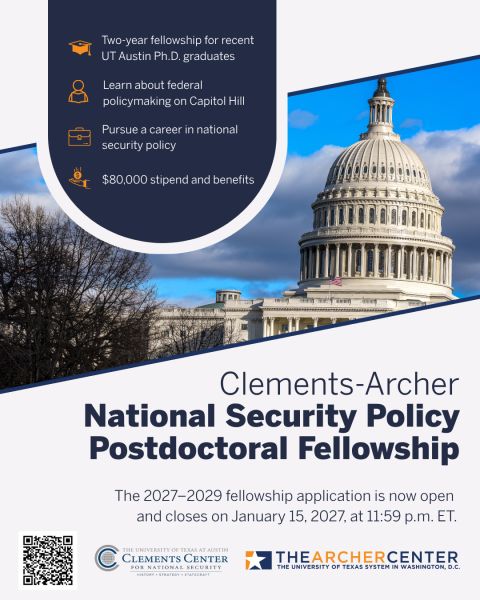
Recent doctoral graduates of The University of Texas at Austin who are interested in national security, public policy and federal government decision-making have an opportunity to apply for the Clements-Archer National Security Policy Postdoctoral Fellowship 2027–2029. Offered through a partnership between the Clements Center for National Security and the Archer Center, this prestigious two-year fellowship provides selected scholars with practical experience in the United States federal policymaking environment.
The fellowship is designed to help recent PhD graduates develop the knowledge, professional experience and policy skills required to pursue careers in national security policy. Unlike traditional postdoctoral programmes that primarily focus on academic research, the Clements-Archer Fellowship places participants directly within the United States Congress, where they gain first-hand experience working on national security issues and understanding how federal policy is developed and implemented.
Two fellows will be selected for the 2027–2029 programme. Each successful candidate will receive an annual stipend of $80,000? The programme announcement specifies an $80,000 stipend and benefits for each fellowship, providing substantial financial support throughout the two-year appointment. Fellows will spend their first year working full-time with a committee or member’s office in the United States House of Representatives and their second year working full-time with a committee or member’s office in the United States Senate.
Based in Washington, D.C., the programme combines congressional placements with professional development, mentorship, policy training and opportunities to contribute to the Archer Center’s academic community. It is particularly relevant to UT Austin doctoral graduates whose research focuses on security studies and who want to translate their academic expertise into practical national security policymaking.
The application period opened on October 6, 2026, and interested candidates must submit their applications before the stated deadline.
The Clements-Archer National Security Policy Postdoctoral Fellowship is a specialised professional and academic development programme created through collaboration between the Clements Center for National Security and the Archer Center, which operates as The University of Texas System’s campus in Washington, D.C.
The fellowship provides recent PhD graduates of The University of Texas at Austin with an opportunity to develop an in-depth understanding of federal policymaking while building professional experience in national security policy.
The programme recognises that advanced academic research can make an important contribution to national security decision-making. However, researchers who want to influence public policy also need to understand the institutions, legislative processes and professional environments in which policy decisions are made.
Through placements in both chambers of the United States Congress, fellows gain practical exposure to the work of legislators, congressional committees and their professional staff. They can observe and contribute to the policy process while learning how research and specialised knowledge can inform legislative priorities and national security responses.
The fellowship is structured as a two-year appointment, with a different congressional placement for each year. This arrangement exposes participants to both the House of Representatives and the Senate, offering a broad understanding of the legislative branch of the federal government.
Key Fellowship Details
- Fellowship name: Clements-Archer National Security Policy Postdoctoral Fellowship.
- Programme period: 2027–2029.
- Host institution: The University of Texas at Austin, through the Clements Center for National Security.
- Partner organisation: Archer Center, The University of Texas System.
- Location: Washington, D.C., United States.
- Application opening date: October 6, 2026.
- Application deadline: January 15, 2027, at 11:59 PM Eastern Time.
- Number of fellowships: Two.
- Duration: Two years.
- Stipend: $80,000 per fellowship, as stated in the announcement, in addition to benefits.
- Expected start: Between May and August 2027.
- First-year placement: United States House of Representatives.
- Second-year placement: United States Senate.
- Eligibility: UT Austin PhD students and recent doctoral graduates whose research focuses on security studies.
- Selection process: Review by a committee comprising Clements Center and Archer Center staff, followed by an in-person interview.
About the Clements Center for National Security
The Clements Center for National Security at The University of Texas at Austin is the academic centre associated with the fellowship. Its involvement reflects the programme’s emphasis on national security scholarship, research and the development of professionals who can contribute to important security policy discussions.
The centre’s partnership with the Archer Center creates a pathway through which academic expertise can be connected with practical experience in Washington, D.C.
For doctoral researchers whose work focuses on security studies, this connection is particularly valuable. Academic research can provide detailed understanding of international security, defence, strategic competition, geopolitical developments and other complex challenges. The fellowship offers an opportunity to apply that expertise in a federal policymaking environment.
About the Archer Center
The Archer Center is The University of Texas System’s campus in Washington, D.C. It provides an academic and professional environment through which students and scholars can engage with government, public policy and professional opportunities in the nation’s capital.
As a partner in the Clements-Archer Fellowship, the Archer Center plays an important role in supporting fellows throughout their two-year appointments.
Its responsibilities and support include helping fellows navigate the Washington, D.C. professional environment, providing professional development opportunities, connecting participants with its extensive network and supporting their congressional placement arrangements.
Fellows also become members of the Archer Center community. They are expected to contribute to this community by mentoring undergraduate and graduate Archer Fellows and delivering workshops or presentations during their appointments.
Purpose of the Clements-Archer National Security Policy Fellowship
The central purpose of the fellowship is to prepare recent UT Austin doctoral graduates for careers in national security policy by giving them direct experience in the United States federal policymaking process.
The programme is designed for researchers who have developed specialised knowledge through doctoral study and want to understand how that knowledge can contribute to legislative work and government decision-making.
Rather than limiting participants to conventional academic research, the fellowship places them in professional congressional environments where national security issues are discussed, evaluated and addressed.
Its objectives include:
- Developing federal policymaking knowledge: Fellows learn how Congress approaches national security issues, how legislative priorities are established and how congressional offices and committees contribute to policy development.
- Building practical national security policy experience: Participants work full-time in congressional offices or committees, gaining exposure to the responsibilities and challenges associated with national security policymaking.
- Connecting academic research with public policy: Fellows are encouraged to apply the knowledge and analytical skills developed during their doctoral studies to real-world policy challenges.
- Strengthening professional networks: Through the Archer Center’s network and mentorship opportunities, fellows can develop relationships with professionals and scholars working in national security and public affairs.
- Supporting career development: The programme helps participants prepare for professional opportunities in national security policy and related fields.
- Contributing to the Archer Center community: Fellows are expected to mentor other Archer Fellows and share their knowledge through workshops and presentations.
The programme therefore offers a combination of academic development, professional training and practical government experience.
Two-Year Fellowship Structure: Working in the U.S. House and Senate
One of the most distinctive features of the Clements-Archer National Security Policy Postdoctoral Fellowship is its two-part congressional placement structure.
Each fellow will spend the first year working in the United States House of Representatives and the second year working in the United States Senate.
This arrangement allows participants to gain experience in both chambers of Congress and develop a more comprehensive understanding of the federal legislative system.
First Year: Full-Time Placement in the U.S. House of Representatives
During the first year, each fellow will work full-time on a committee or in the office of a member of the United States House of Representatives.
This placement provides an opportunity to learn how the House approaches national security policy and how members of Congress and their staff engage with issues affecting the country’s security interests.
Fellows will gain experience within a congressional working environment and develop a practical understanding of how policy matters are considered and addressed.
The placement is not automatically assigned by the programme. With support from the Archer Center and its extensive professional network, each fellow is expected to seek and secure an appropriate House placement for the first year.
This means successful candidates should be prepared to engage actively in the placement process and work with the Archer Center to identify a suitable congressional office or committee.
The first-year experience is intended to help fellows understand the responsibilities of congressional offices and the role of legislative institutions in shaping national security policy.
Second Year: Full-Time Placement in the U.S. Senate
During the second year, each fellow will move to a full-time placement on a committee or in the office of a member of the United States Senate.
The second placement provides another perspective on the federal legislative process and allows fellows to gain experience in a different congressional chamber.
As the fellowship approaches its second year, the fellow will be responsible for securing a Senate placement.
The Archer Center will provide support through its professional network, helping fellows navigate the placement process. Nevertheless, participants are expected to take an active role in identifying and securing their placements.
By completing placements in both the House and Senate, fellows can develop a broader understanding of how national security issues are handled across Congress.
Full-Time Residence in Washington, D.C.
Throughout the two-year fellowship period, selected fellows must maintain full-time residence in Washington, D.C.
This requirement is connected to the programme’s emphasis on practical participation in congressional work and engagement with the Archer Center community.
Candidates should therefore be prepared to relocate to Washington, D.C. and remain there throughout the fellowship.
The fellowship is expected to begin between May and August 2027, with the precise start arrangements determined through the programme.
Fellowship Benefits and Financial Support
The Clements-Archer National Security Policy Postdoctoral Fellowship provides a financial package and professional development opportunities designed to support participants during their two-year appointments.
1. $80,000 Stipend and Benefits
Each of the two selected fellows will receive an $80,000 stipend and benefits, according to the programme announcement.
This financial support is an important part of the fellowship package and helps fellows undertake the two-year professional appointment in Washington, D.C.
The announcement does not specify whether the $80,000 is an annual amount or the total stipend for the fellowship period. Applicants should confirm the precise payment arrangement and benefits package with the programme before making financial or relocation plans.
2. Professional Development Training
Fellows will receive ongoing professional development training throughout their appointments.
The Archer Center’s staff and faculty will provide training and coaching to help participants strengthen the professional skills needed to work effectively in Washington, D.C.
This support is particularly important for researchers transitioning from academic environments into federal policy work.
Professional development may help fellows understand the expectations of congressional workplaces, communicate research findings to policy audiences and navigate the demands of professional public service environments.
3. Mentorship from an Established Scholar-Practitioner
Each fellow will receive mentorship from an established scholar-practitioner in their field.
This mentorship is intended to provide professional guidance and help fellows develop their understanding of the relationship between academic research and national security policymaking.
A scholar-practitioner can offer insight into both academic and professional policy environments, helping fellows understand how specialised knowledge can be used to address complex security challenges.
4. Washington, D.C. Orientation
The Archer Center will provide an orientation to help fellows prepare for living and working in Washington, D.C.
Moving to the nation’s capital for a two-year appointment involves adapting to a new professional and residential environment. The orientation is designed to help fellows understand the city and prepare for their responsibilities.
5. Access to the Archer Center’s Professional Network
The Archer Center will support fellows through its extensive professional network.
This network is an important resource for participants as they seek congressional placements, build professional relationships and explore opportunities within the national security policy environment.
6. Membership in the Archer Center Community
Fellows will become valued members of the Archer Center community throughout their appointments.
They will have opportunities to interact with undergraduate and graduate Archer Fellows and contribute to the academic and professional development activities of the centre.
In return, the postdoctoral fellows are expected to mentor several undergraduate and graduate Archer Fellows and share their knowledge through workshops or presentations.
Mentorship and Community Engagement Responsibilities
The Clements-Archer Fellowship is not solely focused on the professional development of the two selected postdoctoral researchers. It also expects fellows to contribute to the wider Archer Center community.
Participants will be required to undertake mentorship responsibilities and deliver educational activities during their appointments.
Mentoring Undergraduate and Graduate Archer Fellows
Each postdoctoral fellow will be expected to mentor several undergraduate and graduate Archer Fellows.
This responsibility provides an opportunity to support students who are developing their own academic and professional interests.
Through mentorship, postdoctoral fellows can share lessons from their doctoral research, explain professional experiences and provide guidance on academic and career development.
The mentoring role also allows fellows to strengthen their own leadership, communication and professional guidance skills.
Delivering Workshops or Presentations
Each fellow will be expected to deliver a workshop or presentation every semester at the Archer Center.
These sessions will provide opportunities to share knowledge and engage with the Archer Center community.
Topics may draw on the fellow’s doctoral expertise, national security research interests or experiences gained through congressional placements, provided they are appropriate for the centre’s activities.
This requirement encourages fellows to communicate complex research and policy issues to wider audiences and contribute actively to the educational environment.
Eligibility Criteria for the 2027–2029 Clements-Archer Fellowship
The Clements-Archer National Security Policy Postdoctoral Fellowship is specifically intended for UT Austin doctoral students and recent graduates whose academic research focuses on security studies.
Applicants must meet the institution’s doctoral qualification and research-area requirements.
1. Applicants Must Be UT Austin PhD Students or Recent Graduates
The opportunity is open to PhD students at The University of Texas at Austin and recent doctoral graduates who completed their degrees from 2026 onwards.
The fellowship is designed specifically for graduates of UT Austin, meaning that applicants must have completed or be completing their doctoral studies at this institution.
Candidates with doctoral degrees from other universities should not assume that they qualify.
2. Doctoral Research Must Focus on Security Studies
Applicants may come from any academic discipline, provided their doctoral research focuses on security studies.
This is an important distinction because the programme does not restrict eligibility to a single department or conventional academic discipline.
Researchers from different fields may be eligible if their doctoral work has a clear focus on security-related questions.
Applicants should be able to demonstrate how their doctoral research connects to security studies and how their academic expertise could contribute to national security policy.
3. Doctoral Degree Must Be Completed Before the Fellowship Begins
All doctoral degree requirements must be satisfied, and the degree must be formally awarded before the fellowship starts.
The announcement specifies that candidates must have completed their doctorate by August 2027 at the latest.
Candidates who completed their doctorate in 2026 are also eligible.
PhD students who are still completing their doctoral requirements should carefully consider the expected award date and ensure that they will meet the requirement before the fellowship begins.
Summary of Eligibility Requirements
To be considered, applicants should meet the following conditions:
- Be a current PhD student at The University of Texas at Austin or a recent UT Austin doctoral graduate from 2026 onwards.
- Have doctoral research focused on security studies.
- Satisfy all doctoral degree requirements before the fellowship begins.
- Have the doctoral degree formally awarded by August 2027 at the latest.
- Be prepared to undertake full-time work in Washington, D.C. throughout the two-year fellowship.
Candidates from any academic discipline may be considered, provided their doctoral research meets the security studies requirement.
Application Requirements: Documents and Materials to Prepare
Applicants must submit a complete application package containing academic references, a cover letter, academic transcripts, a scholarly writing sample and a policy memorandum.
These materials allow the selection committee to evaluate the candidate’s academic background, research capabilities, professional motivation and ability to apply doctoral expertise to national security policy challenges.
1. Two Letters of Recommendation
Applicants must provide two letters of recommendation.
One letter must be academic, while the second may be academic or come from a professional supervisor outside the candidate’s doctoral programme.
The recommendation letters should provide an assessment of the applicant’s academic abilities, research experience, professional qualities and suitability for the fellowship.
Required recommendation letters:
- One academic letter of recommendation.
- One additional letter from an academic recommender or a professional supervisor outside the candidate’s doctoral programme.
Candidates should approach their referees early to give them sufficient time to prepare and submit their recommendations.
2. One-to-Two-Page Cover Letter
Applicants must submit a cover letter of one to two pages describing their qualifications and motivation for the programme.
The cover letter should explain why the candidate is interested in the Clements-Archer Fellowship and how their academic background prepares them for national security policy work.
A strong cover letter should clearly communicate:
- The candidate’s doctoral background and research focus.
- Their relevant academic and professional experience.
- Their interest in national security policy.
- Their motivation for participating in the fellowship.
- How the programme connects to their future career goals.
- What they hope to contribute to the congressional and Archer Center communities.
The cover letter should demonstrate a clear understanding of the fellowship’s purpose and the responsibilities involved in completing two congressional placements.
3. Academic Transcripts from Undergraduate and Graduate Degrees
Applicants must provide academic transcripts covering their undergraduate and graduate degrees.
These records allow the selection committee to review the candidate’s academic history and educational qualifications.
Candidates should ensure that the transcripts are complete and accurately reflect their academic achievements.
4. Scholarly Writing Sample
Applicants must submit a scholarly writing sample demonstrating their academic research and writing abilities.
Examples of acceptable writing samples include:
- A chapter from the candidate’s doctoral dissertation.
- An academic journal article.
- Another relevant scholarly research paper.
The writing sample should demonstrate the candidate’s ability to develop an argument, evaluate evidence, analyse complex issues and communicate research findings in a clear academic format.
Where possible, applicants should select a sample that reflects their expertise in security studies or a related research area.
5. Policy Memorandum of No More Than 800 Words
One of the most important and distinctive application requirements is a policy memorandum of no more than 800 words.
Applicants must prepare a short policy memo based on a hypothetical professional scenario:
You work in the United States Congress and must write a memorandum addressing an important national security policy challenge.
The memorandum should be written as though the applicant is a congressional professional advising a legislator or congressional staff member who has the ability to address the issue.
The assignment is intended to assess whether candidates can translate their academic expertise into practical policy recommendations.
What the Policy Memo Must Include
The memorandum must address four essential elements:
A. Description of the National Security Policy Challenge
The applicant should identify and briefly describe an important national security policy challenge.
The issue should be clearly defined so that the intended congressional reader can understand the problem being addressed.
B. Explanation of Why the Challenge Matters
Applicants must explain why the selected challenge is important.
This section should demonstrate the national security implications of the issue and why it deserves attention from Congress or relevant policymakers.
C. Identification of Stakeholders
The memorandum should identify the major stakeholders connected to the challenge.
Depending on the issue, stakeholders may include government departments, congressional committees, security agencies, international partners, private-sector organisations, affected communities or other relevant institutions.
The applicant should demonstrate an understanding of the different interests and responsibilities involved.
D. Recommendation of a Specific Policy Solution
Applicants must recommend a specific policy solution that could address the identified challenge.
The recommendation should be practical, clearly explained and supported by evidence.
Candidates should avoid presenting only a general discussion of the problem. The assignment requires a concrete policy recommendation that a legislator or congressional staff member could consider.
Demonstrating the Relevance of Doctoral Expertise
An important part of the policy memo is showing how the applicant’s PhD expertise and research skills can illuminate the policy challenge and proposed solution.
Candidates should demonstrate how their doctoral training has prepared them to:
- Analyse complex security issues.
- Evaluate evidence and research findings.
- Understand relevant political, economic, technological or social factors.
- Identify policy gaps and possible responses.
- Develop practical recommendations based on specialised knowledge.
The goal is to show that the applicant can move beyond academic discussion and apply research expertise to a real-world policymaking context.
Citation and Formatting Requirements for the Policy Memo
The policy memorandum must include supporting evidence using one of the following citation styles:
- APA.
- MLA.
- Chicago.
Footnotes and endnotes are not included in the 800-word limit.
Applicants must not include a bibliography.
Candidates should therefore ensure that their evidence is properly cited within the memorandum or through footnotes/endnotes, following the permitted citation style.
The policy memo must not exceed 800 words, making concise and effective communication particularly important.
6. In-Person Interview
Applicants will also be required to participate in an in-person interview with Clements Center and Archer Center staff.
The interview provides an opportunity for the selection committee to assess the candidate’s suitability beyond the written application materials.
Candidates should be prepared to discuss their academic background, doctoral research, interest in national security policy, professional goals and readiness to undertake the fellowship’s congressional placements.
They may also need to explain their policy memo and demonstrate how their research expertise can contribute to practical policymaking.
How the Selection Process Works
Two fellows will be selected for the 2027–2029 fellowship.
The selection process will be conducted by a committee comprising staff from the Clements Center and the Archer Center.
The committee will review applications and select candidates for the fellowship, including an in-person interview as part of the process.
Applicants should ensure that all required documents are submitted and that their application clearly demonstrates their eligibility and suitability.
A strong application should present a convincing connection between the candidate’s doctoral research, the field of security studies and the professional responsibilities of national security policy work.
The selection committee will be looking for candidates who can demonstrate academic ability while also showing an interest in applying their expertise in a government and policy environment.
Application Process: How to Apply for the Clements-Archer Fellowship
The application process is conducted through Interfolio’s Faculty Search platform.
Applicants will receive a free Dossier account through the application system. This allows candidates to submit their application materials, including confidential letters of recommendation, without charge.
The application process involves preparing the required documents and submitting them through the designated online application platform.
CLICK HERE TO APPLY
Step 1: Confirm Your Eligibility
Before beginning the application, confirm that you are a UT Austin PhD student or a recent doctoral graduate who meets the programme’s security studies requirement.
Ensure that your doctoral degree will be formally awarded before the fellowship begins, no later than August 2027.
Step 2: Contact Your Recommenders
Arrange the two required letters of recommendation.
Remember that one letter must be academic, while the second may come from an academic or professional supervisor outside your doctoral programme.
Give your referees enough time to prepare their recommendations and follow the application platform’s submission requirements.
Step 3: Prepare Your Cover Letter
Write a one-to-two-page cover letter explaining your qualifications, motivation and interest in the fellowship.
Make sure the letter demonstrates how your academic experience and professional goals connect with national security policymaking.
Step 4: Gather Your Academic Transcripts
Prepare your undergraduate and graduate academic transcripts.
Check that the documents are complete and ready for submission through the application system.
Step 5: Select Your Scholarly Writing Sample
Choose a suitable academic writing sample, such as a dissertation chapter or scholarly article.
The sample should demonstrate your ability to conduct rigorous research and communicate complex arguments effectively.
Step 6: Write Your 800-Word Policy Memorandum
Prepare the required policy memo addressing an important national security challenge.
The memo must:
- Describe the policy challenge.
- Explain why it matters.
- Identify relevant stakeholders.
- Recommend a specific policy solution.
- Demonstrate how your doctoral expertise informs the analysis and recommendation.
- Use APA, MLA or Chicago citations.
- Remain within the 800-word limit, excluding footnotes and endnotes.
- Not include a bibliography.
Step 7: Submit Through Interfolio
The institution uses Interfolio’s Faculty Search platform to manage the application process.
Applicants receive a free Dossier account and can submit all application materials through the platform. Confidential recommendation letters can also be sent through the system without charge.
Step 8: Attend the In-Person Interview
Candidates who progress through the selection process should be prepared for an in-person interview with Clements Center and Archer Center staff.
Important Dates and Application Deadline
Applicants should take note of the following programme dates:
- Application opening date: October 6, 2026.
- Application deadline: January 15, 2027, at 11:59 PM Eastern Time.
- Expected fellowship start: Between May and August 2027.
- Latest permitted doctoral degree award date: August 2027.
- Fellowship duration: Two years, covering the 2027–2029 period.
Candidates are encouraged to prepare their application materials well before the deadline, particularly the recommendation letters and policy memorandum.
Applicants should also account for the time difference when submitting from outside the United States.
CLICK HERE for more information on Clements-Archer National Security Policy Postdoctoral Fellowship 2027–2029
Inquiries and Further Information
Applicants who have questions about the fellowship can contact Derek O’Leary, Academic Director at the Archer Center.
The contact email provided in the programme announcement is doleary@utsystem.edu.
Candidates should direct relevant questions to the programme contact if they need clarification about eligibility, the application requirements, the congressional placement process or other aspects of the fellowship.
Equal Employment Opportunity and Non-Discrimination Policy
The University of Texas at Austin states that it is an equal opportunity and affirmative action employer and complies with applicable federal and state laws concerning nondiscrimination and affirmative action.
The university is committed to providing equal opportunity and does not discriminate on the basis of:
- Race.
- Colour.
- National origin.
- Age.
- Marital status.
- Sex.
- Sexual orientation.
- Gender identity.
- Gender expression.
- Disability.
- Religion.
- Veteran status.
This commitment applies to employment, educational programmes and activities, and admissions.
Conclusion
The Clements-Archer National Security Policy Postdoctoral Fellowship 2027–2029 is a distinctive opportunity for recent PhD graduates of The University of Texas at Austin who want to build careers in national security policy and federal government.
Through its partnership between the Clements Center for National Security and the Archer Center, the programme offers two selected fellows a two-year professional experience combining congressional placements, policy development, mentorship, professional training and engagement with an established academic community in Washington, D.C.
The opportunity to work first in the United States House of Representatives and then in the Senate gives fellows practical exposure to both chambers of Congress. Combined with an $80,000 stipend and benefits, professional coaching, mentorship from an established scholar-practitioner and access to the Archer Center’s network, the fellowship provides a valuable pathway from doctoral research into national security policymaking.
Eligible UT Austin PhD students and recent graduates from 2026 onwards whose doctoral research focuses on security studies should carefully review the requirements and prepare all the necessary application materials. Particular attention should be given to the two recommendation letters, cover letter, academic transcripts, scholarly writing sample and the 800-word policy memorandum.