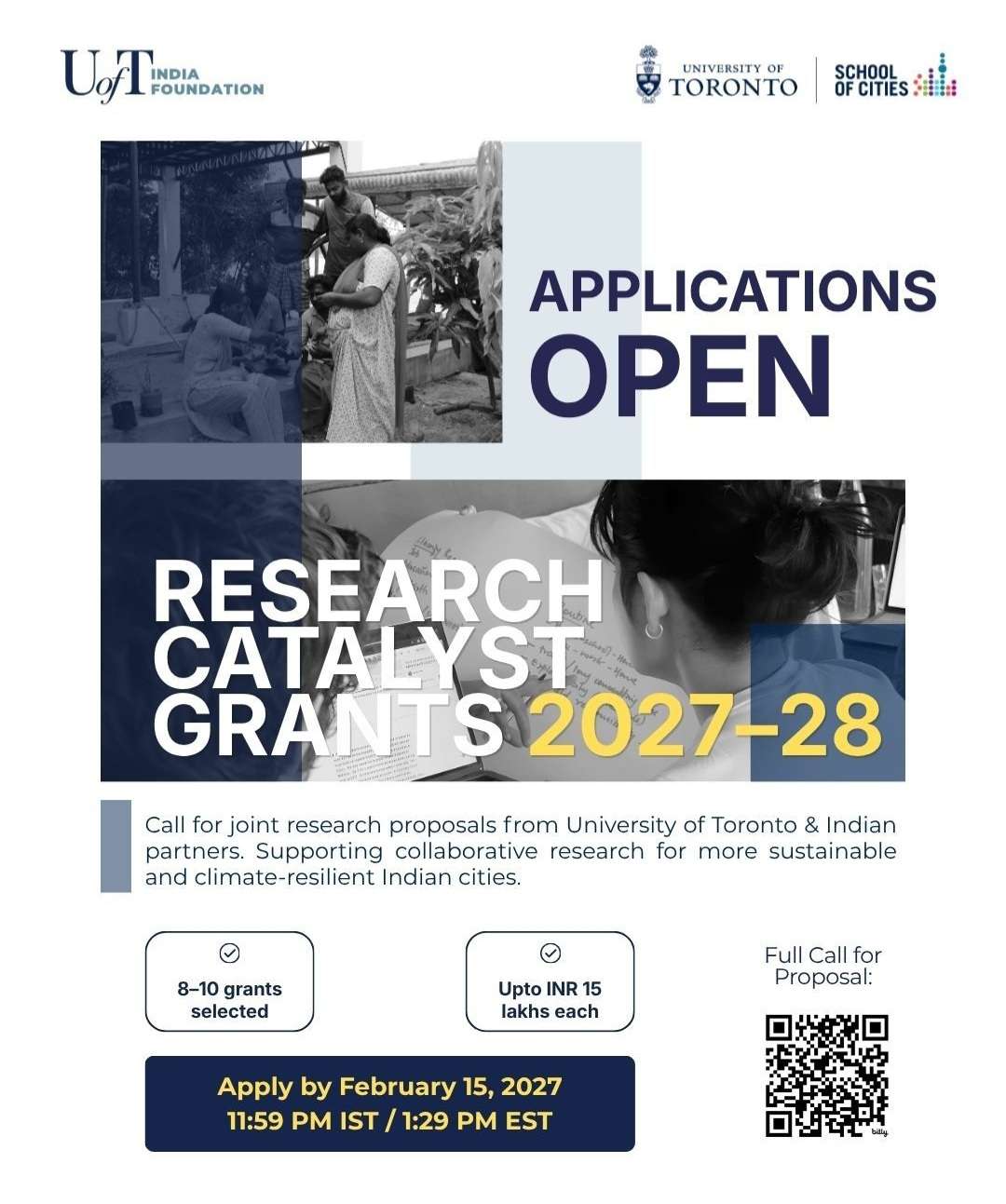
Selected projects will receive grants ranging from INR 9 lakhs to INR 15 lakhs, equivalent to approximately CAD $15,000–CAD $25,000. The funding will support research activities taking place between April 2027 and March 2028. The programme expects to select between eight and ten successful proposals.
The initiative welcomes proposals from different academic disciplines and encourages collaboration between universities, research institutions, non-governmental organisations, civil society organisations, foundations and government bodies. Research may address issues such as air quality, housing, water and sanitation, sustainable livelihoods, infrastructure, energy, mobility, urban planning, waste management and data-driven sustainability.
Importantly, the programme is not limited to research focused on large metropolitan cities. It recognises the diversity of urban India and welcomes proposals that address sustainability challenges in small towns, growing cities, major metropolitan areas and their surrounding regions.
The application deadline is 15 February 2027, at 1:29 PM Eastern Time (ET) / 11:59 PM Indian Standard Time (IST).
The Research Catalyst Grants are a seed-funding initiative established to support collaborative research between the University of Toronto and organisations based in India.
The programme recognises that the sustainability and climate resilience of Indian cities require research that combines academic expertise, local knowledge, practical experience and institutional collaboration.
Urban challenges are often interconnected. For example, climate change can affect housing, public health, transport, water availability, livelihoods and infrastructure at the same time. Addressing these problems requires more than isolated research activities. It requires collaboration between researchers, communities, government institutions and organisations that understand local conditions.
The Research Catalyst Grants aim to create opportunities for these different actors to work together and develop solutions that can inform policy, improve institutional practices and support sustainable urban development.
The programme supports both new and existing research collaborations. This means applicants may propose a new partnership or build on an existing relationship between University of Toronto researchers and Indian institutions.
The grants are particularly interested in projects that can produce practical and measurable outcomes rather than research that remains limited to theoretical discussions.
Potential outcomes include:
- Evidence-based recommendations for improving urban sustainability.
- Joint research publications.
- Policy briefs and white papers.
- Knowledge-sharing and research dissemination activities.
- Capacity-building programmes for partner organisations.
- Spatial or design-based interventions.
- Technological products and design prototypes.
- Improved institutional capacity to address climate resilience and urban sustainability challenges.
The programme also seeks to strengthen international research relationships and create opportunities for future collaboration beyond the immediate grant period.
About the University of Toronto India Foundation (UTIF)
The University of Toronto India Foundation, commonly known as UTIF, was established in Mumbai in 2023.
The Foundation serves as a bridge between the University of Toronto and partners across India. Its work focuses on facilitating research and institutional collaborations that translate academic knowledge into policy, practice and scalable public impact.
UTIF recognises the importance of connecting research institutions with organisations that understand the practical challenges facing Indian communities and cities.
Through its programmes, the Foundation supports innovation, knowledge exchange and the development of solutions to pressing urban and environmental challenges.
Its work is particularly relevant to the sustainability and climate resilience of Indian cities, where rapid urbanisation, population growth, infrastructure demands and environmental pressures require coordinated and evidence-based responses.
The Research Catalyst Grants form part of this broader commitment to strengthening collaboration between Canadian and Indian institutions.
About the University of Toronto’s School of Cities
The University of Toronto’s School of Cities is a multidisciplinary centre dedicated to urban research, education and engagement.
Its work focuses on understanding the challenges facing cities and developing new, equitable and practical approaches that allow cities and their residents to thrive.
The School brings together researchers, students, professionals, policymakers and other urban stakeholders from different disciplines to investigate issues affecting urban environments.
Its research and engagement activities cover a wide range of subjects, including:
- Urban planning and development.
- Housing and urban inequality.
- Climate change and environmental sustainability.
- Urban infrastructure and mobility.
- Municipal governance and public policy.
- Urban data and technology.
- Community development and social justice.
- Sustainable and inclusive cities.
The Role of School of Cities India
School of Cities India is a focused area within the University of Toronto’s School of Cities that works with Indian students, faculty members, municipalities, urban stakeholders and policymakers.
Its activities involve multidisciplinary initiatives connected to urban studies, data, research and training.
The initiative seeks to strengthen the capacity of Indian cities to become more sustainable, resilient and vibrant.
Its broader vision is to:
- Conduct multidisciplinary research on the challenges and opportunities facing Indian cities.
- Mobilise knowledge that can inform policy, institutional practices and public decision-making.
- Build the capacity of individuals and organisations working on urban development.
- Encourage collaboration between Indian and international researchers.
- Support solutions that improve the sustainability and resilience of urban communities.
- Contribute to better outcomes for people living in Indian cities and surrounding regions.
The Research Catalyst Grants directly support this vision by providing funding for collaborative research projects that can generate practical urban solutions.
Objectives of the 2027–2028 Research Catalyst Grants
The programme has three broad objectives: supporting urban sustainability and climate resilience, generating high-impact research outcomes, and developing equitable international research partnerships.
1. Supporting the Sustainability and Climate Resilience of Indian Cities
The primary objective is to support research that addresses challenges affecting the sustainability and climate resilience of Indian cities and city-regions.
Urban sustainability involves developing cities that can meet the needs of their populations while protecting natural resources, improving living conditions and ensuring that development is environmentally and socially responsible.
Climate resilience, meanwhile, refers to the ability of cities and communities to prepare for, withstand, adapt to and recover from climate-related risks.
The programme recognises that urban challenges differ across locations. A small town may face water shortages, inadequate sanitation or limited infrastructure, while a major metropolitan area may experience air pollution, housing pressures, traffic congestion and climate-related risks.
For this reason, the grant welcomes research focused on cities of different sizes and levels of development.
Potential research areas include:
- Air quality and urban pollution.
- Affordable and sustainable housing.
- Sustainable livelihoods.
- Water management and sanitation.
- Urban infrastructure and construction.
- Renewable energy and energy efficiency.
- Public transport and urban mobility.
- Urban planning and land-use management.
- Data-driven sustainability solutions.
- Waste management and recycling.
- Climate adaptation and resilience.
These areas are illustrative rather than exhaustive. Applicants may propose other research topics provided they demonstrate a clear connection to the sustainability or climate resilience of Indian cities and city-regions.
2. Facilitating High-Impact Research and Practical Solutions
The programme is not simply intended to finance academic research. It seeks to support research that can contribute to practical improvements in urban environments.
Successful projects should generate useful evidence, insights and recommendations that can inform decisions made by policymakers, urban institutions, communities and other stakeholders.
The programme particularly encourages projects that can produce:
Evidence-based recommendations: Research findings should provide reliable information that can help institutions understand urban challenges and identify appropriate interventions.
Joint academic publications: Collaborating researchers are encouraged to produce academic publications that contribute to knowledge and discussions within their respective fields.
Capacity development: Projects may strengthen the ability of partner organisations and their staff to undertake research, analyse evidence and implement solutions.
Knowledge dissemination: Findings should be communicated to relevant audiences, including policymakers, practitioners, researchers and communities.
Practical interventions: Where appropriate, projects may develop spatial interventions, design solutions, technological products or prototypes that address specific urban problems.
Ultimately, the programme seeks to ensure that funded research contributes to more sustainable and climate-resilient Indian cities.
3. Developing Equitable Partnerships Between Canadian and Indian Institutions
A central requirement of the programme is the establishment of meaningful and equitable partnerships between researchers at the University of Toronto and eligible Indian organisations.
The grant recognises that international research partnerships are most effective when participating institutions contribute their expertise, knowledge and resources fairly.
University of Toronto researchers can contribute academic expertise, research methodologies and international perspectives, while Indian partners bring local knowledge, contextual understanding, institutional relationships and practical experience.
Both sides are expected to contribute meaningfully to the design and implementation of the research.
The partnership must be formalised through a two-party agreement between UTIF and the Indian partner organisation.
The programme therefore encourages applicants to develop collaborative relationships that are based on shared responsibility, complementary expertise and clearly defined research objectives.
Research Themes and Areas of Focus
The 2027–2028 Research Catalyst Grants welcome proposals addressing a broad range of urban sustainability and climate resilience issues.
Applicants are encouraged to identify a clearly defined problem affecting an Indian city or city-region and explain why further research is necessary.
The following areas provide examples of the types of research that may be supported.
1. Air Quality and Urban Pollution
Air pollution is a major challenge in many Indian cities, affecting public health, environmental quality and overall urban liveability.
Research in this area could investigate the sources of urban air pollution, the effects of exposure on different population groups, and the effectiveness of policies designed to improve air quality.
Possible research questions include:
- What are the main sources of air pollution in a particular city?
- How does exposure to poor air quality affect vulnerable populations?
- Which urban planning and transport interventions could reduce pollution?
- How can cities improve air-quality monitoring and public access to environmental information?
- What policies could support cleaner and healthier urban environments?
Projects may combine environmental research, public health, urban planning and policy analysis.
2. Housing and Sustainable Urban Development
Rapid urbanisation creates increasing demand for affordable, safe and sustainable housing.
Research could examine housing affordability, informal settlements, access to basic services, housing quality and the relationship between urban development and climate resilience.
Potential areas include:
- Affordable housing policies.
- Climate-resilient housing design.
- Informal settlement upgrading.
- Access to safe and adequate housing.
- Sustainable construction materials.
- Housing inequality and urban displacement.
- The relationship between housing and access to employment and services.
The programme welcomes solutions-focused research that can inform better housing policies and urban development strategies.
3. Sustainable Livelihoods
Urban sustainability is closely connected to the ability of residents to access secure and decent livelihoods.
Many urban populations depend on informal employment, small businesses and other economic activities that may be affected by environmental risks, infrastructure limitations and changing urban conditions.
Research in this area could explore how cities can support sustainable livelihoods while improving economic inclusion and resilience.
Possible topics include:
- Livelihood opportunities in climate-resilient cities.
- The effects of climate change on informal workers.
- Urban poverty and economic inequality.
- Sustainable employment opportunities.
- The relationship between urban planning and local economic development.
- Support systems for vulnerable urban populations.
4. Water and Sanitation
Access to safe water and effective sanitation is essential for public health, environmental protection and urban resilience.
Indian cities face different water-related challenges, including groundwater depletion, water contamination, inadequate sanitation infrastructure, flooding and unequal access to reliable water services.
Potential research areas include:
- Sustainable urban water management.
- Groundwater monitoring and protection.
- Wastewater treatment and reuse.
- Sanitation infrastructure.
- Water contamination and public health.
- Climate-resilient water systems.
- Community participation in water governance.
- Water access in informal and underserved settlements.
Research may focus on developing better infrastructure, improving management systems or identifying policies that support equitable access to water and sanitation.
5. Infrastructure and Construction
Urban infrastructure is fundamental to the functioning of cities.
However, infrastructure development must account for environmental sustainability, climate risks, population growth and the needs of different communities.
Research could investigate how cities can develop infrastructure that is efficient, inclusive, affordable and resilient.
Possible topics include:
- Climate-resilient infrastructure.
- Sustainable construction materials.
- Urban drainage and flood management.
- Infrastructure planning and maintenance.
- Green buildings.
- Infrastructure financing.
- The environmental effects of construction.
- Sustainable approaches to urban expansion.
6. Energy and Sustainable Urban Power Systems
Energy systems are essential to urban development, but conventional energy production and consumption can contribute to pollution and greenhouse gas emissions.
Research in this area could examine how cities can improve energy efficiency, expand access to cleaner energy and develop more resilient energy infrastructure.
Potential topics include:
- Renewable energy integration.
- Urban solar energy systems.
- Energy-efficient buildings.
- Sustainable electricity distribution.
- Clean cooking and household energy.
- Urban energy access and affordability.
- Energy resilience during extreme weather events.
7. Mobility and Sustainable Transportation
Transportation is a major component of urban sustainability.
Poor transport systems can contribute to air pollution, traffic congestion, economic inequality and limited access to essential services.
Research could investigate how cities can develop more accessible, affordable and environmentally sustainable transport systems.
Possible areas include:
- Public transportation planning.
- Sustainable urban mobility.
- Walking and cycling infrastructure.
- Transport accessibility for persons with disabilities.
- Transport poverty and social inequality.
- Electric mobility.
- Climate-friendly transport policies.
- The relationship between transport and land-use planning.
8. Urban Planning and Governance
Effective urban planning is necessary for managing population growth, infrastructure development, environmental protection and access to public services.
Research in this area could explore how planning institutions and government agencies can make urban development more sustainable, inclusive and responsive to community needs.
Possible topics include:
- Land-use planning.
- Participatory urban governance.
- Municipal planning systems.
- Climate-responsive urban development.
- Urban policy implementation.
- Community participation in planning.
- Data-informed municipal decision-making.
- Coordination between local and regional authorities.
9. Data-Driven Sustainability
Urban data can help policymakers and researchers understand how cities function and identify areas requiring intervention.
The programme welcomes research that uses data, digital tools and analytical methods to improve urban sustainability.
Potential topics include:
- Urban data collection and management.
- Geographic information systems.
- Satellite imagery and remote sensing.
- Data-driven urban planning.
- Smart-city technologies.
- Digital monitoring of environmental conditions.
- Urban risk mapping.
- Data systems for climate adaptation.
10. Waste Management
Waste management is a major challenge for rapidly growing cities.
Inadequate waste collection, disposal and recycling systems can affect public health, pollute water sources and contribute to environmental degradation.
Research could investigate more sustainable ways of managing municipal waste and promoting circular economic practices.
Possible areas include:
- Solid waste management.
- Recycling systems.
- Waste reduction and reuse.
- Plastic pollution.
- Organic waste and composting.
- Waste-to-energy solutions.
- Informal waste workers and livelihoods.
- Community participation in waste management.
A Broad Understanding of Urban Sustainability
Applicants should note that the programme does not restrict sustainability to environmental or engineering research.
Solutions-focused research in the social sciences and humanities is also welcome.
This means proposals may investigate the social, political, economic, cultural and institutional dimensions of urban sustainability.
For example, a project could examine how housing policies affect vulnerable populations, how local communities participate in urban planning, or how municipal institutions can improve accountability in climate-related decisions.
Interdisciplinary research is encouraged, but it is not compulsory.
Who Is Eligible to Apply?
The Research Catalyst Grants are designed for collaborative research teams involving at least one University of Toronto Co-Principal Investigator and at least one Co-Principal Investigator from an eligible Indian partner organisation.
The eligibility conditions apply to both the individual researchers and their institutions.
1. University of Toronto Co-Principal Investigator
Every proposal must include at least one Co-Principal Investigator from the University of Toronto.
The University of Toronto Co-PI must:
- Meet the University’s definition of a Principal Investigator.
- Hold an eligible appointment at the University of Toronto.
- Maintain that appointment for the entire duration of the grant funding period.
- Have demonstrated experience working on or engaging with the problem the proposed research intends to address.
The University of Toronto researcher will contribute academic and research expertise to the project and work collaboratively with the Indian Co-PI.
2. Indian Co-Principal Investigator
Every proposal must also include at least one Co-Principal Investigator from an eligible Indian partner organisation.
The Indian Co-PI must:
- Be employed by the Indian partner organisation.
- Be working full-time with that organisation.
- Have experience working on the central issue or thematic area addressed by the proposed research.
- Demonstrate relevant knowledge and experience in the Indian context.
- Contribute meaningfully to the design and implementation of the research.
Research experience is highly desirable. However, the programme recognises that practical experience can also be valuable.
Indian Co-PIs from non-academic organisations may demonstrate their suitability through:
- Experience managing and implementing projects.
- Technical knowledge of the relevant issue in the Indian context.
- Field experience.
- Project management skills.
- Team management capabilities.
This approach allows professionals working in non-profit organisations, civil society institutions and other eligible entities to participate in the programme.
3. Eligible Indian Partner Organisations
The Indian partner organisation must be based in and operate in India.
Eligible organisations include:
- Universities.
- Academic institutions.
- Research centres.
- Non-governmental organisations.
- Civil society organisations.
- Foundations.
- Government bodies.
- Community-based organisations.
- Other eligible not-for-profit entities.
The programme is not restricted to universities or traditional academic institutions.
This is particularly important because it allows organisations with practical experience in urban development, environmental protection, community engagement and public policy to collaborate directly with academic researchers.
4. For-Profit Organisations Are Not Eligible as Co-PIs or Grant Recipients
For-profit companies and industry organisations are not eligible to act as Co-Principal Investigators or hold the grant funds under this call.
The current round is open to academic institutions and not-for-profit entities.
Researchers or organisations that do not meet the eligibility requirements should consider participating in an appropriate supporting or consultancy capacity where permitted by the programme.
5. Demonstrated Experience in the Research Area
Both the University of Toronto Co-PI and the Indian Co-PI must have demonstrated experience working on or engaging with the problem they intend to investigate.
This requirement is important because the programme wants to support research teams that understand the issues they are addressing.
The Indian Co-PI should bring knowledge of the local context, while the University of Toronto Co-PI should contribute relevant research expertise.
Together, they should demonstrate that their combined experience is appropriate for the proposed project.
Partnership Requirements: Why Collaboration Is Essential
A defining feature of the Research Catalyst Grants is the requirement for an equitable partnership between the University of Toronto and an Indian organisation.
Applicants cannot submit an eligible proposal independently without the required institutional collaboration.
The partnership should be based on shared responsibility and meaningful participation throughout the research process.
1. Equal and Equitable Research Contributions
The programme expects both Co-PIs to contribute equally and equitably to the design and implementation of the project.
This does not necessarily mean that both researchers must perform identical tasks. Instead, their contributions should be meaningful, complementary and appropriately recognised.
For example:
- The University of Toronto Co-PI may contribute expertise in research design, analytical methods and academic publication.
- The Indian Co-PI may contribute local knowledge, institutional relationships, community engagement and field implementation experience.
Both should participate in developing the research question, determining the methodology, interpreting findings and communicating results.
2. Formal Institutional Support
The application must include a letter of support from the Indian partner organisation.
The letter must:
- Be written on the organisation’s official letterhead.
- Be signed by a designated institutional signatory.
- Describe the organisation’s proposed involvement in the project.
- Explain the outcomes the organisation hopes to achieve.
- Demonstrate how the project outcomes will contribute to the organisation’s objectives.
- Provide a brief overview of the organisation’s experience managing grant funds.
This letter is important because it demonstrates that the Indian partner organisation is formally committed to the proposed collaboration.
3. Two-Party Agreement
The partnership will be formalised through a two-party agreement between UTIF and the Indian partner organisation.
The grant is therefore not simply an award to individual researchers. The Indian partner organisation plays a central role in receiving and administering the funds.
4. Additional Researchers and Institutional Partners
The programme welcomes proposals involving researchers from multiple institutions and different organisational sectors.
However, the lead applicants must still satisfy the eligibility requirements, including the participation of at least one eligible Indian partner organisation and one University of Toronto Co-PI.
Individuals who are not affiliated with an eligible Indian partner organisation or the University of Toronto should be listed as consultants rather than Co-PIs.
This allows research teams to bring in additional expertise while maintaining the required institutional partnership structure.
Can You Apply Without an Existing University of Toronto Partner?
Applicants who do not already have a relationship with a University of Toronto faculty member are still encouraged to explore the opportunity.
However, the application cannot be submitted without the required University of Toronto Co-PI.
The programme has indicated that India-based organisations should take the initiative to identify and engage an appropriate University of Toronto researcher.
The October 27, 2026 webinar was organised to provide India-based organisations and partners with guidance on the process of building partnerships with University of Toronto Principal Investigators.
The webinar date has passed, but the application requirements remain relevant. The programme does not guarantee that it will identify or secure a University of Toronto Co-PI for applicants.
Therefore, Indian organisations interested in applying should begin identifying potential academic collaborators as early as possible.
They should look for faculty members whose research interests, academic expertise and previous work align with the proposed urban sustainability or climate resilience project.
What Types of Research Proposals Are Welcome?
The programme welcomes proposals from a broad range of academic disciplines.
Although interdisciplinary collaboration is encouraged, applicants are not required to form multidisciplinary teams.
The important requirement is that the proposed research clearly addresses an urban sustainability or climate resilience issue affecting India.
A strong proposal should explain:
- The urban problem the research intends to address.
- Why the problem requires further investigation.
- The significance of the problem for the selected city or city-region.
- The research question and objectives.
- The proposed methodology and activities.
- The roles of the Indian and University of Toronto researchers.
- The expected research outputs and potential impact.
- The proposed budget and project timeline.
The programme also welcomes research collaborations involving different organisational sectors, provided the lead applicants satisfy the eligibility requirements.
New and Existing Research Projects
The grants can support both new and existing research initiatives.
Applicants with ongoing research projects may apply if the proposed activities align with the objectives of the grant.
However, the requested funding must be used for costs or research activities that were not already included in the original research budget.
Applicants should therefore clearly distinguish between activities already funded and the additional work that the Research Catalyst Grant would support.
Grant Amount, Duration and Financial Arrangements
The Research Catalyst Grants provide seed funding to support selected collaborative research projects.
The programme expects to fund between eight and ten successful proposals.
Grant Value
Each selected proposal will receive funding ranging from:
INR 9 lakhs to INR 15 lakhs
This is approximately equivalent to:
CAD $15,000 to CAD $25,000
The actual award will depend on the proposed project, its activities and the approved budget.
Number of Awards
The programme expects to select between eight and ten proposals.
The funding is competitive, meaning that submitting an application does not guarantee an award.
Applications will be assessed against the programme’s research, partnership, feasibility and impact criteria.
Grant Currency and Recipient
The grants will be awarded in Indian rupees.
The funds will be transferred by UTIF to the Indian partner organisation where the Indian Co-PI is employed.
The grant will not be paid directly to individual Co-PIs or other team members.
FCRA Registration Is Not Required
An important feature of the programme is that the grant is classified as a non-FCRA grant.
Consequently, Indian partner organisations are not required to have Foreign Contribution Regulation Act (FCRA) registration to receive this funding.
This is particularly relevant for eligible Indian non-profit organisations and institutions that may not have FCRA registration but are otherwise qualified to participate.
Grant Period
The funding will support project activities between April 2027 and March 2028.
The stated grant period begins on 15 April 2027 and ends on 20 March 2028.
Successful applicants should therefore prepare realistic workplans that can be completed within this period.
Disbursement of Funds
Grant funds will be disbursed in instalments or tranches.
The Indian partner organisation will be responsible for managing the grant funds and ensuring that expenditure follows the approved project budget and applicable financial policies.
The Indian partner organisation will also be expected to cover reasonable costs associated with the University of Toronto Co-PI’s economy-class travel using the disbursed grant funds.
Travel arrangements must be made through India-based travel agencies.
An important restriction is that grant funds cannot be used to cover expenses incurred outside India.
Eligible and Ineligible Expenses
Applicants must prepare a detailed project budget using the prescribed budget template.
The proposed budget should include only expenses that are permitted under the programme.
Understanding these restrictions is essential because an otherwise strong proposal may face difficulties if its budget includes costs that do not comply with the grant requirements.
Eligible Expenses
The following categories of expenditure may be covered.
1. Fieldwork Costs
The grant can support reasonable costs directly associated with fieldwork and research activities.
Examples include:
- Research consumables.
- Field allowances for Indian research assistants.
- Honoraria for research participants.
- Fees for data collection platforms.
- Analytical software.
- Local Institutional Review Board sitting fees.
- Equipment rental.
These costs should be clearly connected to the proposed research activities.
2. Additional India-Based Staffing Costs
The grant can cover additional investigator and staffing costs that facilitate the research process.
However, these costs must not exceed 25% of the overall project budget.
Applicants should therefore ensure that staffing expenses remain within the specified limit.
3. Economy-Class Travel and Accommodation
The grant can cover eligible economy-class travel costs for University of Toronto faculty members and local Indian partners within India.
Eligible travel may include:
- Economy-class flights.
- Accommodation and hotel costs.
- Other reasonable travel arrangements directly related to the project.
Only basic economy airfare is eligible.
Premium economy airfare will not be covered.
Travel arrangements must be made through India-based travel agencies, and the programme requires that funded expenses be incurred within India.
4. Capacity-Building Activities
Projects may include activities designed to strengthen the skills, knowledge and institutional capabilities of researchers and partner organisations.
Examples could include:
- Research training.
- Technical workshops.
- Knowledge-sharing sessions.
- Methodology training.
- Capacity-building activities for project participants.
- Institutional learning and research development activities.
Such activities should be directly connected to the objectives and implementation of the project.
5. Publication and Dissemination Costs
The grant can cover reasonable costs associated with publishing and communicating research findings.
This may include activities that help make the research accessible to policymakers, practitioners, researchers and communities.
Applicants should explain how dissemination activities will contribute to the project’s intended impact.
6. Project Equipment
Equipment directly associated with the research project may be funded.
However, equipment costs are capped at 5% of the overall project budget.
Applicants should carefully justify the need for any equipment included in their budgets.
7. Grant Administration and Management Costs
Reasonable grant administration and management costs may be included.
However, these costs are capped at 7% of the overall project budget.
The budget should clearly identify these expenses and ensure that the permitted limit is not exceeded.
Ineligible Expenses
The following expenses cannot be covered by the grant:
- Costs incurred outside India.
- Replacement research or teaching costs.
- Costs associated with the applicants’ or Co-PIs’ own time.
- Scholarships.
- Conference attendance.
- Tuition fees.
Applicants should not include these expenses in their proposed budgets.
For example, a researcher cannot use the grant to pay their own salary for time spent working on the project. Similarly, the funding cannot be used to cover tuition fees or conference attendance.
A carefully prepared budget should focus on eligible project activities and provide a clear explanation of how each requested expense supports the research objectives.
How to Prepare and Structure Your Research Proposal
The application must follow the prescribed proposal template and include all the required sections.
The programme expects applicants to explain their research objectives, methodology, expected outcomes, partnership arrangements, sustainability plans, timeline and budget.
The following sections describe the major components of the proposal.
1. Initiative Overview
Applicants must provide a brief overview of the proposed research initiative.
This section should identify:
- The proposed project.
- The names and titles of the Co-PIs.
- The organisations where the Co-PIs are employed.
- A clear description of the initiative.
The overview should allow reviewers to understand the project and the institutions involved.
2. Background and Rationale – 150 Words
This section should describe the research question, objectives and anticipated contribution of the initiative.
The explanation must be written in plain language suitable for public use.
Applicants should clearly communicate:
- The urban sustainability or climate resilience challenge.
- Why the problem matters.
- The research question.
- The goals of the proposed initiative.
- The contribution the project expects to make.
The maximum word count for this section is 150 words.
Candidates should avoid unnecessary technical language and focus on communicating the importance of the research clearly.
3. Methodology and Activity Plan – Maximum 1,000 Words
This is one of the most important sections of the proposal.
Applicants must explain how the research will be conducted and how the proposed activities will produce the intended results.
The methodology should address:
Research approach: Explain the methods that will be used to investigate the research problem. This may involve qualitative research, quantitative research, mixed methods, modelling, spatial analysis or other suitable approaches.
Sampling strategy: Where applicable, describe how research participants, locations, communities or datasets will be selected.
Participant mobilisation: Explain how participants will be identified, contacted and involved in the research.
Data storage: Describe how collected data will be stored and managed securely.
Data analysis: Explain how information will be analysed and how the findings will answer the research questions.
Dissemination plan: Describe how research findings will be shared with relevant stakeholders.
Ethical compliance and data privacy: Where applicable, explain how participant confidentiality, privacy and ethical considerations will be addressed.
The maximum word count for this section is 1,000 words.
Applicants should ensure that the proposed methods are realistic and appropriate for the research problem.
4. Outputs and Potential Impact – 300 Words
This section should explain what the project expects to produce and how the findings will contribute to sustainable and climate-resilient Indian cities.
Potential outputs include:
- Peer-reviewed academic publications.
- Policy briefs and white papers.
- Knowledge translation and dissemination activities.
- Capacity-building programmes.
- Spatial or design-based interventions.
- Technological products and prototypes.
Applicants should also explain the anticipated impact of these outputs.
For example, a research project examining urban water management could produce evidence-based recommendations for improving groundwater governance, while a project on climate-resilient housing could generate practical design or policy recommendations.
The maximum word count for this section is 300 words.
5. Collaborative Team – 300 Words
Applicants must describe the roles, responsibilities and contributions of the Co-PIs and other key participants.
This section should demonstrate that the research team has the necessary expertise and capacity to implement the project.
The explanation should identify:
- The responsibilities of the University of Toronto Co-PI.
- The responsibilities of the Indian Co-PI.
- The contributions of other researchers and key participants.
- How the team will coordinate research activities.
- How the partnership will ensure equitable participation.
The maximum word count for this section is 300 words.
The programme places particular importance on the equitable nature of the partnership. Applicants should therefore explain how both Co-PIs will contribute meaningfully to the project.
6. Project Sustainability – 300 Words
Project sustainability is considered during the assessment process, although it is not a mandatory requirement.
Applicants should explain whether the research has the potential to continue beyond the grant period.
This section may address:
- Existing external funding that supports the research team.
- Additional funding sources the team intends to pursue.
- Opportunities to expand the research.
- Potential for scaling up the proposed intervention.
- Possibilities for adapting the findings to other cities or regions.
- Long-term institutional or community benefits.
The maximum word count for this section is 300 words.
Applicants are encouraged to demonstrate how the research could create value beyond the initial funding period.
7. Proposed Timeline
The proposal must include a project timeline outlining the major research activities and milestones.
The timeline should identify:
- The main project activities.
- The expected start and completion dates of each activity.
- Fieldwork periods.
- Travel arrangements, where applicable.
- Research and data collection milestones.
- Analysis and reporting stages.
- Publication and dissemination activities.
The proposed timeline should be realistic and consistent with the grant period.
8. Project Budget
Applicants must provide a detailed budget showing the amount of funding requested and how the money will be used throughout the project.
The budget must be prepared using the prescribed Excel budget template.
All requested costs should be itemised and linked to specific project activities.
Applicants should also ensure that the proposed expenditure complies with the programme’s eligibility restrictions and spending caps.
Documents Required for the Application
The application must contain two principal files.
File 1: Combined Research Proposal PDF
Applicants must submit a single PDF file containing:
- The full research proposal.
- The abbreviated CVs of all Principal Investigators.
- A letter of support from the Indian partner organisation.
The abbreviated CVs of the Indian and University of Toronto PIs must not exceed five pages each.
The letter of support must be on the Indian organisation’s official letterhead and signed by an authorised institutional representative.
File 2: Independent Excel Budget Sheet
The second file must be the completed budget sheet submitted as a separate Excel document.
The budget must use the prescribed template and provide an itemised breakdown of the requested funding.
Language and Formatting Requirements
All applications must be submitted in English.
Applicants must use the prescribed templates provided under the call for proposals.
The files must also follow the specified naming conventions:
- Research proposal: Application PI1 Name PI2 Name
- Budget: Budget PI1 Name PI2 Name
Applicants should ensure that both documents are correctly named and uploaded before submitting the application.
The proposal’s word limits do not include the CVs and letters of support.
How Will Applications Be Evaluated?
The Research Catalyst Grants are competitive, and applications will be assessed by a peer review committee.
The committee will consider the strength of the proposed research, the quality of the partnership, the potential impact and the feasibility of the project.
The main evaluation criteria are outlined below.
1. Quality and Equity of the Partnership
Reviewers will assess whether the collaboration between the University of Toronto and Indian partner organisation is equitable and meaningful.
They will consider:
- The respective expertise of team members.
- Whether the researchers have complementary skills.
- The extent to which both Co-PIs contribute to the research.
- The team’s ability to implement the project.
- The institutional commitment of the partners.
A strong application should demonstrate that the partnership is based on shared responsibility rather than a one-sided arrangement.
2. Clarity, Relevance and Focus of the Research Problem
The committee will examine whether the research problem is clearly defined and relevant to the objectives of the grant.
Reviewers will consider:
- The clarity of the research question.
- The importance of the issue.
- Its connection to urban sustainability or climate resilience.
- The justification for conducting the research.
- The level of innovation and critical thinking demonstrated by the proposal.
Applicants should avoid proposals that are too broad or unclear.
A clearly defined problem with a convincing research rationale is more likely to demonstrate the value of the proposed work.
3. Potential Impact and Outcomes
The programme will assess whether the proposed research can generate meaningful results.
Reviewers will consider the potential contribution of the research to sustainable and climate-resilient Indian cities.
Projects should identify realistic and measurable outputs and explain how those outputs could benefit institutions, policymakers, communities or other stakeholders.
4. Quality of the Research Approach
The research methodology will be assessed for its rigour, suitability and feasibility.
The committee will consider:
- The research design.
- The proposed methodology.
- Ethical considerations.
- The data analysis plan.
- Participant mobilisation and engagement.
- The feasibility of the proposed activities.
- The ability of the research team to complete the project.
Applicants should ensure that their methods are appropriate for the research question and that the project can realistically be implemented within the funding period.
5. Project Timeline and Workplan
The committee will examine whether the proposed timeline is realistic and whether the activities are appropriately organised.
The budget will also be assessed to determine whether the requested funding is reasonable and consistent with the proposed work.
Applicants should ensure that each major research activity has an appropriate timeline and budget allocation.
6. Long-Term Sustainability and Scalability
The potential for long-term sustainability and scalability is an advantageous criterion, but it is not mandatory.
Proposals that demonstrate opportunities to continue, expand or adapt their research beyond the grant period are particularly encouraged.
For example, a successful urban water management project may provide a framework that can be adapted to other cities facing similar challenges.
The committee will select between eight and ten proposals for funding. All applicants will receive the results through email.
Application Timeline and Important Dates
Applicants should take note of the following dates for the 2027–2028 Research Catalyst Grants.
| Activity | Date |
|---|---|
| Call for proposals opens | 21 September 2026 |
| Webinar for India-based partners | 27 October 2026 |
| Application deadline | 15 February 2027 |
| Expected announcement of successful grants | Approximately 16 March 2027 |
| UTIF finalises project and disbursement plans with Indian partners | 1 April 2027 |
| Grant period begins | 15 April 2027 |
| Grant period ends | 20 March 2028 |
The application deadline is 15 February 2027, at 1:29 PM Eastern Time (ET) / 11:59 PM Indian Standard Time (IST).
The October 27, 2026 webinar was intended to provide guidance to India-based organisations on building partnerships with University of Toronto Principal Investigators. Since that date has passed, organisations that did not attend should use the published application information and contact the programme team if they need clarification.
Applicants are strongly encouraged to begin preparing their proposals well ahead of the deadline.
How to Submit an Application
Applications must be submitted electronically through the official online application form designated by the programme.
Before submitting, applicants should ensure that they have completed the following steps:
- Identify an eligible Indian partner organisation.
- Secure an eligible University of Toronto Co-Principal Investigator.
- Confirm that both Co-PIs have relevant experience in the proposed research area.
- Develop a clearly defined research question.
- Prepare the full proposal using the prescribed template.
- Obtain the abbreviated CVs of all Principal Investigators.
- Secure the signed institutional letter of support from the Indian partner organisation.
- Complete the itemised Excel budget sheet.
- Ensure that all documents are written in English.
- Check the word limits, file formats and naming conventions.
- Upload both required files through the application form.
- Submit the application before the closing time.
The application must contain two files: one combined PDF document and one independent Excel budget sheet.
Applicants should not wait until the final hours to submit. Late applications will not be considered.
Reporting Requirements for Successful Applicants
Organisations that receive funding will be required to submit progress and final reports.
Reporting is an important condition of receiving the grant because it allows UTIF to monitor project implementation, assess progress and understand the outcomes generated by the research.
Awardees must submit:
1. Six-Month Progress Report
The first progress report must be submitted six months after the commencement of the grant.
It should provide information on the progress of the research and the activities undertaken during the initial implementation period.
2. Nine-Month Progress Report
A second progress report must be submitted nine months after the grant begins.
This report should provide further information on the project’s progress, activities, challenges and achievements.
3. Final Report
A final report must be submitted within two months after the grant closes.
The final report should describe:
- The activities completed.
- The research outcomes.
- The impact of the initiative.
- The results generated through the partnership.
- Opportunities for future collaboration.
Successful organisations should therefore plan their monitoring, documentation and reporting activities from the beginning of the project.
Click HERE for more information
Frequently Asked Questions About the UTIF Research Catalyst Grants 2027–2028
1. What are the UTIF Research Catalyst Grants?
The Research Catalyst Grants are a seed-funding initiative supporting collaborative research between University of Toronto researchers and eligible Indian organisations.
The programme focuses on improving the sustainability and climate resilience of Indian cities and city-regions.
2. How much funding is available?
Successful projects may receive between INR 9 lakhs and INR 15 lakhs, approximately equivalent to CAD $15,000–CAD $25,000.
3. How many projects will receive funding?
The programme expects to support between eight and ten successful proposals.
4. Who can apply?
Applications must include at least one University of Toronto Co-Principal Investigator and at least one Co-Principal Investigator employed by an eligible Indian partner organisation.
5. Can non-governmental organisations apply?
Yes. Eligible Indian non-governmental organisations, civil society organisations, foundations and community-based organisations can participate as partner organisations.
The Indian organisation must be based in and operate in India and must satisfy the programme’s eligibility requirements.
6. Can an Indian organisation apply without a University of Toronto partner?
No. A University of Toronto Co-PI is a mandatory requirement.
Organisations without an existing relationship with a University of Toronto researcher are encouraged to identify and engage an appropriate faculty member before applying.
The programme does not guarantee that it will find a partner for applicants.
7. Can for-profit companies apply?
For-profit companies and industry organisations are not eligible to act as Co-PIs or hold the grant funds under this call.
The programme is open to academic institutions and not-for-profit entities.
8. Does the Indian Co-PI have to work at a university?
No. The Indian Co-PI may be employed by a university, research centre, NGO, civil society organisation, foundation, community-based organisation or government body, provided the organisation meets the eligibility requirements.
The individual must work full-time with the Indian partner organisation and demonstrate relevant experience in the proposed research area.
9. Is FCRA registration required?
No. The grant is classified as a non-FCRA grant, meaning Indian partner organisations do not need FCRA registration to receive the funding.
10. Can researchers from multiple institutions participate?
Yes. The programme welcomes collaborative and multidisciplinary proposals involving researchers from different institutions and organisational sectors.
However, the lead applicants must meet the mandatory partnership requirements.
Individuals not affiliated with the eligible Indian partner organisation or University of Toronto should be listed as consultants.
11. Can a University of Toronto faculty member participate in multiple applications?
Yes. A University of Toronto faculty member may be listed as a Co-PI on multiple applications.
However, the faculty member can be a Co-PI on a maximum of two awarded grants in the same funding cycle.
12. Can an organisation submit more than one proposal?
Yes. Principal Investigators and organisations may submit up to two applications.
However, the applications must be distinct and should focus on different thematic areas and/or different research questions.
13. Can an ongoing research project receive funding?
Yes. Existing research projects may apply, provided the proposed activities align with the grant objectives.
The requested funding must cover costs or research activities that were not included in the original research budget.
14. Are ethical approvals required?
Projects involving human participants, animals or sensitive data may require ethical approval or Institutional Review Board approval before project activities begin.
Awardees should ensure that all applicable ethical requirements are satisfied before commencing the relevant research activities.
15. Can applicants revise an application after submission?
Yes. Applicants who wish to make significant changes should submit a revised application through the submission form before the deadline.
They must:
- Indicate “Revised Application of Interest” followed by the project title in the project title field.
- Mark the application and budget files as “revised”.
- Submit the revised documents before the application deadline.
Only revised applications clearly identified as revisions will be considered as revised submissions. If the revised submission is not properly identified, the original application will be considered.
16. What happens if an application is submitted after the deadline?
Late applications will not be considered.
Applicants are encouraged to submit well before the closing time to avoid technical or logistical problems.
17. How will successful applicants receive the funding?
The funds will be awarded in Indian rupees to the Indian partner organisation employing the Indian Co-PI.
The money will be disbursed in tranches and cannot be transferred directly to individual Co-PIs or other team members.
18. When will the successful projects begin?
The grant period is expected to begin on 15 April 2027 and end on 20 March 2028.
19. How can applicants ask questions about the grant?
Questions concerning the call for proposals can be directed to the programme team through its official contact email address.
The programme advises applicants to allow up to five working days for a response.
20. Can organisations receive updates about future grant opportunities?
Yes. Organisations and researchers who are not applying for the current round but wish to receive information about future opportunities can contact the programme team and request to be added to its mailing list.
They may also provide a short profile of their organisation or research activities and request a conversation about the Foundation’s broader work.
Examples of Previously Funded Research Projects
The Research Catalyst Grants build on an existing programme of collaboration between the University of Toronto and Indian research and development organisations.
The 2026–2027 Research Catalyst Grants supported projects addressing a variety of urban sustainability and climate resilience challenges.
These projects demonstrate the programme’s multidisciplinary approach and the different types of research that can contribute to more sustainable Indian cities.
Examples include:
1. Assessing the Impact of Heat Exposure on Pregnant and Postpartum Women and Their Newborns in Maharashtra
This project examines the effects of heat exposure on pregnant and postpartum women and their newborns.
It demonstrates how climate-related urban challenges can be investigated through public health and social research.
2. Making Transport Poverty Visible: Equity and Climate Justice in Ahmedabad’s Low-Income Settlements
This research examines transport poverty and the relationship between mobility, inequality and climate justice in low-income urban settlements.
It highlights the importance of developing transportation systems that are accessible and equitable.
3. Grid Integration Challenges and Mitigation Strategies for Distributed Rooftop Solar Photovoltaic Inverters in Urban India
This project investigates technical challenges associated with integrating distributed rooftop solar photovoltaic systems into urban electricity grids.
It demonstrates the role of engineering and energy research in supporting sustainable urban infrastructure.
4. Inclusive Climate Action Planning Centring Informal Workers in Akola and Nagpur
This project focuses on incorporating informal workers into climate action planning.
It highlights the importance of ensuring that climate policies account for the needs and experiences of workers who may be particularly vulnerable to environmental and economic changes.
5. Reporting Dharavi: Understanding Local News and Knowledge Networks for Environmental Action
This research explores local information networks and the role of knowledge in supporting environmental action in Dharavi.
It demonstrates how communication, community knowledge and urban research can contribute to environmental sustainability.
6. Mapping On-Site Sanitation Contamination Pathways for Climate-Resilient Urban Water Management
This project uses a cost-effective sensor-based approach to investigate sanitation contamination pathways.
Its focus demonstrates the importance of technical innovation and environmental monitoring in improving urban water management.
7. Climate-Resilient Life-Cycle Assessment Framework for Sustainable Urban Materials in India
This research examines how urban construction materials can be assessed in relation to their environmental impact and climate resilience.
It demonstrates the relevance of sustainable construction and infrastructure research.
8. Integrating Traditional and Modern Water Infrastructure for Climate Resilience in Urban and Peri-Urban Himachal Pradesh
This project investigates how traditional and modern water infrastructure can be combined to strengthen water management and climate resilience.
It highlights the value of integrating local knowledge with contemporary infrastructure approaches.
9. Assessing the Impact of Ambient Air Quality on the Elderly Population
This project examines the relationship between air quality and the health of older people through a comparative study of Delhi, Mumbai and Thiruvananthapuram.
It demonstrates how environmental sustainability research can address the needs of vulnerable population groups.
10. Mapping Bengaluru’s Groundwater Flows
This project investigates groundwater flows in Bengaluru and contributes to research on urban water resources.
It highlights the importance of understanding underground water systems when developing sustainable urban water management strategies.
These examples illustrate the broad range of research disciplines and urban challenges that the Research Catalyst Grants can support.
They also demonstrate that the programme is interested in research that combines technical, environmental, social, health, planning and policy perspectives.
Tips for Developing a Strong Research Catalyst Grant Application
Because the programme is competitive and expects to fund only eight to ten proposals, applicants should carefully develop their research ideas and partnership arrangements.
The following recommendations can help research teams prepare stronger applications.
1. Begin With a Specific Urban Problem
Avoid proposing a project that attempts to address every aspect of urban sustainability.
Instead, identify a clearly defined issue affecting a particular city or city-region.
For example, rather than proposing a broad study on climate change and Indian cities, a team could investigate how extreme heat affects informal workers in a specific urban area.
A focused research question makes it easier to develop an appropriate methodology, budget and implementation plan.
2. Demonstrate Why the Research Matters
Applicants should explain why the identified problem deserves further investigation.
Where possible, support the rationale with relevant data, existing studies, policy documents and evidence from the affected communities.
The proposal should show that the research responds to a real challenge rather than simply exploring an issue of general academic interest.
3. Find a Suitable University of Toronto Research Partner Early
The University of Toronto partnership is mandatory.
Indian organisations should therefore identify faculty members whose research expertise aligns with the proposed project.
A good partnership should be based on complementary expertise and a shared interest in the research problem.
4. Demonstrate Genuine Local Knowledge
The Indian partner should demonstrate a strong understanding of the local context.
This may include experience working with affected communities, government institutions, urban authorities, research participants or organisations operating in the relevant field.
Local knowledge is important because research findings must be grounded in the realities of the city or region being studied.
5. Make the Partnership Equitable
The proposal should clearly explain how both Co-PIs will contribute to the project.
Avoid presenting the Indian partner as merely a fieldwork provider or the University of Toronto researcher as the sole intellectual contributor.
The programme expects both researchers to participate meaningfully in designing and undertaking the research.
6. Develop Measurable Outputs
Applicants should identify specific results that can be achieved within the funding period.
These may include publications, policy briefs, training activities, data products, prototypes, design interventions or institutional recommendations.
The proposed outputs should be realistic and directly connected to the research objectives.
7. Prepare a Realistic Budget
The budget should reflect the actual requirements of the research.
Applicants should ensure that all costs are eligible and that the spending limits for staffing, equipment and grant administration are respected.
The budget should also be consistent with the activities and timeline described in the proposal.
8. Explain the Potential for Long-Term Impact
Although project sustainability is not compulsory, the programme particularly encourages proposals that could generate benefits beyond the grant period.
Applicants should consider whether their findings could inform future policies, be adapted to other cities or support additional research and institutional partnerships.
9. Follow the Prescribed Templates and Word Limits
The application must follow the programme’s prescribed format.
Applicants should carefully observe the word limits for the different sections and ensure that the required supporting documents are included.
A technically strong research idea can still be weakened by an incomplete or poorly structured application.
10. Submit Before the Deadline
Applicants should allow sufficient time for institutional approvals, partner coordination, budget preparation and document review.
The deadline is 15 February 2027 at 1:29 PM ET / 11:59 PM IST. Late applications will not be considered.
Contact Information for Enquiries
Applicants who require clarification about eligibility, partnerships, proposal requirements, budgets or the submission process can contact the Research Catalyst Grants programme team.
Email: catalystgrant@uoftindiafoundation.com
The programme advises applicants to allow up to five working days for a response.
Organisations that are interested in future opportunities but are not applying for the current funding round may also contact the team to request inclusion on its mailing list.
Important Application Summary
| Opportunity Detail | Information |
|---|---|
| Grant Name | UTIF Research Catalyst Grants 2027–2028 |
| Funding Organisations | University of Toronto India Foundation and University of Toronto’s School of Cities |
| Opportunity Type | Research Grant |
| Main Focus | Urban sustainability and climate resilience in India |
| Eligible Country for Indian Partner | India |
| Required Collaboration | University of Toronto Co-PI and eligible Indian organisation Co-PI |
| Eligible Indian Partners | Universities, research centres, NGOs, civil society organisations, foundations and government bodies |
| For-Profit Companies | Not eligible as Co-PIs or grant recipients |
| Number of Awards | Approximately 8–10 |
| Grant Amount | INR 9–15 lakhs |
| Approximate Canadian Dollar Value | CAD $15,000–$25,000 |
| Funding Currency | Indian Rupees (INR) |
| FCRA Registration | Not required |
| Grant Period | 15 April 2027–20 March 2028 |
| Application Language | English |
| Required Files | Combined proposal PDF and independent Excel budget sheet |
| Application Deadline | 15 February 2027, 1:29 PM ET / 11:59 PM IST |
| Enquiries | catalystgrant@uoftindiafoundation.com |
Conclusion
The University of Toronto India Foundation Research Catalyst Grants 2027–2028 offer an important funding opportunity for researchers and institutions working to address urban sustainability and climate resilience challenges in India.
With grants ranging from INR 9 lakhs to INR 15 lakhs, the programme provides financial support for collaborative research that can generate evidence-based recommendations, academic publications, policy solutions, capacity-building activities and practical interventions.
One of the programme’s most valuable features is its emphasis on equitable international partnerships. By bringing together University of Toronto researchers and Indian organisations, the initiative creates opportunities to combine academic expertise with local knowledge and practical experience.
The programme is also particularly accessible to eligible non-profit organisations, civil society institutions, foundations, community-based organisations and government bodies that have relevant experience but may not be traditional academic research institutions. Its non-FCRA status further means that Indian partner organisations do not need FCRA registration to receive the grant.
However, applicants should understand that the required University of Toronto partnership is essential. Organisations that do not already have an eligible academic collaborator should begin identifying potential partners as early as possible. They should also prepare a clear research proposal, demonstrate the value of their collaboration, develop measurable outputs and ensure that their budgets comply with the programme’s financial requirements.
Researchers and organisations with innovative ideas for addressing urban challenges should consider this opportunity to develop collaborative research that can contribute to more sustainable, inclusive and climate-resilient Indian cities.
Interested applicants should prepare their proposals and submit all required documents before the 15 February 2027 deadline.