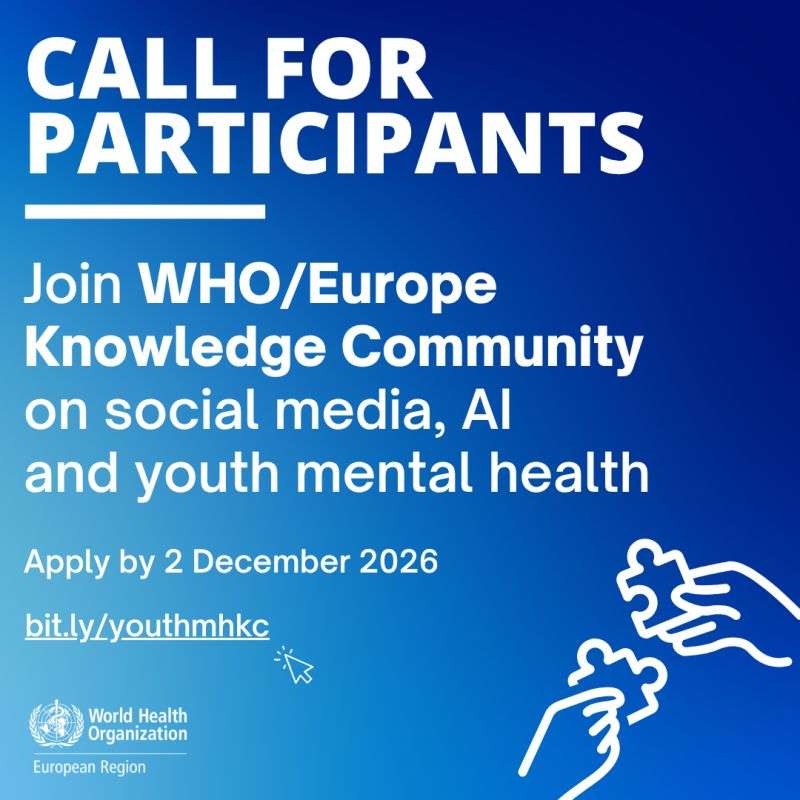
The World Health Organization Regional Office for Europe (WHO/Europe) is inviting individuals and stakeholders from different professional, academic and community backgrounds to join its Knowledge Community on Social Media, AI and Youth Mental Health. This initiative seeks to bring together young people, parents and caregivers, health professionals, policy-makers, educators, researchers, technology representatives and youth organizations to explore how digital spaces can better protect and promote the mental health and well-being of young people.
As social media platforms, generative artificial intelligence (AI) tools and other digital technologies continue to influence how young people communicate, learn, access information and interact with society, questions about digital safety and mental health are becoming increasingly important. While digital environments can create opportunities for connection, learning and access to services, they also present challenges that require coordinated responses from governments, health systems, educational institutions, technology companies, families and young people themselves.
Through this Knowledge Community, WHO/Europe aims to create an opportunity for multidisciplinary dialogue, knowledge exchange and collective problem-solving. Participants will examine the relationship between digital environments and youth mental health, identify barriers to safer online spaces and explore practical actions that could help create a future in which digital technologies better support young people’s well-being.
The initiative will run for eight weeks and will combine thematic forum discussions with webinars facilitated by young people from WHO/Europe’s Youth4Health network, together with WHO/Europe staff.
The Knowledge Community is open to all interested parties, with particular encouragement for individuals aged 18 to 30, parents and caregivers, health professionals, policy-makers, technology and AI industry representatives, educators and researchers.
Interested individuals are invited to complete an online expression of interest form to become part of the community. The deadline for submitting an expression of interest is 2 December 2026.
The WHO/Europe Knowledge Community on Social Media, AI and Youth Mental Health is a multidisciplinary initiative designed to explore how digital environments can be made safer and more supportive of young people’s mental health.
The community will bring together individuals with different forms of expertise, professional experience and personal perspectives to examine the challenges associated with digital technologies and identify possible solutions.
WHO/Europe describes knowledge communities as informal, time-bound forums that bring together multidisciplinary expertise to support the analysis of complex issues in the WHO European Region. These forums are designed as problem-focused platforms where participants can collectively identify potential solutions through shared experience, dialogue and reflection.
This means that the Knowledge Community will not operate simply as a conventional academic discussion or professional networking platform. Instead, it will provide a structured opportunity for participants to examine a specific problem, exchange knowledge and reflect on what different stakeholders can do to address it.
The central issue under consideration is how social media, generative AI platforms and other digital environments can better protect the mental health and well-being of young people.
Participants will be encouraged to contribute their knowledge, experiences and perspectives to discussions about digital safety, youth engagement, public health, education, technology development and digital governance.
The initiative recognizes that protecting young people’s mental health in digital spaces requires more than the involvement of health professionals alone. It requires collaboration between different sectors and meaningful participation from the young people whose experiences are directly connected to these environments.
Why WHO/Europe Is Establishing This Knowledge Community
The Knowledge Community builds on WHO/Europe’s ongoing work on the digital determinants of youth mental health and well-being.
This previous work has identified cross-sectoral coordination, including meaningful engagement of young people, as a leading barrier to progress.
The growing influence of digital technologies means that young people’s mental health and well-being are connected to decisions and activities taking place across several sectors. Social media platforms, AI systems, education environments, public health services, government policies and family settings can all influence the digital experiences of young people.
However, these different areas do not always work together effectively. This can make it difficult to develop coordinated responses to the challenges associated with digital environments.
For example, health professionals may have important knowledge about mental health and well-being, while educators may understand how digital technologies influence young people’s learning experiences. Technology companies have knowledge about digital platform development, while policy-makers are involved in shaping governance and regulatory approaches.
Parents and caregivers can contribute perspectives on young people’s everyday digital experiences, while youth organizations can help communicate the needs and priorities of the people most directly affected.
Without effective coordination, these different contributions may remain disconnected.
WHO/Europe is therefore establishing the Knowledge Community to encourage a shared understanding of the issues and help stakeholders explore how they can work together.
The initiative also emphasizes that young people should have a meaningful role in discussions about digital environments. Their experiences and perspectives are essential when considering how social media and AI platforms can better protect their mental health.
By bringing together different stakeholders, WHO/Europe aims to support a more collaborative approach to addressing the digital determinants of youth mental health and well-being.
The 2035 Vision: Creating Digital Spaces That Protect Youth Mental Health
One of the most important elements of the Knowledge Community is its future-oriented approach to problem-solving.
Participants will begin with a preferred future in 2035, in which recommendations from WHO/Europe’s previous work on the digital determinants of youth mental health and well-being have been successfully implemented.
Rather than starting only with the challenges that exist today, participants will first consider what a successful future would look like. They will then work backward to identify the conditions, decisions and actions that would have been necessary to achieve that future.
This approach will help members examine the relationship between long-term ambitions and the practical steps required in the near term.
The exercise will consider several important dimensions.
1. Identifying the Conditions Needed for a Safer Digital Future
Participants will explore what needs to be in place for digital spaces to better protect young people’s mental health.
This will involve considering the institutional, social, educational, health-related and digital governance conditions that could support a healthier digital environment.
The discussion will encourage participants to think about the different contributions required from governments, technology actors, educational institutions, health systems, families and youth organizations.
2. Identifying Barriers to Progress
The community will also examine the obstacles that could prevent the preferred 2035 future from becoming a reality.
These barriers may differ depending on the country, community, health system, educational environment and digital governance context.
Participants will be encouraged to consider why certain recommendations may be difficult to implement and what could be done to address those challenges.
3. Examining Risks and Potential Challenges
In addition to identifying barriers, members will explore the risks that could affect efforts to create safer digital environments.
This will allow participants to reflect on the possible difficulties associated with implementing recommendations and the importance of considering different perspectives before taking action.
4. Identifying Near-Term Actions
The future-oriented exercise will ultimately help participants identify practical actions that can be taken in the near term.
The aim is to connect the preferred 2035 vision with realistic steps that WHO/Europe and other stakeholders can consider implementing.
Through this process, the Knowledge Community will seek to identify the actions and conditions needed to move towards a future in which digital spaces better protect young people’s mental health.
Key Questions That Will Guide the Knowledge Community Discussions
WHO/Europe has identified several central questions that will guide the community’s discussions and analysis.
These questions will help participants examine the responsibilities of different stakeholders, consider implementation challenges and explore practical actions that could improve digital environments for young people.
What Near-Term Actions Should WHO Take to Support Safer Digital Environments for Youth?
One of the central questions is what WHO should do in the near term to support safer digital environments for young people.
Participants will explore possible actions that WHO could take to contribute to improvements in digital spaces and the protection of youth mental health.
This discussion will consider the role of WHO in supporting knowledge exchange, encouraging cooperation and helping stakeholders identify areas where coordinated action may be necessary.
Members will be able to contribute perspectives on which actions should receive attention and what kinds of support could help advance the goal of safer digital environments.
The discussion will also connect immediate actions with the longer-term vision of a digital environment that better protects young people’s mental health by 2035.
What Would Make Recommended Actions Easier or More Difficult to Implement?
A second important question concerns the factors that could influence whether recommended actions can be implemented successfully.
The conditions for implementing digital health and safety measures are not necessarily the same in every country or community.
Different countries have different policy environments, health systems, education structures and approaches to digital governance. Communities may also face different circumstances that influence their ability to introduce and sustain changes.
The Knowledge Community will therefore explore how recommendations could be affected by:
- National and country-specific contexts.
- Local community circumstances.
- The capacity and structure of health systems.
- Educational systems and institutional environments.
- Digital governance arrangements.
- The involvement and coordination of different stakeholders.
By examining these factors, participants will be able to consider what makes certain actions easier or more difficult to implement and how recommendations might need to be adapted to different settings.
What Roles Should Different Stakeholders Play in Implementing Recommended Actions?
The third central question concerns the responsibilities and contributions of different sectors and stakeholders.
WHO/Europe recognizes that creating safer digital environments requires cooperation across multiple areas of society.
The community will therefore explore the roles that should be played by:
- The health sector.
- The education sector.
- Policy-makers.
- Technology and AI actors.
- Parents and caregivers.
- Youth organizations.
This discussion will help participants consider how different stakeholders can contribute to a shared objective and how their activities can be better coordinated.
Programme Structure: Eight Weeks of Thematic Discussions and Webinars
The WHO/Europe Knowledge Community will run for eight weeks.
During this period, the programme will alternate between thematic forum discussions and webinars. This structure is intended to create opportunities for ongoing engagement, reflection and knowledge exchange.
Participants will be able to contribute to discussions and learn from the experiences and perspectives of people working in different sectors.
Thematic Forum Discussions
The thematic forums will provide a space for members to examine specific questions connected to social media, artificial intelligence, digital environments and youth mental health.
These discussions will encourage participants to share experiences, identify challenges and consider possible solutions.
Because the community is multidisciplinary, participants will be able to approach the issues from different perspectives. A young person may contribute direct experience of using digital platforms, while a health professional may offer insights connected to mental health and well-being.
Similarly, educators, policy-makers, technology representatives, researchers and parents may identify different aspects of the problem.
The exchange of these perspectives is expected to support a broader understanding of the challenges and possible responses.
Webinars Facilitated by Youth4Health Members and WHO/Europe Staff
The programme will also include webinars facilitated by young people from WHO/Europe’s Youth4Health network, together with WHO/Europe staff.
The webinars will complement the thematic forum discussions and provide additional opportunities for dialogue and knowledge exchange.
The involvement of Youth4Health members is particularly significant because meaningful youth engagement is one of the issues identified in WHO/Europe’s previous work.
By involving young people in facilitating the webinars, the initiative recognizes the importance of including youth perspectives in discussions about the digital environments that affect them.
The combination of webinars and thematic forum discussions will support the community’s eight-week programme of collaborative analysis and reflection.
Who Can Apply for the WHO/Europe Knowledge Community?
The Knowledge Community is open to all interested parties. WHO/Europe particularly encourages participation from people and groups whose professional experience, responsibilities or personal perspectives can contribute to discussions about digital spaces and youth mental health.
There is a special emphasis on young people aged 18 to 30, but participation is not limited to this age group.
The following categories of participants are particularly encouraged to express their interest.
1. Young People Aged 18 to 30
Young people aged 18 to 30 are among the main groups WHO/Europe particularly wants to involve in the Knowledge Community.
Their participation is important because they can contribute direct perspectives on how social media, AI platforms and other digital environments influence their everyday lives.
Young people are often active users of digital technologies and may have valuable experiences and insights concerning the opportunities and challenges associated with online environments.
Their contributions can help the community understand what safer digital spaces should look like and what changes may be necessary to support youth mental health.
The initiative also recognizes that young people should be meaningfully involved in conversations and decision-making processes that affect their well-being.
2. Parents and Caregivers
Parents and caregivers are also encouraged to join the community.
They can contribute perspectives on the experiences and needs of young people in digital environments, including the challenges families may encounter when supporting young people’s online activities and well-being.
Their participation can help ensure that discussions consider the family and caregiving dimensions of digital experiences.
3. Health Professionals
Health professionals with an interest in mental health, youth well-being, public health and digital health are welcome to participate.
Their professional perspectives can contribute to discussions about how digital environments relate to young people’s mental health and what approaches may help protect well-being.
Health professionals can also contribute insights into the role of health systems in supporting safer digital environments.
4. Policy-makers
Policy-makers are encouraged to contribute their knowledge and experience.
Their participation is relevant because national and regional policies can influence how digital environments are governed and how recommendations are implemented.
Policy-makers can help the community examine the practical implications of proposed actions across different country and governance contexts.
5. Technology and AI Industry Representatives
Representatives from the technology and artificial intelligence industries are also encouraged to join.
Their participation can help bring industry perspectives into discussions about social media platforms, generative AI systems and digital environments.
Technology and AI actors have an important role in conversations about how digital spaces can better protect young people’s mental health.
6. Educators and Education Stakeholders
Educators and other professionals working in the education sector are invited to contribute.
Their experiences can help the community examine how digital technologies interact with educational environments and the well-being of young people.
Education stakeholders can also contribute perspectives on the role of schools and educational institutions in supporting young people as they navigate digital spaces.
7. Researchers
Researchers interested in youth mental health, digital health, artificial intelligence, social media, education, public policy and related areas are welcome to express their interest.
Their contributions can help strengthen the community’s analysis by bringing research-based perspectives and multidisciplinary knowledge into discussions.
8. Youth Organizations and Other Interested Parties
Youth organizations and other individuals or groups interested in the subject are also relevant to the initiative.
Youth organizations can contribute perspectives on the needs and priorities of young people and help ensure that youth experiences are considered in discussions about digital safety and mental health.
The community is open to all interested parties, so individuals who do not fall directly into the listed categories may still express their interest if they would like to contribute to the discussions.
Eligibility clarification: The announcement does not state a specific nationality requirement, academic qualification, professional experience threshold or geographic restriction for participation. It describes the community as open to all interested parties, with particular encouragement for the groups identified above.
The Role of Different Sectors in Protecting Youth Mental Health Online
A major focus of the Knowledge Community will be understanding how different sectors can contribute to creating safer digital environments.
The initiative recognizes that the relationship between digital technologies and youth mental health is a complex issue that cannot be addressed through isolated interventions.
The Health Sector
The health sector can contribute professional knowledge and perspectives related to mental health, public health, youth well-being and digital health.
Health professionals and institutions can participate in discussions about how digital environments affect young people and what types of coordinated responses may be needed.
The Education Sector
The education sector can contribute knowledge about young people’s experiences in schools and other learning environments.
Educators and educational institutions are important stakeholders because digital technologies are increasingly connected to learning, communication and access to information.
Policy-makers and Government Institutions
Policy-makers can contribute to discussions about governance, public policy and the conditions needed to implement recommendations.
Their participation can help connect the community’s ideas with the different national and institutional contexts in which digital policies are developed and applied.
Technology and Artificial Intelligence Actors
Technology and AI representatives can contribute perspectives on the development and operation of digital platforms and generative AI systems.
Their participation is relevant to discussions about how digital environments can better protect young people’s mental health.
Parents and Caregivers
Parents and caregivers can provide perspectives based on their experiences supporting young people in digital environments.
Their contributions can help ensure that discussions reflect the realities of families and caregiving relationships.
Young People and Youth Organizations
Young people and youth organizations are essential participants because the initiative focuses on their mental health and well-being.
Their engagement can help ensure that discussions reflect actual youth experiences and that proposed actions take account of young people’s needs and priorities.
How the Knowledge Community Supports WHO/Europe’s Regional Health and Digital Strategies
The Knowledge Community is connected to several important regional strategies and policy frameworks.
These initiatives provide the broader context for WHO/Europe’s work on digital health, mental health, child and adolescent well-being, artificial intelligence and collaboration.
Second European Programme of Work 2026–2030
The Knowledge Community supports the Second European Programme of Work 2026–2030.
This regional programme provides an important strategic context for WHO/Europe’s activities and priorities.
The Knowledge Community contributes to this wider work by bringing stakeholders together to discuss a complex issue affecting health and well-being in the region.
Regional Digital Health Action Plan for the WHO European Region 2023–2030
The initiative also supports the Regional Digital Health Action Plan for the WHO European Region 2023–2030.
This connection reflects the importance of digital health and the need to consider how digital technologies can contribute to better health outcomes.
The Knowledge Community will provide an opportunity to examine the relationship between digital environments and youth mental health while encouraging cooperation among relevant stakeholders.
Strategy for Child and Adolescent Health and Well-being in the WHO European Region 2026–2030
The community also supports the Strategy for Child and Adolescent Health and Well-being in the WHO European Region 2026–2030.
Its focus on youth mental health and safer digital environments is relevant to broader regional efforts to protect and promote the health and well-being of children and adolescents.
Upcoming WHO European Framework for Action on Mental Health 2027–2037
The Knowledge Community will be guided by the upcoming WHO European Framework for Action on Mental Health 2027–2037.
The framework identifies collaboration and knowledge exchange as strategic priorities.
These priorities are reflected in the Knowledge Community’s approach of bringing together different stakeholders to share experiences, discuss challenges and explore possible solutions.
Roadmap for Action on Artificial Intelligence in Health in the WHO European Region 2026–2033
Another important framework guiding the initiative is the Roadmap for Action on Artificial Intelligence in Health in the WHO European Region 2026–2033.
The roadmap provides a strategic connection between artificial intelligence and health in the European Region.
The Knowledge Community’s focus on generative AI platforms and youth mental health makes this framework particularly relevant to its discussions.
Together, these strategies and frameworks demonstrate how the initiative connects youth mental health with wider regional priorities concerning digital health, artificial intelligence, child and adolescent well-being and cross-sectoral collaboration.
Benefits of Joining the WHO/Europe Knowledge Community
Participating in the WHO/Europe Knowledge Community offers an opportunity to contribute to an important regional discussion about the relationship between digital technologies and youth mental health.
The initiative is particularly relevant to people who want to share knowledge, exchange perspectives and help identify practical actions for safer digital environments.
Key reasons to consider joining include:
- Contribute to an important public health discussion: Participants can contribute perspectives on how social media, generative AI platforms and other digital environments relate to young people’s mental health and well-being.
- Share professional and personal experiences: The community brings together people from different backgrounds, allowing members to contribute knowledge and experiences from their respective fields and communities.
- Engage in multidisciplinary knowledge exchange: Participants can interact with young people, health professionals, educators, policy-makers, technology representatives, researchers, parents and youth organizations.
- Help identify practical solutions: Members can contribute to discussions about the actions required to create digital environments that better protect youth mental health.
- Explore barriers to implementation: Participants can examine the factors that could make recommendations easier or more difficult to implement in different countries, communities, health systems, educational settings and digital governance contexts.
- Support meaningful youth engagement: Young people and youth organizations can help ensure that youth perspectives are included in discussions about the digital environments that affect them.
- Participate in an eight-week programme: Members will have opportunities to engage in thematic forum discussions and webinars facilitated by Youth4Health network members and WHO/Europe staff.
- Contribute to long-term regional priorities: Participants can take part in discussions connected to WHO/Europe’s wider work on digital health, mental health, child and adolescent well-being and artificial intelligence in health.
- Help shape thinking about the future of digital spaces: Through the community’s 2035 vision exercise, members can contribute to identifying the conditions, barriers, risks and near-term actions needed to move towards safer digital environments.
The initiative provides a platform for participation and knowledge exchange. The announcement does not specify financial compensation, scholarships, grants, travel funding or other monetary benefits for participants.
How to Join the WHO/Europe Knowledge Community on Social Media, AI and Youth Mental Health
Interested individuals must complete an online expression of interest form to become part of the Knowledge Community.
The application process is based on submitting the required expression of interest through the designated online form before the deadline.
CLICK HERE TO APPLY
Applicants can follow these general steps:
Step 1: Understand the Focus of the Knowledge Community
Before submitting an expression of interest, interested individuals should familiarize themselves with the initiative’s focus.
The community will explore how digital spaces, including social media and generative AI platforms, can better protect young people’s mental health.
Potential participants should consider how their experiences, professional background, research interests or community involvement relate to this subject.
Step 2: Identify How You Can Contribute
The Knowledge Community welcomes people from different backgrounds.
Interested individuals may consider the perspectives and experiences they could bring to discussions about youth mental health, digital environments, artificial intelligence, education, public policy, health systems, technology and youth engagement.
Young people aged 18 to 30, parents and caregivers, health professionals, policy-makers, technology and AI representatives, educators and researchers are particularly encouraged to participate.
Step 3: Complete the Online Expression of Interest Form
Interested participants must complete the online expression of interest form provided by WHO/Europe.
The form is the designated route for expressing interest in joining the Knowledge Community.
Applicants should ensure that they provide the information requested in the form and submit their expression of interest before the closing date.
Step 4: Submit Before the Deadline
The expression of interest must be submitted by 2 December 2026.
Interested individuals should avoid waiting until the final day to complete the process.
Step 5: Contact WHO/Europe if You Have Questions
Individuals who need clarification about the Knowledge Community or the expression of interest process can contact WHO/Europe by email.
The designated contact email address is:
Questions should be sent before the application deadline.
Application Deadline for the WHO/Europe Knowledge Community 2026
The deadline for submitting an expression of interest to join the WHO/Europe Knowledge Community on Social Media, AI and Youth Mental Health is:
2 December 2026
All interested individuals should complete and submit the online expression of interest form before this date.
The initiative is open to all interested parties, with particular encouragement for young people aged 18 to 30 and stakeholders working in or interested in health, education, technology, artificial intelligence, research, public policy and youth engagement.
CLICK HERE for more information on the WHO/Europe Knowledge Community 2026
Conclusion
The WHO/Europe Knowledge Community on Social Media, AI and Youth Mental Health represents an opportunity for young people and a wide range of stakeholders to contribute to discussions about one of the important challenges associated with the growing influence of digital technologies.
As social media and generative artificial intelligence platforms continue to shape how young people communicate, learn and interact, cooperation between different sectors is essential to understanding how digital environments can better protect mental health and well-being.
Through its eight-week programme of thematic forum discussions and webinars, WHO/Europe will bring together young people, parents and caregivers, health professionals, policy-makers, technology representatives, educators, researchers and youth organizations to exchange knowledge and explore practical solutions.
Participants will examine the near-term actions needed to support safer digital environments, the barriers and risks that could affect implementation, and the responsibilities of different stakeholders. They will also work backward from a preferred 2035 future in which recommendations on the digital determinants of youth mental health have been successfully implemented.
The initiative is particularly valuable because it emphasizes multidisciplinary collaboration and meaningful youth engagement. It recognizes that young people should have an active role in shaping discussions about digital spaces and the conditions that affect their mental health.
Individuals interested in contributing their experiences, expertise and perspectives are encouraged to express their interest in joining the community before 2 December 2026.
The Knowledge Community offers a platform to participate in regional dialogue and contribute to efforts to make digital spaces safer and more supportive of young people’s mental health and well