Deadline: May 29, 2026
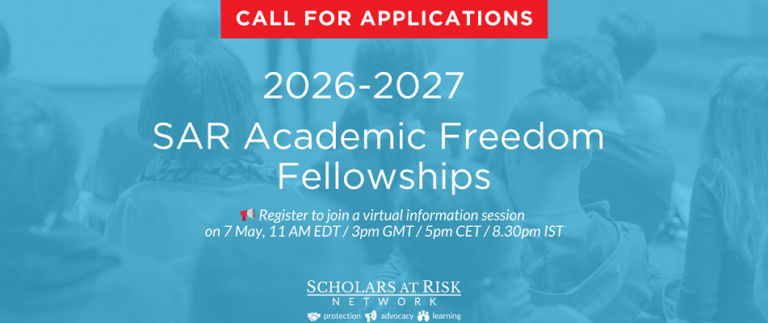
Applications for the Scholars at Risk (SAR) Academic Freedom Fellowships 2026-2027 are now open. Scholars at Risk (SAR) is pleased to invite early-career researchers to apply for remote research fellowships focusing on academic freedom and related higher education values. The fellowship program is supported by the Mellon Foundation, among other donors, and is intended to foster a professional community of researchers dedicated to developing new research, formal written publications, new course offerings, workshops, webinars or other significant end products.
The fellowship includes the following tracks:
- Track 1: Global Mellon Academic Freedom Fellowship
- Focus: Global, comparative, or single-country issues (excluding the US).
- Availability: up to 6 fellowships.
- Track 2: US Academic Freedom Fellowship
- Focus: Academic freedom issues specifically within the United States.
- Availability: up to 6 fellowships.
Benefits
- Fellows will receive a stipend of USD ~$8,000 intended to cover research expenses, publication, or other costs, as the fellow may decide.
- Participants will have the opportunity to gain exposure to SAR’s programming and to network with SAR partner-experts on academic freedom issues.
Eligibility
- Applicants should have PhD degree received within the last 8 years. In limited cases, doctoral candidates in the final stages of dissertation completion may be considered; clearly state your current status.
- Current research or teaching affiliation with a higher education institution, association, or research organization.
- A demonstrated interest in teaching, researching, or publishing about issues of academic freedom or related higher education values.
- For track 1 (Global): Preference will be given to projects involving comparative, international, or collaborative research. All relevant topics are welcome for application.
- For track 2 (US): Applicants’ work should be focused on issues of academic freedom in the United States. Researchers studying all relevant topics are welcome to apply, but applications focused on themes relating to university autonomy, institutional neutrality, students and academic freedom, or academic freedom and the natural sciences will be given priority.
- Commitment to participate in monthly remote workshops/webinars with co-recipients, SAR staff, network members, and guests (with proper security accommodations) from September 2026 to June 2027, with final scheduling to be fixed after selection of participants.
- Ability to lawfully receive stipend funds and complete program requirements in the country of current location, assuming responsibility for any local tax or reporting requirements.
- While personal experience with risk is not a selection requirement, current or formerly at-risk researchers are highly encouraged to apply.
- Candidates in/from the Global South and/or from marginalized communities are strongly encouraged to apply.
Application
Combine the following into a single PDF file, saved as “LAST NAME, First Name – Project Title”:
- An abstract* (max 250-500 words), summarizing your research.
- A research plan & timeline (max 2 pages), detailing your methodology and 10-month timeline (September 2026 – June 2027).
- A CV (max 2 pages), including the contact information of two professional references who can speak to your candidacy for this fellowship program. Note: If your PhD is pending, please include your expected completion date.
Applications that do not include all of the above will be ineligible for consideration.
Abstract Guidelines. Your abstract should specifically address:
- Research Question: What specific research question(s) do you wish to address and why is it significant?
- Relevance: How is your research question related to academic freedom and its values?
- Methodology: What methodology will you employ to address your research question(s), and what types of evidence do you propose to gather?
- Contribution: How will your findings improve our understanding or protection of academic freedom?
*The abstract refers to the formal publishable research proposed by the applicant, whereas the end product refers to both the research and the form(s) of its dissemination.
For more information, visit SAR Academic Freedom Fellowships.

![agora-fellowship-2027-for-mid-career-leaders-[cohort-2]](https://opportunityforafrica.org/wp-content/uploads/2026/09/15212-agora-fellowship-2027-for-mid-career-leaders-cohort-2-238x178.png "AGORA Fellowship 2027 for Mid-career Leaders [Cohort 2]")