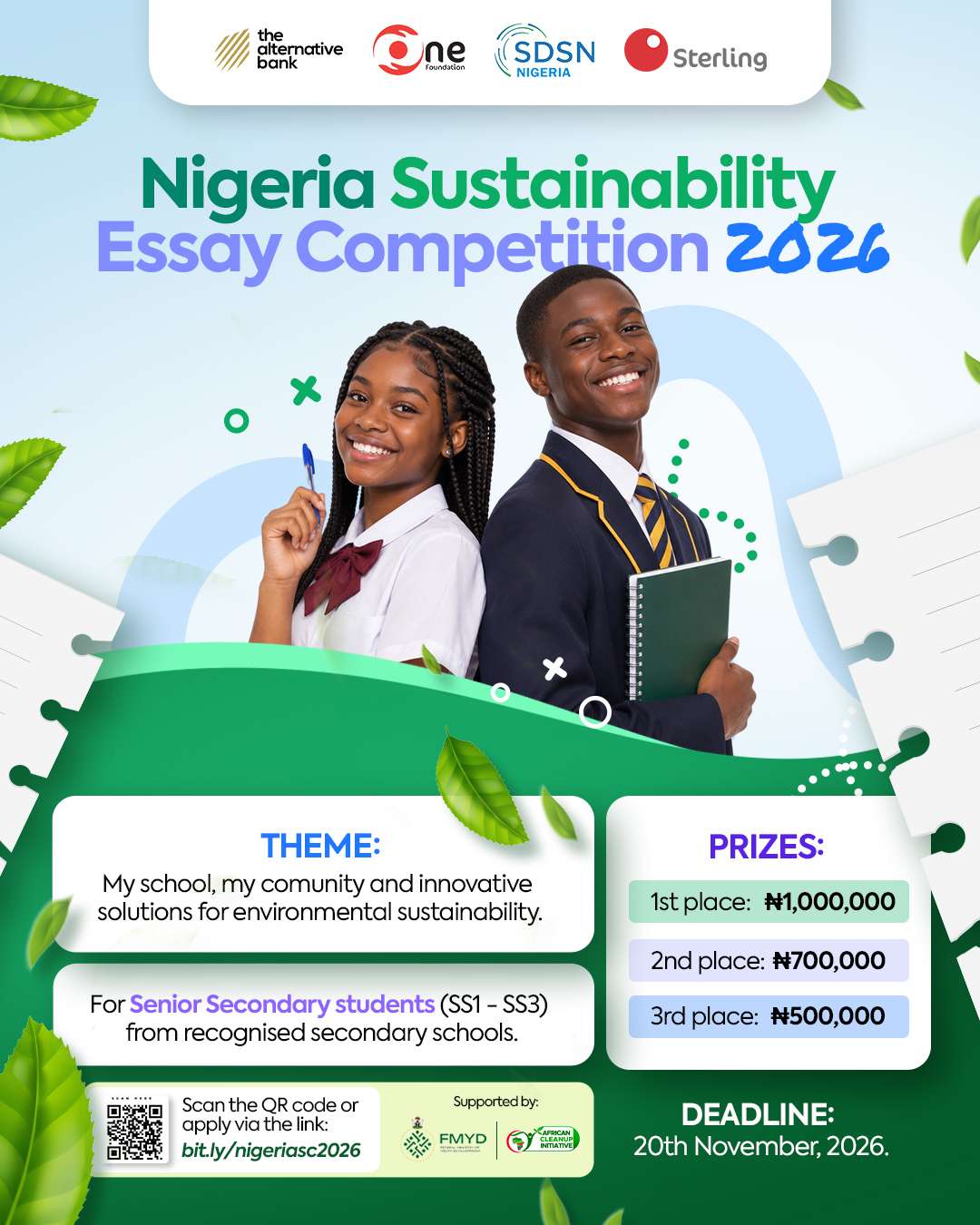
The Nigeria Sustainability Competition 2026 is inviting secondary school students and schools across Nigeria to develop innovative, practical and affordable solutions to environmental challenges affecting their communities. Organised by Sterling Bank, Alt Bank, Sterling One Foundation and SDSN Nigeria, the third edition of this national sustainability initiative seeks to strengthen environmental awareness, encourage youth participation and recognise innovative approaches to sustainable development.
Under the theme “My School, My Community and Innovative Solutions for Environmental Sustainability,” the competition provides a platform for young Nigerians to identify environmental problems, communicate their ideas and demonstrate how schools and communities can contribute to a cleaner, healthier and more sustainable future.
The 2026 edition features two major participation pathways: the Sustainability Essay Competition, which is open to individual senior secondary school students (SS1–SS3) aged 12–18 across Nigeria, and the Green Innovation Awards, which recognise public and private secondary schools in Lagos State that have developed or implemented environmental sustainability initiatives.
Through the student-based category, participants are expected to submit an original 1,000-word essay and a 90-second video presentation proposing practical solutions to environmental challenges in their schools or communities. The school-based category invites eligible schools to showcase their existing or ongoing environmental projects through a three-minute video presentation supported by photographs and other relevant evidence.
The competition offers cash prizes of ₦1,000,000 for first place, ₦700,000 for second place and ₦500,000 for third place in the student-based Sustainability Essay Competition. The Green Innovation Awards will also recognise outstanding school-based environmental innovations, although the specific monetary value of the school awards is not stated in the supplied competition information.
Importantly, participation is completely free. Applications opened on 1 November 2026, and the deadline for submitting all required materials is 20 November 2026. Interested students and eligible schools are encouraged to complete the official online application and submit their entries before the deadline.
The Nigeria Sustainability Competition is an initiative designed to promote sustainability education, environmental literacy, creativity and practical environmental action among secondary school students and educational institutions in Nigeria.
The 2026 edition is the competition’s third edition and is organised through a partnership involving:
- Sterling Bank
- Alt Bank
- Sterling One Foundation
- SDSN Nigeria
The initiative recognises that environmental sustainability is an increasingly important issue for Nigeria and that young people have an important role to play in identifying and addressing environmental challenges.
Nigeria faces several environmental, social and economic concerns that directly affect communities, livelihoods and the future of young people. These include climate change, flooding, environmental degradation, poor waste management, biodiversity loss, pollution, food insecurity, rapid urbanisation, energy challenges and unequal access to basic services.
Addressing these problems requires more than government policies and financial investment. It also requires informed citizens, innovative thinking, responsible environmental practices and active participation from communities.
The competition therefore seeks to introduce secondary school students to sustainability challenges and encourage them to think critically about solutions that can be developed and implemented within their immediate environments.
By engaging students and schools, the initiative aims to transform environmental education from theoretical learning into practical action.
2. Background and Rationale: Why Is the Competition Important?
The Nigeria Sustainability Competition 2026 is built around the understanding that schools are important environments for developing the knowledge, attitudes and skills young people need to contribute to sustainable development.
Secondary school students are at a formative stage of their development. This is an important period for strengthening critical thinking, creativity, civic responsibility and awareness of how local environmental problems connect to wider national and global challenges.
Through education, students can begin to understand how everyday activities, community practices and institutional decisions affect the environment.
For example, poor waste disposal can contribute to blocked drainage systems and flooding. Plastic pollution can affect waterways and ecosystems. Deforestation and biodiversity loss can undermine environmental health, while unsustainable energy practices can contribute to pollution and climate-related challenges.
These problems are not limited to one community or state. They form part of broader sustainability challenges that require informed participation and practical solutions.
A. Strengthening climate change education in schools
The competition is aligned with the role of education recognised in the Federal Ministry of Education’s Climate Change Education Handbook for Schools in Nigeria.
The handbook recognises that schools have an important responsibility in equipping learners with the knowledge, attitudes, skills and commitment required to respond to climate change and promote sustainable practices.
The competition supports this educational direction by encouraging students to examine environmental issues in their own schools and communities rather than treating sustainability as an abstract subject.
Students are expected to identify challenges, understand their effects and develop ideas that can contribute to environmental improvement.
B. Alignment with Nigeria’s climate policy direction
The initiative is also aligned with Nigeria’s climate policy direction as described in Nigeria’s Nationally Determined Contribution 3.0 (NDC 3.0).
The competition background identifies several priorities within this policy direction, including:
- Integrating climate change education into primary, secondary and tertiary education.
- Incorporating climate-risk activities into school syllabi.
- Strengthening teacher training on climate change.
- Promoting youth-focused climate education.
These priorities demonstrate the importance of preparing young people to understand climate-related risks and participate in efforts to build more resilient communities.
By involving secondary school students and educators, the Nigeria Sustainability Competition provides a practical platform for advancing sustainability awareness and encouraging young people to contribute ideas that respond to environmental challenges.
C. Encouraging young people to become problem-solvers
The competition is not limited to testing students’ knowledge of environmental issues. It also encourages them to move beyond identifying problems and think about possible solutions.
Students are expected to consider questions such as:
- What environmental challenges affect my school or community?
- What causes these problems?
- Who is affected by them?
- What practical solutions could help address them?
- Can the proposed solution be implemented at an affordable cost?
- How could the solution be sustained or replicated elsewhere?
This approach encourages participants to connect environmental knowledge with creativity, critical thinking and community responsibility.
3. Vision, Mission and Goal of the Competition
The Nigeria Sustainability Competition 2026 is guided by a vision, mission and goal that explain its intended contribution to environmental education and sustainable development in Nigeria.
Vision
To nurture a generation of Nigerian secondary school students and educators who are informed, innovative and actively engaged in advancing sustainable development in their communities and across Nigeria.
This vision places young people and educators at the centre of efforts to build a more environmentally responsible society.
Mission
To strengthen sustainability literacy, critical thinking, creativity and innovative solutions across secondary schools in Nigeria.
The mission recognises that environmental education should help students understand sustainability challenges while also developing the capacity to respond to them.
Goal
To engage secondary schools across Nigeria in deepening their understanding of sustainability challenges, developing evidence-based solutions and communicating ideas that can help build a more sustainable and resilient Nigeria.
The competition therefore combines learning, problem identification, innovation and communication.
4. Theme of the Nigeria Sustainability Competition 2026
The official theme for the 2026 edition is:
“My School, My Community and Innovative Solutions for Environmental Sustainability.”
The theme encourages participants to examine the environmental conditions within their immediate surroundings and identify practical ways of improving them.
It places particular emphasis on the relationship between schools, communities and environmental sustainability.
Students are encouraged to think about how their schools and surrounding communities experience environmental challenges and what innovative approaches could help address those problems.
The theme also provides an opportunity for schools to demonstrate how environmental initiatives can be developed and implemented within educational environments.
Rather than focusing only on broad national or international environmental issues, participants are encouraged to connect their ideas to real challenges that they can observe and understand.
5. Competition Structure: Two Major Participation Categories
The Nigeria Sustainability Competition 2026 consists of two main pathways.
- Category 1: Sustainability Essay Competition (Student-Based).
- Category 2: Green Innovation Awards (School-Based).
Although both categories promote environmental sustainability, they have different target participants, geographic coverage, submission requirements and participation formats.
The student-based category is open to eligible individual senior secondary school students across all 36 states of Nigeria and the Federal Capital Territory.
The school-based category is specifically open to recognised public and private secondary schools located in Lagos State.
Competition overview
| Programme element | Category 1: Student-Based | Category 2: School-Based |
|---|---|---|
| Competition pathway | Sustainability Essay Competition | Green Innovation Awards |
| Target participants | Individual SS1–SS3 students | Public and private secondary schools |
| Geographic coverage | All 36 states and the FCT | Lagos State only |
| Participation format | Individual essay and video presentation | School-led environmental innovation showcase |
| Main submission | Original 1,000-word essay and 90-second video | Three-minute video and supporting photographs |
| Main focus | Identifying environmental challenges and proposing solutions | Showcasing implemented or ongoing green initiatives |
| Application fee | Free | Free |
The following sections explain each category and its requirements in detail.
6. Category 1: Sustainability Essay Competition 2026
The Sustainability Essay Competition is designed for individual senior secondary school students who want to demonstrate their understanding of environmental sustainability and propose innovative solutions to environmental challenges.
It aims to strengthen environmental literacy, critical thinking and problem-solving skills among young Nigerians.
Through the essay competition, students are encouraged to examine environmental issues affecting their schools or communities and develop practical, innovative and affordable solutions.
The competition provides a national platform for students to communicate their ideas and demonstrate how young people can contribute to environmental sustainability.
A. Who can participate in the Sustainability Essay Competition?
The student-based category is open to individual students who meet the following requirements:
- Must be enrolled in Senior Secondary School 1 (SS1), Senior Secondary School 2 (SS2) or Senior Secondary School 3 (SS3).
- Must be between 12 and 18 years old at the time of submission.
- Must be attending a recognised public, private or unity secondary school in Nigeria.
- May come from any of Nigeria’s 36 states or the Federal Capital Territory.
- Must complete the official application and submission form accurately.
- Must independently develop and submit an original essay.
- Must provide the contact details of a teacher, school administrator or principal who can verify the student’s enrolment and authorship.
The competition is therefore open to eligible students from recognised secondary schools across Nigeria, regardless of whether their schools are public, private or unity schools.
B. Essay competition theme
All participants must write their essays on the official competition theme:
“My School, My Community and Innovative Solutions for Environmental Sustainability.”
Students should use the theme as the foundation for identifying an environmental challenge and explaining how it could be addressed through a practical and innovative solution.
The essay should demonstrate the student’s understanding of the problem and ability to propose an approach that is realistic and relevant to the school or community.
C. Essay submission requirements
Each student is required to submit an original essay of 1,000 words.
The essay should be independently developed by the student and must address the competition theme.
Participants should ensure that their submissions clearly communicate:
- The environmental challenge affecting their school or community.
- Why the challenge is important and needs attention.
- The people, environment or community activities affected by the problem.
- The proposed solution.
- How the proposed solution could be implemented.
- Why the solution is practical, innovative and affordable.
- How the proposed approach could contribute to environmental sustainability.
The competition specifically requires original work. Students should therefore avoid submitting copied essays, work written by another person or material that does not represent their own ideas.
D. 90-second video presentation
In addition to the written essay, each participant must upload a 90-second video presentation.
The purpose of the video is to allow students to explain the central idea of their essays in a clear and engaging way.
The presentation should:
- Introduce the environmental challenge identified by the student.
- Explain how the challenge affects the school or community.
- Present the proposed solution.
- Explain the central idea of the essay.
- Communicate how the proposed solution could contribute to environmental sustainability.
Students should ensure that their videos are consistent with the ideas presented in their written essays.
The video should be clear, understandable and focused on the student’s proposed solution.
E. Student application process
Students interested in participating in the Sustainability Essay Competition are required to complete the following steps:
Step 1: Complete the official online application form
Access the official Nigeria Sustainability Competition 2026 application form and select the student-based Sustainability Essay Competition category.
Step 2: Provide personal and school information
Applicants must provide accurate personal details and information about the secondary school in which they are enrolled.
Step 3: Prepare the 1,000-word essay
Write an original essay addressing the official theme, “My School, My Community and Innovative Solutions for Environmental Sustainability.”
Step 4: Record the 90-second video presentation
Prepare a short video explaining the environmental challenge, the proposed solution and the main ideas contained in the essay.
Step 5: Provide a school verification contact
Include the contact details of a teacher, school administrator or principal who can verify the student’s enrolment and authorship.
Step 6: Upload and submit all required materials
Complete the application form and ensure that the essay, video and other requested information are submitted before the deadline.
Start Your Application HERE
7. Category 2: Green Innovation Awards 2026 (School-Based)
The Green Innovation Awards are designed to recognise secondary schools in Lagos State that are contributing to environmental sustainability through innovative school-led projects and initiatives.
Unlike the Sustainability Essay Competition, which focuses on individual students’ ideas, this category focuses on environmental innovations developed or implemented by schools.
The awards provide an opportunity for schools to demonstrate how they are addressing environmental challenges within their school environments and surrounding communities.
The competition recognises that schools can play an important role in promoting environmental responsibility through practical initiatives, projects and sustainability activities.
A. Who can participate in the Green Innovation Awards?
The school-based category is open to:
- Recognised public secondary schools located in Lagos State.
- Recognised private secondary schools located in Lagos State.
- Schools presenting a school-led environmental innovation, project or sustainability initiative.
- Schools that designate a teacher or staff member to coordinate the application and serve as the official contact person.
- Schools that can provide the contact details of a principal or authorised administrator to verify their participation and the authenticity of the initiative.
Unlike the student-based category, the Green Innovation Awards are restricted to eligible secondary schools in Lagos State.
Schools from other Nigerian states are not included in the stated geographic eligibility for this category.
B. Types of environmental projects that can be showcased
The Green Innovation Awards recognise school-based environmental initiatives that demonstrate creativity, practical problem-solving and commitment to addressing environmental concerns.
The competition identifies several areas that eligible schools may explore.
These include:
1. Waste management
Schools may showcase initiatives designed to improve the collection, sorting, recycling, reduction or responsible disposal of waste.
Examples of relevant areas include efforts to reduce waste generation, improve waste separation or promote recycling practices within school environments.
2. Plastic pollution
Schools may present initiatives aimed at reducing plastic pollution and encouraging more responsible plastic use and disposal.
Such projects may demonstrate how students and school communities are working to reduce plastic waste or improve the management of plastic materials.
3. Flood mitigation and drainage management
Schools may showcase initiatives that address flooding and drainage-related problems within school environments or surrounding communities.
This may include practical approaches to improving drainage management and reducing environmental conditions that contribute to flooding.
4. Water conservation
Water conservation initiatives may focus on reducing unnecessary water consumption, promoting responsible water use or introducing practical approaches to conserving water within schools.
5. Renewable energy
Schools may present projects that explore or implement renewable energy solutions as part of their contribution to environmental sustainability.
6. Development of green spaces
Schools may also showcase initiatives involving the creation, improvement or maintenance of green spaces.
Such initiatives can demonstrate how school environments and surrounding communities can benefit from activities that support greener spaces.
7. Established and ongoing environmental projects
The awards are not limited to newly completed projects. Schools may also present established sustainability initiatives and ongoing environmental projects that are intended to promote positive environmental change.
This provides an opportunity for schools to demonstrate continuing efforts and practical environmental activities.
C. Green Innovation Awards submission requirements
Participating schools are required to submit a three-minute video presentation showcasing their environmental innovation or sustainability initiative.
The submission should clearly communicate the project’s purpose, implementation and environmental contribution.
The video must demonstrate the following:
- The environmental challenge: Identify the environmental problem the school is addressing and explain why it requires attention.
- The innovation or solution: Present the proposed or implemented environmental initiative and explain how it works.
- The implementation process: Describe how the project was introduced, developed or is intended to be implemented.
- The results or expected impact: Explain the environmental benefits already achieved or expected from the initiative.
- Affordability and practicality: Demonstrate whether the project is affordable, practical and suitable for the school’s circumstances.
- Potential for replication: Explain whether the initiative could be adopted or adapted by other schools or communities.
Schools may also submit supporting photographs and other relevant evidence to demonstrate their projects.
The FAQ information specifies that the school-based category requires photographs and horizontal, landscape-format video evidence showcasing existing sustainability initiatives and ongoing projects.
All submitted videos, photographs and supporting information must accurately represent the school’s initiative.
D. School application process
Eligible schools interested in the Green Innovation Awards should follow these steps:
Step 1: Complete the official online application form
The application should be submitted on behalf of the school. Applicants must select “Green Innovation Awards – School-Based” when choosing the relevant category.
Step 2: Provide the school’s information
Enter the required school details and the contact information of the designated teacher or staff member coordinating the application.
Step 3: Identify the environmental innovation
Select the environmental project or initiative the school intends to showcase.
The initiative should address an environmental challenge within the school environment or surrounding community.
Step 4: Prepare the three-minute video
Produce a video explaining the environmental problem, the innovation, the implementation process and the expected or demonstrated impact.
Step 5: Gather supporting photographs and evidence
Include relevant photographs and other supporting materials that demonstrate the authenticity and implementation of the initiative.
Step 6: Provide verification details
Include the contact details of the school principal or an authorised administrator who can verify the school’s participation and the authenticity of the project.
Step 7: Submit the completed application
Review all information and supporting materials before submitting the application through the official online form.
Start Your Application HERE
8. Prizes and Awards: What Can Participants Win?
The Nigeria Sustainability Competition 2026 includes a prize structure for the individual Sustainability Essay Competition and recognition for outstanding school-based environmental innovations.
A. Sustainability Essay Competition cash prizes
The student-based category offers the following cash prizes:
| Position | Cash prize |
|---|---|
| First Place | ₦1,000,000 |
| Second Place | ₦700,000 |
| Third Place | ₦500,000 |
These prizes recognise students who demonstrate strong environmental understanding, critical thinking and innovative solutions through their essays and video presentations.
The competition provides an opportunity for young participants to communicate ideas that could contribute to environmental improvement in their schools and communities.
B. Green Innovation Awards
The school-based category recognises outstanding environmental innovations developed or implemented by secondary schools in Lagos State.
The competition information describes the awards as including grand prizes and recognition for outstanding school-based innovations.
However, the specific monetary values, number of winning schools and detailed prize distribution for the Green Innovation Awards are not stated in the supplied information.
Interested schools should consult the official competition guidelines or contact the organisers for clarification about the school-based awards.
9. Application Fee: Is Participation Free?
Yes. Participation in both competition categories is completely free.
There is no application fee for:
- Individual students entering the Sustainability Essay Competition.
- Public and private secondary schools applying for the Green Innovation Awards.
Students and schools are therefore not required to pay an application fee to participate.
Applicants should nevertheless ensure that they submit their entries through the official application platform and provide all required information and materials.
10. Application Timeline and Important Deadline
The Nigeria Sustainability Competition 2026 is taking place in November 2026.
The application portal information provides the following dates:
| Application milestone | Date |
|---|---|
| Application opening date | 1 November 2026 |
| Application deadline | 20 November 2026 |
| Competition edition | Third edition, 2026 |
| Project duration | November 2026 |
Application deadline: 20 November 2026.
All interested students and eligible schools must complete their applications and submit the required materials on or before this date.
Late submissions may not be considered.
Applicants are encouraged to prepare their essays, videos, photographs and supporting information early to avoid incomplete submissions or last-minute difficulties.
11. Important Application Guidelines and Conditions
Before submitting an entry, students and schools should carefully review the competition’s application guidelines.
The application portal highlights several important conditions.
A. Applicants must select the correct competition category
The competition has two distinct pathways.
- Individual students should select the Sustainability Essay Competition.
- Eligible schools should select the Green Innovation Awards – School-Based category.
The application portal states that applicants must select only one competition pathway per submission.
B. All information must be accurate
Applicants must provide correct personal, school and project information.
For school-based entries, the details of the designated teacher or coordinating staff member and the school principal or authorised administrator must be provided as required.
C. Submissions must be original
Student essays must be original and independently developed by the participating student.
School-based project information, photographs and videos must genuinely represent the school’s environmental initiative.
D. Incomplete or misleading submissions may be disqualified
The application information warns that incomplete, misleading or plagiarised submissions may be disqualified.
Applicants should therefore review all materials carefully before submitting them.
E. Application does not guarantee an award
Submitting an application does not automatically guarantee selection or a prize.
Students and schools must complete the relevant submission requirements and undergo the competition’s selection process.
12. Frequently Asked Questions About the Nigeria Sustainability Competition 2026
1. What is the Nigeria Sustainability Competition 2026?
The Nigeria Sustainability Competition 2026 is an initiative organised by Sterling Bank, Alt Bank, Sterling One Foundation and SDSN Nigeria to promote environmental awareness, sustainability education, youth participation and practical environmental action among Nigerian students and schools.
It features an individual Sustainability Essay Competition and school-based Green Innovation Awards.
2. Who is eligible to participate?
Eligibility depends on the competition category.
Sustainability Essay Competition: Open to individual students enrolled in SS1–SS3 in recognised public, private or unity secondary schools in Nigeria. Participants must be between 12 and 18 years old at the time of submission.
Green Innovation Awards: Open to recognised public and private secondary schools located in Lagos State that have a school-led environmental innovation, project or sustainability initiative to showcase.
3. What are the two competition categories?
The two categories are:
- Category 1: Sustainability Essay Competition (Student-Based): An individual competition for eligible senior secondary school students across Nigeria.
- Category 2: Green Innovation Awards (School-Based): A competition recognising environmental innovations and sustainability projects developed or implemented by public and private secondary schools in Lagos State.
4. What is the official competition theme?
The theme is:
“My School, My Community and Innovative Solutions for Environmental Sustainability.”
All student essays and school-based submissions should relate to this theme.
5. What must students submit for the Sustainability Essay Competition?
Students must submit:
- An original 1,000-word essay addressing the competition theme.
- A 90-second video presentation explaining the environmental challenge and proposed solution.
- Accurate personal and school information.
- Contact details of a teacher, school administrator or principal who can verify the student’s enrolment and authorship.
6. What must schools submit for the Green Innovation Awards?
Eligible schools must submit:
- The completed school-based application form.
- School details and the contact information of the designated teacher or coordinating staff member.
- A three-minute video presentation showcasing the environmental innovation.
- Supporting photographs and relevant evidence.
- Contact details of the principal or authorised administrator who can verify the school’s participation and the authenticity of the initiative.
The video should show the environmental challenge, the innovation, its implementation process and its expected or demonstrated impact.
7. Can schools outside Lagos State apply for the Green Innovation Awards?
No. The school-based Green Innovation Awards are specifically open to recognised public and private secondary schools located in Lagos State.
However, the individual Sustainability Essay Competition is open to eligible students from all 36 states and the Federal Capital Territory.
8. Is there an application fee?
No. Participation in both categories is completely free.
9. What are the prizes for the student-based category?
The Sustainability Essay Competition offers:
- First place: ₦1,000,000.
- Second place: ₦700,000.
- Third place: ₦500,000.
The specific monetary values for the Green Innovation Awards are not provided in the supplied competition information.
10. When is the application deadline?
The application deadline is 20 November 2026.
Applications opened on 1 November 2026. Late submissions may not be considered.
11. Does submitting an application guarantee that a participant will win?
No. Submission does not automatically guarantee selection or an award. Applicants must meet the relevant requirements and submit complete, original and verifiable materials.
13. How to Apply for the Nigeria Sustainability Competition 2026
Interested students and eligible secondary schools can apply through the official online application portal.
Applicants should ensure that they select the correct competition category and submit all required materials before the deadline.
Official application form: Apply for the Nigeria Sustainability Competition and Green Innovation Awards 2026
Application details at a glance
- Application opening date: 1 November 2026.
- Application deadline: 20 November 2026.
- Application fee: Free.
- Student category: Sustainability Essay Competition.
- School category: Green Innovation Awards – School-Based.
- Competition theme: My School, My Community and Innovative Solutions for Environmental Sustainability.
For enquiries and further information, applicants can contact the organisers through:
Email: nigeria@sdsnyouth.org
Applicants should use the official competition form and follow the instructions provided by the organisers.
Visit HERE to learn more about the Nigeria Sustainability Competition 2026.
Conclusion: Empowering Young Nigerians to Build a Sustainable Future
The Nigeria Sustainability Competition 2026 represents an important effort to connect environmental education with practical innovation and youth participation. By involving secondary school students and educational institutions, the initiative recognises that sustainable development requires informed young people who can identify environmental challenges and contribute meaningful solutions.
Through the Sustainability Essay Competition, individual students from across Nigeria can demonstrate their understanding of environmental problems, develop original ideas and communicate practical solutions through written essays and video presentations. The Green Innovation Awards provide public and private secondary schools in Lagos State with an opportunity to showcase environmental initiatives and demonstrate how sustainability can be translated into action within school environments and surrounding communities.
With cash prizes of up to ₦1,000,000 for the student-based competition, additional recognition for outstanding school-based innovations and no application fee, the competition offers an accessible platform for eligible students and schools to participate in promoting environmental sustainability.
The initiative also supports broader efforts to strengthen climate change education, encourage critical thinking and prepare young people to contribute to Nigeria’s environmental future.
Eligible students and schools are encouraged to prepare their submissions, complete the official application form and submit all required materials before the 20 November 2026 deadline.
Ultimately, the Nigeria Sustainability Competition 2026 seeks to inspire young Nigerians to move beyond recognising environmental problems and become active contributors to solving them. Meaningful environmental change can begin in our schools and communities, and the ideas developed by young people today can help shape a more sustainable, resilient and environmentally responsible Nigeria.