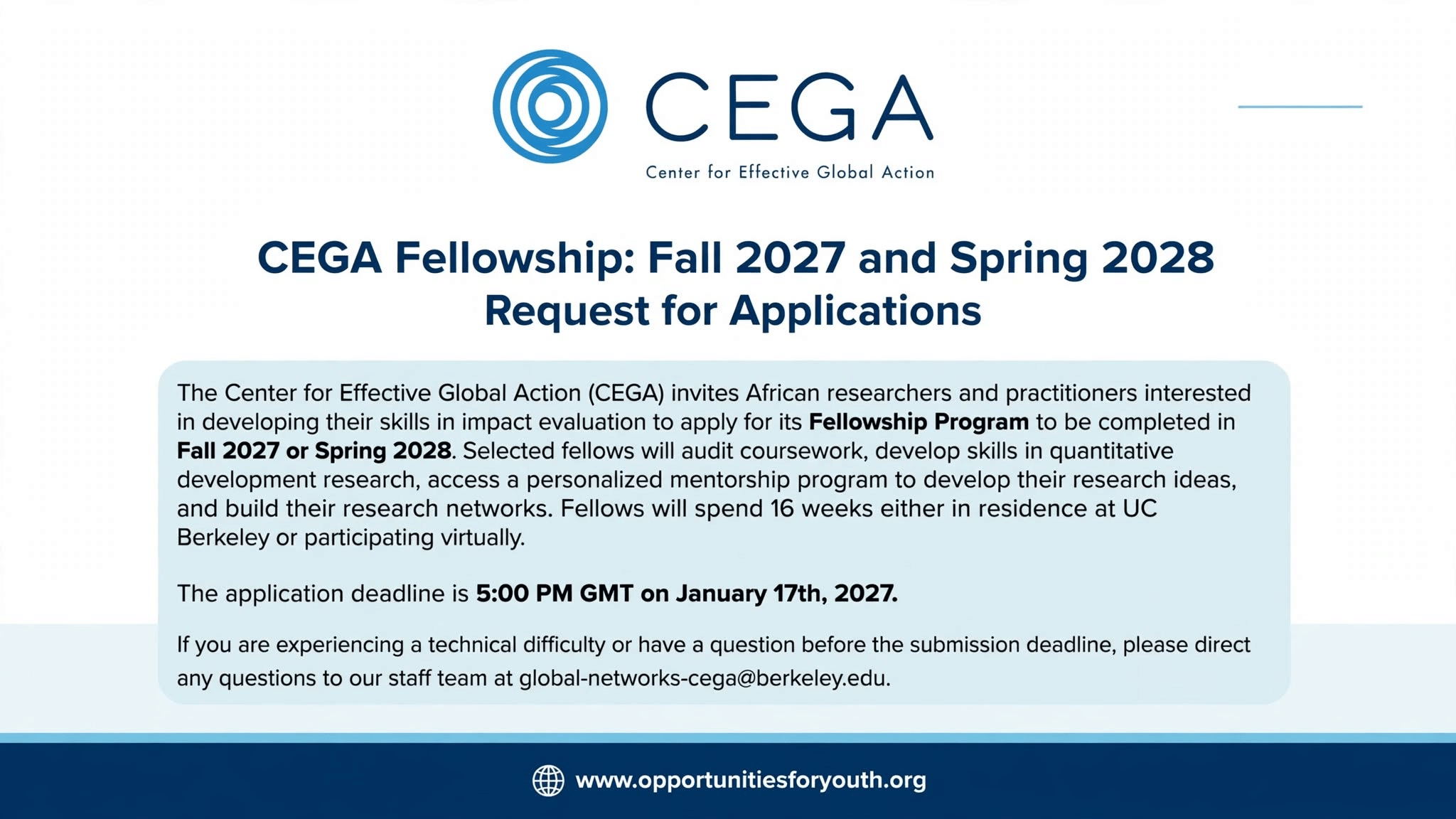
The 2027–2028 Center for Effective Global Action (CEGA) Fellowship Program is inviting applications from qualified researchers and practitioners from East and West Africa who want to strengthen their expertise in impact evaluation, quantitative research and evidence-based policymaking.
Hosted by the Center for Effective Global Action (CEGA) at the University of California, Berkeley, the programme provides an opportunity for African researchers to develop their research capabilities through specialised academic coursework, personalised mentorship, professional development and engagement with international research networks.
The fellowship is designed for individuals interested in using rigorous research methods to address economic and social development challenges across Africa. Research interests may include agriculture, financial inclusion, gender, technology for development, energy and climate change, poverty reduction and other areas of economic development.
Unlike programmes that focus exclusively on students pursuing undergraduate or postgraduate degrees, the CEGA Fellowship welcomes two different categories of applicants through its Practitioner Track and Academic Track. The Practitioner Track targets professionals working in African government ministries, non-governmental organisations and think tanks, while the Academic Track is designed for doctoral students and researchers working in universities or research institutions.
Selected fellows will participate in a 16-week programme, either in residence at the University of California, Berkeley, or remotely through the Non-Resident Fellowship arrangement.
The fellowship offers two programme periods: Fall 2027, running from August to December 2027, and Spring 2028, running from January to May 2028.
Participants will benefit from academic mentorship, research training, professional development and opportunities to build connections with scholars and development practitioners. Resident fellows will undertake their fellowship in person at UC Berkeley, while Non-Resident fellows will participate online.
The programme is particularly relevant to African researchers who want to improve their ability to design research projects, evaluate development interventions and produce credible evidence that can inform government policies and development programmes.
Applications are open for the 2027–2028 cycle, with a confirmed deadline of 17 January 2027 at 5:00 PM GMT (8:00 PM East Africa Time).
1. Overview of the 2027–2028 CEGA Fellowship Program
The CEGA Fellowship Program is an academic and professional development initiative designed to strengthen research capacity among African social scientists and development practitioners.
The programme focuses on helping participants improve their knowledge of impact evaluation and quantitative development research while developing research ideas that can contribute to economic and social development.
The fellowship combines academic learning with practical research development. Fellows will have opportunities to audit university coursework, receive individual mentorship, interact with experienced researchers and build professional networks.
The programme has two main career tracks and two participation formats, allowing applicants to select the arrangement that best matches their professional background and circumstances.
Programme details
| Detail | Information |
|---|---|
| Programme name | CEGA Fellowship Program |
| Fellowship cycle | 2027–2028 |
| Host organisation | Center for Effective Global Action |
| Host university | University of California, Berkeley |
| Target applicants | Qualified researchers and practitioners from East and West Africa |
| Duration | 16 weeks |
| Career tracks | Practitioner Track and Academic Track |
| Participation formats | Resident and Non-Resident |
| Resident location | UC Berkeley, California, USA |
| Non-Resident format | Online |
| Fall fellowship | August–December 2027 |
| Spring fellowship | January–May 2028 |
| Non-Resident weekly commitment | Approximately 15–20 hours |
| Application announcement | 2 November 2026 |
| Application deadline | 17 January 2027, 5:00 PM GMT |
2. About the Center for Effective Global Action (CEGA)
The Center for Effective Global Action (CEGA) is a research centre based at the University of California, Berkeley.
CEGA works with researchers and academic institutions to generate evidence that can help address important economic and social development challenges, particularly those affecting low-income populations.
Its research activities focus on understanding how development interventions work, whether they produce meaningful results and how evidence can be used to improve policies and programmes.
The organisation supports research across several areas of economic development, including poverty alleviation, agriculture, financial inclusion, public policy, gender, technology and climate-related development challenges.
CEGA’s commitment to evidence-based development
Development programmes are often introduced to address problems such as poverty, unemployment, limited access to healthcare, poor educational outcomes and inadequate agricultural productivity.
However, the success of these interventions cannot always be determined simply by looking at whether a programme has been implemented.
Researchers must investigate whether the intervention actually improves the intended outcomes and whether the observed changes can reasonably be attributed to the programme.
This is where rigorous impact evaluation becomes useful.
Impact evaluation provides methods for examining the effects of policies and interventions using systematic research designs and appropriate analytical techniques.
For example, a researcher may investigate whether:
- A government cash transfer programme improves household welfare.
- An agricultural intervention increases crop productivity.
- A financial inclusion programme improves access to credit.
- A public health initiative improves healthcare outcomes.
- An education programme improves learning and school attendance.
- A climate adaptation programme improves the resilience of vulnerable communities.
CEGA supports research that helps answer such questions and contributes to better-informed development decisions.
Supporting African researchers
The fellowship recognises the importance of strengthening research capacity within African institutions.
African researchers have important contextual knowledge and experience that can contribute to understanding the continent’s economic and social development priorities.
By supporting researchers and practitioners from East and West Africa, CEGA seeks to strengthen their ability to undertake rigorous research, develop evidence-based policy recommendations and contribute to the wider international development research community.
The programme also encourages fellows to maintain connections with African research institutions after completing their fellowship.
3. Objectives of the CEGA Fellowship Program
The 2027–2028 fellowship has several interconnected objectives.
Strengthening impact evaluation expertise
The programme aims to improve participants’ understanding of research methods used to evaluate the effects of development interventions.
This includes strengthening quantitative research capabilities and understanding how different evaluation approaches can be applied to real-world policy questions.
Developing policy-relevant research
The fellowship supports participants in developing research ideas that address important economic and social challenges.
Rather than producing research that is purely theoretical, fellows are encouraged to consider how their findings could inform decisions made by policymakers, development organisations and other stakeholders.
Improving African research capacity
The programme aims to support researchers and professionals who can contribute to stronger evidence-generation systems within African institutions.
This includes developing research capabilities that can be applied to government ministries, universities, NGOs and think tanks.
Building international research networks
Another objective is to connect African researchers with academics, mentors and other development professionals.
These relationships can support future research collaborations, professional development and the exchange of knowledge across institutions.
4. The Two Fellowship Tracks
One of the most important features of the 2027–2028 CEGA Fellowship Program is the availability of two different career tracks.
Applicants must select the track that best reflects their professional background and future research goals.
A. Practitioner Track
The Practitioner Track is intended for professionals working in organisations that use research and evidence to inform economic and social development policies and programmes.
It is particularly suitable for individuals employed by:
- Government ministries in East or West Africa.
- Non-governmental organisations.
- Think tanks.
- Development organisations involved in evidence-informed programmes and policies.
Applicants should demonstrate an interest in improving their research capabilities to advance their professional careers.
They should also be actively using or promoting the use of evidence to improve economic and social well-being.
The programme intends to select seven fellows for the Practitioner Track.
What Practitioner Track applicants should demonstrate
Candidates should:
- Work for an NGO, think tank or government ministry in an East or West African country.
- Have an interest in advancing their careers within their organisations or the wider development sector.
- Be actively using evidence to inform programmes, policies or institutional decisions, or promoting its use.
- Demonstrate an interest in improving their research and impact evaluation capabilities.
- Be able to develop a policy-focused statement addressing a relevant development challenge.
What the Practitioner Track offers
The programme provides an opportunity for professionals to strengthen their ability to use research evidence in their work.
Participants can improve their understanding of programme evaluation, quantitative research and evidence-based policy.
This may be particularly useful for professionals involved in:
- Monitoring and evaluation.
- Programme management.
- Public policy.
- Development research.
- Government planning.
- NGO programme implementation.
- Social and economic development initiatives.
The track is intended to help practitioners become better equipped to assess programmes and use evidence when making policy or operational decisions.
B. Academic Track
The Academic Track is designed for early-career researchers who intend to pursue academic or research-oriented careers.
It is suitable for doctoral students and individuals currently working in universities or research institutions.
The programme will select four fellows for this track.
Academic Track applicants should be interested in developing their own research projects or contributing to an existing faculty research project.
What Academic Track applicants should demonstrate
Candidates should:
- Be currently enrolled in a doctoral programme or hold a staff position at a university or research institution.
- Have an interest in policy-relevant quantitative social science research.
- Be prepared to develop their own research proposal.
- Alternatively, be prepared to participate in an existing faculty research project.
- Demonstrate the analytical and academic capabilities needed to benefit from the programme.
What the Academic Track offers
The Academic Track provides an opportunity to strengthen research design, quantitative analysis and impact evaluation skills.
Participants can work towards developing research ideas that may contribute to academic knowledge and practical development policy.
The programme is particularly relevant to doctoral researchers and university-based scholars interested in economics, public health, political science, statistics and other social science disciplines.
It can also help fellows improve their research proposals and establish relationships with academics working in related fields.
5. The Two Participation Formats: Resident and Non-Resident Fellowships
In addition to selecting a career track, applicants must choose between the Resident and Non-Resident participation formats.
These formats determine how fellows participate in the 16-week programme.
A. Resident Fellowship
The Resident Fellowship provides an in-person academic and research experience at the University of California, Berkeley, in California, United States.
Selected fellows will spend the fellowship period participating in university-based academic activities, research development and professional networking.
The Resident Fellowship is intended for participants who can dedicate themselves to a full-time research and training experience.
Key features include:
- In-person participation at UC Berkeley.
- Academic coursework and research training.
- Personalised mentorship.
- Interaction with university faculty and PhD researchers.
- Research seminars and workshops.
- Opportunities to develop research projects.
- Access to academic and professional networks.
Time commitment
Resident fellows are expected to dedicate approximately 40 hours per week to the programme over four months.
Applicants must provide evidence of approval for a full-time leave of absence from their employer or institution, where applicable.
Financial support for Resident Fellows
The official CEGA information confirms that Resident Fellows receive financial support covering several costs associated with participation.
The support includes:
- Return flights.
- Accommodation.
- Meals.
- Visa fees.
- Health insurance.
- A monetary stipend for miscellaneous expenses.
The fellowship does not provide a salary for the fellow’s time. Participants may therefore need to arrange leave from their existing employment or academic responsibilities.
The official programme information also explains that CEGA arranges accommodation for selected Resident Fellows at International House at UC Berkeley.
This financial support makes the Resident Fellowship a substantial opportunity for eligible African researchers who want to participate in an international research environment.
B. Non-Resident Fellowship
The Non-Resident Fellowship offers a remote participation option for selected candidates.
This format allows fellows to participate in the programme online without relocating to the United States.
It is designed for individuals who want to improve their research capabilities while remaining connected to their home institutions or professional environments.
Key features include:
- Online participation.
- Virtual academic mentorship.
- Research training.
- Access to relevant coursework.
- Research development activities.
- Professional networking.
- Opportunities to collaborate with researchers.
Time commitment
Non-Resident Fellows are expected to dedicate approximately 15–20 hours per week to the fellowship.
The official application materials specify a 20-hour weekly commitment over four months, with a corresponding requirement for institutional or employer approval where applicable.
Financial support for Non-Resident Fellows
Non-Resident Fellows also receive a monetary stipend for miscellaneous expenses.
However, the programme does not provide a salary for their time.
The remote format may be particularly suitable for researchers and practitioners who want to remain based in their home countries while participating in international academic development activities.
6. Benefits of the 2027–2028 CEGA Fellowship
The CEGA Fellowship offers a combination of academic, financial, research and professional development opportunities.
The following are some of the main benefits available to selected fellows.
1. Specialised training in impact evaluation
Fellows will strengthen their understanding of impact evaluation and quantitative development research.
This is particularly relevant for researchers who want to assess the effectiveness of development programmes and generate evidence that can guide policy decisions.
2. Academic coursework at a leading university
Participants will have opportunities to audit relevant university coursework.
The programme provides exposure to academic learning in areas related to quantitative research, statistics and programme evaluation.
This can help fellows strengthen their theoretical understanding and analytical capabilities.
3. Personalised academic mentorship
Each fellow will receive support through a personalised mentorship arrangement involving a CEGA faculty mentor and a PhD peer partner.
This provides an opportunity to receive guidance while developing research ideas and improving research projects.
4. Opportunities to develop independent research
Fellows will have opportunities to develop their own research ideas and projects.
For Academic Track applicants, this may involve developing a research proposal or working within an existing faculty research project.
For Practitioner Track applicants, the focus includes improving the ability to use evidence in policy and programme decisions.
5. Access to research networks
Participants can build professional relationships with researchers, academics and other fellows.
These networks may provide opportunities for future research collaboration and academic development.
6. Professional development workshops
The fellowship includes professional development activities designed to strengthen fellows’ research and communication capabilities.
These activities can help participants become more effective at presenting findings and engaging with different audiences.
7. Financial support for selected fellows
The Resident Fellowship provides return flights, accommodation, meals, visa fees, health insurance and a miscellaneous-expenses stipend.
The Non-Resident Fellowship also provides a monetary stipend for miscellaneous expenses.
Neither arrangement provides a salary for the fellow’s time.
8. Continued engagement after the fellowship
CEGA maintains connections with fellowship alumni through the Network of Impact Evaluation Researchers in Africa (NIERA).
This network provides a way for former fellows to remain connected with research opportunities, collaborations and professional activities.
Eligible alumni may also access further opportunities, including relevant research funding initiatives.
7. Research Areas Covered by the Fellowship
The CEGA Fellowship welcomes research interests across economic development.
Applicants are not limited to one particular subject area, provided their work addresses relevant development questions and meets the programme’s research expectations.
The official announcement highlights the following areas.
Agriculture
Agricultural research can examine productivity, farmers’ livelihoods, rural development, food security and the effects of agricultural interventions.
Financial inclusion
Research in financial inclusion may examine access to banking services, savings, credit, insurance and financial technologies.
Gender
Gender-focused research can investigate economic participation, inequality, access to opportunities and the effects of policies on different population groups.
Technology for development
Technology research may explore how digital tools and technological solutions influence economic and social development.
Energy and climate change
This area includes research into energy access, climate adaptation, environmental risks and the economic consequences of climate change.
Other areas of economic development may also be considered.
Applicants should ensure that their proposed research is relevant to the programme’s emphasis on rigorous quantitative social science research.
8. Eligibility Requirements for the CEGA Fellowship 2027–2028
The fellowship has specific academic, geographical, professional and research-related eligibility requirements.
Applicants must satisfy the general requirements and the additional conditions for their selected fellowship track and participation format.
A. Geographical eligibility
Applicants must be from an East African or West African country.
They must also have completed at least their secondary school education at an educational institution in Africa.
The programme is currently restricted to East and West African scholars. Applicants from Southern, Central and North Africa are not eligible under the current call.
Applicants who are currently living outside Africa may still be considered if they meet the relevant educational, institutional and return requirements.
B. Academic qualifications
Applicants must meet at least one of the following academic requirements:
- Hold a Master’s degree.
- Be currently enrolled in a PhD programme.
- Have completed a PhD within the previous eight years.
The accepted academic disciplines include:
- Economics.
- Political science.
- Statistics.
- Epidemiology.
- Public health.
- Other social science disciplines.
Applicants who are still completing their Master’s degree may apply if they will have completed it before the beginning of their selected fellowship period.
For the Fall 2027 cohort, the Master’s degree must be completed before the fellowship begins in August 2027. For the Spring 2028 cohort, it must be completed before January 2028.
C. English language proficiency
Applicants must be fluent in spoken and written English.
They should also demonstrate strong communication skills because the fellowship involves academic coursework, mentorship, research discussions and professional engagement.
D. Quantitative research experience
Candidates should demonstrate strong analytical abilities and relevant previous coursework in quantitative methods.
The official application information also expects applicants to have participated in or have familiarity with at least one of the following:
- Impact evaluation research.
- Randomized controlled trials.
- Quasi-experimental research.
- Policy analysis.
- Field data collection.
Applicants should be able to demonstrate their understanding of research methods and their relevance to development challenges.
E. Commitment to evidence-informed policymaking
Applicants should demonstrate an interest in using research evidence to improve economic and social outcomes.
This may be demonstrated through previous professional experience, academic research, policy engagement or an understanding of how evidence informs development decisions.
F. Commitment to African institutions
Candidates must demonstrate a commitment to strengthening research and development capacity within African institutions.
They should plan to return to an institution in East or West Africa after completing the fellowship.
Applicants who are currently enrolled in PhD programmes outside Africa may complete their doctoral studies before returning, subject to the programme’s stated conditions.
G. Institutional or employer approval
Applicants must be able to dedicate the required time to the fellowship.
The application requires a letter of support or evidence of leave approval from the applicant’s supervisor or department chair.
The letter must confirm that the applicant can take:
- Full-time leave for the Resident Fellowship, requiring approximately 40 hours per week.
- Part-time leave for the Non-Resident Fellowship, requiring approximately 20 hours per week.
Both arrangements cover four months.
9. Country Eligibility and Regional Restrictions
The 2027–2028 CEGA Fellowship has specific geographical eligibility requirements.
Although the programme targets African researchers, it currently accepts applicants from East and West African countries only.
There are also different country considerations for the Resident and Non-Resident participation formats.
East and West African countries
The programme requires applicants to originate from an East or West African country and to have completed at least secondary school education in an African institution.
Resident Fellowship: Eligible J-1 visa countries
According to the official announcement, Resident Fellows must come from countries eligible for a US J-1 visa under the applicable requirements.
The current list provided by CEGA includes:
- Djibouti.
- Ethiopia.
- Ghana.
- Guinea.
- Guinea-Bissau.
- Kenya.
- Liberia.
- Madagascar.
- Mauritius.
- Mozambique.
- Rwanda.
- Seychelles.
- Uganda.
The list is subject to change depending on US regulations.
Applicants should confirm their individual eligibility before applying.
Non-Resident Fellowship: Priority countries
For the Non-Resident Fellowship, priority will be given to applicants from countries currently subject to US visa restrictions, as identified in the programme announcement.
These include:
- Benin.
- Burkina Faso.
- Burundi.
- Côte d’Ivoire.
- The Gambia.
- Malawi.
- Mali.
- Mauritania.
- Niger.
- Nigeria.
- Senegal.
- Sierra Leone.
- Tanzania.
- Togo.
- Zambia.
- Zimbabwe.
This is a priority list rather than a statement that only applicants from these countries can apply for the Non-Resident option.
Can Kenyan applicants apply?
Yes. Kenya is specifically included in the countries listed as eligible for the Resident Fellowship under the current J-1 visa eligibility requirements.
Kenyan researchers who satisfy the academic, professional, research and institutional requirements can therefore consider applying for the Resident Fellowship.
Kenyan applicants should also review the Non-Resident option and the full programme conditions to determine which format is appropriate.
Can applicants from Southern, Central and North Africa apply?
No. According to CEGA’s official frequently asked questions, the current fellowship is restricted to scholars from East and West Africa.
Applicants from Southern, Central and North Africa are therefore not eligible under this particular application cycle.
Is there a race or ethnicity restriction?
The programme does not specify a racial or ethnic eligibility restriction.
Its geographical eligibility is based on East and West African origin and the stated educational and institutional requirements.
CEGA also strongly encourages female applicants to apply.
10. Required Application Documents
Applicants must prepare several documents before submitting their applications.
The application materials are designed to help the selection committee assess the candidate’s academic background, professional experience, research interests and ability to benefit from the programme.
The official application requires the following.
1. Personal statement (maximum one page)
All applicants must submit a personal statement of no more than one page.
The statement should explain:
- Why they are interested in the CEGA Fellowship.
- Why they have selected this particular programme.
- What they hope to accomplish during the fellowship.
- Their longer-term academic or professional objectives.
- Their ability to commit to the fellowship.
- How participation will fit with their existing responsibilities.
Applicants should provide specific reasons for wanting to participate rather than relying on general statements about their interest in research.
2. Curriculum Vitae or résumé (maximum two pages)
Applicants must submit a CV or résumé of no more than two pages.
The document should clearly communicate their academic and professional background.
An important requirement is that candidates should include relevant quantitative coursework they have completed.
This may include coursework in:
- Statistics.
- Econometrics.
- Quantitative research methods.
- Research methodology.
- Data analysis.
- Programme evaluation.
Applicants should also highlight relevant research, professional and academic experience.
3. Policy statement for Practitioner Track applicants (maximum two pages)
Candidates applying under the Practitioner Track must submit a policy statement.
The statement should follow the template provided by CEGA.
It should demonstrate the applicant’s understanding of an actual policy or programme issue and explain how evidence can help address it.
The statement should be practical and connected to a real decision that a government ministry, NGO, think tank or development organisation could make.
4. Research proposal for Academic Track applicants (maximum two pages)
Academic Track applicants must submit a research proposal of no more than two pages.
The proposal should follow the official CEGA template.
Applicants should identify a relevant development problem and explain how they intend to investigate it.
The research proposal should demonstrate:
- A clearly defined research problem.
- A focused research question.
- Appropriate research methodology.
- Relevant data requirements.
- Clearly identified outcomes of interest.
- An understanding of how the findings could contribute to policy or academic research.
The proposed research should emphasise rigorous quantitative social science methods.
CEGA also considers mixed-methods proposals that combine quantitative and qualitative approaches, provided they contribute to rigorous and actionable findings.
Purely qualitative proposals without a strong quantitative research component do not meet the stated methodological preference.
5. Two professional or academic references
Applicants must provide the names and contact information of two referees.
The referees should be individuals who can speak about the applicant’s qualifications and suitability for the programme.
Suitable referees may include:
- Academic supervisors.
- University professors.
- Senior colleagues.
- Professional supervisors.
- Research collaborators.
The required information includes:
- Full name.
- Email address.
- Telephone number.
- Institutional or organisational affiliation.
6. Letter of support or evidence of leave approval
Applicants must submit evidence that their institution or employer supports their participation.
This should be a letter from their supervisor or department chair confirming that the applicant will be able to take the required leave if selected.
For Resident Fellows, the letter must demonstrate approval for a four-month full-time leave of absence.
For Non-Resident Fellows, it must demonstrate approval for a four-month part-time leave arrangement of approximately 20 hours per week.
7. Optional working paper or publication
Applicants may also attach one working paper or academic publication.
This is optional rather than compulsory.
Where available, a relevant research paper can help demonstrate the applicant’s research interests, analytical skills and academic capabilities.
Document submission formats
CEGA requests that application documents be saved in one of the following formats:
- PDF.
- DOC.
- DOCX.
Applicants should follow the official templates and page limits when preparing their applications.
11. How Applications Will Be Evaluated
The selection process considers whether applicants have the academic background, professional experience and research interests needed to benefit from the programme.
CEGA highlights several areas that are particularly relevant to the assessment.
Analytical and quantitative capabilities
Applicants should demonstrate strong analytical abilities and relevant quantitative coursework.
Their applications should show that they have the necessary foundation to participate in research training and develop rigorous research projects.
Familiarity with impact evaluation
Experience with randomized or quasi-experimental research, policy analysis or field data collection is relevant.
Applicants do not necessarily need to have completed an extensive portfolio of published research, but they should demonstrate appropriate familiarity with research and evaluation.
Commitment to evidence-informed development
Candidates should demonstrate that they understand how research evidence can improve economic and social outcomes.
The programme is particularly interested in applicants who can connect research to actual development priorities.
Potential contribution to African institutions
The fellowship seeks individuals who are committed to strengthening research and evidence-generation capacity in East and West Africa.
Applicants should explain how the skills and connections gained through the programme will contribute to their future work.
Track-specific assessment
For the Practitioner Track, reviewers will pay particular attention to policy insight and feasibility.
Applicants should connect their policy statement to a real programme or policy decision, identify who would use the findings and demonstrate the practical relevance of the proposed work.
For the Academic Track, reviewers will focus on the quality of the research proposal and the applicant’s ability to develop a clearly structured research idea.
The proposal should demonstrate an understanding of appropriate methods, data needs and research outcomes.
Use of generative AI in applications
CEGA specifically states that reviewers want to see that applicants’ research proposals are not written entirely using generative AI.
Applicants should follow the programme templates and ensure that their submissions genuinely reflect their own thinking, research interests and analytical abilities.
They should also follow any instructions concerning disclosure of AI assistance.
12. Fellowship Duration and Important Dates
The 2027–2028 CEGA Fellowship offers two possible participation periods.
Both options run for approximately 16 weeks.
| Fellowship period | Dates |
|---|---|
| Fall 2027 | August–December 2027 |
| Spring 2028 | January–May 2028 |
Applicants will be able to indicate their preferred fellowship period in the application.
Important application dates
| Activity | Date |
|---|---|
| Fellowship announcement | 2 November 2026 |
| Online information webinar | 2 December 2026 |
| Application deadline | 17 January 2027 |
| Application review | 18 January–7 February 2027 |
| First-round interviews | 8–12 February 2027 |
| Final interviews | 22–26 February 2027 |
| Final selection notifications | 1–12 March 2027 |
| Fall 2027 fellowship | August–December 2027 |
| Spring 2028 fellowship | January–May 2028 |
13. Online Information Session
CEGA will host an online information session for prospective applicants on 2 December 2026.
The webinar is scheduled as follows:
- Date: 2 December 2026.
- Time: 7:00 PM East Africa Time.
- Corresponding time: 4:00 PM GMT.
The session will provide an opportunity for interested researchers and practitioners to learn more about the fellowship and its application process.
Applicants are encouraged to register through the official CEGA announcement.
A recording of the information session is expected to be uploaded to the CEGA website.
Questions concerning eligibility and applications can also be directed to the programme team at:
global-networks-cega@berkeley.edu
14. How to Apply for the CEGA Fellowship Program 2027–2028
Interested applicants should submit their applications through the official CEGA online application platform.
The application process involves selecting the appropriate career track, choosing the participation format and fellowship period, and submitting the required supporting documents.
Follow these steps.
Step 1: Read the official Request for Applications
Start by reviewing the complete 2027–2028 CEGA Fellowship Request for Applications.
This document contains the eligibility conditions, fellowship structure, application requirements and selection timeline.
Official announcement:
https://cega.berkeley.edu/article/cega-fellowship-program-2027-2028-request-for-applications/
Step 2: Confirm your eligibility
Check that you meet the geographical, educational, professional and research requirements.
Ensure that you have the required academic qualifications and can obtain institutional approval for the time commitment.
Step 3: Select your fellowship track
Choose one of the following:
- Practitioner Track, for eligible professionals working in government ministries, NGOs or think tanks.
- Academic Track, for eligible doctoral students and university or research institution staff.
Step 4: Select your participation format
Choose between:
- Resident Fellowship, based at UC Berkeley.
- Non-Resident Fellowship, conducted online.
Applicants should carefully consider the relevant weekly time commitment and any institutional leave requirements.
Step 5: Choose your preferred fellowship period
Indicate whether you prefer:
- Fall 2027, August to December.
- Spring 2028, January to May.
Step 6: Prepare the application documents
Prepare the personal statement, CV, references and institutional support letter.
Practitioner Track applicants should prepare a policy statement, while Academic Track applicants should prepare a research proposal.
Follow all page limits and official templates.
Step 7: Submit the online application
Complete the application through CEGA’s official submission platform.
Official application portal:
https://cega.submittable.com/submit
Applicants should ensure that their applications are submitted successfully before the deadline.
15. Important Questions About the CEGA Fellowship
Is the CEGA Fellowship fully funded?
The fellowship provides financial support, but the arrangements differ between the Resident and Non-Resident formats.
Resident Fellows receive return flights, accommodation, meals, visa fees, health insurance and a monetary stipend for miscellaneous expenses.
Non-Resident Fellows receive a monetary stipend for miscellaneous expenses.
Neither fellowship provides a salary for the participant’s time.
Can Kenyan researchers apply?
Yes. Kenya is included in the current list of countries eligible for the Resident Fellowship under the stated J-1 visa requirements.
Kenyan applicants must still meet the academic, research and institutional requirements.
Can undergraduate students apply?
The programme requires applicants to hold at least a Master’s degree, be enrolled in a PhD programme or have completed a PhD within the previous eight years.
Undergraduate students who do not meet these academic requirements are not eligible.
Can applicants from Nigeria apply?
Nigeria appears on the list of countries given priority for the Non-Resident Fellowship.
Applicants must also meet the other geographical, academic and professional requirements.
Can applicants from South Africa apply?
No. The current fellowship call is restricted to East and West African countries.
South Africa is in Southern Africa and is not included in the eligible geographical regions for this cycle.
Can applicants currently living outside Africa apply?
Yes, subject to the programme’s conditions.
Applicants must meet the educational and geographical requirements and have or plan to have an affiliation with an institution in East or West Africa after the fellowship.
Those currently pursuing doctoral studies outside Africa may complete their studies before returning, as permitted by the programme conditions.
Is there an age limit?
No. CEGA’s official FAQ states that there is no age limit for applicants.
Can applicants apply for both fellowship tracks?
The application platform allows candidates to select one preferred track.
However, CEGA may consider an applicant for the more appropriate track if the selection committee determines that another track is a better fit.
Does the programme support accommodation and travel?
Yes, for selected Resident Fellows. CEGA confirms that it arranges accommodation and covers return flights, meals, visa fees and health insurance for the fellowship period.
When will selected fellows be notified?
The official timeline indicates that final selection notifications will be issued between 1 and 12 March 2027.
Conclusion
The 2027–2028 CEGA Fellowship Program offers an important opportunity for qualified researchers and development practitioners from East and West Africa to strengthen their research skills, improve their understanding of impact evaluation and contribute to evidence-based policymaking.
Hosted by the Center for Effective Global Action at the University of California, Berkeley, the programme combines academic coursework, personalised mentorship, research development and professional networking.
Its two career tracks make the opportunity relevant to different professional backgrounds. The Practitioner Track supports professionals working in government ministries, NGOs and think tanks, while the Academic Track supports doctoral students and university-based researchers seeking to advance their academic careers.
The programme also provides two participation formats. Resident Fellows will undertake an immersive research experience at UC Berkeley, with support for return travel, accommodation, meals, visa fees and health insurance. Non-Resident Fellows can participate remotely while committing approximately 20 hours per week.
For researchers from eligible East and West African countries, the fellowship offers an opportunity to strengthen their contribution to research and development initiatives across the continent.
Candidates interested in economics, public health, political science, statistics and other social science disciplines should review the requirements carefully, prepare the appropriate application documents and select the track that best reflects their professional or academic goals.
The application deadline is 17 January 2027 at 5:00 PM GMT (8:00 PM EAT).
Interested candidates should access the official application portal and submit their applications before the closing date.
Official fellowship announcement: https://cega.berkeley.edu/article/cega-fellowship-program-2027-2028-request-for-applications/
Online application portal: https://cega.submittable.com/submit
OPPORTUNITY CLASSIFICATION AND ELIGIBILITY (FOR EDITORIAL USE ONLY)
Category of opportunity: Fellowship
Opportunity name: CEGA Fellowship Program 2027–2028.
Who qualifies?
- Early-career African social scientists and development practitioners.
- Researchers holding at least a Master’s degree.
- Candidates currently enrolled in PhD programmes.
- Candidates who completed their PhD within the last eight years.
- Professionals working in eligible government ministries, NGOs and think tanks.
- Doctoral students and university or research institution staff.
- Applicants with relevant quantitative research knowledge and English proficiency.
Eligible academic disciplines
- Economics.
- Political Science.
- Statistics.
- Epidemiology.
- Public Health.
- Other Social Science disciplines.
Eligible geographical regions
- East Africa.
- West Africa.
Examples of eligible countries
- Kenya.
- Uganda.
- Tanzania.
- Rwanda.
- Ethiopia.
- Ghana.
- Nigeria.
- Senegal.
- Liberia.
- Sierra Leone.
- Mali.
- The Gambia.
- Burundi.
- Zambia.
- Zimbabwe.
- Other qualifying East and West African countries, subject to the different Resident and Non-Resident conditions.
Race and ethnicity: No racial or ethnic restriction is stated. Eligibility is based on geographical origin, education and professional qualifications.
Female applicants: Strongly encouraged to apply.
Important geographical restriction: Applicants from Southern, Central and North Africa are not eligible under this current call.
Kenyan applicants: Eligible to apply for the Resident Fellowship, subject to all other requirements and the current J-1 country conditions.
Application deadline: 17 January 2027, 5:00 PM GMT (8:00 PM EAT).
Fellowship duration: 16 weeks.