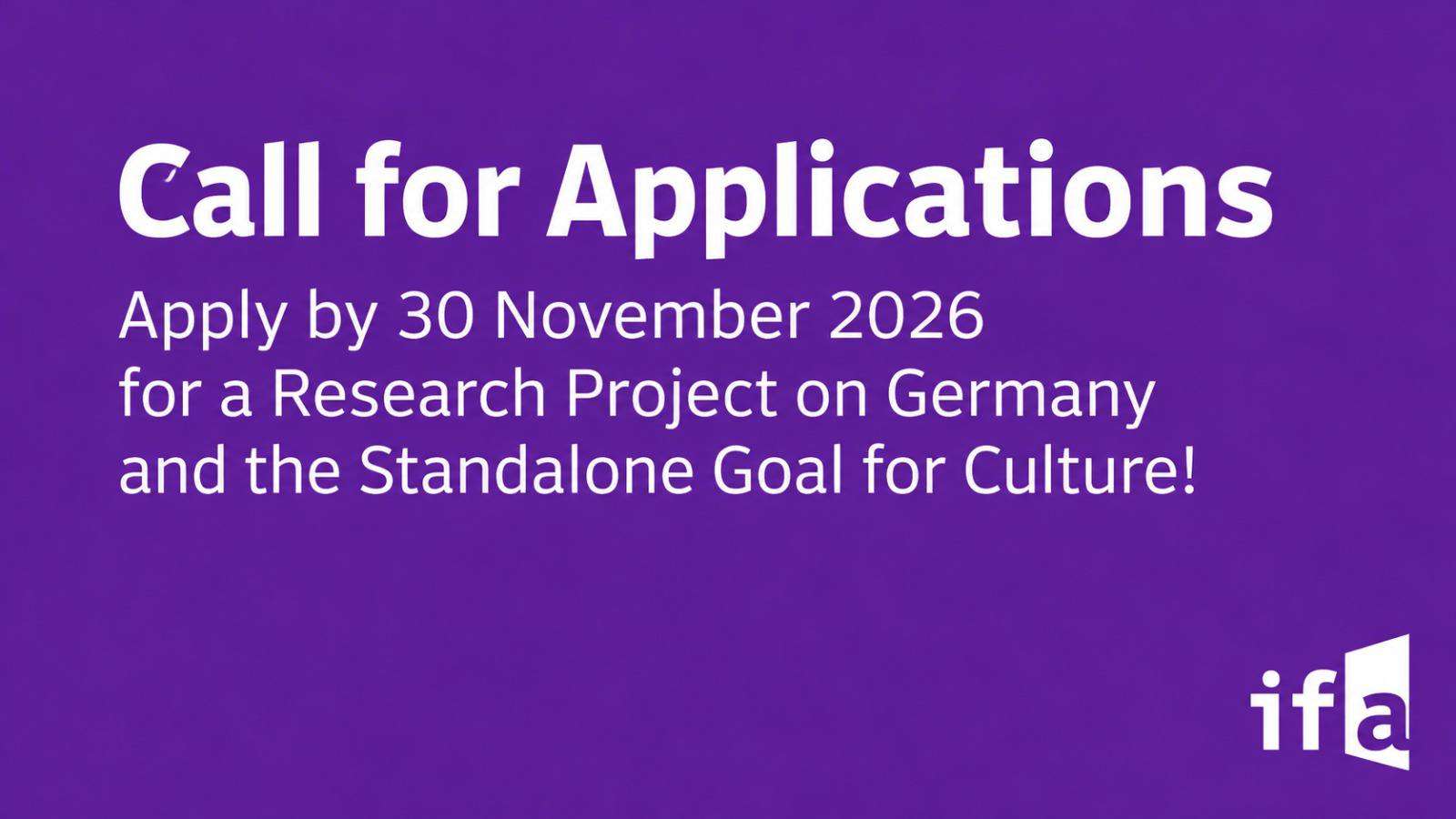
For the 2026 call, ifa is particularly interested in research proposals addressing the theme “Culture to Empower Civil Society: A Stand-Alone Goal for Culture?” The selected researcher will investigate the importance of recognising culture as an independent objective within the United Nations’ future sustainable development agenda and examine how cultural participation, cultural rights, heritage, and diversity can strengthen active citizenship and democratic societies.
Applications are open until 30 November 2026, making this an opportunity for postgraduate researchers and professionals with relevant expertise in cultural relations, foreign cultural policy, international development, and related fields.
1. Overview of the ifa Research Programme
The ifa Research Programme on Culture and Foreign Policy is designed to connect academic research with practical policy development. It creates opportunities for experts to investigate contemporary challenges affecting international cultural relations and translate their findings into useful knowledge for policymakers, cultural institutions, researchers, and other stakeholders.
Rather than focusing exclusively on theoretical academic research, the programme encourages participants to work at the intersection of research and practice. Researchers are expected to examine relevant developments, identify policy challenges, and communicate their findings in ways that can support decision-making and future international cooperation.
Research projects normally run for a period of up to six months. During this period, selected experts undertake several responsibilities, including:
- Conducting research on current issues related to international cultural relations.
- Preparing clear and concise summaries of relevant academic research and recent findings.
- Developing practical recommendations for future foreign policy strategies.
- Sharing research findings with stakeholders working in international cultural relations.
- Initiating professional discussions and dialogue among experts.
- Organising discussion forums, workshops, and other relevant events where appropriate.
- Connecting academic knowledge with real-world cultural policy challenges.
Through this approach, ifa seeks to strengthen the relationship between research institutions, cultural organisations, policymakers, and international stakeholders.
The programme is particularly relevant to researchers who want their academic work to contribute to policy discussions and influence how governments and international institutions approach cultural relations.
2. Research Project Theme: Culture to Empower Civil Society – A Stand-Alone Goal for Culture?
For the 2026 application round, ifa is inviting proposals for a specific research project titled:
“Culture to Empower Civil Society: A Stand-Alone Goal for Culture?”
The central question behind this research project is whether culture should be recognised as a standalone goal in the international sustainable development framework rather than being treated primarily as a tool for achieving other development objectives.
The proposed research will explore the importance of culture in strengthening civil society, promoting active citizenship, protecting cultural rights, and supporting sustainable development.
To understand the importance of this research theme, applicants should consider the relationship between culture and the United Nations’ existing sustainable development agenda.
Understanding the United Nations’ 2030 Agenda and the Role of Culture
In 2015, the United Nations adopted the 2030 Agenda for Sustainable Development, establishing a common framework of Sustainable Development Goals (SDGs) for countries around the world.
The framework introduced 17 interconnected goals addressing major global challenges, including poverty, education, health, gender equality, environmental sustainability, economic development, and peace.
Although culture contributes to several areas of sustainable development, it was not established as an independent Sustainable Development Goal.
Instead, culture was largely recognised through its cross-cutting contributions to other development objectives. This means that cultural heritage, cultural diversity, artistic expression, and cultural participation can support development in different sectors, but culture does not have a dedicated standalone goal within the existing framework.
The research proposal highlights an important concern arising from this approach: when culture is treated mainly as a means of achieving other objectives, its independent value and contribution to society may not receive sufficient recognition, investment, or accountability.
Culture is not simply an additional instrument for economic or social development. It is also an important foundation for human identity, freedom of expression, social participation, diversity, and democratic citizenship.
Recognising culture as a standalone goal could therefore help ensure that cultural rights, cultural heritage, and cultural diversity receive stronger recognition within international sustainable development policies.
Why Is a Standalone Sustainable Development Goal for Culture Important?
A dedicated goal for culture could create a more structured approach to protecting and promoting cultural development internationally.
The research project will examine several important dimensions of this proposal.
1. Protecting cultural rights
Cultural rights are essential to ensuring that individuals and communities can participate in cultural life, express their identities, preserve their traditions, and access artistic and cultural opportunities.
A standalone goal could strengthen international recognition of these rights and encourage governments to develop policies that protect cultural participation and expression.
2. Promoting cultural diversity
Cultural diversity is an important part of inclusive and sustainable societies. Different communities contribute unique traditions, languages, knowledge systems, artistic expressions, and perspectives.
Recognising culture as an independent development objective could strengthen efforts to protect cultural diversity and encourage greater respect for different cultural identities.
3. Preserving cultural heritage
Cultural heritage includes historical sites, monuments, traditional practices, languages, artistic traditions, and other forms of cultural knowledge.
A dedicated goal could encourage stronger investment in preserving cultural heritage and ensuring that future generations can access and benefit from it.
4. Strengthening civil society and active citizenship
Access to art and culture can contribute to more active and engaged communities. Cultural participation provides opportunities for people to exchange ideas, express opinions, engage with social issues, and participate in public life.
The research will particularly examine how access to culture can help realise the full scope of active citizenship rights.
5. Improving investment and accountability
One of the central arguments for establishing a standalone goal is that it could make culture more visible in international development priorities.
A dedicated objective could encourage governments and international organisations to establish measurable commitments, allocate resources, and develop accountability mechanisms for cultural development.
3. Why Is This Research Particularly Important in 2026 and 2027?
The timing of this research project is significant because the international community is preparing to discuss the structure of the next sustainable development agenda, which is expected to take effect from 2030.
International discussions surrounding the future of sustainable development will intensify in 2027. One important question will be whether a new goal specifically dedicated to culture should be introduced and, if so, how it should be structured.
Several organisations and policymakers have already expressed support for giving culture a more prominent position in the next international sustainability framework.
UNESCO’s Position on Culture and Sustainable Development
UNESCO and various cultural policy stakeholders have been advocating for stronger recognition of culture within the international sustainable development agenda.
Their position reflects the growing understanding that culture plays an important role in addressing social, economic, environmental, and political challenges.
A standalone goal could provide a more comprehensive framework for integrating cultural priorities into international development policies.
Germany’s Position and the Role of the KMK
Germany is also an important part of the current discussion.
In May 2026, the German Standing Conference of the Ministers of Education, Science and Cultural Affairs (KMK) expressed support for establishing a standalone goal for culture in the future sustainable development agenda.
This position represents an important development in Germany’s national discussions about cultural policy and international sustainability.
The discussions are also continuing at the federal level, where responsibility for multilateral negotiations and the development of a common European position lies.
The research project will therefore examine how a standalone cultural goal could contribute to Germany’s national policy objectives and strengthen its role in international cultural relations.
4. Main Objectives and Scope of the Research Project
The selected researcher will be expected to investigate the political, social, cultural, and international implications of introducing a standalone goal for culture.
The research should go beyond explaining why culture matters. It should identify practical policy opportunities, potential risks, and recommendations that can help policymakers understand how such a goal could be implemented.
The main areas of investigation include the following.
A. Identifying the Contribution of Culture to German Federal Policy Objectives
The research should identify which objectives, policy goals, and sectors at the German federal level could benefit from a standalone goal for culture.
This includes examining how cultural development could contribute to existing government priorities and where additional opportunities for policy integration might exist.
The researcher should consider the possible impact of a dedicated cultural goal across relevant sectors and explain how it could strengthen Germany’s approach to sustainable development.
B. Examining the Potential Impact of a Standalone Goal
Another important responsibility is to examine what difference a dedicated goal for culture could make.
The research should investigate whether such a goal would improve cultural participation, strengthen the protection of cultural rights, encourage investment in cultural institutions, and create greater accountability for cultural development.
The researcher should also explore how a standalone goal could support the broader objective of empowering civil society through access to art and culture.
C. Identifying Potential International Illiberal Strategies
The research will also address potential risks associated with introducing a standalone goal for culture.
In particular, the project should investigate possible international illiberal strategies that could be connected to such a goal.
This is an important aspect because cultural policy can be influenced by political interests, ideological agendas, and competing interpretations of cultural identity and heritage.
A dedicated cultural development framework could create new opportunities for protecting cultural rights, but it could also potentially be misused or manipulated by actors seeking to restrict cultural freedoms or advance illiberal objectives.
The researcher should identify these risks and develop constructive recommendations for preventing or addressing them.
D. Exploring Culture as a Foundation for Active Citizenship
A central focus of the research is the relationship between access to art and culture and the realisation of active citizenship rights.
The project should investigate how cultural participation enables individuals to engage more actively in society.
This could involve examining:
- Access to artistic and cultural activities.
- Freedom of cultural expression.
- Participation in cultural institutions and public discussions.
- The relationship between cultural diversity and social inclusion.
- The role of culture in strengthening democratic participation.
- The contribution of cultural activities to civil society development.
The research should draw on existing academic studies, including the work of O’Connor, Oakley, and Barnett (2026), titled Culture as Foundational, published in the European Journal of Cultural Studies.
E. Identifying Opportunities for Germany’s Foreign Policy
The selected researcher should explore how the proposed standalone cultural goal could create opportunities for Germany’s foreign policy.
This may involve examining how Germany could use international cultural relations to strengthen cooperation, support cultural rights, promote diversity, and contribute to sustainable development discussions.
The research should also identify relevant existing studies and policy developments that can inform Germany’s international engagement.
F. Analysing International Support and Opposition
The project should examine which countries support the introduction of a standalone goal for culture and which countries do not.
Importantly, the research should not simply identify different national positions. It should investigate the reasons behind those positions.
This analysis could help explain the political, economic, cultural, and institutional factors influencing international negotiations.
Understanding these differences will be important for identifying potential areas of agreement, anticipating challenges, and developing constructive approaches to international cooperation.
5. Research Format and Project Duration
The selected project will follow a study and workshop format.
This means that the researcher will be expected to combine independent research with opportunities for professional exchange and discussion.
The workshop component can help bring together relevant experts and stakeholders to discuss the research findings, examine policy challenges, and explore possible recommendations.
The programme’s research projects normally last up to six months.
Applicants should therefore develop a realistic research plan that demonstrates how the proposed work can be completed within the available funding period.
Important project details:
- Research programme: ifa Research Programme – Culture and Foreign Policy.
- Research project: Culture to Empower Civil Society: A Stand-Alone Goal for Culture?
- Format: Study and workshop.
- Starting period: December 2026.
- Location: Flexible.
- Project duration: Normally up to six months.
- Research fee: €9,000 gross.
6. Financial Support: €9,000 Gross Research Fee
One of the main benefits of this opportunity is the financial compensation provided to the selected researcher.
The programme offers a gross fee of €9,000 for the research project.
This amount represents the stated gross project fee, rather than a confirmed monthly salary or a separate monthly stipend.
The researcher will receive this compensation in connection with carrying out the agreed research project and fulfilling its responsibilities.
Applicants should take note that the announcement does not specify additional benefits such as travel allowances, accommodation, relocation assistance, health insurance, or other financial support.
Therefore, interested applicants should review the official programme information or contact ifa if they require clarification regarding payment arrangements and any additional project-related expenses.
7. Eligibility Requirements: Who Can Apply?
The ifa Research Programme is intended for qualified individuals with postgraduate academic backgrounds and demonstrated professional or research experience in the subject area.
Applicants must meet the general requirements established for the programme.
Academic Qualification
Applicants must possess a postgraduate degree of at least a Master of Arts (M.A.) or an equivalent postgraduate qualification.
This requirement indicates that the programme is primarily intended for individuals who have completed postgraduate education and have the academic background necessary to conduct independent research.
Relevant Research Experience and Subject Knowledge
Applicants must demonstrate proven experience and sound knowledge of the specific research topic.
For this particular project, relevant expertise may include:
- International cultural relations.
- Foreign cultural policy.
- Cultural diplomacy.
- Cultural rights and cultural diversity.
- International sustainable development policy.
- Civil society and active citizenship.
- Cultural heritage and cultural participation.
- International relations and multilateral policy discussions.
- Academic research related to culture and foreign affairs.
Applicants should be able to demonstrate that their previous academic, professional, or research experience prepares them to investigate the proposed topic.
Knowledge of Foreign Cultural and Educational Policy
Applicants must also possess sound knowledge of foreign cultural and educational policy.
This is particularly important because the research project involves examining Germany’s international cultural relations and identifying opportunities for future foreign policy strategies.
Experience working with cultural institutions, international organisations, academic research centres, government institutions, or policy-related organisations could help demonstrate relevant expertise.
Event Organisation Experience
For projects that include an event component, applicants must demonstrate proven experience in event organisation.
Since this research project follows a study and workshop format, experience organising workshops, professional discussions, conferences, expert meetings, or similar events would be relevant.
Applicants should be prepared to demonstrate their ability to plan and coordinate activities involving experts and other stakeholders.
Editorial and Academic Publication Experience
For projects involving publications, applicants must demonstrate very good and proven knowledge of editorial work and academic publications.
This may include experience preparing research reports, editing academic materials, writing scholarly articles, developing policy briefs, or contributing to research publications.
Language Requirements
Applicants must have good knowledge of English and the language required for the particular research project.
For this project, applicants should pay particular attention to the language requirements associated with the research, communication, and workshop activities.
The announcement does not explicitly identify a separate mandatory language certificate or minimum test score.
8. Is the ifa Research Programme Open to International Applicants?
The application announcement does not specify a nationality restriction or state that applicants must be German citizens.
It also does not provide a list of eligible countries or limit applications to a particular continent.
The eligibility requirements focus primarily on academic qualifications, professional experience, relevant subject knowledge, event organisation experience where applicable, editorial skills where required, and language proficiency.
Therefore, the announcement does not establish a specific racial, national, or continental eligibility restriction.
However, international applicants should confirm any residency, contractual, tax, or other administrative requirements directly with ifa before applying.
Applicants from Africa, Asia, Europe, North America, South America, and Oceania should assess their eligibility against the stated professional and academic requirements.
9. Application Documents: What You Need to Prepare
Applicants must submit a complete application containing three main documents:
- A letter of motivation.
- A description of the proposed research project.
- A curriculum vitae (CV).
Each document should clearly demonstrate the applicant’s suitability for the research programme.
Document 1: Letter of Motivation
The letter of motivation should explain why you are interested in participating in the ifa Research Programme and why you are a suitable candidate for the proposed research project.
It should clearly communicate your academic background, professional experience, relevant research interests, and understanding of the research theme.
The letter must also include your contact information:
- Full name.
- Postal address.
- Email address.
- Telephone number.
- Fax number, if applicable.
- Mobile number.
Applicants should use the letter to demonstrate their understanding of the relationship between culture, civil society, active citizenship, and international sustainable development.
It is also useful to explain how their previous research or professional activities relate to the proposed project.
Document 2: Description of the Research Project
The project description is one of the most important parts of the application.
Applicants must provide a structured explanation of their proposed research and demonstrate that they understand the subject, its importance, and the methods required to investigate it.
The project description should include the following components.
A. Title and Topic
Provide a clear and relevant title that communicates the central focus of the proposed research.
The topic should directly address the research question and demonstrate its relevance to the theme of culture and civil society empowerment.
B. Relevance of the Research and Gaps in Existing Studies
Applicants should provide a short explanation of why the proposed research is important.
This section should identify gaps in existing academic research, policy discussions, or practical approaches to cultural development.
Applicants should demonstrate how their research will contribute new knowledge or provide a useful perspective on the proposed standalone goal for culture.
C. Research Project Plan (Maximum Two Pages)
Applicants must provide a brief outline of the proposed research plan, with a maximum length of two pages.
This section should explain:
- The main research question.
- The objectives of the project.
- The key issues to be investigated.
- The proposed research approach.
- The expected findings and outcomes.
- The relevance of the findings to international cultural relations and foreign policy.
The research plan should be focused, clear, and realistic.
D. Provisional Work Plan
Applicants must provide a provisional work plan showing how the research project can be completed within the available funding period.
The work plan should identify the major research activities and the approximate time required for each stage.
For example, the proposed activities could include:
- Reviewing existing academic literature and policy documents.
- Identifying relevant German and international policy positions.
- Conducting comparative research on countries’ positions.
- Analysing potential benefits and risks of a standalone cultural goal.
- Developing policy recommendations.
- Preparing research findings and summaries.
- Organising or contributing to the workshop.
- Finalising the research outputs.
Applicants should ensure that their proposed schedule is achievable.
E. Relevant Sources and Research Methods
The project description must also identify the relevant research sources and methods.
Applicants should explain what information they intend to use and how they will analyse it.
Potential research sources may include academic publications, international policy documents, government strategies, UNESCO materials, United Nations reports, cultural policy frameworks, and relevant institutional publications.
Depending on the research design, possible methods could include:
- Literature reviews.
- Comparative policy analysis.
- Document analysis.
- Expert interviews.
- Stakeholder consultations.
- Qualitative research.
- Case studies.
Applicants should select methods that are appropriate to their research questions and demonstrate how those methods will help achieve the project’s objectives.
Document 3: Curriculum Vitae (CV)
Applicants must submit an updated CV outlining their academic and professional background.
The CV should clearly demonstrate the qualifications and experience required for the research project.
Relevant information may include:
- Educational qualifications.
- Postgraduate academic achievements.
- Previous research projects.
- Publications and academic writing experience.
- Professional employment.
- Experience in international cultural relations.
- Knowledge of foreign cultural and educational policy.
- Workshop and event organisation experience.
- Relevant language skills.
- Participation in conferences, seminars, and professional networks.
Applicants should prioritise experience that directly relates to the research theme.
10. How to Apply for the ifa Research Programme 2026
Interested and qualified applicants must submit their complete applications by email.
The application process involves preparing the required documents, combining them into one attachment, and sending the application to the official programme email address.
Follow these steps:
Step 1: Review the Research Project
Carefully examine the research theme, “Culture to Empower Civil Society: A Stand-Alone Goal for Culture?”
Ensure that your academic background and professional experience are relevant to the subject.
Step 2: Prepare Your Letter of Motivation
Write a letter explaining your interest in the research project and demonstrating your suitability.
Remember to include all required contact information.
Step 3: Develop Your Research Project Description
Prepare the research proposal according to the specified requirements.
Include the project title, research relevance, gaps in existing research, a research plan of no more than two pages, a provisional work plan, and relevant sources and methods.
Step 4: Update Your CV
Prepare a professional CV highlighting your postgraduate qualification, relevant expertise, research experience, publications, language skills, and other relevant professional activities.
Step 5: Combine All Documents into One Attachment
The application must contain all three required documents in one attachment.
The maximum permitted file size is 3 MB.
Applicants should ensure that the attachment is complete, readable, and properly organised before submission.
Step 6: Submit Your Application by Email
Send the complete application to the official research programme email address:
Email: research@ifa.de
Application deadline: Monday, 30 November 2026.
Applicants should submit their applications before the deadline to avoid last-minute technical difficulties.
11. Application Deadline and Selection Process
The official application deadline for the ifa Research Programme 2026 is:
30 November 2026 (Monday).
All application documents must be submitted by email to research@ifa.de.
According to the announcement, the selection process is expected to take place around the week of 30 November 2026.
The announcement does not provide a specific date for publishing the final selection results or notifying successful applicants.
The research project is expected to have a flexible starting period beginning in December 2026.
Applicants should therefore ensure that they are available to undertake the proposed research activities within the programme’s expected timeframe.
12. Tips for Preparing a Competitive Application
Although meeting the minimum eligibility requirements is essential, applicants should also focus on presenting a strong and convincing research proposal.
The following recommendations may help strengthen an application.
1. Demonstrate a Strong Understanding of Cultural Policy
Applicants should demonstrate a clear understanding of why culture deserves recognition as an independent development objective.
The research proposal should go beyond general arguments about the importance of culture and address specific policy implications.
2. Connect the Research to International Development
The proposed research should clearly explain how a standalone cultural goal could contribute to sustainable development, civil society empowerment, cultural rights, and active citizenship.
3. Include a Strong Comparative Perspective
The call specifically asks researchers to examine which countries support the proposed goal and which do not.
A strong proposal should explain how different national positions will be identified and compared.
4. Address Potential Political Risks
Applicants should not overlook the requirement to investigate international illiberal strategies.
The proposal should demonstrate an understanding of the potential risks and explain how the research will develop constructive recommendations to prevent them.
5. Present Practical Policy Recommendations
The programme places considerable importance on connecting research with policy practice.
Applicants should explain how their findings could support Germany’s foreign policy and contribute to international discussions.
6. Demonstrate Research Feasibility
A strong proposal should have realistic objectives, appropriate research methods, and a clear timeline.
The selection process will benefit from applications that demonstrate how the proposed research can be completed within the available funding period.
7. Highlight Relevant Professional Experience
Applicants should clearly demonstrate their previous experience in research, international cultural relations, policy analysis, academic writing, and event organisation where applicable.
13. About the Institute for Foreign Cultural Relations (ifa)
The Institute for Foreign Cultural Relations (ifa), officially known as Institut für Auslandsbeziehungen, is an organisation dedicated to promoting international cultural relations and intercultural dialogue.
Its work focuses on strengthening international exchange, supporting cultural cooperation, and encouraging dialogue between societies.
Through research programmes and other initiatives, ifa contributes to discussions about the role of culture in international relations and foreign policy.
The Culture and Foreign Policy Research Programme reflects the organisation’s commitment to connecting academic research with practical policy development.
By supporting experts who investigate current international cultural issues, ifa aims to provide policymakers and cultural stakeholders with reliable research, informed perspectives, and practical recommendations.
For this particular research project, the organisation is seeking an expert who can contribute to an important international discussion about the future position of culture within sustainable development.
14. Official Application Links and Contact Information
Applicants who are interested in this opportunity should consult the official ifa website for additional information about the research programme and its application requirements.
- Official organisation: Institute for Foreign Cultural Relations (ifa).
- Research programme: Culture and Foreign Policy.
- Research project: Culture to Empower Civil Society: A Stand-Alone Goal for Culture?
- Application email: research@ifa.de
- Application deadline: 30 November 2026.
- Research fee: €9,000 gross.
- Official programme website: https://www.ifa.de/en/research/research-programmes/
Applicants are encouraged to review the official information carefully before submitting their applications.
Conclusion
The ifa Research Programme 2026 presents a valuable opportunity for postgraduate researchers and experienced professionals interested in international cultural relations, foreign policy, sustainable development, and cultural diplomacy.
With a gross research fee of €9,000 and a project duration of up to six months, the programme offers selected experts an opportunity to conduct meaningful research while contributing to important international policy discussions.
The proposed research, “Culture to Empower Civil Society: A Stand-Alone Goal for Culture?”, addresses a timely question about the future of culture within the global sustainable development framework. As international discussions about the post-2030 agenda intensify, understanding how culture can strengthen civil society, protect cultural rights, promote diversity, and support active citizenship will become increasingly important.
Qualified applicants with a postgraduate degree, relevant research expertise, and a strong understanding of foreign cultural and educational policy are encouraged to prepare their applications carefully.
Interested candidates should remember that the application deadline is 30 November 2026 and that all three required documents must be submitted together in a single attachment not exceeding 3 MB.
This is an opportunity to contribute academic expertise to a significant international discussion and help shape the future relationship between culture, civil society, and sustainable development.