Deadline: July 24, 2026
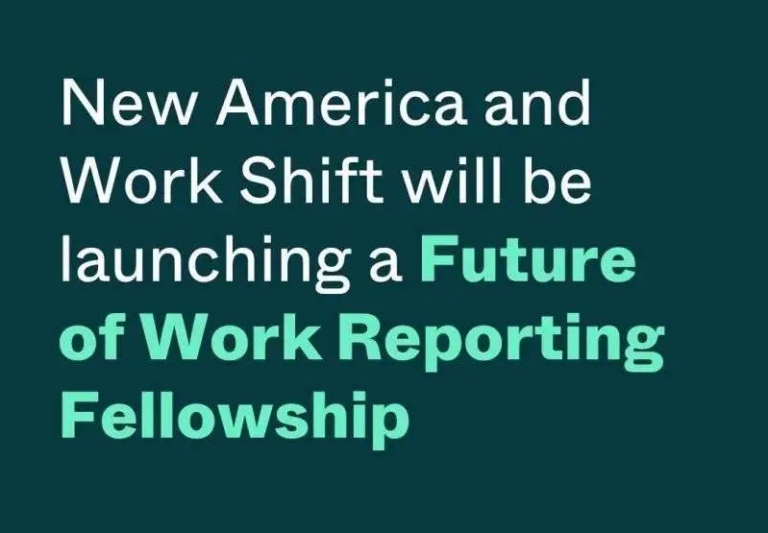
Applications for the Future of Work Reporting Fellowship 2026 are now open. The Future of Work Reporting Fellowship will support journalists telling place-based stories that explore how government and private investments are reshaping economic opportunity across the United States.
Billions of dollars are flowing into communities across America—government and private investments in emerging technologies, advanced manufacturing, and innovation hubs that promise to transform regional economies and create new pathways to good jobs. But will these investments actually deliver economic mobility for working families? Who gets left behind, and who benefits?
These are the stories that matter most right now, yet they’re going undertold. As school systems forge new partnerships with tech companies, as community colleges retool programs for a changing labor market, as entire regions bet their futures on becoming the next tech hub—local communities need journalism that connects the dots and holds institutions accountable.
The Future of Work Reporting Fellowship, co-organized by Work Shift and New America’s Future of Work & Innovation Economy initiative, supports journalists telling these essential stories: how education, workforce development, and the innovation economy intersect in real communities, and what it means for people’s lives and livelihoods.
Benefits
Each Fellow in the Work Shift & New America Reporting Fellowship will receive:
- $5,000 stipend for project completion
- $1,500 expense budget for travel, research, and other reporting expenses
- Professional development and editorial support including coaching, editing, and peer learning opportunities from Work Shift editors and New America leaders
- A virtual workshop organized by New America to deepen understanding of the intersection of education, industrial policy, and tech-driven economic development
- Access to expert sources and data resources to support high-quality, informed reporting
Eligibility
- The Fellowship is open to U.S.-based journalists whose work includes reporting on education (K-12 or postsecondary), workforce development, economic development, technology, industrial policy, or related social and public policy issue.
- They particularly encourage applications from local and regional reporters covering the workforce and education impacts of advanced manufacturing, semiconductor, next generation energy, and other technology investments in their communities. National reporters are also eligible if their work focuses on place-based stories and on-the-ground impacts.
- Potential fellows will be early- and mid-career journalists (approximately 1-15 years of professional reporting experience) interested in deepening and expanding their understanding of how education systems connect to technology-driven economic development and the future of work.
- Print, online, radio, TV and multimedia reporters and editors from local and national publications and digital-only news platforms are eligible. So are independent news podcasters, newsletter writers, and freelancers who target nonpartisan media outlets.
- Your application should state your intended outlet and its commitment to run your project. Work Shift is open to co-publishing or being the primary publisher on some projects. If you would like the organisers to be the primary or secondary publisher of your work, there will be a space for you to indicate that in the application.
Application
A complete application consists of these required components:
- Basic applicant information (personal and professional details)
- Statement of interest / Project proposal (500-750 words; see below for details)
- One letter of recommendation OR a statement of qualifications (see below for details)
- Résumé
- Links to three (3) work samples (provide links to three work samples published within the past five years. Samples should be your best recent work.)
For more information, visit Future of Work Reporting Fellowship.




![award-women-in-agriculture-leadership-program-fellowship-2026-[cohort-2]](https://opportunityforafrica.org/wp-content/uploads/2026/09/14220-award-women-in-agriculture-leadership-program-fellowship-2026-cohort-2-238x178.png "AWARD Women in Agriculture Leadership Program Fellowship 2026 [Cohort 2]")