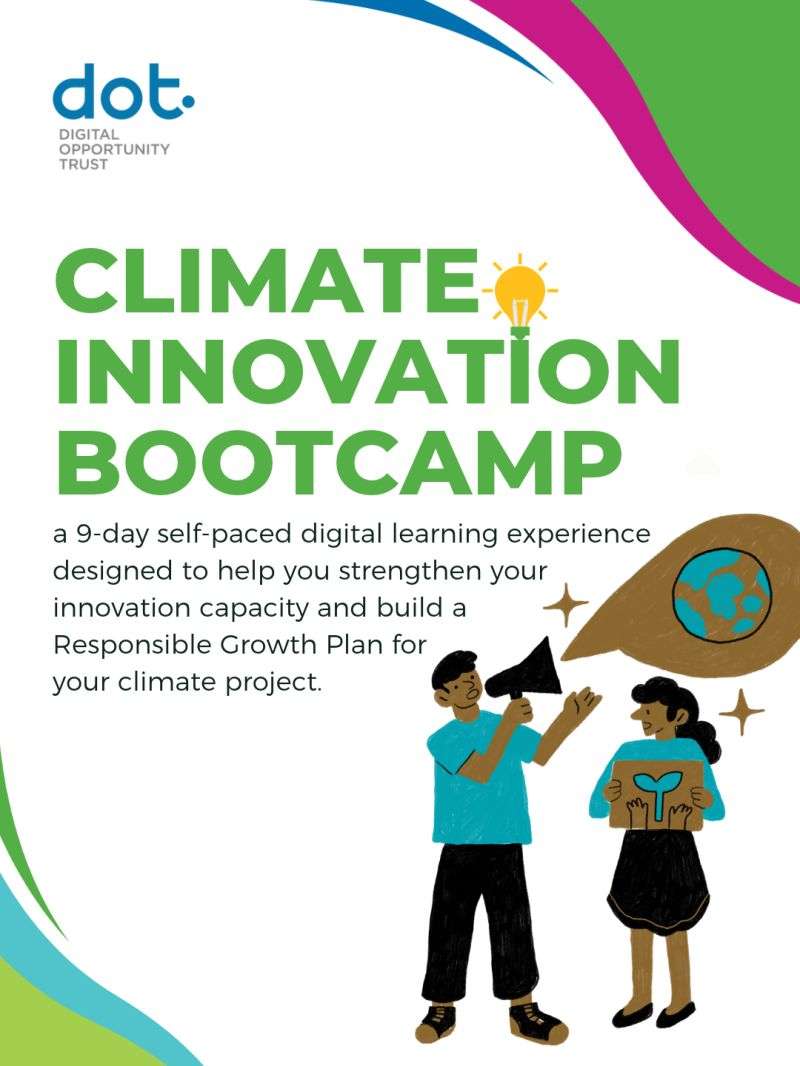
Young people with innovative ideas and projects addressing climate change have an opportunity to strengthen their skills, develop practical growth strategies, and turn their climate initiatives into scalable solutions through the Digital Opportunity Trust (DOT) Climate Innovation Bootcamp 2026.
The Climate Innovation Bootcamp is a complimentary, nine-day online learning programme designed for young climate innovators, grassroots leaders, students, recent graduates, and early-stage climate entrepreneurs who want to expand the reach and impact of their environmental initiatives.
Starting on December 3, 2026, the bootcamp will equip participants with practical tools, learning resources, worksheets, and strategies to develop a responsible six-month growth roadmap for their climate projects. Participants will explore different approaches to scaling their initiatives, building partnerships, securing resources, communicating their impact, and measuring meaningful outcomes.
The programme is particularly relevant for young people who already have a climate-focused idea or project and want to move beyond the initial stages of implementation toward sustainable and responsible growth.
Overview of the DOT Climate Innovation Bootcamp 2026
The Climate Innovation Bootcamp is organized by Digital Opportunity Trust (DOT) through its learning platform. It focuses on helping young people strengthen their capacity to develop and scale climate solutions while maintaining their original mission, values, and commitment to environmental and social impact.
The programme recognizes that having a promising climate idea is only the beginning. Successfully expanding an initiative requires more than enthusiasm. Innovators need to understand their readiness, identify suitable growth models, build relationships with relevant stakeholders, access funding and resources, communicate their work effectively, and measure the results of their activities.
Through a structured nine-day learning experience, participants will work through these important areas and develop a practical roadmap for the next six months of their climate initiatives.
Programme Details
- Programme Name: DOT Climate Innovation Bootcamp
- Organizer: Digital Opportunity Trust (DOT)
- Start Date: December 3, 2026
- Duration: 9 days
- Format: Online and self-paced
- Cost: Completely free of charge
- Age Range: 18–35 years
- Certificate: Certificate of Completion from the DOT Climate Team
- Required Prerequisite: Certificate from DOT’s Climate Leadership for Community Action course
- Daily Learning Commitment: Approximately 45–60 minutes of learning content, plus time for worksheet activities
- Application/Enrollment: Online registration through the DOT Learning Platform
Climate change requires practical solutions, innovative thinking, and cooperation among individuals and organizations working toward a more sustainable future. Young people are increasingly contributing to this work through community-based environmental projects, climate-focused businesses, advocacy initiatives, and other forms of grassroots action.
However, developing a project and expanding its impact are two different challenges. A climate initiative that works well within one community may require additional resources, stronger partnerships, improved organizational capacity, and a different implementation strategy before it can reach more people.
The DOT Climate Innovation Bootcamp is designed to address this challenge.
The programme supports young innovators who have a climate-focused idea or an existing project and want to strengthen their ability to grow it responsibly. Rather than focusing only on theoretical knowledge, the bootcamp combines daily video lessons, curated readings, practical worksheets, examples from climate innovators, and structured activities that participants can apply directly to their initiatives.
By the end of the nine-day programme, participants are expected to have developed a personalized six-month growth roadmap that can guide their next steps.
Who Should Apply for the Climate Innovation Bootcamp?
The programme is intended for young people between the ages of 18 and 35 who are interested in developing, improving, or expanding climate-focused initiatives.
The organizers identify several groups that may particularly benefit from participating:
1. Young Climate Innovators
Young people who have developed a climate-related idea or are already working on an environmental initiative can use the programme to evaluate their current approach and identify opportunities to expand their impact.
2. Youth-Led Organizations and Grassroots Leaders
Leaders of youth-led organizations and community-based initiatives can learn how to strengthen their organizational capacity, identify potential partners, and develop strategies for reaching more communities.
3. Students and Recent Graduates
Students and recent graduates who have developed climate-focused projects can gain practical knowledge about project development, resource mobilization, partnership building, and responsible growth.
4. Early-Stage Climate Entrepreneurs
Young entrepreneurs working on climate-related products, services, or business ideas can explore different scaling models and learn how to build a sustainable growth strategy.
5. Community Changemakers
Individuals passionate about sustainability and environmental protection who are already involved in community initiatives can strengthen their ability to organize, communicate, and expand their climate action activities.
An important consideration is that the programme is designed for participants who have a climate-focused idea or project. It is not simply a general introductory course about climate change.
What Participants Will Learn and Receive
The bootcamp offers a combination of learning materials, practical exercises, and resources intended to help participants apply the lessons to their own projects.
1. Practical Tools and Templates for Scaling Climate Initiatives
Participants will receive practical tools and templates that can help them assess their projects, organize their growth strategies, and identify the resources needed to expand their activities.
These resources are intended to make the learning experience actionable. Instead of simply studying different approaches to innovation, participants will be encouraged to apply the concepts to their own climate initiatives.
2. Daily Video Lessons and Curated Readings
The programme includes daily video lessons and selected reading materials from global climate leaders.
These resources will introduce participants to important concepts and approaches used by climate innovators around the world. Participants can use the lessons to understand the challenges associated with scaling climate solutions and explore strategies that may be suitable for their own projects.
3. Nine Hands-On Worksheets
One of the practical components of the bootcamp is its collection of nine downloadable worksheets.
Each worksheet corresponds to the programme’s learning structure and allows participants to work directly on their climate initiatives.
The worksheets are designed to help participants assess their readiness, explore scaling models, identify stakeholders, plan resource requirements, develop communication strategies, and establish meaningful performance indicators.
4. Personalized Six-Month Growth Roadmap
A central outcome of the programme is the development of a personalized six-month growth roadmap.
This roadmap will help participants translate their ideas into a structured plan by identifying important priorities, possible partnerships, required resources, and practical steps for expanding their projects.
It is intended to provide direction beyond the nine-day learning experience.
5. Completion Certificate
Participants who successfully complete all required activities within the cohort period will receive a certificate from the DOT Climate Team.
The certificate provides recognition of participation and completion of the bootcamp’s learning activities.
6. Additional Resources and Examples
The programme also includes examples from real climate innovators and a bonus resource list covering funding opportunities, partnerships, and storytelling.
These materials can help participants identify additional sources of support and understand how to communicate their projects to potential funders, collaborators, and other stakeholders.
Detailed Nine-Day Climate Innovation Bootcamp Curriculum
The bootcamp follows a structured nine-day programme. Each day focuses on a different aspect of developing and scaling a climate initiative.
Day 1: Vision for Climate Impact
The first day focuses on defining the vision behind a climate initiative.
Participants will work on identifying their desired impact and establishing a clear direction for their projects. The concept of a scaling North Star helps innovators understand what they ultimately want to achieve and how future decisions should contribute to that vision.
A clear vision is important because growth should not happen simply for the sake of expansion. It should support the project’s original purpose and intended environmental or social outcomes.
Day 2: Climate Readiness Check
Before expanding an initiative, innovators need to understand whether their projects and organizations are prepared for growth.
The second day focuses on assessing climate readiness and identifying areas that may need improvement.
Participants will consider their current capacity, resources, organizational strengths, and potential challenges. This assessment can help them determine whether they are ready to scale or whether they should first strengthen particular aspects of their initiatives.
Day 3: Choose Your Scaling Model
Not every climate initiative should grow in the same way.
Some projects may expand by reaching additional communities, while others may grow through partnerships, replication, collaboration, or the development of new services.
On the third day, participants will explore different scaling models and consider which approach best fits their project’s objectives, available resources, and operating environment.
The aim is to identify a realistic growth path rather than adopt an expansion strategy that may not be suitable for the initiative.
Day 4: Map Your Climate Action Ecosystem
Climate solutions often depend on cooperation among different individuals, organizations, institutions, and communities.
The fourth day focuses on understanding the ecosystem surrounding a climate initiative.
Participants will identify potential allies, stakeholders, influencers, and organizations that may contribute to their projects. Mapping this ecosystem can help innovators understand who they need to engage with and how different relationships may support their objectives.
Day 5: Resource Strategy
Expanding a climate initiative requires resources, including funding, people, expertise, equipment, and other forms of support.
The fifth day focuses on developing a resource strategy.
Participants will explore what their projects need to grow and consider how they might secure the necessary resources. This is particularly important for early-stage innovators who may have strong ideas but limited access to financial and organizational support.
Day 6: Storytelling for Climate Action
Communicating a climate initiative effectively can make a significant difference when approaching potential partners, funders, and communities.
The sixth day focuses on storytelling for climate action.
Participants will explore how to communicate the purpose of their projects, explain the problems they are addressing, and demonstrate the value of their proposed solutions.
Strong storytelling can help innovators make their work more understandable, attract interest, and build support for their initiatives.
Day 7: Partnerships for Scale
Partnerships can provide access to knowledge, resources, networks, and opportunities that individual innovators may not be able to obtain independently.
The seventh day focuses on building trust-based collaborations.
Participants will explore how to identify potential partners, develop meaningful relationships, and establish collaborations that support long-term project growth.
The emphasis is on partnerships that contribute to shared objectives and create value for the people and communities involved.
Day 8: Metrics That Matter
Growing a climate initiative is not only about increasing its size or reaching more people. Innovators also need to understand whether their activities are producing meaningful results.
The eighth day focuses on measuring climate outcomes.
Participants will explore how to identify relevant indicators and track the progress of their initiatives. This can help them understand what is working, identify areas that need improvement, and communicate their impact more effectively.
Day 9: Responsible Growth Plan
The final day brings together the lessons and practical activities completed throughout the bootcamp.
Participants will develop a responsible growth plan that outlines their next steps over the following six months.
The plan is intended to help innovators move forward with a clearer understanding of their priorities, growth strategy, resource requirements, partnerships, and expected outcomes.
By completing this final stage, participants will have a practical roadmap to guide the continued development of their climate initiatives.
Why Should You Join the DOT Climate Innovation Bootcamp?
There are several reasons why young climate innovators may find this programme valuable.
Develop Practical Innovation Skills
The bootcamp focuses on practical strategies that participants can apply directly to their climate projects. It covers important areas such as readiness assessment, scaling models, resource planning, partnerships, and impact measurement.
Build a Structured Growth Strategy
Participants will have the opportunity to develop a personalized six-month roadmap. This can help turn a promising idea into a more organized and actionable initiative.
Improve Your Ability to Attract Support
Learning how to communicate a project’s purpose, demonstrate its impact, and identify potential partners can strengthen an innovator’s ability to engage funders and collaborators.
Understand How to Scale Responsibly
Expanding an initiative without considering its capacity, resources, and long-term impact can create challenges. The bootcamp emphasizes responsible growth that remains connected to the project’s mission and values.
Learn From Climate Innovation Examples
The programme includes examples from real climate innovators, giving participants an opportunity to explore approaches used in different contexts.
Connect With a Global Youth Climate Network
The bootcamp highlights participation in a global youth climate network that supports young people working toward climate solutions. This can be valuable for learning, exchanging ideas, and identifying opportunities for collaboration.
Participate Without Paying Tuition Fees
The programme is offered free of charge, making the learning opportunity accessible without a course participation fee. Participants should still review the registration requirements and any applicable access conditions before enrolling.
Programme Format, Duration, and Daily Time Commitment
The DOT Climate Innovation Bootcamp is delivered entirely online through the DOT Learning Platform.
It is designed as a self-paced programme, meaning participants can complete the daily learning activities at their own pace while following the recommended nine-day schedule.
The organizers estimate that participants will need approximately 45–60 minutes per day to go through the learning content, in addition to the time required to complete the worksheets and apply the lessons to their projects.
The recommended learning structure is as follows:
- Watch the daily video lesson.
- Review the selected reading materials.
- Complete the corresponding worksheet.
- Apply the concepts to your climate idea or existing project.
- Use the lessons to develop your six-month growth roadmap.
Although the programme is self-paced, participants are expected to complete all required activities within the cohort window to qualify for the completion certificate.
Important Prerequisite: DOT Climate Leadership for Community Action Certificate
One of the most important requirements for joining the Climate Innovation Bootcamp is the prerequisite course.
Applicants must have a certificate from DOT’s Climate Leadership for Community Action course.
This means that having a climate-focused project and meeting the age requirement may not be sufficient on their own. Prospective participants should ensure that they have completed the required course and obtained its certificate before enrolling.
If you have not yet completed the prerequisite, visit the DOT Learning Platform to review the available course information and determine how to obtain the required certificate.
How to Enroll in the DOT Climate Innovation Bootcamp 2026
Interested and eligible participants can register through the official DOT Learning Platform.
The enrollment process is outlined below:
Step 1: Visit the Official Bootcamp Page
Access the DOT Climate Innovation Bootcamp page through the official learning platform:
Step 2: Review the Programme Requirements
Before enrolling, carefully review the programme details, including the age range, climate-project focus, online learning format, and prerequisite certificate requirement.
Step 3: Confirm Your Prerequisite Certificate
Make sure you have obtained a certificate from DOT’s Climate Leadership for Community Action course, as this is a stated requirement for participation.
Step 4: Enroll in the Bootcamp
Use the enrollment option provided on the official course page and follow the platform’s instructions to register.
Step 5: Begin the Learning Activities
The bootcamp is scheduled to start on December 3, 2026. Once the cohort begins, participants can follow the recommended daily learning structure and complete the video lessons, readings, and worksheets.
Step 6: Complete the Programme and Develop Your Roadmap
Work through all nine days of activities and complete the final responsible growth plan. Participants who complete all required activities within the cohort window will receive a certificate from the DOT Climate Team.
Additional Information and Contact Details
For further information about the bootcamp, participants can use the following official resources:
- Bootcamp Enrollment Page: https://learn.dotrust.org/course/view.php?id=248
- Share Your Climate Initiative: https://docs.google.com/forms/d/e/1FAIpQLSfGfuMkCnD8yvZ01goGRKNrwxsP6V-NmEPJ8M-ziA7rMmH0IQ/viewform?usp=header
- Contact Email: climate@dotrust.org
- Organizer: Digital Opportunity Trust (DOT)
The initiative-sharing form provides an additional way to share information about a climate initiative with the organizers.
Frequently Asked Questions (FAQs)
1. Is the DOT Climate Innovation Bootcamp free?
Yes. The programme is complimentary, meaning participants do not have to pay a course participation fee.
2. When does the Climate Innovation Bootcamp begin?
The bootcamp is scheduled to start on December 3, 2026.
3. How long does the programme last?
The programme is structured as a nine-day learning experience.
4. Is the bootcamp conducted online or in person?
It is delivered online through the DOT Learning Platform and is designed to be self-paced.
5. Who can participate?
The programme is intended for young people aged 18–35, including climate innovators, youth-led organizations, grassroots leaders, students, recent graduates, early-stage climate entrepreneurs, and community changemakers.
Participants should have a climate-focused idea or project.
6. Is previous experience in climate innovation required?
The announcement is designed for people with a climate-focused idea or project, whether the idea is at an early stage or the project has already been piloted. It does not specify a particular number of years of professional experience.
7. Is there a prerequisite for joining?
Yes. Participants must have a certificate from DOT’s Climate Leadership for Community Action course.
8. How much time should participants dedicate each day?
The organizers recommend approximately 45–60 minutes for the daily learning content, in addition to time for completing the worksheets and applying the lessons.
9. Will participants receive a certificate?
Yes. Participants who complete all required activities within the cohort window will receive a certificate from the DOT Climate Team.
10. What will participants achieve after completing the bootcamp?
Participants will work toward developing a personalized six-month growth roadmap for their climate initiatives. They will also gain practical tools, worksheets, learning resources, and strategies for responsible project growth.
11. Is there an application deadline?
The published bootcamp announcement provides a start date of December 3, 2026, but does not state a specific registration deadline. Interested participants should consult the official enrollment page for the latest registration information.
Conclusion
The DOT Climate Innovation Bootcamp 2026 offers young climate innovators an opportunity to strengthen their knowledge, improve their project development skills, and create a practical strategy for expanding their environmental and social impact.
Through nine days of online learning, participants will explore important areas of climate innovation, including project readiness, scaling models, ecosystem mapping, resource mobilization, storytelling, partnership development, and impact measurement. The programme also provides nine practical worksheets, curated learning materials, examples from climate innovators, and the opportunity to develop a personalized six-month responsible growth roadmap.
For young people between the ages of 18 and 35 who already have a climate-focused idea or project, this complimentary programme can provide useful guidance for taking their initiatives to the next stage.
The bootcamp begins on December 3, 2026. Interested participants should review the prerequisite requirement and visit the official DOT Learning Platform to learn more and enroll.