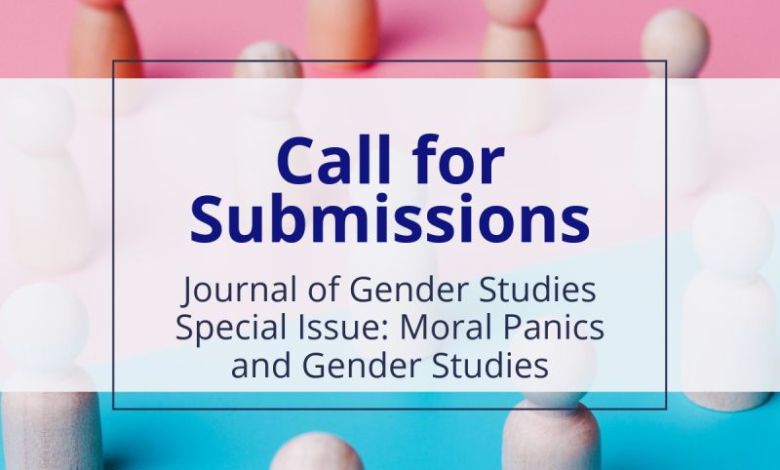
The Journal of Gender Studies has announced a special issue titled “Moral Panics and Gender Studies,” inviting scholars from across disciplines to examine the growing relationship between gender-related debates and moral panic narratives in contemporary societies. The special issue seeks to advance theoretical and empirical understanding of how concerns surrounding gender, sexuality, identity, and Equality, Diversity and Inclusion (EDI) policies are framed, circulated, and contested within public discourse, media environments, and political arenas.
Researchers are encouraged to submit innovative contributions that investigate the ways in which gender issues become focal points for broader cultural, political, and moral conflicts. The special issue will be edited by Morena Tartari of Northumbria University and Anita Lavorgna of the University of Bologna.
Understanding the Contemporary Context
Across both Western and non-Western societies, recent years have witnessed significant political and cultural shifts that have intensified debates surrounding gender and identity. Questions related to feminism, LGBTQ+ rights, masculinity, family values, reproductive rights, and gender education have increasingly become subjects of public controversy.
These debates are often amplified through traditional media platforms, social media networks, political campaigns, and public institutions. In many cases, specific groups, identities, or behaviors are portrayed as threats to societal norms, cultural values, or national identity. Such portrayals can generate widespread fear, social anxiety, and calls for intervention, creating conditions commonly associated with moral panics.
The special issue recognizes that these developments are occurring within broader contexts marked by the rise of nationalist, populist, and authoritarian political movements. Consequently, gender-related moral panics are not isolated incidents but may reflect deeper transformations in political culture, social regulation, and public discourse.
Revisiting Moral Panic Theory
The concept of moral panic has played a central role in sociology, criminology, media studies, and cultural studies since Stanley Cohen introduced it in the 1970s. The framework has traditionally been used to examine how societies identify and respond to perceived threats, often through processes involving media amplification, public concern, expert commentary, and political intervention.
Over the decades, scholars have expanded and refined the concept by connecting it to discussions of risk, fear, social problems, moral regulation, and discourse analysis. At the same time, moral panic theory has faced significant criticism regarding its assumptions, terminology, and application.
Despite these debates, the editors argue that moral panic remains a valuable analytical framework for understanding contemporary social conflicts. They emphasize that gender-related controversies offer particularly important opportunities to reassess and strengthen the concept in light of current social, political, and technological realities.
Gender as a Central Dimension of Moral Panic
Although moral panic research has generated substantial scholarship, gender has often received limited attention as a central organizing factor in the production of fear, anxiety, and moral outrage.
Today, discussions surrounding gender ideology, sexual citizenship, reproductive rights, transgender identities, contemporary masculinities, and feminist movements have become highly visible subjects of moral panic. These debates influence public policy, lawmaking, educational systems, and media narratives while shaping perceptions of social order and morality.
The special issue also highlights growing concerns regarding attacks on gender studies as an academic field. Scholars working within feminist, queer, and gender studies programs have increasingly faced political opposition, institutional restrictions, funding cuts, and public campaigns aimed at delegitimizing their work. Contributors are encouraged to critically analyze these developments as significant dimensions of contemporary gender-related moral panics.
Topics of Interest
The editors welcome interdisciplinary submissions that engage with, challenge, or extend moral panic theory through gender-focused analysis. Potential topics include:
• Rethinking moral panic theory through gender studies perspectives.
• Feminist, queer, and intersectional approaches to moral panic research.
• Gendered moral panics in traditional and digital media.
• Political and media discourses surrounding gender ideology and sexual citizenship.
• Moral regulation of sexuality, reproduction, and family life.
• Moral panics linked to masculinity, misogyny, and gender-based violence.
• Social media outrage, trolling, and gender-related misinformation.
• The role of educational, religious, legal, and political institutions in producing or countering moral panics.
• Moral entrepreneurs and claim-makers in gender-related controversies.
• Comparative and historical studies of gender-based moral panics.
• Emotional dimensions of moral panic narratives.
• Gender, intersectionality, and contemporary social anxieties.
Submissions from sociology, criminology, gender studies, media studies, communication studies, cultural studies, behavioral sciences, feminist studies, queer studies, and related disciplines are particularly encouraged.
Submission Guidelines
Researchers are invited to submit abstracts of up to 500 words outlining their research focus, theoretical framework, and methodological approach. Each submission should also include a brief biographical note of up to 100 words.
Abstracts must clearly demonstrate how the proposed research contributes to understanding moral panics in relation to gender studies and contemporary social debates.
Authors should submit abstracts directly to both guest editors.
Important Dates
• Abstract Submission Deadline: 15 September 2026
• Notification of Acceptance: 30 September 2026
• Full Manuscript Submission Deadline: 15 March 2027
• Completion of First Round Peer Review: 30 June 2027
• Final Paper Submission Deadline: 30 September 2027
Why This Special Issue Matters
As gender-related debates continue to shape public conversations, political agendas, and institutional responses across the globe, understanding the mechanisms that produce fear, moral outrage, and social regulation has never been more important. This special issue offers an opportunity for scholars to critically examine the relationship between gender and moral panic while contributing to broader discussions about democracy, social justice, public discourse, and cultural change.
By bringing together diverse disciplinary perspectives, the issue aims to deepen understanding of how gender-related moral panics emerge, evolve, and influence societies in an era of rapid political and technological transformation.