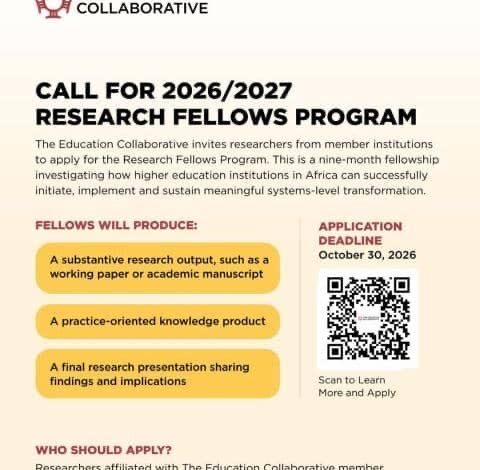
Are you a researcher passionate about higher education, institutional transformation, innovation, and entrepreneurship in Africa? The Education Collaborative Research Fellows Program 2026/27 offers an opportunity to investigate how African universities and higher education institutions can implement sustainable change and improve graduate employability, entrepreneurship, and innovation.
The nine-month fellowship brings together researchers interested in transforming institutional experience, programme evidence, and cross-institutional learning into practical knowledge that can influence higher education policy and practice across Africa.
Selected fellows will receive tailored research mentorship, access to relevant institutional data and resources, opportunities to collaborate with researchers across the Education Collaborative network, and support for eligible research dissemination costs.
However, applicants should note that the fellowship does not provide a salary or stipend. Instead, it focuses on research development, mentorship, knowledge production, and professional networking.
If you are an active researcher affiliated with an Education Collaborative member institution, or have demonstrated engagement with its research and knowledge activities, this opportunity may be worth exploring.
The Education Collaborative has developed a growing body of knowledge through its engagement with higher education institutions across Africa.
This includes institutional assessments, programme documentation, workshops, peer-learning activities, systems-strengthening initiatives, and experiences shared by member institutions.
The Research Fellows Program provides a structured opportunity to examine this evidence and develop research that explains how higher education institutions can initiate, implement, and sustain meaningful systems-level transformation.
The programme aims to bridge the gap between institutional experience and evidence-based decision-making by supporting research that contributes to institutional practice, regional learning, and broader conversations about African higher education.
What Is the Main Research Focus for 2026/27?
The central research question for the 2026/27 fellowship is:
How can higher education institutions in Africa successfully initiate, implement, and sustain meaningful systems-level transformation in employability, entrepreneurship, and innovation?
Research fellows will explore this question through interconnected areas of inquiry examining institutional change, regional collaboration, and Africa-wide systems transformation.
1. Institutional Transformation
This area explores how higher education institutions transform from within.
Researchers may investigate the roles of institutional leadership, staff, students, change champions, departments, resources, and learning systems in supporting sustainable institutional change.
The focus is on understanding what enables transformation to begin, how it is implemented, and what helps ensure that improvements last.
2. Regional Transformation
This area examines how institutions within a particular sub-region can learn from one another and use shared evidence to improve higher education practice.
Potential research questions include how peer-learning models influence institutional performance, how collaborative approaches can inform regional policies, and how evidence from multiple institutions can support better regulation and decision-making.
3. Africa-Wide Systems Transformation
This area considers how lessons from institutional and regional initiatives can influence higher education systems across the continent.
Researchers may examine how networks, shared knowledge, institutional partnerships, and accumulated evidence can contribute to changes in policy, professional practice, and expectations across African higher education.
Applicants should select an area that aligns with their experience and proposed research direction.
Who Can Apply for the Fellowship?
The programme primarily targets active researchers working at Education Collaborative member institutions whose interests align with the fellowship’s research priorities.
Applicants should meet the following general eligibility criteria:
- Have a current affiliation with an Education Collaborative member institution or demonstrate engagement with the Collaborative’s research and knowledge activities.
- Have an active research interest in higher education, institutional transformation, education systems, or a related field.
- Possess experience using qualitative, quantitative, or mixed-methods research approaches.
- Demonstrate strong analytical, research, and academic writing skills.
- Have a record of producing research outputs, such as academic papers, reports, case studies, or other knowledge products.
- Be able to participate fully in the nine-month fellowship.
Priority may be given to applicants who are already familiar with the Education Collaborative’s programmes, institutional engagements, and available research evidence.
Important: The supplied terms of reference do not specify a general age limit or require applicants to be enrolled in a particular degree programme. Prospective applicants should consult the official application form for any additional requirements.
What Support Will Selected Fellows Receive?
Although the fellowship does not provide a stipend or salary, selected researchers will receive several forms of professional and research support.
Research mentorship
Fellows will receive tailored guidance from experienced researchers across the network to help refine their research questions, strengthen their methodology, and develop high-quality research outputs.
Access to data and institutional evidence
Participants will be able to access relevant data and resources from the Education Collaborative to support their approved research, subject to applicable access and governance requirements.
Cross-institutional networking
The programme offers opportunities to connect with researchers and higher education institutions across the Collaborative’s member network, encouraging knowledge-sharing and collaborative research.
Research dissemination opportunities
Fellows will have a guaranteed opportunity to present their work at the Research Conference during the Education Collaborative’s June 2027 convening.
Support for eligible research dissemination costs, including expenses associated with presenting or publishing research, may also be available under the programme’s applicable arrangements and limits.
What Are the Fellowship Responsibilities?
Selected fellows will be expected to undertake research aligned with their approved proposals and grounded primarily in the Collaborative’s available data, documentation, and implementation experience.
Their responsibilities include participating in the inception workshop, research clinics, peer-review sessions, and mentorship activities.
Fellows must also present interim progress and final findings, contribute to peer-learning activities, and support the Collaborative’s wider research dissemination efforts.
Where primary data collection involves human participants or identifiable personal information, fellows must comply with applicable research ethics requirements. Required ethical approval must be obtained before commencing data collection.
What Deliverables Must Fellows Produce?
Each fellow is expected to complete three principal outputs during the programme.
1. A substantive research output: This may be a working paper or academic manuscript examining a relevant question in African higher education.
2. A practice-oriented knowledge product: Examples include an insight brief or practice brief translating research findings into useful information for institutional leaders, practitioners, or policymakers.
3. A final research presentation: Fellows will present their findings and explain their implications for institutional transformation and higher education systems.
These outputs are intended to ensure that research contributes both to academic knowledge and to practical institutional learning.
How Long Does the Fellowship Last?
The Education Collaborative Research Fellows Program runs for approximately nine months, from October 2026 to July 2027.
During this period, fellows will refine their research designs, analyse evidence, engage with mentors, develop their knowledge products, and prepare their final presentations.
The programme culminates in an opportunity to present research at the Research Conference during the Collaborative’s June 2027 convening.
How to Apply for the Education Collaborative Research Fellows Program 2026/27
According to the supplied terms of reference, applicants must submit the following materials through the online application process:
- A completed online application form.
- An updated CV highlighting relevant academic, research, and professional experience.
- A research proposal of no more than two pages addressing the 2026/27 focus area and situated within one of the programme’s four areas of inquiry.
Before submitting, applicants are expected to familiarise themselves with the Education Collaborative’s ongoing work, programmes, institutional engagements, and relevant available evidence.
The proposal should include a proposed title, research question, rationale, methodology, relevant data sources, expected contribution, and planned outputs.
Applicants should demonstrate that their research is feasible within the nine-month fellowship period and relevant to institutional transformation in African higher education.
Because the official application URL and submission deadline were not included in the supplied terms of reference, prospective applicants should obtain these details directly from the Education Collaborative before submitting.
Why Consider This Research Fellowship?
The fellowship offers researchers an opportunity to investigate practical questions affecting African universities and higher education systems.
By combining research mentorship, institutional evidence, peer learning, and knowledge dissemination, the programme can help researchers strengthen their analytical skills and develop work that informs institutional decision-making.
It may be particularly valuable for researchers interested in graduate employability, entrepreneurship education, innovation ecosystems, institutional leadership, and sustainable systems-level change.
Although the programme does not provide a salary or stipend, the research support, networking opportunities, and conference presentation can offer meaningful professional development for eligible participants.
Final Thoughts
The Education Collaborative Research Fellows Program 2026/27 provides an opportunity to turn evidence and institutional experience into research that can inform the future of higher education in Africa.
If you have relevant research experience and a strong interest in institutional transformation, consider developing a focused proposal that connects your expertise with the programme’s priorities.
Review the terms of reference carefully, prepare your CV and two-page research proposal, and confirm the official application deadline and submission process before applying.