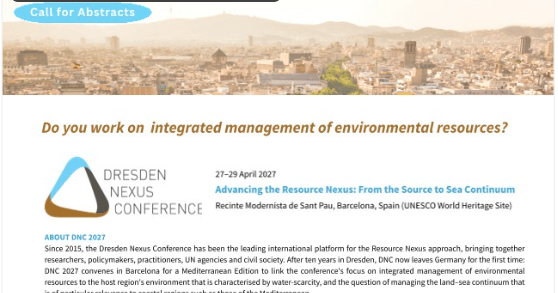
Researchers, policymakers, practitioners, civil society representatives, and professionals working on sustainable resource management are invited to prepare submissions for the Dresden Nexus Conference (DNC) 2027, which will take place in Barcelona, Spain.
The international conference provides a platform for exchanging research, policy perspectives, and practical experiences around the Resource Nexus approach and integrated management of environmental resources. The 2027 edition will mark an important change for the conference as it moves outside Germany for the first time since its establishment.
The Call for Abstracts opens on 15 October 2026 and closes on 15 November 2026, giving prospective contributors one month to submit their work.
Since 2015, the Dresden Nexus Conference has brought together stakeholders from different sectors to explore how environmental resources are interconnected and how their management can be improved through integrated approaches.
The conference has traditionally been held in Dresden, Germany. For 2027, however, the conference will move to Barcelona for a Mediterranean Edition, creating an opportunity to examine the Resource Nexus from the perspective of a region facing distinctive environmental challenges.
The conference is expected to connect researchers and practitioners working across disciplines with policymakers, UN agencies, civil society organizations, and other stakeholders.
Conference Highlights
- Event: Dresden Nexus Conference 2027
- Location: Barcelona, Spain
- Edition: Mediterranean Edition
- Call for Abstracts opens: 15 October 2026
- Submission deadline: 15 November 2026
- Target participants: Researchers, policymakers, practitioners, UN agencies, and civil society
- Focus: Integrated environmental resource management and the Resource Nexus
Dresden Nexus Conference 2027 in Barcelona: Focus on the Mediterranean Region
The 2027 conference will use its Mediterranean setting to explore environmental challenges that are particularly relevant to the region.
One important issue is water scarcity, which creates significant pressures on communities, ecosystems, agriculture, and other water-dependent sectors. The Mediterranean context also provides an opportunity to consider how land and marine systems interact.
The land–sea continuum is particularly relevant to coastal regions because decisions and activities on land can have consequences for marine environments, while changes in coastal and marine systems can affect communities and resource management on land.
By bringing the conference to Barcelona, the organizers aim to connect the Resource Nexus approach with these regional realities while maintaining its international perspective.
Dresden Nexus Conference 2027 in Barcelona: Who Should Submit an Abstract?
The Call for Abstracts is relevant to professionals and researchers working on issues connected to sustainable resource management and interconnected environmental systems.
Potential contributors include:
- Researchers and academics
- Policymakers
- Development practitioners
- Environmental professionals
- Civil society organizations
- UN agencies and international organizations
- Professionals working on water and land management
- Coastal and marine researchers
- Sustainability and resource-management specialists
The conference provides an opportunity for contributors to share research findings, policy perspectives, practical experiences, and innovative approaches with an international audience.
Why the Resource Nexus Matters
Environmental challenges rarely occur in isolation. Decisions involving one natural resource can create consequences for other resources and sectors.
For example, water-management decisions can influence agriculture, energy production, ecosystems, and communities. Similarly, land-use decisions can affect water quality and coastal and marine environments.
The Resource Nexus approach encourages stakeholders to examine these connections rather than addressing environmental challenges through isolated sectoral approaches.
This integrated perspective is increasingly important as countries and communities respond to climate change, resource scarcity, environmental degradation, urbanization, and growing demands for natural resources.
Opportunities for Researchers and Practitioners
The Dresden Nexus Conference offers researchers an opportunity to present their work in an interdisciplinary environment and engage with people working beyond their own academic or professional fields.
For policymakers and practitioners, the conference can provide a space to share lessons from implementation and discuss how research and evidence can inform decision-making.
Civil society organizations and other stakeholders can also contribute practical perspectives on environmental resource management and community-level challenges.
The Mediterranean Edition may be particularly valuable for contributors working on water scarcity, coastal management, land-use planning, sustainable development, climate resilience, and integrated resource management.
Prepare for the Call for Abstracts
The Call for Abstracts will open on 15 October 2026 and close on 15 November 2026.
Researchers, policymakers, and practitioners interested in contributing should use the period before the opening date to prepare their proposed abstract and identify the research, policy experience, or practical case study they would like to present.
Applicants should ensure that their proposed contribution clearly demonstrates its relevance to the Resource Nexus and the broader themes of integrated environmental resource management.
With a one-month submission window, prospective contributors are encouraged to prepare early rather than waiting until the final days of the call.
How to Participate
Interested researchers and professionals should monitor the official Dresden Nexus Conference 2027 communication channels for the full Call for Abstracts and submission instructions when the call opens on 15 October 2026.
The conference represents an opportunity to contribute to international discussions on how interconnected environmental resources can be managed more sustainably, particularly in regions facing water scarcity and complex land–sea interactions.
The Barcelona Mediterranean Edition will also mark a new chapter for the Dresden Nexus Conference, bringing its established international Resource Nexus platform to a new regional context for the first time.