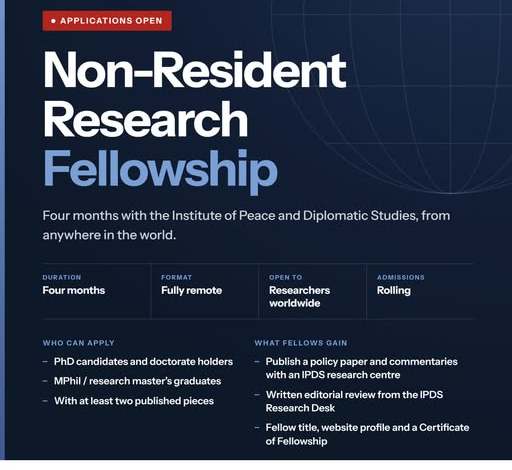
Researchers seeking to take their academic work beyond the university and into the world of policy and diplomacy can apply for the IPDS Non-Resident Research Fellowship, a four-month, fully remote research opportunity open to eligible researchers anywhere in the world.
The fellowship is offered by the Institute of Peace and Diplomatic Studies (IPDS) and is designed for researchers whose academic work is ready to engage with policymakers, diplomats and practitioners. Fellows join one of IPDS’s research centres, develop policy-oriented research, publish under the institute’s name and receive editorial guidance from the IPDS Research Desk.
The programme is particularly suited to PhD candidates, doctorate holders and graduates of MPhil or equivalent research master’s programmes who already have a record of published writing.
Applications are accepted on a rolling basis, meaning eligible researchers can apply while the fellowship remains open.
IPDS Non-Resident Research Fellowship
The IPDS Non-Resident Research Fellowship provides early-career scholars with an opportunity to transform academic research into analysis that can contribute to policy discussions.
The fellowship lasts four months and is entirely remote. Fellows can participate from their own countries and time zones, with meetings and seminars conducted online. The programme requires approximately 8–10 hours per week.
Rather than requiring fellows to abandon their existing research, IPDS encourages applicants to develop projects connected to their doctoral or MPhil research. This can allow a researcher to transform part of a thesis into policy analysis or develop a new research question with practical relevance.
Who Can Apply?
The fellowship is open to researchers who meet specific academic and publication requirements.
Applicants must have one of the following:
- A completed MPhil, MS or research master’s degree equivalent to 18 years of education
- Current enrolment in a PhD or doctoral programme
- A completed doctorate
Applicants must also have a degree in a discipline relevant to IPDS research, such as:
- International relations
- Political science
- Peace and conflict studies
- Strategic, security or defence studies
- Area or regional studies
- Economics or international political economy
- International law
- Public policy and governance
- History
- Gender studies
- Media, communication or diplomacy studies
- A related field
Another important requirement is a record of at least two published pieces, such as journal articles, book chapters, policy briefs, working papers or opinion pieces published through recognised outlets. Applicants must also demonstrate publishable-standard written English and be able to commit approximately 8–10 hours per week.
Applicants who are still completing an MPhil, or who only hold a taught master’s or bachelor’s degree, are not currently eligible.
Research Centres and Areas
Fellows choose a preferred IPDS research centre and may identify a second choice. Research proposals should align with the selected centre’s agenda.
Available areas include the Centre for Africa Studies, Centre for BRI and China Studies, Centre for SCO Studies, Centre for Central Asia and Eurasian Studies, Centre for European Studies, Centre for American Studies, Centre for ASEAN Studies, Centre for Women, Peace and Leadership and IPDS Leadership Center.
There is also a cross-centre focus on Peace, Security and Global Governance.
Topics range from African Union affairs and regional economic communities to diplomacy, international security, gender and peacebuilding, China and the Belt and Road Initiative, European foreign policy, ASEAN regionalism and global governance.
What Will Fellows Do?
During the four-month fellowship, participants agree on a research plan with their selected centre.
The standard fellowship outputs include:
One policy paper: A substantial 3,000–5,000-word paper developed with the centre and published in the IPDS research series.
Two commentaries: Fellows produce two 800–1,500-word commentaries addressing current developments in their field and written for a broader policy audience.
Centre research: Fellows may contribute to ongoing centre activities, including trackers, briefings and literature reviews.
Online seminars: Fellows participate in at least one IPDS online seminar or roundtable and present their work in progress.
Fellows also have monthly discussions with their centre lead and provide written updates during the fellowship.
What Does the Fellowship Offer?
Although the fellowship is honorary and unpaid, it provides several professional and academic benefits.
Fellows receive published and citable work under an established research institute, including a policy paper and two commentaries. They also receive editorial feedback from the IPDS Research Desk on argument, evidence and clarity.
Successful fellows receive the title of Non-Resident Research Fellow, a profile on the IPDS website during their appointment, a Certificate of Fellowship and a completion letter documenting their role and outputs.
The programme can also provide opportunities to participate in online seminars and IPDS dialogues. Fellows are encouraged to develop their policy paper into a potential article for the Journal of Peace and Diplomacy, subject to the journal’s normal peer-review process.
Is the Fellowship Paid?
No. Applicants should note that the fellowship is honorary and unpaid. It does not provide a stipend, salary, travel or visa support and does not establish an employment relationship with IPDS.
However, the fellowship is completely remote, meaning researchers do not need to relocate to Pakistan. Fellows retain copyright in their work while granting IPDS a non-exclusive right to publish and disseminate it.
How to Apply
Applicants should prepare their documents before beginning the application. These include:
- CV
- A single-authored writing sample of at least 1,500 words
- Proof of degree or doctoral enrolment
- A 500–800-word research proposal
- A 300–500-word statement of purpose
- Details of one academic referee
Applications are reviewed in batches on a rolling basis. Eligible applications are assessed based on the quality of the writing sample, research proposal, relevance and fit with the selected centre. Shortlisted candidates are invited to a 30-minute online interview.
Application status: Open and reviewed on a rolling basis.
Official application: Apply for the IPDS Non-Resident Research Fellowship
Researchers with completed MPhil or research master’s degrees, current PhD candidates and doctorate holders who want their scholarship to reach policy audiences can consider this opportunity to build an international research profile while continuing their academic work remotely.