Deadline: May 29, 2026
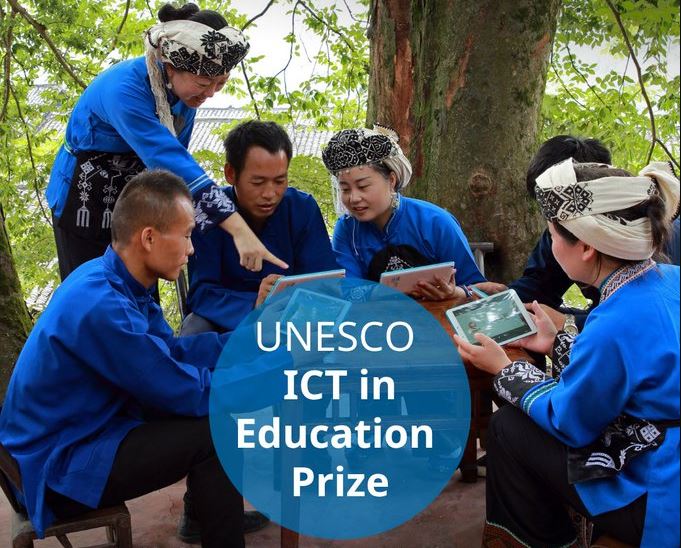
Applications are open for the UNESCO King Hamad Bin Isa Al-Khalifa Prize for the use of ICT in Education 2026. The UNESCO King Hamad Bin Isa Al-Khalifa Prize for the Use of ICT in Education recognizes innovative approaches in leveraging new technologies to expand educational and lifelong learning opportunities for all, in line with the 2030 Agenda for Sustainable Development and its Goal 4 on education.
Established in 2005 with the support of the Kingdom of Bahrain, the Prize rewards individuals and organizations that are implementing outstanding projects and promoting the creative use of technologies to enhance learning, teaching and overall educational performance in the digital age.
Theme of the 2026 edition: Reimagining creativity and critical thinking with artificial intelligence
Education plays a pivotal role in redefining what it means to know, think critically, and imagine differently in the age of artificial intelligence (AI). As AI systems produce content and analysis with increasing fluency, they unsettle previous assumptions about creativity and knowledge. Yet AI systems cannot care, exercise judgment, or discern meaning. These capacities remain fundamentally human. Cultivating these abilities requires equipping learners to question algorithmic authority, identify bias and limitations, and combine imagination with ethical judgment. In doing so, education can ensure that AI is used as a tool for expanding human agency, rather than as a substitute for human thought.
In this context, the 2026 edition of the Prize focuses on the theme “Reimagining creativity and critical thinking with artificial intelligence”. It aims to surface and amplify evidence-based practices across diverse contexts that demonstrate how teachers and learners are engaging with AI systems in ways that encourage critical thinking, imagination and creativity.
Prizes
- Each prize winner receives US$25,000, a medal and a diploma during a ceremony at UNESCO Headquarters in Paris.
Eligibility
- Applications may be submitted by individuals, institutions, non-governmental organizations (NGO) or other entities with an established, ongoing project (operational for at least one year).
- Projects must be relevant to the 2026 theme: Reimagining creativity and critical thinking with artificial intelligence.
- The project should be ongoing for at least one year.
- The project and its organization should not be affiliated to UNESCO or receive any funding from UNESCO.
Selection Criteria
- Learning contexts: Vivid descriptions of contexts and conditions under which AI is used to enable critical thinking and creativity
- Pedagogical innovation: Demonstrates creative, contextually-relevant integration of AI that cultivates critical thinking and creativity
- Evidence of learning: Provides clear qualitative or quantitative evidence of how students’ critical thinking and creative capabilities are developed through the use of AI
- Inclusion and equity: Reflects how AI was used to reach learners who are excluded, marginalized or disengaged
- Agency and voice: Highlights how learners exercise choice, curiosity and authorship in AI-supported learning
- Replicability: Offers insights into how the initiative can be adapted by other teachers in diverse classroom contexts
Application
- For the application to be considered, it should be nominated by either the National Commission of the UNESCO Member State or an NGO in official partnership with UNESCO.
- All applicants are encouraged to get in touch with the NGO or National Commission ahead of the application process. Self-nominations will not be accepted.
- Governments of UNESCO Member States and NGOs in official partnership with UNESCO are invited to elicit and nominate up to three projects.
For more information, visit UNESCO King Hamad Bin Isa Al-Khalifa Prize.