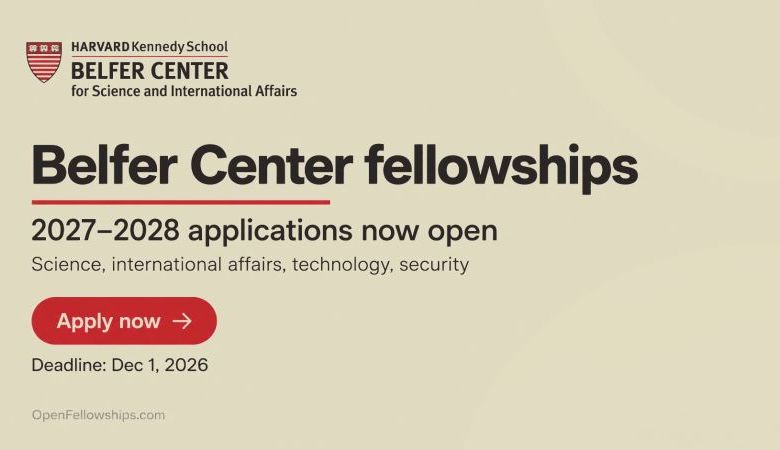
Applications are now open for the Harvard Kennedy School Belfer Center Fellowships for the 2027–2028 academic year, offering scholars, researchers and experienced professionals an opportunity to undertake policy-relevant work at Harvard University in Cambridge, Massachusetts.
Rather than a single fellowship, the Belfer Center is offering 14 fellowship opportunities covering areas including artificial intelligence, emerging technologies, international security, nuclear policy, energy, climate, geopolitics, history and international affairs.
The fellowships generally run during the academic year, with many programs offering approximately 10 months of research and professional engagement. Applications for the 2027–2028 cycle close on December 1, 2026, while recommendation letters are due by December 15, 2026.
The Belfer Center for Science and International Affairs at Harvard Kennedy School hosts academic and professional-track fellows during the academic year.
Selected fellows become part of a research community focused on some of the world’s most important challenges in science, technology and international affairs. Fellows receive opportunities to engage with Harvard faculty, researchers and other affiliated experts while pursuing policy-relevant research.
The 2027–2028 fellowship cycle includes 14 different programs, meaning applicants are encouraged to identify the fellowship that most closely matches their academic background, professional experience and proposed research.
Fellowship Opportunities Available
The available fellowships cover a broad range of disciplines and career stages.
Among the programs are:
- Technology and Geopolitics Fellowship – for current doctoral students in the dissertation-writing stage and recent PhD or equivalent degree recipients.
- Nova Fellowship – designed for senior-level technologists, scientists and engineers, particularly innovators, founders and researchers working in areas such as AI, biotechnology, quantum computing and space.
- Managing the Atom Fellowship – supports predoctoral and postdoctoral scholars, university faculty and mid-career professionals researching nuclear policy, nonproliferation, arms control, disarmament and nuclear energy.
- International Security Program Fellowship – supports predoctoral candidates and recent PhD or equivalent degree recipients pursuing research in security studies.
- Geopolitics of Energy Fellowship – focuses on the relationship between international politics, security and energy.
- Energy, Climate, and Technology Policy Fellowship – supports research on energy policy, climate policy, climate finance and energy technology innovation.
- Arctic Initiative Fellowship – examines policy, governance and international challenges arising from rapid transformation in the Arctic.
- Ernest May Fellowship in History and Policy – supports historians working at the intersection of professional history and strategic studies.
- Emirates Leadership Initiative Research Fellowship – provides a ten-month stipend for eligible scholars working on policy issues relevant to the UAE, Gulf region and broader Arab world.
- Kuwait Program Research Fellowship – offers a ten-month stipend for eligible policy-oriented scholars connected to Kuwait.
- Israel Program Research Fellowship – brings experienced scholars and practitioners working on Israel and related regional issues to Harvard Kennedy School for short-term residencies.
- Kuwait Program Visiting Scholar Fellowship – designed for senior policy-oriented scholars and faculty from Kuwait.
- Recanati-Kaplan Foundation Fellowship – supports intelligence officers from U.S. and foreign intelligence services moving into or already occupying leadership roles.
- Belfer Young Leaders Student Fellowship – designed specifically for eligible Harvard Kennedy School students.
Who Can Apply?
Eligibility varies substantially between the different fellowship programs.
Some opportunities are intended for doctoral candidates and recent PhD graduates, while others target junior faculty, visiting scholars, mid-career professionals or senior practitioners.
For example, the Technology and Geopolitics Fellowship is aimed at dissertation-stage doctoral researchers and recent PhD recipients. Managing the Atom accepts a broader range of candidates, including doctoral researchers, recent PhD graduates, faculty and mid-career professionals.
The Nova Fellowship, meanwhile, is particularly suited to senior-level technology professionals, scientists and engineers who have demonstrated significant impact in their fields.
Applicants should therefore avoid treating the 14 fellowships as having identical eligibility requirements.
What Do Fellows Receive?
Fellowship benefits vary by program. Some fellowships provide stipends, while others have different funding arrangements.
The Belfer Center states that housing is not included, and applicants should carefully review the funding provisions of their selected fellowship before applying.
For selected international fellows, visa sponsorship is available, subject to the applicable requirements.
Across the fellowship portfolio, participants benefit from access to Harvard Kennedy School’s academic environment, faculty and affiliated experts, as well as opportunities to develop research and policy-relevant work.
Duration and Location
Many of the Belfer Center’s research fellowships operate for approximately 10 months during the academic year.
The fellowship experience is based at the Harvard Kennedy School in Cambridge, Massachusetts, although the exact structure and duration can differ between programs.
Fellows join a cohort of researchers and professionals working on major issues affecting science, technology, security and international affairs.
Application Deadline
Applications for the 2027–2028 Harvard Belfer Center fellowship cycle must be submitted by:
Application deadline: December 1, 2026
Recommendation letters deadline: December 15, 2026
Because each fellowship has its own eligibility criteria and research focus, prospective applicants should begin by selecting the most appropriate program before preparing their application materials.
How to Apply
Interested researchers and professionals can review the 14 fellowship options, eligibility requirements and individual program information through the official Belfer Center fellowship page.
Apply here: Harvard Belfer Center Fellowship Application Portal
Applicants should carefully review the requirements for their chosen fellowship and ensure that recommendation letters are submitted by the separate December 15 deadline.
Why This Opportunity Matters
The Harvard Belfer Center fellowships provide an opportunity for researchers and professionals to place their work within a leading global environment for science and international affairs.
For applicants working on AI, emerging technology, geopolitics, nuclear policy, climate, energy, international security or related areas, the 2027–2028 cycle offers multiple pathways rather than a one-size-fits-all fellowship.
The strongest approach is therefore not simply asking whether someone is a fit for Belfer, but identifying which of the 14 fellowship programs best matches their research, professional experience and policy interests.