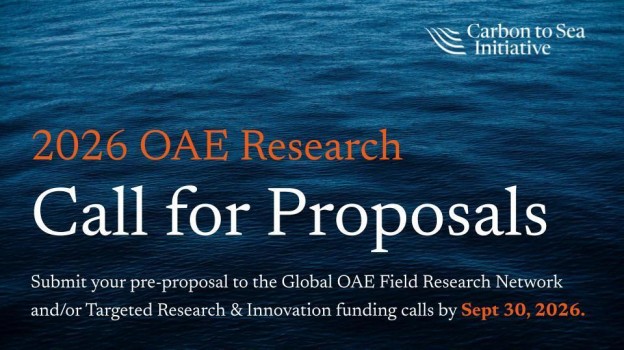
Carbon to Sea has announced its 2026 Ocean Alkalinity Enhancement (OAE) Research Call for Proposals, opening two new funding opportunities designed to advance scientific, technical and social understanding of Ocean Alkalinity Enhancement as a potential climate solution.
The two open calls seek to support research that can help determine whether OAE can be measured, verified and responsibly scaled in real-world environments.
Carbon to Sea is making up to $6 million in total funding available across the two research calls. Researchers and teams working on relevant scientific, technical and field-based questions are encouraged to review the requirements and submit a pre-proposal before the deadline.
The pre-proposal submission period is open until Wednesday, September 30, 2026.
What Is Ocean Alkalinity Enhancement?
Ocean Alkalinity Enhancement is an emerging carbon dioxide removal approach that seeks to increase the ocean’s capacity to absorb and store atmospheric carbon dioxide.
As research into OAE develops, scientists are increasingly examining its potential impacts, effectiveness, measurement challenges and scalability.
Research to date has included laboratory experiments, mesocosm studies and small-scale field research. The next stage requires stronger evidence from field environments and targeted scientific and technical advances.
The 2026 Carbon to Sea research calls are intended to contribute to this next phase by supporting projects that address important questions surrounding the responsible development and potential deployment of OAE.
Open Call #1: Global OAE Field Research Network
The first funding opportunity, Global OAE Field Research Network, is focused on expanding and coordinating field-based research into Ocean Alkalinity Enhancement.
Carbon to Sea is making up to $5 million available through this call.
The opportunity includes four grant types supporting the exploration, development and coordination of OAE field research sites.
The call invites global participation and aims to generate evidence about OAE under increasingly realistic and larger-scale conditions.
Research supported through the Global OAE Field Research Network may examine areas including:
- Environmental impacts of OAE at increasing scales
- The effectiveness of different OAE deployment methods
- Measurement and verification of outcomes
- Sector-specific OAE demonstrations
- Cost trajectories as OAE research and deployment develop
- Development and coordination of field research sites
The network is intended to strengthen the evidence base needed to understand how OAE might perform outside laboratory and controlled experimental settings.
Open Call #2: Targeted Research & Innovation
The second opportunity is the Targeted Research & Innovation call, which has up to $1 million available.
This call includes two grant types aimed at teams working on specific scientific and technical challenges relevant to OAE.
One area of research concerns how natural sediment-related alkalinity fluxes could affect additionality claims associated with carbon removal.
Additionality is an important consideration in carbon removal because researchers and project developers need to establish that claimed carbon removal represents an additional outcome rather than something that would have occurred naturally without an intervention.
The second research area focuses on innovation in alkalinity sourcing and production.
Developing effective and potentially more sustainable approaches to sourcing and producing alkalinity could be important to the future scalability and economics of OAE.
Who Can Benefit From the Research Calls?
The calls are relevant to researchers, scientific teams and other organisations working on questions connected to Ocean Alkalinity Enhancement.
Potential applicants may include teams with expertise in areas such as:
- Ocean science
- Climate science
- Carbon dioxide removal
- Marine ecology
- Geochemistry
- Environmental monitoring
- Carbon removal measurement and verification
- Alkalinity production and sourcing
- Field research
- Climate technology
- Scientific modelling and assessment
Applicants should carefully review the official call documentation to determine whether their proposed research fits within the specific grant types and requirements.
Why the Research Funding Matters
OAE is part of a growing field of research into potential carbon dioxide removal approaches. However, moving from laboratory research and small-scale experiments to responsible real-world deployment requires substantial scientific evidence.
Questions about environmental impacts, measurement, effectiveness, verification, costs and scalability remain important.
Carbon to Sea’s 2026 research calls are designed to help address some of these questions by supporting both field-based research and targeted scientific and technical innovation.
The $5 million Global OAE Field Research Network provides significant funding for expanding field research, while the $1 million Targeted Research & Innovation call focuses on specific knowledge and technology gaps.
Together, the two calls could help researchers generate evidence needed to assess the potential of OAE while identifying challenges that need to be addressed before responsible scaling can take place.
Pre-Proposal Deadline
Researchers interested in the Carbon to Sea 2026 OAE Research Calls should note that pre-proposal submissions are open through September 30, 2026.
Applicants should allow sufficient time to review the relevant grant category, develop their research concept and ensure that the pre-proposal meets the requirements outlined by Carbon to Sea.
There are two separate opportunities to consider:
Open Call #1 – Global OAE Field Research Network: Up to $5 million available across four grant types.
Open Call #2 – Targeted Research & Innovation: Up to $1 million available across two grant types.
How to Apply
Interested research teams should review the official Carbon to Sea call documentation and identify the grant type that best matches their proposed work.
Applicants should focus their pre-proposals on clearly demonstrating how their research will contribute to improving scientific, technical or social understanding of Ocean Alkalinity Enhancement.
The deadline for submitting pre-proposals is Wednesday, September 30, 2026.
With up to $6 million in combined funding, the 2026 Carbon to Sea OAE Research Call represents a significant opportunity for researchers working on ocean-based carbon removal, climate science and related technologies.
Researchers and institutions with relevant expertise are encouraged to review the requirements and submit their pre-proposals before the deadline.