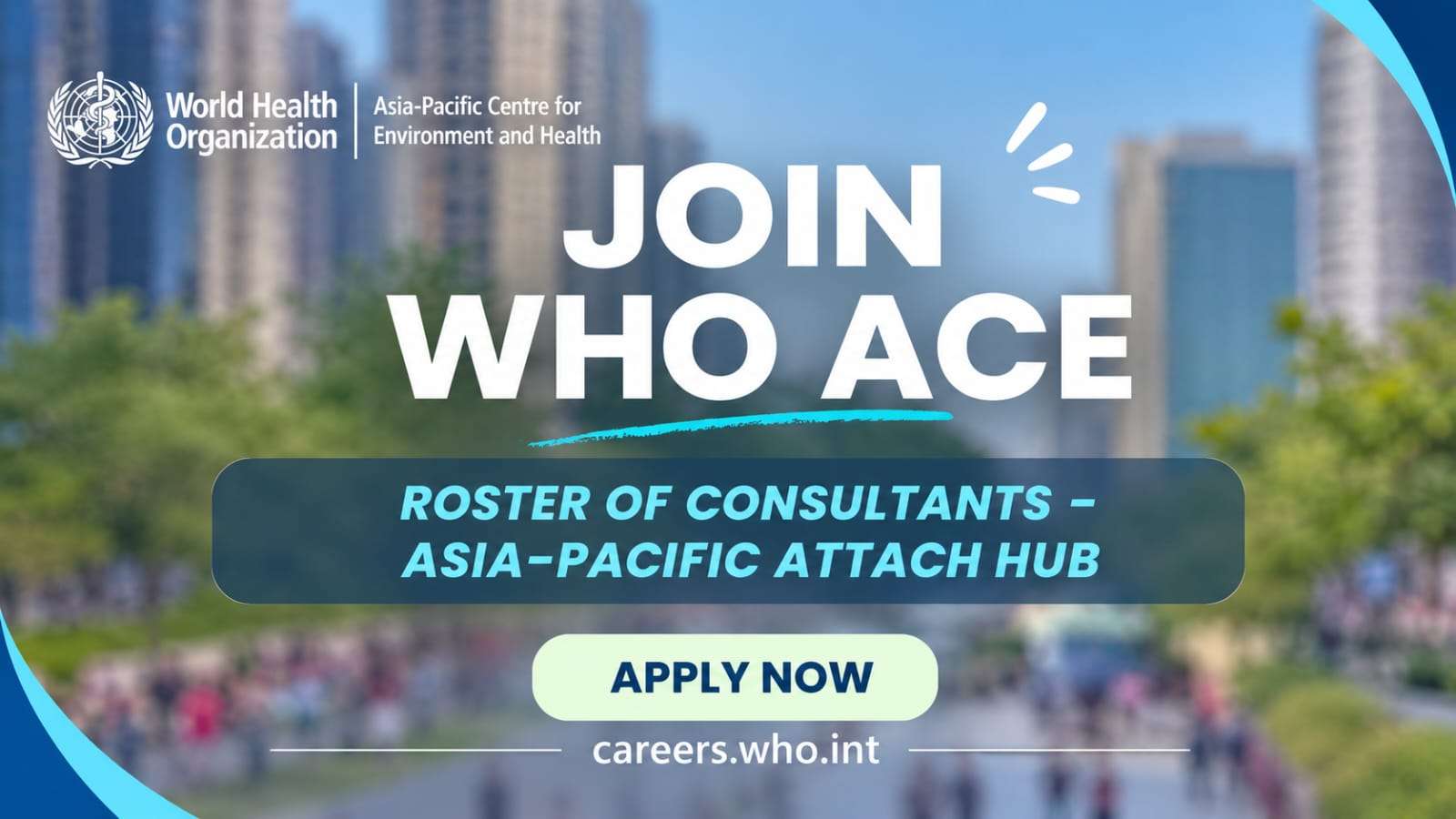
The World Health Organization (WHO) is inviting applications from qualified professionals for its Roster of Consultants – Asia-Pacific ATACH Hub: Climate-Resilient, Low-Carbon and Environmentally Sustainable Health Systems in Seoul, Republic of Korea. This consultancy opportunity aims to identify experienced experts who can contribute to strengthening healthcare systems against climate change, reducing greenhouse gas emissions from healthcare services, and promoting environmentally sustainable health infrastructure across the Asia-Pacific region.
The consultancy is based within the WHO Asia-Pacific Centre for Environment and Health (WHO ACE) and supports the work of the Alliance for Transformative Action on Climate and Health (ATACH). Through this initiative, WHO aims to connect governments, technical experts, development partners, and other stakeholders to accelerate practical climate and health solutions.
Selected candidates will be included in a roster of qualified consultants and may subsequently be considered for individual consultancy assignments. The opportunity offers monthly remuneration ranging from USD 3,955 to USD 9,980, depending on the consultant’s qualification and experience level.
Professionals with backgrounds in public health, environmental health, climate change, engineering, healthcare systems, sustainability, supply-chain management, procurement, economics, and international development are encouraged to explore this opportunity.
Overview of the WHO Asia-Pacific ATACH Hub Consultancy
The WHO Asia-Pacific ATACH Hub is working to support countries in developing healthcare systems that can withstand climate-related risks while reducing their environmental footprint. Climate change is creating significant challenges for healthcare delivery, including extreme weather events, rising temperatures, environmental hazards, and disruptions to essential healthcare infrastructure and supply chains.
These challenges can affect hospitals, healthcare workers, medical supplies, healthcare facilities, and the continuity of essential health services. Therefore, governments and healthcare institutions need practical strategies to improve climate resilience while transitioning towards low-carbon and environmentally sustainable healthcare systems.
Through this consultancy roster, WHO seeks professionals who can provide technical expertise, support country-level implementation, develop evidence-based knowledge products, facilitate regional cooperation, and document successful approaches that can be replicated in other countries.
The roster will help WHO identify qualified consultants for assignments covering different technical areas of climate-resilient and sustainable healthcare development.
Important: Inclusion in the consultancy roster does not automatically guarantee employment or a consultancy contract. Candidates who are successfully included in the roster may be considered for future assignments depending on the requirements of individual projects. Each assignment will have separate terms of reference covering responsibilities, deliverables, duration, location, travel requirements, and remuneration.
About the World Health Organization and Asia-Pacific ATACH Hub
The World Health Organization (WHO) is a specialized agency of the United Nations responsible for promoting global health, supporting healthcare systems, coordinating international health initiatives, and providing technical guidance to countries.
The WHO Asia-Pacific Centre for Environment and Health (WHO ACE) supports Member States in addressing environmental and climate-related health challenges. Its work includes technical cooperation, research and evidence development, capacity building, partnerships, and investment in sustainable healthcare systems.
The Asia-Pacific ATACH Hub is based within WHO ACE in Seoul, Republic of Korea. It operates as part of the Alliance for Transformative Action on Climate and Health, a WHO-hosted and Member State-led platform that supports countries in implementing their climate and health commitments.
The Hub connects national priorities with technical expertise, practical tools, partnerships, and financing opportunities. It also facilitates regional cooperation, knowledge exchange, and peer learning to help countries identify effective approaches to climate-resilient and low-carbon healthcare.
The work is aligned with the WHO ACE Strategic Plan 2025–2030, which emphasizes practical action, technical cooperation, evidence-based policies, and sustainable healthcare development.
Main Objectives of the Consultancy
The primary objective is to establish a roster of qualified consultants who can support WHO’s regional and country-level activities through technical expertise and practical implementation assistance.
The consultants may contribute to the following objectives:
-
Strengthening the resilience of healthcare systems against climate change and environmental risks.
-
Supporting the development of climate-resilient hospitals and healthcare facilities.
-
Reducing greenhouse gas emissions generated by healthcare delivery and associated activities.
-
Promoting environmentally sustainable procurement and healthcare supply chains.
-
Improving healthcare waste management and reducing environmental impacts.
-
Supporting governments in implementing climate and health priorities.
-
Developing technical guidance, policy briefs, research-based publications, and case studies.
-
Facilitating partnerships and knowledge exchange among countries and technical organizations.
-
Identifying opportunities for financing and investment in sustainable healthcare systems.
-
Documenting successful interventions, implementation experiences, and lessons that can support wider regional adoption.
Three Main Workstreams of the ATACH Hub
Consultants selected through the roster may be considered for assignments under three principal workstreams.
1. Building Climate-Resilient and Sustainable Health Systems and Healthcare Facilities
Climate change poses serious risks to healthcare infrastructure and the delivery of essential medical services. Hospitals and healthcare facilities must be prepared to respond to extreme weather events, rising temperatures, environmental hazards, and other climate-related disruptions.
Under this workstream, consultants may support countries in identifying vulnerabilities within their healthcare systems and developing practical strategies to improve resilience.
Potential areas of work include:
-
Supporting climate-resilience planning for hospitals and healthcare facilities.
-
Identifying climate and environmental risks affecting healthcare infrastructure.
-
Helping countries strengthen the continuity of essential healthcare services.
-
Supporting the development of sustainable healthcare infrastructure.
-
Identifying practical interventions to reduce environmental impacts.
-
Sharing technical guidance and successful approaches among countries.
-
Supporting the implementation of national and regional climate and health priorities.
2. Building Low-Carbon Health Systems
Healthcare delivery can generate significant greenhouse gas emissions through energy consumption, infrastructure, procurement, manufacturing, transportation, storage, and waste management.
This workstream focuses on reducing the environmental footprint of healthcare systems while maintaining the quality and accessibility of essential health services.
Consultants may contribute to:
-
Identifying opportunities to reduce greenhouse gas emissions from healthcare delivery.
-
Supporting sustainable procurement practices.
-
Examining the environmental impacts of healthcare products and medical supplies.
-
Promoting improvements in the production, packaging, transportation, and storage of health products.
-
Supporting environmentally responsible use and end-of-life management of healthcare products.
-
Developing practical recommendations for low-carbon healthcare operations.
-
Facilitating discussions among governments, healthcare institutions, and technical partners.
3. Foresight and Intelligence for Decision-Making
Evidence, research, technical analysis, and knowledge management are essential for making informed decisions about climate-resilient healthcare systems.
Under this workstream, consultants may help WHO and its partners identify emerging challenges, compile relevant information, and develop knowledge products that support policy decisions and investment planning.
Activities may include:
-
Collecting and analysing information related to climate change and healthcare systems.
-
Developing evidence-based technical documents.
-
Identifying successful country-level initiatives.
-
Preparing case studies and comparative assessments.
-
Supporting knowledge-sharing activities.
-
Documenting lessons learned from practical implementation.
-
Developing recommendations that can guide future policies and programmes.
Key Responsibilities and Consultancy Deliverables
The selected consultants may be assigned responsibilities across four major output areas. Their specific duties will depend on the individual assignment and its terms of reference.
Output 1: Implementing the ATACH Hub Workplan
Consultants will contribute to implementing the Asia-Pacific ATACH Hub workplan by supporting WHO country offices, technical teams, and Member States.
Responsibilities may include:
-
Working with WHO country offices and technical teams to identify Member State priorities, implementation challenges, and opportunities for technical cooperation.
-
Supporting Member States through WHO country offices in designing and implementing priority actions.
-
Mapping relevant ATACH, WHO, and partner initiatives, tools, and examples related to climate-resilient and low-carbon healthcare systems.
-
Connecting available technical resources with country-specific priorities.
-
Supporting regional and country-level discussions on practical ways to reduce emissions across healthcare supply chains.
-
Examining emissions associated with procurement, production, packaging, transportation, storage, use, and end-of-life management of healthcare products.
-
Coordinating technical contributions to guidance documents, policy briefs, webinars, and other knowledge products.
Consultants will help translate regional and international climate and health commitments into practical actions that can be implemented at the country level.
Output 2: Developing and Compiling Country and Partner Case Studies
Another important responsibility is documenting successful initiatives and practical experiences from countries and partner organizations.
Case studies will help identify effective interventions, explain how they were implemented, and provide evidence that can support similar initiatives elsewhere.
Consultants may be responsible for:
-
Identifying and prioritizing relevant healthcare system initiatives.
-
Supporting the preparation and publication of country and partner case studies.
-
Describing the context and objectives of individual interventions.
-
Documenting implementation processes, participating organizations, and partnerships.
-
Recording measurable results and relevant qualitative findings.
-
Identifying factors that supported successful implementation.
-
Highlighting challenges, limitations, and lessons learned.
-
Assessing opportunities for replication and expansion.
-
Engaging Member States, WHO teams, and partners to collect and verify information.
-
Maintaining an organized repository of case studies.
-
Preparing cross-case analyses that identify common lessons, gaps, and recommendations.
All documented claims must be evidence-based and appropriately attributed. Information must also be cleared by contributing countries and partners before publication or dissemination.
Output 3: Supporting Communication, Knowledge Exchange, and Uptake
Consultants will contribute to communication and knowledge-sharing activities to ensure that technical findings, practical experiences, and successful interventions reach relevant stakeholders.
Responsibilities may include:
-
Preparing presentations and briefing notes.
-
Developing web content and other communication materials.
-
Sharing the findings of country case studies.
-
Organizing or supporting webinars.
-
Facilitating peer-learning sessions and technical discussions.
-
Contributing regional evidence and examples to ATACH events.
-
Supporting global publications and major climate and health milestones.
-
Promoting the use of case studies in country-level discussions.
-
Supporting technical cooperation and partnership development.
-
Contributing to resource mobilization activities.
-
Developing key publications for delivery each year.
This workstream requires the ability to communicate complex technical information clearly and effectively to different audiences, including policymakers, healthcare professionals, researchers, and development partners.
Output 4: Strengthening ATACH Hub Coordination and Country Support
Consultants may also support coordination between the Asia-Pacific ATACH Hub, WHO headquarters, regional offices, country offices, Member States, and external partners.
Their responsibilities may include:
-
Participating in relevant global ATACH working groups and initiatives.
-
Coordinating Western Pacific regional and country inputs into ATACH processes.
-
Supporting regional events and knowledge-exchange activities.
-
Helping Member States engage with ATACH partners and members.
-
Identifying priority implementation needs.
-
Supporting access to relevant technical resources.
-
Maintaining a regional database covering country participation, priorities, technical assistance needs, planned activities, and progress.
-
Coordinating with WHO headquarters, regional offices, and technical teams.
-
Promoting consistent communication and coherent technical support.
-
Facilitating two-way knowledge exchange between global and regional levels.
These activities will help strengthen regional coordination and ensure that country-level priorities are reflected in broader international climate and health initiatives.
Educational Qualifications and Academic Requirements
Applicants must meet the relevant educational requirements for the consultancy band under which they are considered.
WHO has identified two qualification levels:
Band Level A
Applicants must hold a university degree in one of the following fields or another discipline relevant to the assignment:
-
International Development
A relevant university degree in another related field may also be considered, depending on the requirements of the assignment.
Band Level B
Applicants must hold an advanced university degree in a relevant field.
Candidates with postgraduate qualifications and relevant professional expertise may be considered for assignments requiring more advanced technical, policy, programme-management, or coordination responsibilities.
Desirable Academic Qualifications
In addition to the essential educational requirements, the following qualifications are considered desirable:
-
Relevant specialist training.
-
Professional certifications in relevant technical areas.
-
A strong record of technical or scientific publications.
Applicants should ensure that their academic qualifications are obtained from institutions accredited or recognized in the World Higher Education Database (WHED), maintained by the International Association of Universities and UNESCO.
Professional Experience Requirements
Applicants must demonstrate relevant professional experience in one or more areas covered by the consultancy roster.
Band Level A Experience
Applicants must have:
-
At least five years of relevant professional experience in one or more roster areas.
-
Demonstrated experience contributing to technical projects.
-
Experience in analysis, coordination, implementation, capacity building, or knowledge-product development.
-
Experience working at national and/or international levels.
Band Level B Experience
Applicants must have:
-
Between five and ten years of relevant professional experience in one or more roster areas.
-
Experience providing technical support.
-
Experience in project leadership, policy advice, or programme coordination.
-
Professional experience at national and/or international levels.
Additional Desirable Experience
The following experience will be considered an advantage:
-
Working with government institutions.
-
Working with WHO or other United Nations agencies.
-
Experience with development partners.
-
Experience with civil society organizations.
-
Experience in academic or research institutions.
-
Experience in the private sector.
-
Working in low-resource settings.
-
Working in climate-vulnerable environments.
-
Experience collaborating with multidisciplinary and multicultural teams.
-
Leadership of complex technical products, projects, or stakeholder processes.
Applicants with relevant experience in climate and health programmes, environmental sustainability, healthcare systems, and international development should highlight their practical achievements and contributions in their applications.
Required Skills and Technical Knowledge
Candidates must demonstrate strong technical knowledge in at least one area of expertise covered by the consultancy roster.
The required skills include:
Technical and Analytical Skills
-
Strong knowledge of at least one relevant technical field.
-
Ability to analyse complex information.
-
Ability to synthesize technical and scientific evidence.
-
Ability to prepare accurate, evidence-based documents.
-
Ability to develop outputs suitable for different audiences.
Project Management and Coordination
-
Strong project coordination skills.
-
Planning and organizational abilities.
-
Stakeholder engagement and facilitation skills.
-
Knowledge-management capabilities.
-
Ability to manage competing priorities.
-
Ability to deliver high-quality work within agreed deadlines.
Communication and Collaboration
-
Ability to communicate effectively with diverse stakeholders.
-
Ability to work independently.
-
Ability to build constructive professional relationships.
-
Ability to collaborate within multidisciplinary and multicultural teams.
-
Strong written communication skills.
Digital and Technical Tools
Applicants must be proficient in standard office applications. Depending on the specific assignment, additional proficiency may be required in:
-
Reference-management tools.
-
Qualitative research tools.
-
Data-visualization applications.
-
Digital collaboration platforms.
Language Requirements
Expert knowledge of English is an essential requirement for this consultancy.
Applicants should be able to understand, analyse, prepare, and communicate complex technical information in English.
Knowledge of additional languages is desirable. In particular, intermediate or expert knowledge of another United Nations official language and/or a language relevant to the specific assignment may be an advantage.
Consultancy Location and Travel Requirements
The consultancy assignments are based at the WHO Asia-Pacific Centre for Environment and Health in Seoul, Republic of Korea.
Assignments are expected to be conducted onsite at WHO ACE. Selected consultants will be responsible for meeting the applicable visa requirements.
Candidates may request visa-support documentation where appropriate.
The consultant is also expected to travel as part of the assignment when required.
Applicants should therefore be prepared for the possibility of international travel and onsite consultancy responsibilities in accordance with the terms of reference for each individual assignment.
Consultancy Duration and Contractual Arrangement
The advertised opportunity is an external consultancy roster with a stated contract duration of 11 months.
The purpose of the recruitment process is to establish a roster of qualified professionals who may be considered for consultancy assignments supporting the Asia-Pacific ATACH Hub.
It is important to understand that the roster is not a guaranteed employment contract. Individual assignments will be arranged separately and will include their own terms of reference.
These terms will specify:
-
Remuneration and payment arrangements.
The vacancy may also be used to identify candidates for other similar consultancy opportunities at the same level.
Salary and Financial Benefits
The WHO consultancy offers monthly remuneration based on the selected candidate’s band level.
Monthly consultancy remuneration
Band Level A
USD 3,955–6,980
Per month
Band Level B
USD 7,000–9,980
Per month
Additional living expense
An additional living expense will be paid for the first 15 days of the contract.
The remuneration level will depend on the applicable consultancy band and the candidate’s qualifications and professional experience.
Applicants should also understand that consultants work as independent contractors in a personal capacity rather than as representatives of an organization or government authority.
WHO will not be responsible for taxes, duties, social security contributions, or other applicable payments. Consultants are responsible for meeting their own tax and contribution obligations in the relevant jurisdictions.
Important Information for Applicants
Before submitting an application, candidates should carefully review the following conditions and requirements.
1. Roster Inclusion Does Not Guarantee a Contract
Successful candidates may be included in the consultancy roster and considered for future assignments. However, inclusion does not guarantee selection or a consultancy contract.
2. Written Assessment May Be Conducted
WHO may use a written test as part of its candidate-screening process.
3. Academic Documents May Be Requested
Candidates retained for an interview will be required to provide scanned copies of the relevant degrees, diplomas, and certificates in advance.
WHO only considers higher educational qualifications obtained from institutions accredited or recognized in the World Higher Education Database (WHED).
4. Background Verification
WHO conducts background verification of shortlisted candidates to ensure compliance with its professional integrity and ethical standards.
5. Professional Conduct
Candidates must demonstrate an impeccable record of integrity and professional ethics.
WHO maintains zero tolerance for sexual exploitation and abuse, sexual harassment, discrimination, abuse of authority, and other forms of abusive conduct.
6. Smoke-Free Workplace Policy
WHO maintains a smoke-free environment and does not recruit smokers or users of any form of tobacco.
7. Vaccination Requirements
WHO consultancy contracts are conditional on the consultant confirming that they have received vaccinations required by WHO before undertaking the assignment, except where an eligible medical exemption applies and is certified through WHO’s Staff Health and Wellbeing Services.
Successful candidates may be asked to provide relevant vaccination evidence as part of the medical clearance process.
8. Equal Opportunity and Diversity
WHO is committed to creating a diverse and inclusive working environment. It recruits individuals regardless of disability status, sex, gender identity, sexual orientation, language, race, marital status, religious, cultural, ethnic, and socioeconomic backgrounds, or other personal characteristics.
Women, persons with disabilities, and nationals of unrepresented and underrepresented WHO Member States are strongly encouraged to apply.
Persons with disabilities may request reasonable accommodations during the recruitment process by contacting the WHO recruitment team through the designated accommodation email address.
Why Consider the WHO Asia-Pacific ATACH Hub Consultancy?
This consultancy provides an opportunity for experienced professionals to contribute to international climate and health initiatives through technical cooperation and regional collaboration.
Some of the key aspects of this opportunity include:
-
International Professional Exposure: Work with WHO teams, Member States, technical experts, and international partners.
-
Climate and Health Impact: Contribute to practical initiatives addressing climate change and environmental risks affecting healthcare systems.
-
High-Level Consultancy Remuneration: Receive monthly remuneration of up to USD 9,980, depending on the consultancy band.
-
Technical Knowledge Development: Contribute to evidence-based research, policy documents, case studies, and regional publications.
-
Regional Collaboration: Participate in knowledge exchange and cooperation activities across the Asia-Pacific region.
-
Professional Networking: Engage with government institutions, WHO teams, development partners, and other stakeholders.
-
Sustainable Development Contribution: Support the transition towards climate-resilient, low-carbon, and environmentally sustainable healthcare systems.
For professionals with relevant expertise and a strong background in public health, environmental sustainability, climate change, and healthcare systems, this roster may provide an opportunity to contribute to important international initiatives.
Deadline to Apply
The closing date listed in the WHO vacancy announcement is 27 November 2026 at 3:59 AM.
Applicants are strongly advised to check the deadline displayed on the official WHO recruitment portal because the vacancy notice states that the displayed deadline reflects the applicant’s personal device system settings.
Candidates should complete and submit their applications before the deadline rather than waiting until the final hours.
Conclusion
The WHO Roster of Consultants for the Asia-Pacific ATACH Hub offers an important opportunity for experienced professionals to contribute to climate-resilient, low-carbon, and environmentally sustainable healthcare systems. Through this initiative, the World Health Organization aims to strengthen technical cooperation, support country-level climate and health priorities, reduce greenhouse gas emissions from healthcare delivery, and promote sustainable healthcare infrastructure across the region.
Professionals with relevant university qualifications, at least five years of professional experience, strong technical expertise, and excellent English-language skills may be considered for consultancy assignments under the roster. The opportunity covers several areas, including public health, environmental health, engineering, climate change, sustainability, healthcare supply chains, procurement, economics, and international development.
With monthly remuneration ranging from USD 3,955 to USD 9,980, the consultancy may be particularly valuable for professionals seeking to contribute their expertise to international development and global health initiatives.
Interested applicants should carefully review the official vacancy announcement, verify their eligibility, prepare their academic and professional documents, and submit their applications before 27 November 2026.
Official Application and Relevant Links
Apply for the WHO Asia-Pacific ATACH Hub Consultancy:
WHO Official Careers and Job Application Portal
Relevant Links:
Search for vacancy reference 2604783 on the WHO Careers portal to locate the specific announcement.