Deadline: April 15, 2026
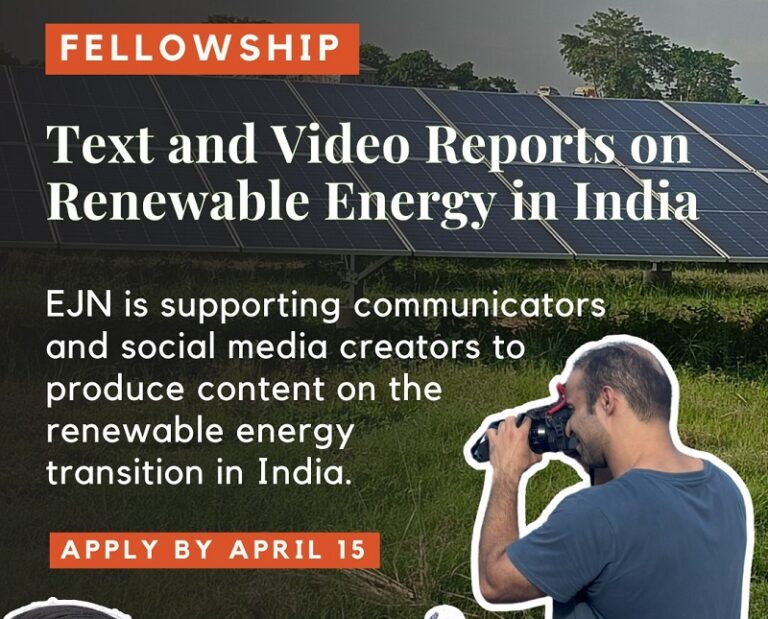
Applications for the EJN Text and Video Reports on Renewable Energy in India Programme 2026 are now open. Internews’ Earth Journalism Network (EJN) is offering support to communicators and social media content creators to produce in-depth reports on various aspects of the transition to renewable energy in India. They welcome pitches on the progress of the transition towards clean energy, the challenges ahead and how to overcome them, and scalable and replicable solutions that empower communities through decentralized renewable energy initiatives.
Overview
The transition to clean energy and clean mobility is moving quickly in India, but there is still a long way to go for the country to meet its commitment of installing 500 GW renewable energy (RE) generation capacity by 2030, nearly double the installed capacity in February 2026.
The road ahead is promising but there are obstacles that must be overcome. They include payment delays to RE firms, inadequate grid capacity, lack of clarity on how to repower old wind turbines, shortage of land available for new projects and the uneven rollout of rooftop solar. It is important for communicators to draw attention to these challenges and point to ways they can be overcome. That is the way the public is made fully aware of the urgency to transition to clean energy, and the transition can become a peoples’ movement.
To promote this, Earth Journalism Network (EJN) is seeking applications from communicators and social media content creators for reports on RE. Selected applicants will be provided necessary financial support and 1:1 editorial mentorship on how to produce rigorous and impactful reports.
Eligibility
- Communicators including social media content creators based in India are eligible to apply. They will give preference to applicants from Andhra Pradesh, Madhya Pradesh, Maharashtra, Odisha and Uttar Pradesh.
- They will also give special preference to joint applications from communicators and social media content creators.
- However, the application must be made in the name of one lead applicant. Lead applicants are responsible for communicating with EJN and receiving funds on the group’s behalf, if awarded.
- For the purposes of this grant opportunity, applications can be submitted in English, Hindi, Marathi Odiya or Telugu.
- They welcome applications from communicators and social media content creators with a track record of reporting on environmental issues. Women and young applicants, as well as applicants from indigenous communicators and marginalized communities and those who are differently abled are especially encouraged to apply. They encourage applications from freelancers and staff from international, national, local or community-based outlets and social media channels.
- Content creators should actively and frequently post short-form videos on Facebook, YouTube, Instagram, X or other leading social media platforms, relating to topics such as lifestyle, social issues, travel, science, economy, politics, and health. Creators with an audience size of above 20,000 followers will be preferred. Prior content focused on renewable energy is not a requirement. However, an interest in linking your work to these issues is key.
- Communicators should actively and frequently be reporting through print, broadcast or digital media on energy issues and can be staff or freelancer. If communicators maintain an active presence on platforms such as Facebook, YouTube, Instagram, X, or other major social media channels and use them to share video or written content related to their reports, this will be viewed as an advantage. However, it is not a mandatory requirement.
- EJN reserves the right to disqualify applicants from consideration if they have been found to have engaged in unethical or improper professional conduct, including, but not limited to, plagiarism and/or submitting AI-generated content as their own.
Judging Criteria
Applicants should consider the following judging criteria when devising their proposals.
- Relevance: Does the proposal meet the criteria and objectives of the call? Why does this report matter and to whom? Are the main idea, context and overall value to the target audience clearly defined?
- Objectivity: Is the proposed report likely to be balanced and objective? Communicators and content creators should take care that proposed sources represent (or at the very least, invite comment from) a diversity of stakeholders and perspectives: communities, scientists and researchers, policy experts and government officials and industry spokespersons.
- Angle: If the report has been covered, does your proposal bring new insights to the topic or offer a fresh angle?
- Impact: Does the proposal have a compelling narrative or investigative element that will inform and engage, draw attention, trigger debate and urge action?
- Innovative reports: The use of creative approaches and data visualization will be considered a plus.
- Outlet: They encourage selected fellows to ensure their reports are freely accessible to the public. If an outlet publishes behind a paywall, they ask that the paywall be dropped for a limited time, or a gift link be shared for wider distribution. This ensures the information remains accessible to the wider public and helps achieve broader audience engagement.
- Plan for timely publication: Communicators, whether freelance or employed at a media outlet, will need to include a letter of support from an editor in their application, committing to publish their reports by October 31, 2026.
Application
The application deadline is April 15, 2026, 11:59 PM (Asia/Kolkata).
For more information, visit EJN.