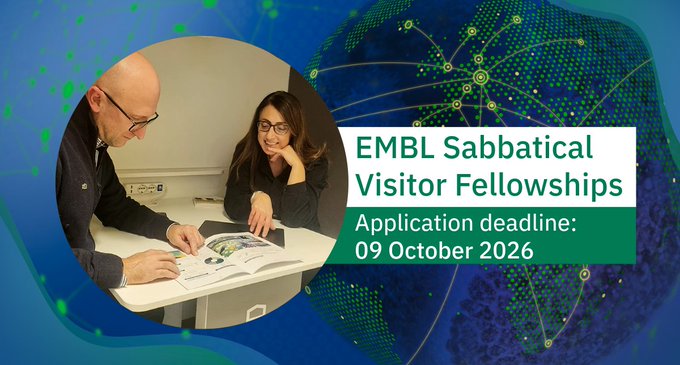
The European Molecular Biology Laboratory (EMBL) is inviting applications for its 2026–2027 Sabbatical Visitor Fellowship, a competitive international research opportunity for established independent scientists and technical experts seeking to spend three to six months at one of EMBL’s six research sites.
The fellowship is offered through EMBL’s Scientific Visitor Programme (SVP) and is designed to promote scientific exchange, interdisciplinary collaboration and the transfer of expertise between external researchers and the EMBL scientific community.
Applicants can be based anywhere in the world, but must have an existing position at a research institution and approval from their home institution to undertake the sabbatical.
Application deadline: 9 October 2026
About EMBL
The European Molecular Biology Laboratory is an international research organisation focused on exploring fundamental questions in molecular biology and the life sciences.
EMBL operates six sites in Heidelberg, Barcelona, Grenoble, Hamburg, Cambridge (Hinxton) and Rome, with a scientific programme spanning research from molecules and cells through to organisms and ecosystems.
The Sabbatical Visitor Fellowship forms part of EMBL’s efforts to strengthen scientific exchange by connecting established external researchers with EMBL group and team leaders.
About the EMBL Sabbatical Visitor Fellowship
The fellowship supports eligible scientists who want to spend part of their sabbatical at EMBL while engaging in high-level scientific dialogue with EMBL researchers.
The programme is not intended to centre on delivering a single predefined research project. Instead, visitors are encouraged to use the sabbatical to explore scientific ideas, exchange expertise, develop new collaborations and identify opportunities for future joint work.
Applicants should demonstrate a clear mutual benefit for themselves and EMBL, including the scientific strengths and knowledge they can contribute, the EMBL researchers they hope to connect with and the expertise, technologies or methodologies they would like to learn.
Fellowship Duration and Location
The fellowship supports visits lasting between three and six months.
Eligible visitors may be hosted at any one of EMBL’s six sites:
- Heidelberg, Germany
- Barcelona, Spain
- Grenoble, France
- Hamburg, Germany
- Cambridge (Hinxton), United Kingdom
- Rome, Italy
Visitors are expected to spend a significant proportion of their sabbatical on-site at the host EMBL campus.
Who Can Apply?
The fellowship is aimed at established external scientists and technical experts.
Applicants must:
- Hold a position as a principal investigator, independent scientist or technical expert at a research institution anywhere in the world
- Maintain that position both before and after the sabbatical visit
- Receive a salary from their home institution during the sabbatical
- Obtain approval from their home institution to undertake the visit
- Be able to commit significant time to the EMBL host site
- Identify at least one EMBL Group or Team Leader (GTL) willing to act as the primary host
The programme therefore differs from a typical postdoctoral fellowship because it is intended for researchers who already hold independent positions at their home institutions.
What Fellows Are Expected to Do
Sabbatical visitors are expected to make active use of the fellowship to exchange knowledge and establish meaningful scientific connections.
Responsibilities and expectations include:
- Reflecting on their scientific goals and research direction
- Engaging in high-level scientific discussions with EMBL researchers
- Sharing expertise, knowledge and methodologies with the EMBL community
- Exploring new research collaborations
- Participating in scientific networking and community activities
- Delivering at least two seminars or talks, one at the beginning and one at the completion of the sabbatical
- Completing a feedback survey
- Submitting a short progress report to the Scientific Visitor Programme
Senior applicants are additionally expected to contribute their experience and engage with EMBL fellows, staff and faculty through informal scientific networking.
Benefits and Research Environment
The fellowship provides access to EMBL’s internationally connected scientific environment and opportunities for collaboration across disciplines and research sites.
Depending on individual circumstances, visitors may benefit from:
- Access to EMBL scientific and social activities
- Participation in group and unit seminars
- Research retreats and scientific networking
- Staff association and community activities
- Access to local scientific events and conferences at subsidised or no cost rates
- Support with relocation logistics from the Scientific Visitor Programme Office and relevant site administrators
The source information does not specify a fixed fellowship stipend or salary, and applicants are expected to continue receiving their salary from their home institution during the sabbatical.
Scientific Exchange and Collaboration
A key objective of the fellowship is to encourage cross-fertilisation of knowledge and technologies.
Visitors are expected to engage with EMBL researchers whose expertise complements their own, while identifying new scientific approaches, methods and collaborative possibilities.
The programme can help strengthen connections between EMBL and the visitor’s home research group or institution, potentially leading to longer-term individual or institutional collaborations.
Application Process
Applications for the EMBL Sabbatical Visitor Fellowship must be submitted by the hosting EMBL Group or Team Leader (GTL).
Potential applicants should therefore identify and engage with a suitable EMBL researcher before the application is submitted.
Detailed application instructions are provided on the dedicated EMBL Sabbatical Visitor Fellowship webpage.
Applicants should prepare a clear description of:
- Their scientific background and strengths
- The areas of knowledge they wish to share
- The EMBL researchers and groups they wish to engage with
- Expertise, technologies or methodologies they hope to learn
- The potential mutual benefits of the sabbatical visit
- How the visit could support future collaboration
How to Strengthen the Application
A strong application should clearly demonstrate why the proposed sabbatical would be valuable to both the visitor and EMBL.
Applicants should identify a host whose scientific expertise closely complements their own and explain how meaningful exchange could take place.
The proposal should focus on scientific interaction, knowledge transfer and collaboration rather than presenting the visit simply as a request to access EMBL facilities.
It is also important to demonstrate sufficient institutional support, including continued employment and salary arrangements during the sabbatical.
Important Deadline
The deadline for the EMBL Sabbatical Visitor Fellowship 2026–2027 is:
9 October 2026 at 23:59 CET
Applicants should note that the application must be submitted by the hosting EMBL Group or Team Leader.
Opportunity Summary
| Category | Details |
|---|---|
| Opportunity | EMBL Sabbatical Visitor Fellowship |
| Programme | Scientific Visitor Programme |
| Organisation | European Molecular Biology Laboratory (EMBL) |
| Duration | 3–6 months |
| Location | EMBL sites in Germany, Spain, France, UK and Italy |
| Target Applicants | Principal Investigators, Independent Scientists & Technical Experts |
| Eligible Applicants | Researchers worldwide |
| Salary | Continued salary from home institution |
| Research Focus | Scientific exchange, knowledge transfer & collaboration |
| Host Required | EMBL Group/Team Leader |
| Application Submitted By | Hosting GTL |
| Deadline | 9 October 2026 |