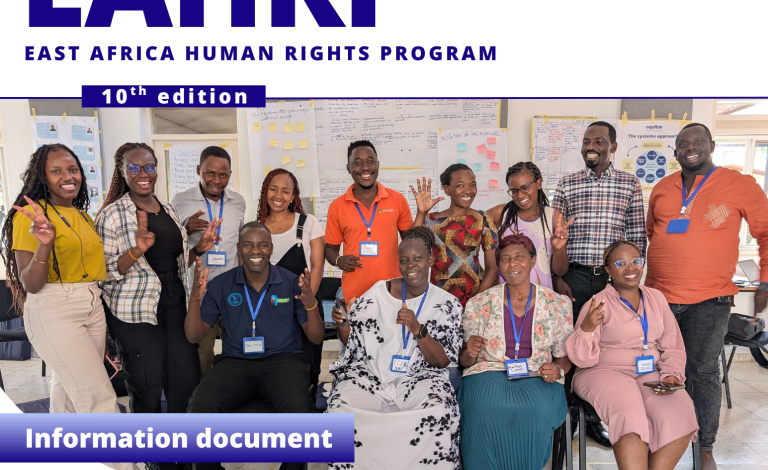
The East Africa Human Rights Program (EAHRP) 2027 has opened applications for its 10th edition, offering human rights workers, educators, defenders, activists and other practitioners across East Africa an opportunity to strengthen their knowledge and practical skills in human rights education.
Organised in Arusha, Tanzania, the intensive regional programme will combine online preparation with an in-person training period. Applications are open until September 20, 2026, with early applications encouraged.
Programme Overview
The EAHRP 2027 will take place through two phases. The first is an online preparatory phase running from December 2026 to January 10, 2027. This self-paced component requires approximately 12–15 hours over five weeks, allowing participants to prepare for the intensive residential programme.
The in-person training will be held in Arusha, Tanzania, from February 4–16, 2027, providing 11 days of focused learning, collaboration and practical engagement.
The programme will be conducted entirely in English and is expected to bring together approximately 45 human rights educators and defenders from across East Africa.
Participation Costs and Bursaries
The participation fee is CAD 5,000, equivalent to approximately USD 3,570, depending on prevailing exchange rates. The fee covers training costs, accommodation, meals, educational materials and emergency medical insurance.
Participants should note that international travel and visa expenses are not included in the participation fee.
Limited full and partial bursaries may be available to eligible applicants. Prospective participants who require financial assistance are therefore encouraged to review the programme information carefully and indicate their circumstances through the application process.
Who Can Benefit from the Programme?
The EAHRP is designed for individuals working in human rights education, advocacy and protection across the region. It provides an opportunity for professionals and practitioners from civil society organisations, institutions and government agencies to deepen their understanding of human rights and strengthen their ability to apply human rights-based approaches in their work.
The programme is particularly relevant to human rights workers, defenders, educators and activists seeking practical tools for advancing gender equality, human rights and social change.
Through its participatory learning methodology, the programme encourages participants to exchange experiences, reflect on challenges and learn from peers working in different national and institutional contexts.
Building Practical Human Rights Capacity
A central objective of the EAHRP is to strengthen a regional pool of human rights organisations and institutions capable of applying a human rights-based approach (HRBA) to their work.
Rather than focusing exclusively on theoretical knowledge, the programme emphasises practical learning and the transfer of knowledge into participants’ professional and community activities. Participants are expected to develop an Individual Plan during the training outlining how they will apply their learning after completing the programme.
The programme also places considerable emphasis on follow-up activities, helping ensure that knowledge gained during the training contributes to longer-term institutional and community impact.
Regional Networking and Collaboration
The EAHRP also provides an important platform for networking among human rights practitioners from across East Africa. Participants can connect with representatives of civil society organisations, national human rights institutions, regional and international organisations, government agencies and other stakeholders.
These relationships can support the development of collaborative initiatives, professional networks and partnerships aimed at strengthening human rights protection and education at national and regional levels.
Since its establishment, the programme has contributed to the development of a home-grown human rights training and education curriculum addressing relevant regional human rights issues. It has also helped establish a pool of committed human rights training facilitators equipped to support a stronger culture of human rights across the region.
Organisers and Partners
The 2027 EAHRP is organised by TUSONGE in collaboration with Equitas – International Centre for Human Rights Education and its partner networks across East Africa. The programme is financially supported by the Government of Canada through Global Affairs Canada.
The EAHRP emerged from the efforts of Equitas alumni from East Africa who recognised the need to expand access to high-quality human rights training for practitioners working at national and community levels.
Application Deadline
Interested candidates should submit their applications by September 20, 2026. Early applications are encouraged, particularly for individuals who may require additional time to prepare supporting information or seek bursary consideration.
Applicants should consult the EAHRP 2027 Information Guide for detailed information concerning eligibility, application procedures, candidate profiles, reference letters, selection, fees and bursaries.
The programme is delivered in English. Individuals interested in French-language training should explore the separate Regional Human Rights Training Session in French.
For additional information, prospective applicants can contact eahrp@equitas.org
Key Details
• Programme: East Africa Human Rights Program 2027
• Edition: 10th edition
• Location: Arusha, Tanzania
• Online preparation: December 2026–January 10, 2027
• In-person training: February 4–16, 2027
• Duration: 11-day intensive residential training
• Language: English
• Participants: Approximately 45 human rights educators and defenders
• Fee: CAD 5,000, approximately USD 3,570
• Bursaries: Limited full and partial bursaries may be available
• Application deadline: September 20, 2026
Human rights practitioners across East Africa seeking to strengthen their capacity, expand professional networks and translate human rights education into practical social change are encouraged to consider the EAHRP 2027 opportunity.