Gender, Work & Organization invites submissions for a special issue on Gendered Practices at Work. Researchers worldwide can submit conceptual, empirical, and methodological papers by 31 January 2027.
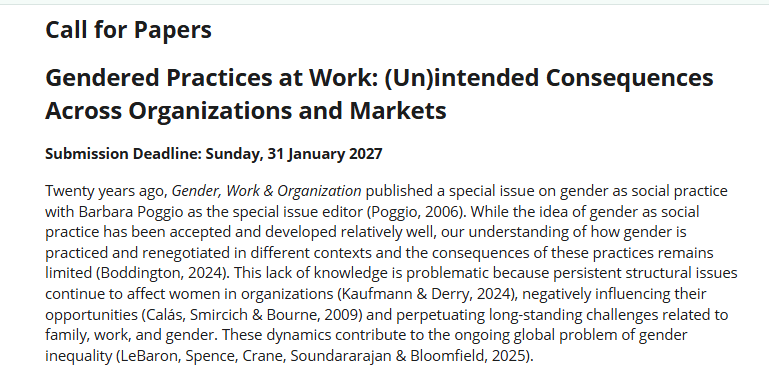
The academic journal Gender, Work & Organization (GWO) has announced a Call for Papers for a special issue titled “Gendered Practices at Work: (Un)intended Consequences Across Organizations and Markets.” Scholars from around the world are invited to submit original research examining how gendered practices are created, reproduced, challenged, and transformed within organizations, industries, and markets.
The submission deadline is 31 January 2027, providing researchers with an opportunity to contribute to one of the leading international journals focused on gender, organizations, and work.
The special issue seeks conceptual, empirical, and methodological contributions that deepen understanding of how workplace gender practices influence organizational cultures, leadership, inclusion, inequality, and business outcomes.
Exploring the Consequences of Gendered Practices
According to the call, gendered practices continue to shape workplaces, professional identities, entrepreneurship, organizational structures, and market systems across the globe.
Although many organizations have implemented diversity and gender equality initiatives—including parental leave policies, mentoring programmes, leadership quotas, and inclusion strategies—these interventions can sometimes generate unintended consequences.
The editors argue that while many initiatives successfully improve representation and inclusion, others may reinforce stereotypes, create new inequalities, or produce unexpected organizational dynamics.
The special issue therefore aims to investigate both:
- Intended outcomes of gender equality initiatives
- Unintended consequences emerging from workplace practices
- Organizational responses to gender reforms
- Everyday interactions that reproduce gender inequalities
Researchers are encouraged to critically examine how formal policies intersect with workplace culture and broader social norms.
Areas of Interest
The journal welcomes submissions addressing a broad range of themes related to gendered organizational practices.
Potential topics include:
- Gendered organizational cultures
- Gender equality policies and their impacts
- Women’s leadership and career progression
- Men’s experiences within gendered workplaces
- Gendered occupational identities
- Entrepreneurship and gender
- Workplace inclusion and exclusion
- Organizational networks and mentoring
- Gendered practices across industries
- Business outcomes of gender equality initiatives
- Gender and organizational change
- Leadership stereotypes
- Gender and media representations
- Democratic participation in organizations
- Workplace power structures
- Organizational resistance to equality initiatives
The editors also encourage research exploring differences across industries traditionally dominated by women or men.
Strong Focus on Intersectionality
A major feature of the special issue is its emphasis on intersectionality and diverse social experiences.
Researchers are encouraged to examine how gendered practices affect individuals across multiple identities, including:
- LGBTQIA+ communities
- Migrants
- Women of colour
- Indigenous communities
- Minority ethnic groups
- Workers in the Global South
- Marginalised populations
The editors note that understanding differences within gender groups is equally important as examining differences between women and men.
Submissions drawing upon intersectional, feminist, postcolonial, Marxist, or decolonial perspectives are particularly welcomed.
Encouraging Research Beyond Western Contexts
The special issue places considerable emphasis on expanding research beyond traditional Western organizational settings.
The editors invite studies from:
- Africa
- Asia
- Latin America
- The Middle East
- Indigenous contexts
- Emerging economies
- Developing countries
The aim is to broaden existing scholarship by examining how gendered practices operate across diverse cultural, political, and economic environments.
Studies focusing on locally specific organizational experiences are encouraged alongside comparative international research.
Suggested Research Questions
The call identifies numerous questions that prospective authors may explore.
Examples include:
- How are gendered practices produced and reproduced in organizations?
- Who shapes or resists workplace gender norms?
- How do equality initiatives influence organizational culture?
- What unintended consequences arise from diversity interventions?
- How do gendered practices affect professional networks?
- What role does media play in reinforcing leadership stereotypes?
- How do organizational practices differ across women- and men-dominated industries?
- How do intersectional identities shape workplace experiences?
- What business outcomes emerge from gender-inclusive practices?
Researchers are not limited to these questions and may propose innovative approaches aligned with the theme.
Types of Papers Accepted
The journal welcomes several forms of scholarly contributions, including:
- Conceptual papers
- Empirical research
- Qualitative studies
- Quantitative analyses
- Mixed-methods research
- Methodological papers
- Comparative international studies
Submissions should contribute original insights into gendered organizational practices and their broader consequences.
Guest Editorial Team
The special issue is led by an international team of scholars:
- Dr. Daniela Giménez-Jiménez (Lead Editor), TU Dortmund, Germany
- Dr. Magdalena Markowska, Umeå University, Sweden
- Dr. Patricia Gabaldón, IE University, Spain
- Prof. Caren Scheepers, Gordon Institute of Business Science, South Africa
Together, the editorial team brings expertise spanning organizational studies, entrepreneurship, gender research, and management.
Submission Guidelines
Authors should prepare manuscripts in accordance with the journal’s official author guidelines.
During submission, contributors must indicate that their manuscript is intended for the special issue by selecting the relevant title within the online submission system.
Researchers are encouraged to begin preparing manuscripts well in advance of the deadline.
Key Dates
- Call: Gendered Practices at Work: (Un)intended Consequences Across Organizations and Markets
- Journal: Gender, Work & Organization
- Submission Deadline: 31 January 2027
- Submission Type: Conceptual, empirical, and methodological papers
- Eligible Applicants: Researchers worldwide
- Research Areas: Gender studies, organizational studies, sociology, management, business, entrepreneurship, political science, communication, and related disciplines
Why This Special Issue Matters
Persistent gender inequalities continue to shape workplaces despite decades of policy reform and organizational change. This special issue seeks to move beyond evaluating whether interventions succeed by examining how gendered practices are created, negotiated, and transformed in everyday organizational life.
By bringing together diverse theoretical perspectives and research from multiple regions, the collection aims to generate practical insights for academics, policymakers, employers, and organizations striving to build more equitable workplaces.
Researchers whose work advances understanding of gender, organizational change, and workplace inclusion are encouraged to submit their manuscripts before the 31 January 2027 deadline.